
Summary
- Panoptic segmentation combines semantic segmentation and instance segmentation into one pixel-complete map of an image.
- Every region in a scene is sorted into stuff (amorphous, like sky or road) or things (countable, like cars or people), and each category is labelled differently.
- Real scenes blur that line constantly: dense crowds, occluded objects and borderline classes like piles of debris all need a documented rule, not a guess.
- A worked street-scene example shows exactly where an annotation guideline has to make a judgement call a model can't make on its own.
- At Chegg, a written guideline and a reviewer's sample check handle these edge cases, a standard that holds regardless of which model runs the first pass.
A single frame from a self-driving car’s camera has to answer two very different questions at once. Which pixels are road, sky and pavement, areas with no fixed edges and nothing to count? And which pixels are this specific pedestrian, that specific parked car, distinct objects a model has to track one by one? Panoptic segmentation is the computer vision task that answers both questions in one pass. It assigns a class label to every pixel in an image, including the amorphous background, and gives every countable object its own instance mask on top of that. The result is one map of the scene, with nothing left unlabelled and nothing counted twice.
I’ve reviewed enough of these datasets to know where the task actually gets hard. It’s rarely the parked cars or the open sky. It’s the pixels in between. A cyclist half-hidden behind a van, a crowd too dense to count person by person, a pile of boxes that might be one object or a dozen. This piece covers what panoptic segmentation actually is and how it’s built from two older tasks. It also covers why the judgement calls at the edges still need a trained human reviewer, the same discipline behind any proper data annotation project.
What panoptic segmentation actually is
“Panoptic” comes from a Greek root meaning “seeing everything,” and that’s a fair description of what the task does. Alexander Kirillov and his co-authors formally proposed panoptic segmentation in a 2019 paper (Kirillov et al., 2019). It names and defines a task that unifies two jobs computer vision had treated separately up to that point. Panoptic segmentation doesn’t replace either of those jobs. It runs both at once and reconciles the results into a single, non-overlapping map: every pixel gets exactly one label, and none are left over.
The two older tasks panoptic segmentation combines
Panoptic segmentation doesn’t invent anything new at the pixel level. It combines two tasks that already existed on their own, and each one is worth understanding by itself before the combination makes sense.
Semantic segmentation, on its own
Semantic segmentation answers one question for every pixel: what class does it belong to? A photo of a park might come back with every grass pixel labelled “grass,” every tree pixel labelled “tree,” every sky pixel labelled “sky.” That’s a complete map of classes. It doesn’t separate individuals, though. Three people standing together all get labelled “person,” merged into one undivided region with no way to tell where one person ends and the next begins.
Instance segmentation, on its own
Instance segmentation does close to the opposite. It finds every countable object in an image and gives each one its own outline and ID: person one, person two, person three, each with a separate mask. What it doesn’t do is label the rest of the scene. The sky, the grass, the pavement, anything that isn’t a distinct, countable object, gets ignored entirely. A finished instance segmentation map can leave most of the image blank.
Put those two gaps side by side and the problem is obvious. Semantic segmentation covers the whole image but loses individual objects. Instance segmentation finds individual objects but leaves most of the image unlabelled. Panoptic segmentation is what’s left once both gaps are closed at the same time.
“Stuff” and “things”: the split panoptic segmentation runs on
The way panoptic segmentation closes that gap is by sorting everything in an image into one of two categories first, then handling each one differently. Researchers call these categories stuff and things. Holger Caesar and his co-authors built one of the first large datasets to formalise the split (Caesar et al., 2018). They define things as objects with a well-defined shape, such as a car or a person. Stuff, in their definition, is amorphous background regions, such as grass or sky. Panoptic segmentation treats the two categories differently on purpose, not by accident.
Things get an instance ID
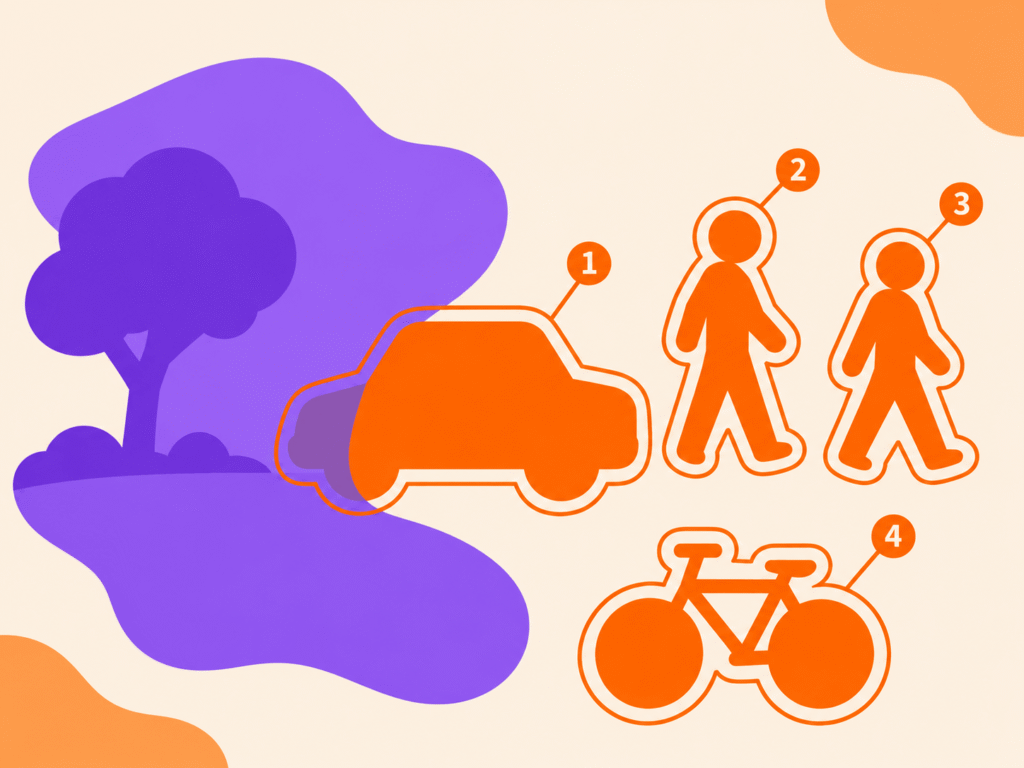
“Things” are anything countable: a car, a person, a dog, a chair. Panoptic segmentation handles every thing the way instance segmentation always has. Each one gets its own mask and its own ID, so a model can tell car one from car two even when they’re parked side by side.
Stuff gets a class label and nothing more
Sky, road, grass and water are stuff. They don’t have a fixed shape, and there’s no sensible way to count them the way you’d count cars. Panoptic segmentation labels every stuff pixel with its class, the way semantic segmentation always has, and stops there. There’s no “sky one” and “sky two.” It’s one continuous region.
This split isn’t academic. It changes how the data gets annotated in the first place. Caesar and his co-authors built their stuff-annotation protocol around superpixels. Labelling an amorphous region pixel by pixel is a fundamentally different job from drawing a box around an object. Get a dataset’s stuff-versus-things split wrong at the annotation stage, and a model trained on it inherits that confusion permanently.
Where “stuff” and “things” stop being obvious
The textbook version of this split works fine for a stock photo of a car parked on an empty street. It gets shakier the moment a scene is crowded, occluded or genuinely ambiguous, which describes most real scenes.
When there are too many things to count
A dense crowd at a train station, a flock of birds crossing a frame, a pile of apples on a market stall: these are technically countable. There can be too many of them, though, overlapping too closely, for a model or a person to draw a clean, separate mask around each one. Most practical datasets handle this with a rule rather than a principle: past a certain density, treat the group as a single region and move on. Exactly where that threshold sits is a judgement call someone has to make and write down. The “stuff versus things” definition alone doesn’t answer it.
When one thing is mostly hidden behind another
A pedestrian walking behind a parked car, a cyclist partly behind a signpost: the visible pixels clearly belong to one instance. Someone still has to decide how much of the hidden shape counts as part of that instance’s mask, and exactly where the boundary line falls. Get that occlusion rule wrong on a single frame and it’s one mislabelled pixel. Get it wrong systematically across a dataset, and a model trained on it learns to lose track of anyone partly hidden behind a car. That mistake repeats on every frame it sees afterward, not only the one that was labelled incorrectly.
When “stuff” starts looking like “things”
A pile of construction rubble, a stack of shipping pallets, a cluster of rocks: none of these sort cleanly into either category. A single large boulder reads as a thing. A scree slope made up of a thousand small ones reads as stuff. Somewhere between the two, a dataset’s annotation guideline has to draw a line, and two different, reasonable reviewers can draw it in two different places.
None of this is a rare stress test built to break the model. It’s the ordinary content of a real photo or a real street scene. That’s exactly why it needs a documented rule and a person checking the rule was actually followed. A hope that a bigger model will eventually learn to guess correctly on its own isn’t a substitute.
A worked example
Take a single frame from a delivery robot’s camera on a residential street. A parked car sits at the kerb. Behind it, a cyclist is visible from the shoulders up. Two pedestrians stand close together on the pavement, one slightly behind the other. A hedge runs along the property line behind them all.
The car and the two pedestrians are straightforward things: distinct, countable, each gets its own mask. The pavement, the road surface and the hedge are stuff: continuous regions, one class label each, no instance count attached. The cyclist is where this frame actually gets hard. Only the rider’s upper body is visible. Does the mask stop at the visible pixels, or estimate the hidden lower portion based on where a bicycle usually sits? The two overlapping pedestrians raise a related question. Is the boundary between them drawn where one body is actually occluded by the other? Or does the annotator guess at where a hidden shoulder line would fall?
A documented annotation guideline answers both questions the same way every time, for every reviewer, on every frame. Without one, two people labelling the same frame can produce two different, equally defensible masks, and a model trained on the mix learns neither rule consistently.
What to check before you trust a panoptic segmentation dataset
None of this is free to do perfectly at scale, either. Cityscapes is one of the most widely used benchmarks for panoptic segmentation in street scenes (Cordts et al., 2016). It pairs 5,000 finely annotated images with 20,000 more labelled only coarsely, because full instance-level detail is expensive to produce at that volume. That’s exactly why the rule matters more than the budget. Whichever frames do get the full treatment need a consistent, written standard behind them, not an assumption that consistency happens automatically.
If your team is building or buying a panoptic segmentation dataset, a few direct questions catch most of the problems above before they ever reach a model:
- Does the guideline define a specific density threshold for treating a cluster of things as a single stuff-like group, or is that left to each annotator’s own judgement?
- Does it specify how occluded objects get masked, visible pixels only or an estimated full extent, and is that rule applied the same way by every annotator?
- Is there a documented rule for ambiguous classes (debris, stacked objects, dense vegetation) that a reviewer can actually check frames against?
- Does a second, independent reviewer check a sample of frames against that guideline, or is the first annotator’s judgement the only pass the data gets?
None of these questions are about which model architecture sits downstream of the data. They’re about whether the same ambiguous cases got resolved the same way, every time, before any model ever saw them.
I’ve written before about what actually makes image annotation difficult. Most of the real cost sits in exactly this kind of judgement call, not in the parts of the job that look simple from the outside. Panoptic segmentation adds a second axis on top of that difficulty. It’s not only where a boundary sits, but which of the two categories, stuff or things, a region belongs to in the first place. Outsourcing this work can make sense once a team has worked out what it actually needs. That only holds, though, once the guideline itself is specific enough that two reviewers would label the same frame the same way. For teams working from video rather than single frames, the review cost compounds further still. The same boundary and category decisions have to stay consistent from one frame to the next, not only within a single image.
How Chegg approaches this
A documented rule only helps if someone actually checks that it was followed. At Chegg, panoptic segmentation annotation work gets a written guideline for exactly the ambiguous cases this piece has walked through. Crowd-density thresholds, occlusion rules, and the stuff-versus-things line on genuinely borderline classes are all covered in writing before anyone annotates a frame. A reviewer checks a sample of frames against that guideline before a dataset ships, not after a model’s accuracy numbers come back low and nobody can say why.
That review step doesn’t go away because the first pass came from a stronger model. A better segmentation model narrows how often the ambiguous cases come up. It doesn’t remove the need for someone to have decided, in writing, how those cases get handled. At Chegg, that’s the standard every panoptic segmentation project is held to, across the annotation work Chegg does.
Key takeaways
- Panoptic segmentation unifies semantic segmentation (every pixel gets a class) and instance segmentation (every countable object gets its own ID) into one non-overlapping map of an image.
- Everything in a scene gets sorted into stuff or things. Stuff (amorphous regions like sky or road) gets labelled by class only. Things (countable objects like cars or people) get labelled by class and by individual instance.
- The split breaks down at real edge cases: dense crowds, occluded objects and borderline classes like piles of debris, where the stuff-versus-things line isn’t obvious.
- A documented annotation guideline, applied consistently and checked by a reviewer, is what actually resolves these edge cases. A stronger model narrows how often they come up. It doesn’t remove the need for the rule.
- The researchers who proposed panoptic segmentation studied human and machine performance on the task side by side, because the ambiguous cases were never expected to resolve themselves.
FAQs
What is panoptic segmentation?
Panoptic segmentation is a computer vision task that labels every pixel in an image. Amorphous background regions, called stuff, such as sky or road, get a class label. Countable objects, called things, such as cars or people, get a class label and their own individual instance ID. The result is one complete, non-overlapping map of the scene.
What’s the difference between panoptic segmentation and instance segmentation?
Instance segmentation only finds and masks countable objects, leaving the rest of the image unlabelled. Panoptic segmentation does that too, but also labels every remaining background pixel with a class, so nothing in the image is left out.
What’s the difference between semantic segmentation and panoptic segmentation?
Semantic segmentation labels every pixel with a class but doesn’t separate individual objects of the same class: three people standing together all read as one “person” region. Panoptic segmentation keeps the full-image coverage semantic segmentation already provides, and adds a separate instance ID for every countable object on top of it.
What does “panoptic” mean?
Panoptic comes from a Greek root meaning “seeing everything.” It’s a fitting name for a task built to leave no pixel in an image unlabelled, whether that pixel belongs to a countable object or an amorphous background region.
What is the Panoptic Quality (PQ) metric?
Panoptic Quality, or PQ, is the evaluation metric Kirillov and his co-authors proposed alongside the panoptic segmentation task itself. It scores performance across both stuff and things classes in one unified number, rather than needing two separate metrics for the two different kinds of region.
Does panoptic segmentation need human review?
Yes, at least at the edges. A model can handle most of a typical frame on its own. The genuinely ambiguous cases, dense crowds, occluded objects, borderline stuff-or-things regions, still get resolved by whatever rule a human annotator or reviewer wrote down. Applying that rule consistently is what the model alone can’t guarantee.