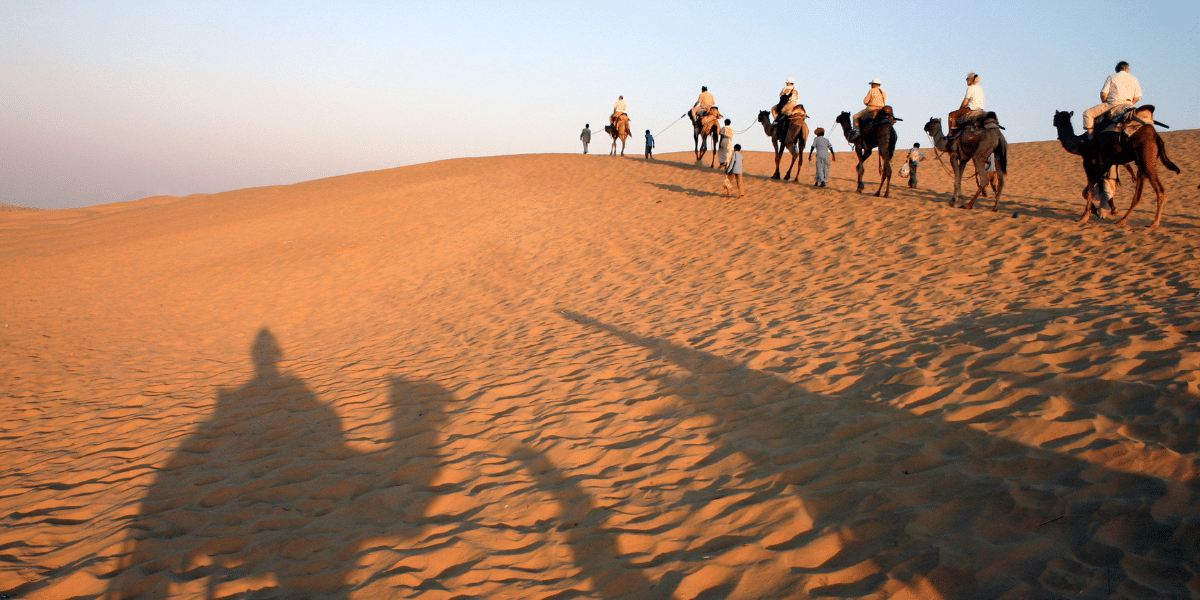
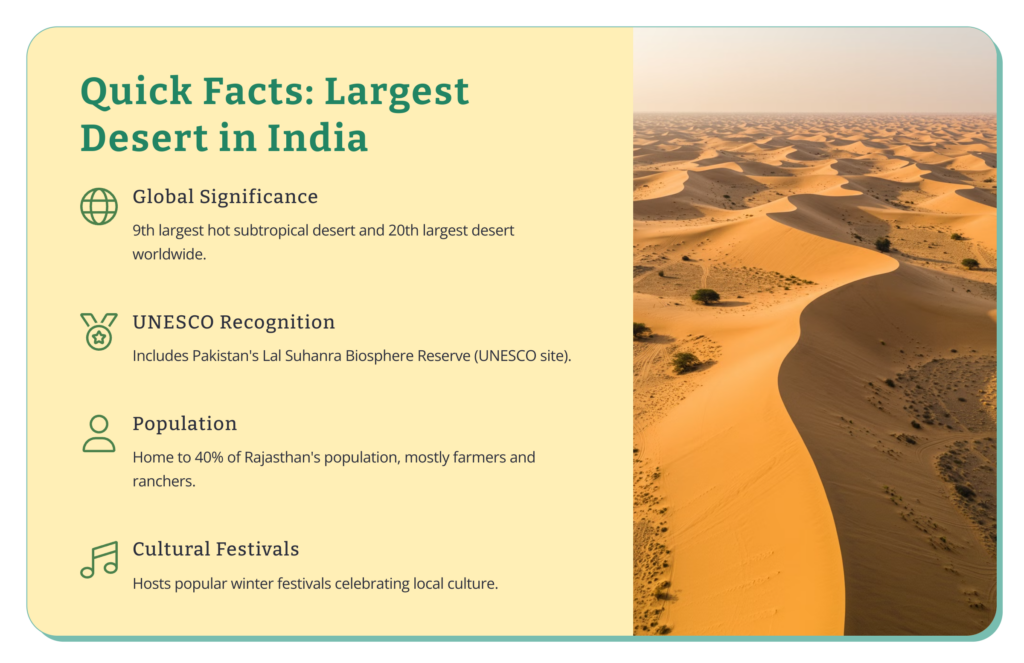
India has diverse landscapes, including lush forests, snowy mountains, and deserts. The largest desert in India is the Thar Desert, also known as the Great Indian Desert. Spanning over 200,000 square kilometers (around 77,000 square miles), it covers parts of Rajasthan and extends into Gujarat, Punjab, and Haryana, with 85% in India and 15% in Pakistan.
It is the world’s 20th-largest desert and the ninth-largest hot subtropical desert. The Thar features rolling sand dunes, barchans, and dry plains located northwest of the Aravali Hills. “Thar” is derived from the local word “thul,” meaning sand ridges. Despite its arid conditions, the region is rich in biodiversity, cultural heritage, and unique geography.

The Thar Desert is known for its rolling sand dunes, vibrant culture, camel fairs, and unique wildlife, such as the blackbuck and Indian bustard. Cities like Jaisalmer, Bikaner, and Barmer lie within the desert zone and offer unforgettable desert experiences.
| Rank | Desert name | Approx area (km²) | State / Region | Highlights |
|---|---|---|---|---|
| 1 | Thar Desert | ~200,000 | Rajasthan, Gujarat, Haryana, Punjab | Culture, dunes, wildlife |
| 2 | Great Rann of Kutch | ~7,500 | Gujarat | Salt plains, Rann Utsav, flamingos |
| 3 | Cold Desert (Ladakh/Nubra) | ~7,700 | Ladakh | High-altitude cold desert, double-humped camels |
| 4 | Spiti Valley | ~7,800 | Himachal Pradesh | Monasteries, rugged landscape |
| 5 | Little Rann of Kutch / Banni | ~4,950 / 3,847 | Gujarat | Wild ass sanctuary, grassland ecology |
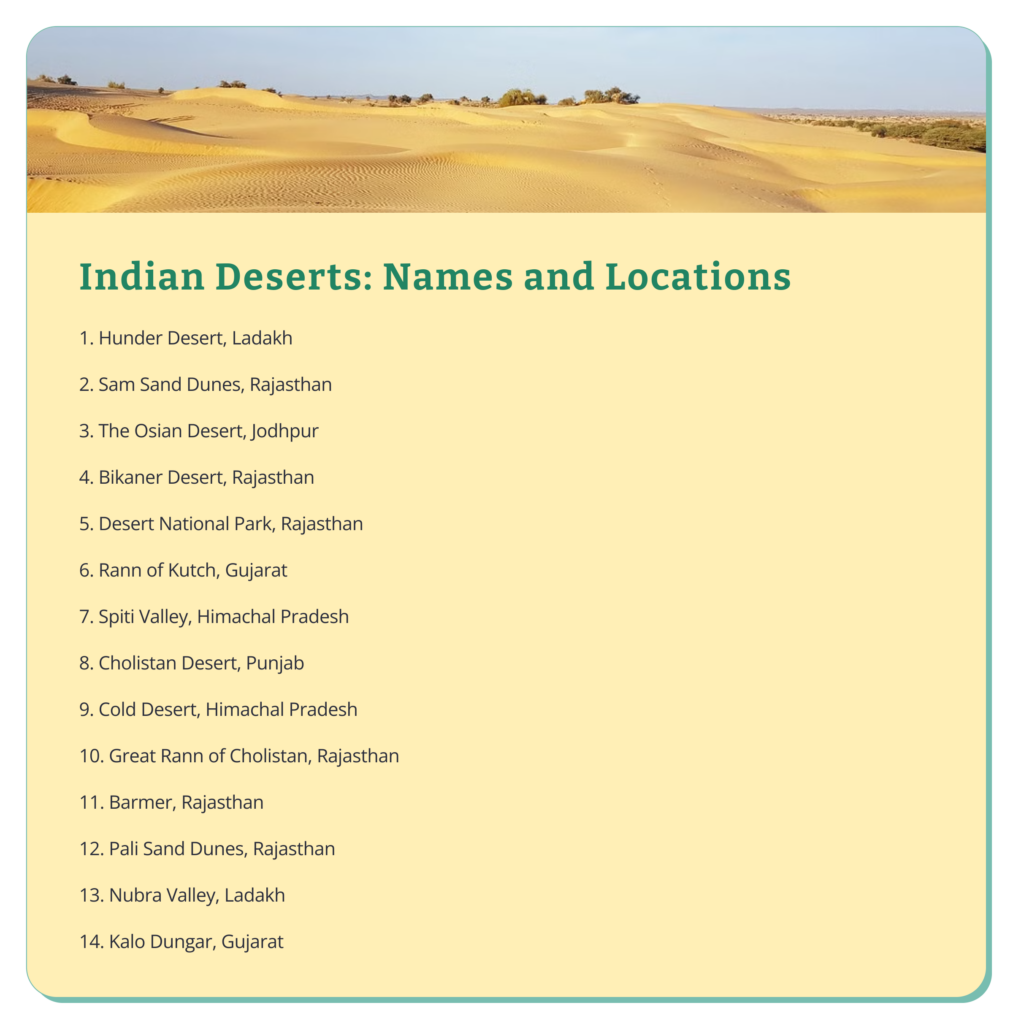
Northwest India is home to the Indian deserts, which support a wide range of flora and fauna adapted to the severe dry climate. Dunes and sandy landscapes distinguish the area. Let’s now understand the various deserts located in different parts of India. Some famous Indian deserts are the Thar Desert, Barmer Desert, Run of Kutch, Hunder Desert, Ladakh, and Cold Desert, Himachal Pradesh.
Hunder village, in the Nubra valley of Jammu and Kashmir, is a stunning yet secluded settlement that appears to be an oasis amidst the chilly desert landscape of the largest desert in India, the Thar Desert. This region is around 10 km from the Diskit village, with unique double-humped camels and picturesque views of the surrounding mountains.
Sam Dunes is one of the renowned dunes in Rajasthan. With its 3 to 5 km wide expanse of natural desert, Sam’s Sand Dunes is the perfect location for activities like paragliding, quad bike dune bashing, and camel safaris. This landscape lies 40 km from Jaisalmer and surrounds a sandy, bushless desert.
The Osian Desert, close to Jodhpur city, offers an enthralling fusion of desert scenery and ancient heritage. One can find the Sachiya Mata Temple and the Sun Temple, which have elaborate sculptures, in the desert settlement. These main temples highlight Rajasthan’s rich cultural heritage. Osian dunes are located at a distance of around 70 km from Jodhpur city.
This region offers a few overnight camps and is relatively less congested, a plus in a “desert-like region.” Visitors and guests can also go on a jeep and camel safari tour, making it an ideal destination to explore the beauty and culture of the largest desert in India.
Bikaner is an attractive city in Rajasthan’s northwest, well-known for its dunes, marvelous architecture, and cultural artifacts. Located within the expansive Thar Desert, the largest desert in India, the Bikaner Desert remains one of Rajasthan’s most alluring travel destinations.
The Desert National Park, situated in Rajasthan near Jaisalmer and part of the largest desert in India, the Thar Desert, features large tracts of dunes and dry terrain. Large tracts of dunes and dry terrain make up this national park, which is home to. Various flora and fauna include the critically endangered Great Indian Bustard. A trip to this desert involves experiencing a jeep safari into the park, watching wildlife in its natural habitat, and taking in the breathtaking species of birds.
One of Gujarat’s most alluring and engaging tourist spots is the Ran of Kutch, which is part of the largest desert in India, the Thar Desert. The vast expanse of salt marsh land borders the Arabian Sea and stretches over Gujarat’s western coast. The sight of white dunes glowing brilliantly in the moonlight is breathtaking at the Rann of Kutch. It’s an unusual salt desert in India whose tranquil ambiance surprises visitors.
The Himalayas nestle the Spiti Valley, one of India’s most stunning tourist locations. This stunning valley is in Himachal Pradesh, midway between Tibet and India.
The enormous Cholistan Desert, an area of limitless dunes and sun-burned land, is located in the center of Punjab. The Great Rann of Cholistan, which is located in Rajasthan’s Thar Desert, provides visitors with a fantastic desert experience full of fascinating scenery and rich cultural diversity. This area contains large dunes, remote settlements, and a lively rural way of life. Every year, Jaisalmer hosts the Desert Festival, which highlights the region’s rich history and includes camel races, folk dances, and traditional music.
The majestic Himalayas cover the Himachal Pradesh Cold Desert, which spans 7,000 square km and is 4,500 meters above sea level. Located in the trans-Himalayan region, the Cold Desert of Himachal Pradesh includes areas like Spiti Valley and Lahaul. Unlike the largest desert in India, the Thar Desert, this region experiences harsh winters with snowfall, minimal vegetation, and low humidity. The stark, rugged terrain supports unique wildlife and a sparse but resilient population adapted to extreme cold and high altitude.
In this region of Rajasthan, you can explore large stretches of dunes, remote settlements, and a lively rural way of life. Jaisalmer hosts the Desert Festival annually, highlighting the region’s rich history, including camel races, folk dances, and traditional music. Discovering the Great Rann of Cholistan enables visitors to take in the warm hospitality of Rajasthan, see historic temples and palaces, and observe the rural way of life of the people. The captivating desert landscapes and the vibrant local culture give travelers a unique and immersive experience.
Covering 28,387 square kilometers, Barmer, one of Rajasthan’s largest and oldest districts, extends over a portion of the Thar Desert, the largest desert in India. Moreover, people can immerse themselves in a genuine desert experience in Barmer by exploring the historic Kiradu Temples ruins, indulging in regional cuisine, and experiencing the native way of life.
The Pali Sand Dunes are a result of years of wind erosion. Presumably, the most enormous dunes in Rajasthan represent a distinctive aspect of the Thar Desert. The largest desert in India, these dunes offer a peaceful environment away from the busy tourist attractions, where you can relax and reconnect with nature. Pali Sand Dunes is the ideal retreat for those looking for comfort amidst the wonder of the desert because of its serene atmosphere, stunning views, and chance to enjoy the starry night sky.
Nestled within the towering Himalayan mountains of Ladakh is the desert-like Nubra Valley. Its majestic villages, turquoise rivers, and towering dunes make it surreal. The picturesque Khardung La Pass, one of the world’s highest motorable passes, leads visitors to the valley.
Diskit Monastery is a well-known attraction in the valley. Known for its elaborate murals, ancient Buddhist artifacts, and an enormous statue of Maitreya Buddha, it is situated atop a hill with a view of the valley. The Nubra Valley is a serene and breathtaking location. It starkly contrasts the Thar Desert’s arid environment in Rajasthan, India’s largest desert. For those wishing to experience Ladakh’s distinctive culture and scenery, it is a well-liked tourist destination.
Kalo Dungar, the highest point in Kutch, Gujarat, is a captivating destination for those who enjoy the outdoors and an exciting adventure. The Great Rann of Kutch, a compelling combination of dry land and white salt desert, is visible from the summit, offering breathtaking panoramic views. In addition, you can observe migratory birds and discover the fascinating legend surrounding the hill. Kalo Dungar’s serene ambiance makes it the ideal spot to unwind and escape the daily grind.

The Thar Desert is the largest desert in India. It is located between the northeastern Aravali Hills. It extends northward to Punjab and Haryana, westward to the Rann of Kutch along the western coast, and northwest to the alluvial plains of the Indus River.
| Protected area | Description |
| Desert Natural Park | It is situated in the Churu district and covers 7 km². A sizable population of foxes, blackbuck, partridge, and other wildlife call the refuge home. |
| Tal Chhapar Sanctuary | It is situated in the Churu district and covers 7 km2. A sizable population of foxes, blackbuck, partridge, and other wildlife call the refuge home. |
| Sundha Mata Conservation Reserve | The area is situated in the Jalore District and spans 117.49 km2. |
With roughly 14,200,000 square kilometers, the Antarctica Desert is the largest in the World. It is located in Antarctica and the oceanic regions surrounding it. It has frigid temperatures and a substantial ice sheet. Amazingly, almost 70% of the freshwater on Earth is frozen in this desert. The Largest desert in India is classified as polar due to its exceptionally low precipitation levels despite its enormous size.
The Antarctic Desert is home to rare wildlife species like penguins, seals, and various seabird species. Its deep ice sheet, which can reach depths of more than two miles in some places, also holds priceless records of Earth’s past climate.
The smallest desert in the world is the Carcross Desert in Yukon, Canada. It is called a “cold desert” because of its low temperatures and 2.6 km2 area. Because of an underground aquifer that supports its vegetation, the desert is home to a diverse range of plants and animals.
The rain shadow effect, which keeps the surrounding mountains comparatively dry, gives rise to the desert’s hot and dry climate. Because of this, uncommon plant species, including the Baikal sedge and the Yukon lupine, have thrived in the desert’s dry conditions.
It is also a well-liked location for outdoor activities. Visitors come here to engage in winter sports like cross-country skiing and horseback riding. The desert’s distinctive terrain, which provides an abundance of slopes and jumps, has even made it a popular place for sandboarding.
The Sahara Desert and India vastly differ in geography, climate, culture, and biodiversity. Here’s a comparison of the two:
| Aspect | Sahara Desert | India |
|---|---|---|
| Geography | World’s largest hot desert (9.2 million sq km), spans North Africa | Seventh-largest country (3.29 million sq km); features mountains, plains, plateaus, and coastlines |
| Climate | Extremely arid; scorching days (up to 50°C), cold nights, <25 mm annual rainfall | Varied: tropical south, temperate north; monsoon rains and distinct seasons |
| Biodiversity | Sparse; camels, desert foxes, cacti dominate | Rich ecosystems: tigers, elephants, rhinos, forests, wetlands, and deserts |
| Culture & Population | Sparsely populated; nomadic tribes like Tuareg and Bedouins | 1.4+ billion people; multilingual, multi-religious, with ancient and diverse traditions |
| Economy | Oasis farming, livestock, trade, oil, and gas exports | Diverse: agriculture, industry, IT, tourism, and services power the economy |
Deserts like the Thar in India are not just vast stretches of sand—they are vibrant cultural landscapes. Events such as the Pushkar Camel Fair in Rajasthan and the Rann Utsav in Gujarat celebrate desert communities’ traditions, music, crafts, and lifestyles. These festivals reflect the resilience and creativity of people living in harsh environments.
Despite the extreme climate, deserts are home to a surprising variety of life. Species like the blackbuck, Indian wild ass, caracal, and various desert birds and reptiles have uniquely adapted to survive here. These ecosystems support many endangered species and rare plants found nowhere else.
Deserts attract thousands of tourists every year. Desert safaris, camel rides, traditional villages, historical forts, salt flats like the White Rann, and scenic sunrises and sunsets create unforgettable experiences for visitors. This boosts the local economy and promotes cultural exchange.
Deserts are crucial in studying arid ecosystems, climate change, and soil erosion patterns. Their unique conditions help scientists understand how global warming affects extreme environments and how plant and animal life adapt to such stressors.
In short, deserts are vital not only for ecological and scientific reasons but also for their cultural richness and economic importance.
Though deserts are often associated with dryness and water scarcity, the Thar Desert, India’s largest desert, has a few important rivers vital to life and agriculture. Chief among them is the Luni River, followed by the Sabarmati River.
The Luni River is the most significant and prominent river flowing through the Thar Desert. It originates in the Pushkar Valley of the Aravalli Range, near Ajmer in Rajasthan. From there, it travels approximately 495 km through the southeastern region of the Thar Desert, passing major cities like Jodhpur, Pali, Nagaur, and Barmer, before disappearing into the marshy lands of the Rann of Kutch in Gujarat.
What makes the Luni unique is its saline nature. Unlike freshwater rivers, the Luni has a high salt content due to the arid terrain and mineral-rich soil. The river often shrinks to a narrow stream during the summer, exposing sandbars and pebbled riverbeds.
Despite its unpredictability, the Luni River is crucial for:
The Luni has sustained local communities for generations, enabling agriculture and settlement in an otherwise hostile environment.
Another vital river that influences the desert margins is the Sabarmati River. It originates from the western slopes of the Aravalli Hills near Ajmer, Rajasthan. Although it doesn’t run directly through the heart of the Thar Desert like the Luni, it flows southwestward across the semi-arid plains and hills, offering water support in adjoining regions of Gujarat and Rajasthan.
The Sabarmati is supplementary to irrigation and urban water supply, especially in cities like Ahmedabad.
These rivers prove that even deserts, often thought to be lifeless, can be nurtured and made productive with the help of precious water sources.
Despite its arid and harsh environment, the largest desert in India, the Thar Desert, is a vibrant ecosystem teeming with life and culture. Stretching across Rajasthan and parts of Gujarat, Punjab, and Haryana, this desert showcases a unique blend of nature and tradition. It supports diverse flora and fauna, such as the Chinkara, Blackbuck, and desert foxes, all of which have adapted to survive the extreme climate.
Apart from its ecological richness, the desert also holds deep cultural significance, with colorful festivals, traditional music, and historic forts enriching its landscape. The largest desert in India not only highlights the resilience of life but also adds a distinct charm to the country’s geography, making it a fascinating region to explore and study.
Read More:
The three largest deserts in India are the Thar Desert, the Rann of Kutch, and the Trans-Himalayan Desert. With a span of 238,254 km², the Thar Desert is the largest in India. With an area of 27,454 km², the Rann of Kutch follows second. While the Trans-Himalayan Desert gets the 3rd place with a length of 1,600 km
The largest Desert in India is in the southern hemisphere of the Antarctic continent. The Antarctic Desert is the biggest globally, covering over 14,000,000 square kilometers.
The world’s smallest desert is the Carcross Desert in Yukon, Canada. Because of its low temperatures, it is also called a “cold desert” and spans 2.6 km².
The hottest desert is the Thar Desert, also known as the Great Indian Desert. It is located on the Indian subcontinent in an arid area with undulating dunes. This area receives little rainfall—less than 150 mm annually.
Ladakh is the coldest desert in India. It is located in the Greater Himalayas east of Jammu and Kashmir, and It is adjacent to China. The Karakoram mountain range to the north and the Zanskar mountains to the south enclose Ladakh’s frigid desert.
The Sahara Desert is significantly larger than India. Covering around 9.2 million square kilometers, the Sahara is the largest hot desert in the world. In comparison, India spans approximately 3.29 million square kilometers. This means the Sahara is nearly three times bigger than India in terms of area.