unesco world heritage site india

UNESCO World Heritage Sites in India: A Complete Guide

Published on September 10, 2025
|
10 Min read time

Quick Summary

  • As of 2025, India has 44 UNESCO World Heritage Sites, 36 cultural, 7 natural, and 1  mixed, highlighting its rich cultural, historical, and ecological diversity.
  • The latest inclusion is Maratha Military Landscapes (44th) and Moidams of the Ahom Dynasty in Assam (43rd), and five more sites are on the tentative list for recognition.
  • These sites reflect India’s global heritage value, from architectural marvels like the Taj Mahal to ecological treasures like the Western Ghats.

Table of Contents

India currently boasts 44 UNESCO World Heritage Sites, spanning cultural, natural, and mixed categories. These prestigious listings include architectural marvels like the Taj Mahal, ecologically significant places like Kaziranga National Park, and recent additions that highlight regional heritage, such as the Charaideo Moidams in Assam and the Maratha Military Landscapes in Maharashtra and Tamil Nadu. Together, they underscore India’s rich and diverse legacy on the global stage.

44 UNESCO World Heritage Site in India

Seeing how many UNESCO World Heritage Site India has is a great honor. The country is rich in cultural and natural wonders that have fascinated the world with their deep historical significance and breathtaking beauty. Among these treasures, 44 have earned the prestigious UNESCO World Heritage Site India title. India is home to 44 world heritage sites in India, showcasing its rich cultural heritage and natural beauty. Iconic landmarks like the Taj Mahal, Ajanta and Ellora Caves, Sun Temple at Konark, and the group of monuments at Hampi highlight its historical splendor. The Moidams of Assam, added in 2024, reflect the Ahom dynasty’s cultural significance.

Other notable sites include Jaipur City, a planned urban marvel; Kaziranga National Park, renowned for its biodiversity; and the Valley of Flowers, famous for breathtaking landscapes. These 44 world heritage sites in India collectively symbolize the nation’s legacy of art, history, and ecological wealth.
UNESCO World Heritage Site India 2025

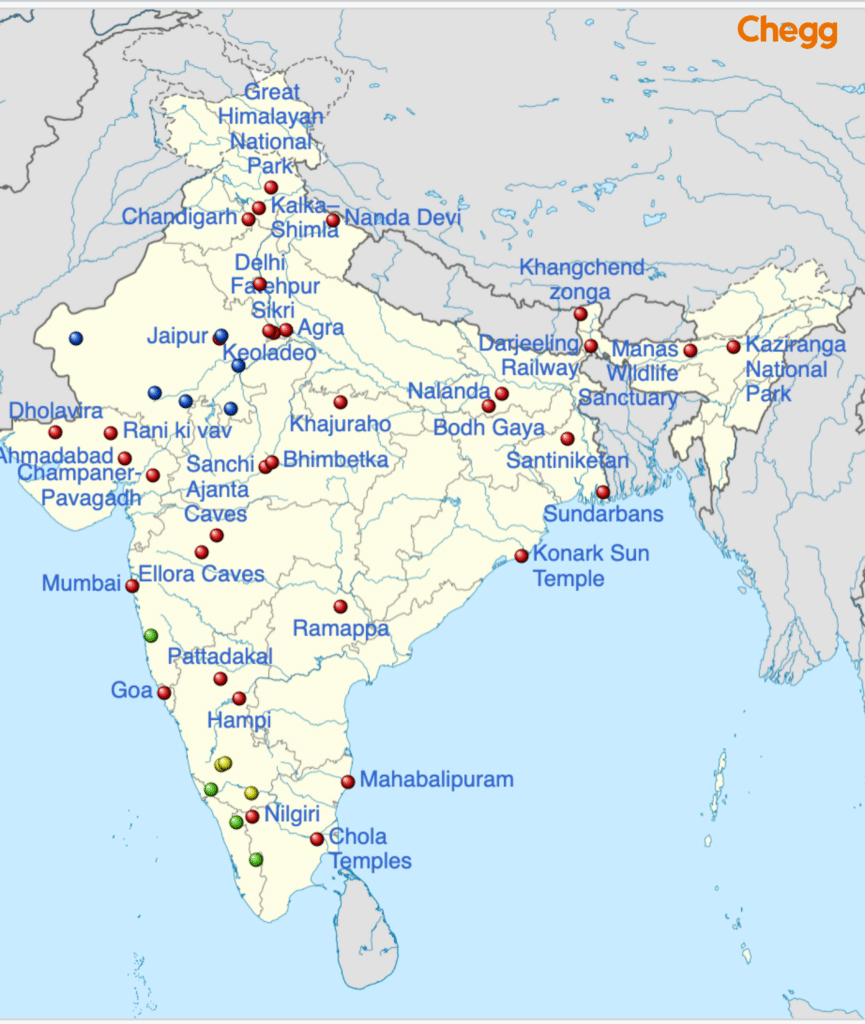
UNESCO World Heritage sites on Indian Map

As of 2025, India has 44 UNESCO World Heritage Sites, showcasing its rich cultural and natural heritage. These include iconic landmarks like the Taj Mahal, Ajanta and Ellora Caves, the Sun Temple at Konark, and Hampi. The Moidams of Assam, inscribed in 2024, are the latest addition.
Additionally, six sites have been added to India’s tentative list for UNESCO recognition in 2025. These include the Mudumal Megalithic Menhirs in Telangana, Kanger Valley National Park in Chhattisgarh, Ashokan Edict Sites, Chausath Yogini Temples, Gupta Temples, and the Palace-Fortresses of the Bundelas.

What are the criteria for UNESCO World Heritage Sites in India?

The criteria for UNESCO World Heritage Sites in India follow global UNESCO guidelines. To qualify, a site must meet at least one of these ten criteria:

  1. Cultural Significance: It represents a masterpiece of human creative genius.
  2. Cultural Exchange: Show an important interchange of human values across time or regions.
  3. Cultural Testimony: Bear a unique testimony to a cultural tradition or civilization.
  4. Architectural Example: Be an outstanding example of architecture or landscape design.
  5. Human Settlement: Exemplify traditional human settlement or land use, showcasing cultural interaction.
  6. Association with Ideas: Be directly associated with events, ideas, or works of universal importance.
  7. Natural Beauty: Contains areas of exceptional natural beauty and aesthetic value.
  8. Earth’s History: Represent primary stages of Earth’s history or geological processes.
  9. Ecosystems: Be an outstanding example of ecological or biological processes.
  10. Biodiversity: Contains essential habitats for biodiversity conservation.

First UNESCO World Heritage Site India

The first UNESCO World Heritage Site in India is the Ajanta Caves, which were inscribed on the World Heritage List in 1983.

Ajanta caves

Source: Wiki

Overview of Ajanta Caves

  • Cultural Importance: The caves are a significant representation of ancient Indian art and culture, showcasing the influence of Buddhism in India during that period.
  • Location: The Ajanta Caves are in Maharashtra, approximately 100 kilometers from Aurangabad.
  • Historical Significance: These caves date from the 2nd century BCE to the 6th century CE and are renowned for their remarkable rock-cut architecture and exquisite frescoes.
  • Art and Architecture: The Ajanta Caves have 30 caves, including monastic and devotional halls (viharas and chaityas). The walls of these caves are adorned with intricate paintings and sculptures depicting Buddha’s life and various Jataka tales.

How Many Unesco Sites in India?

India has a remarkable list of 44 UNESCO World Heritage Sites, celebrated for their cultural and natural significance.

S.NoName of SitesYearLocation
1Ajanta Caves1983Maharashtra
2Ellora Caves1983Maharashtra
3Agra Fort1983Agra
4Taj Mahal1983Agra
5Sun Temple1984Orissa
6Mahabalipuram Monuments1984Tamil Nadu
7Kaziranga National Park1985Assam
8Keoladeo National Park1985Rajasthan
9Manas Wildlife Sanctuary1985Assam
10Churches and Convents of Goa1986Goa
11Monuments of Khajuraho1986Madhya Pradesh
12Monuments of Hampi1986Karnataka
13Fatehpur Sikri1986Agra
14Elephanta Caves1987Maharashtra
15Great Living Chola Temples1987Tamil Nadu
16Pattadakal Monuments1987Karnataka
17Sundarbans National Park1987West Bengal
18Nanda Devi & Valley of Flowers National Park1988Uttarakhand
19Monuments of Buddha1989Sanchi, Madhya Pradesh
20Humayun’s Tomb1993Delhi
21Qutub Minar and its Monuments1993Delhi
22Mountain Railways of Darjeeling, Kalka Shimla & Nilgiri1999Darjeeling
23Mahabodhi Temple2002Bihar
24Bhimbetka Rock Shelters2003Madhya Pradesh
25Chhatrapati Shivaji Terminus2004Maharashtra
26ChampanerPavagadh Archaeological Park2004Gujarat
27Red Fort2007Delhi
28Jantar Mantar2010Delhi
29Western Ghats2012Karnataka, Kerala, Tamil Nadu, Maharashtra
30Hill Forts2013Rajasthan
31Rani Ki Vav (The Queen’s Stepwell)2014Gujarat
32Great Himalayan National Park2014Himachal Pradesh
33Nalanda2016Bihar
34Khangchendzonga National Park2016Sikkim
35Architectural Work of Le Corbusier (Capitol Complex)2016Chandigarh
36The Historic City2017Ahmedabad
37Victorian Gothic and Art Deco Ensembles2018Mumbai
38The Pink City2019Jaipur
39Kakatiya Rudreshwara (Ramappa) Temple2021Telangana
40Dholavira2021Gujarat
41Santiniketan2023West Bengal
42Hoysala temples of Belur, Halebid and Somananthpura2023Karnataka
43Moidams – the Mound-Burial system of the Ahom Dynasty2024Assam
44Maratha Military Landscapes2024Maharashtra

Latest Updates

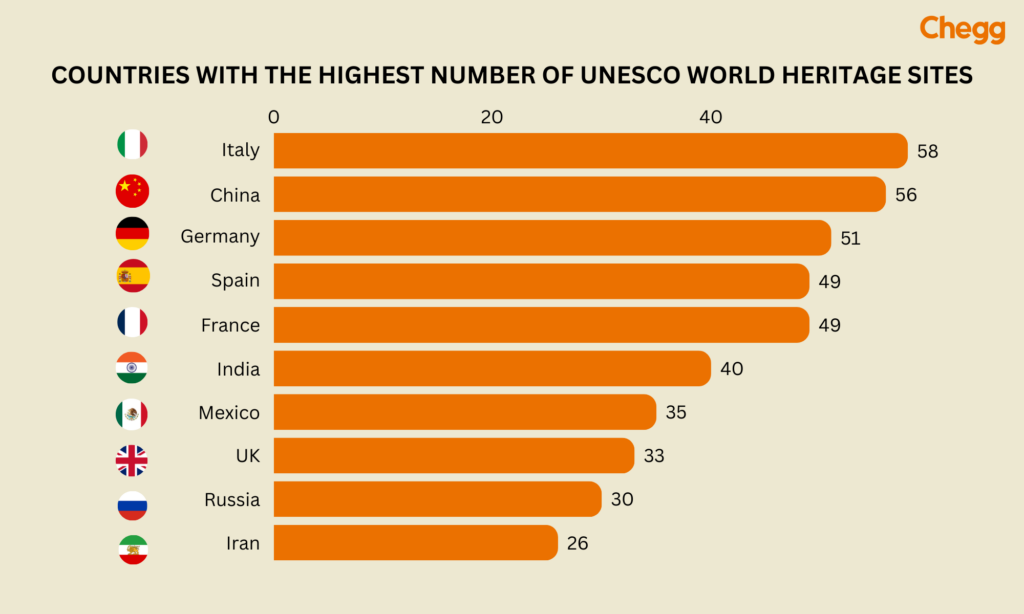
Countries with the highest number of UNESCO World Heritage Sites

India holds the sixth-highest number of UNESCO World Heritage Sites globally. The countries with 42 or more such sites include Italy, Spain, Germany, China, and France. Notably, since 2014, India has added 12 new World Heritage Sites, showcasing its commitment to preserving and promoting its cultural and natural treasures.
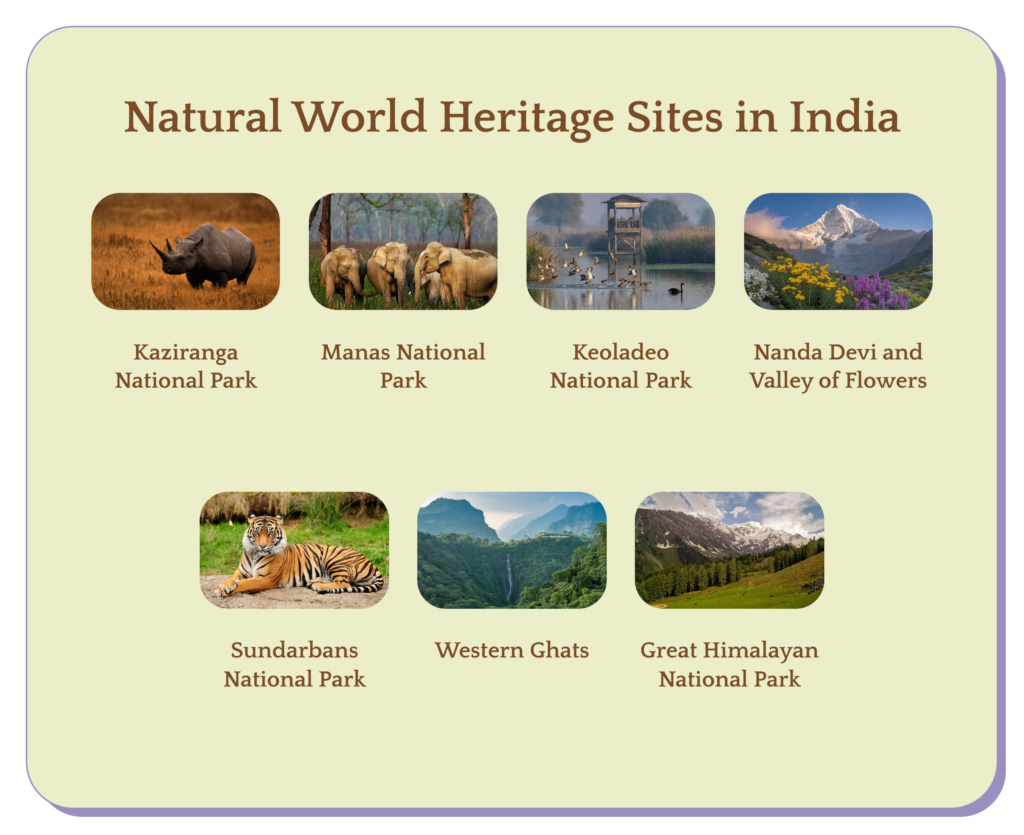
Natural World Heritage Sites in India 2025

natural world heritage sites in india

The number of UNESCO World Heritage Sites in India 2025 is 7. Here’s the complete list.

1. Kaziranga National Park

Famous for the world’s 2/3rd population of Great One-Horned Rhinoceroses. The park holds the record for the highest density of tigers worldwide and wild water buffalo, elephants, and swamp deer. Additionally, it has gained recognition as an Important Bird Area.

2. Manas National Park

A UNESCO World Heritage Site since 1985, Manas National Park is a protected area covering 284 sq km in Assam, India. Its rich biodiversity and endangered species like the Assam roofed turtle, pygmy hog, hispid hare, golden langur, and Bengal florican are well-known.

3. Keoladeo National Park

This former hunting ground of the Maharajas of Bharatpur is now a bird sanctuary home to over 230 species of birds, including the Asian koel, from which it gets its name.

4. Nanda Devi and Valley of Flowers National Parks

This UNESCO World Heritage Site encompasses two national parks, Nanda Devi National Park and Valley of Flowers National Park. The second-highest mountain in India, Nanda Devi, lends its name to Nanda Devi National Park. The meadows filled with wildflowers make the Valley of Flowers National Park renowned.

5. Sundarbans National Park

This park is home to the Royal Bengal tiger, which has the largest tiger population in the world. It also has the largest mangrove forest in the world.

6. Western Ghats

The Western Ghats are a mountain range that runs along the western coast of India. It is a UNESCO World Heritage Site for its rich biodiversity and unique ecosystems.

7. Great Himalayan National Park

This park is in the Himalayas and is home to various mountain animals, including snow leopards, bears, and ibex.

Cultural World Heritage Sites 

34 wonders that are considered UNESCO World Heritage Sites in India.

  1. Ajanta Caves are famous for Buddhist Rock-cut Cave Monuments. They are richly decorated with Paintings and Frescoes, such as Sigiriya Paintings.
  2. Ellora Caves: These caves were excavated out of the Hills, containing Jain and Hindu temples and monasteries. They have rock-cut Architecture.
  3. Agra Fort: This is one of the most prominent monumental structures of the Mughal Empire.
  4. Taj Mahal is one of the Seven Wonders of the World. King Shahjahan built it in memory of his third wife, Begum Mumtaz Mahal.
  5. Sun Temple: This temple is famous for its traditional Kalinga architecture style.
  6. Mahabalipuram Monuments: This monument is famous for being the largest in Mahabalipuram. It features Open-Air Rock Relief, Mandapa, Chariot Temples, and Pallava Dynasty Architecture.
  7. Churches and Convents of Goa: It is famous for the Rome of the Orient, the First Manueline, Mannerist, and Baroque Art Forms in Asia, and the First Latin Rite Mass.
  8. Monuments of Khajuraho: This monument is popular among Jain and Hindu temples. It is situated 175 km southeast of Jhansi. Well known for their Nagara-style symbolism and erotic Figures and sculptures.
  9. Monuments of Hampi: Hampi was a prosperous kingdom of the Vijayanagar. The ruins at Hampi depict the fine Dravidian style of art and architecture. The most essential heritage monument on this site is the Virupaksha Temple.
  10. Fatehpur Sikri: Its structure consists of four main Monuments. The Jama Masjid, The Buland Darwaza, Panch Mahal or Jada Baai ka Mahal, Diwane-Khas, and Diwan-eaam.
  11. Elephanta Caves: Elephanta Caves are popular for Buddhist and Hindu caves. They are situated on an Island in the Arabian Sea and have Basal Rock Caves and Shiva Temples.
  12. Great Living Chola Temples: This temple is popular for Chola Architecture, Sculpture, Painting, and Bronze Casting.
  13. Pattadakal Monuments: It is popular for its Chalukya style of architecture, which originated in Aihole and blended with the Nagara and Dravidian styles.
  14. Monuments of Buddha: It is popular for Monolithic Pillars, Palaces, Monasteries, Temples, Mauryan Architecture, and Ye Dharma Hetu Inscriptions.
  15. Humayun’s Tomb is popular as the precursor to the Taj Mahal and Mughal Architecture. It constitutes a Tomb, a Pavilion, any Water Channels, and A Bath.
  16. Qutub Minar and its Monuments: Includes Qutub Minar, Alai Darwaza, Alai Minar, Qubbat-ul-Islam Mosque, Tomb of Iltumish, and Iron Pillar.
  17. Mountain Railways of Darjeeling, Kalka Shimla & Nilgiri: The mountain railways of India comprise the Darjeeling Himalayan Railway and the Nilgiri Mountain Railway.
    Mountain Railway, and the Kalka-Shimla.
  18. Mahabodhi Temple is an important religious center for Buddhists. It was here that Mahatma Buddha attained enlightenment. Bodh Gaya is considered the holiest pilgrimage spot for Buddhists.
  19. Bhimbetka is famous for its rock paintings in natural rock shelters, stone-age inscriptions, and the Sitting Place of Bhima (Mahabharata).
  20. Chhatrapati Shivaji Terminus: It is popular for the Central Railway’s Headquarters, Terror Attacks on Mumbai in 2008, and Gothic Style Architecture.
  21. Champaner-Pavagadh Archaeological Park is the only complete and unchanged Islamic pre-Mughal city. The park also houses ancient Chalcolithic Indian Sites from the Stone Age era.
  22. Red Fort: Red Fort is popular in Shahjahanabad, Persian, Timuri, and Indian architectural styles, red sandstone architecture, and Moti Masjid.
  23. Jantar Mantar: Famous for its architectural astronomical instruments, the Jantar Mantar is the largest observatory of its kind.
  24. Hill Forts: This place is famous for its unique Rajput Military Defense Architecture. It includes six majestic forts in Chittorgarh, Kumbhalgarh, Ranthambore Fort, Gagron Fort, Amber Fort, and Jaisalmer Fort.
  25. Rani Ki Vav is an explicit example of fine Ancient Indian architecture, constructed during the Solanki dynasty.
  26. Nalanda: A center of learning and a Buddhist monastery from the 3rd century BCE to the 13th century CE.
  27. Architectural Work of Le Corbusier (Capitol Complex): Recognized as a World Heritage Site as part of an outstanding contribution to the Modern Movement.
  28. The Historic City: A walled city on the banks of the Sabarmati, where communities following Hinduism, Islam, and Jainism have co-existed for centuries.
  29. Victorian Gothic and Art Deco Ensembles: It is a collection of 94 buildings of great cultural importance in the Fort Area of Mumbai.
  30. The Pink City: Many magnificent forts, palaces, temples, and museums fill Jaipur, which is also home to local handicrafts and trinkets in abundance.
  31. Kakatiya Rudreshwara (Ramappa) Temple: The Ramappa Temple stands in Palampet Village, Telangana, estimated to be at least 800 to 900 years old. It particularly distinguishes itself with lightweight porous bricks, famously termed floating bricks.
  32. Dholavira: Dholavira is an architectural site in the Kutch district of Gujarat. It is one of the most prominent Indus Valley Civilisation sites.
  33. Santiniketan: Santiniketan, the cultural and educational hub founded by Nobel laureate Rabindranath Tagore, has earned a coveted spot on UNESCO’s World Heritage List. This recognition marks a significant milestone for India and celebrates the enduring legacy of this unique institution located in Bengal’s Birbhum district.
  34. Hoysala Temples: The United Nations Educational, Scientific and Cultural Organization (UNESCO) has added the famed Hoysala temples of Belur, Halebid, and Somanathapura in Karnataka, known as the Sacred Ensembles of the Hoysala, to its World Heritage list. This inclusion marks India’s 42nd UNESCO World Heritage Site and comes just a day after Rabindranath Tagore’s Santiniketan also received this distinguished recognition.

Khangchendzonga National Park: In the UNESCO list, experts consider the national park a mixed type. It earns fame for its fauna and flora, with occasional sightings of snow leopards.

Iconic UNESCO World Heritage Sites in India

Iconic UNESCO sites in India

Various UNESCO World Heritage Sites exhibit India’s rich history and culture, which are well-recognized. These locations are examples of architectural and cultural marvels, ranging from the towering Taj Mahal, a representation of eternal love, to the breathtaking temples of Khajuraho, renowned for their elaborate sexual carvings. Names like Jaipur’s Amer Fort and the spiritual importance of Varanasi’s ghats enhance India’s heritage.

UNESCO world heritage site India UPSC Questons

Since UNESCO sites are part of Indian culture, geography, and environment, they often appear in UPSC Prelims and Mains. Here are some examples of how this topic has been asked in the past:

UPSC Prelims Questions

1. (UPSC Prelims 2021)
Which one of the following statements is correct?

  • (a) Ajanta Caves have mural paintings.
  • (b) Ajanta Caves are rock-cut monuments of the Jains.
  • (c) Ajanta Caves were built in the 8th century A.D.
  • (d) Ajanta Caves depict scenes from the Ramayana.

Answer: (a) Ajanta Caves have mural paintings.

2. (UPSC Prelims 2019)
Which of the following pairs is/are correctly matched?

  1. Rakhigarhi – Indus Valley Civilization site
  2. Dholavira – Indus Valley Civilization site
  3. Kalibangan – Buddhist site

Options:

  • (a) 1 and 2 only
  • (b) 3 only
  • (c) 1 and 3 only
  • (d) 1, 2 and 3

Answer: (a) 1 and 2 only

(Note: Dholavira was later inscribed as a UNESCO World Heritage Site in 2021.)

3. (UPSC Prelims 2018)
Which of the following is a UNESCO World Heritage Site in India?

  • (a) Chilika Lake
  • (b) Bhimbetka Rock Shelters
  • (c) Silent Valley National Park
  • (d) Keibul Lamjao National Park

Answer: (b) Bhimbetka Rock Shelters

UPSC Mains Questions

1. (GS Paper I, 2018)
“Safeguarding the Indian art heritage is the need of the moment.” Discuss.

  • Here, candidates could mention India’s 36 cultural UNESCO sites, their challenges (pollution, encroachment), and steps like INTACH, ASI protection, and UNESCO guidelines.

2. (GS Paper I, 2015)
Examine the significance of the Rock-Cut architecture in India with special reference to Ajanta Caves.

3. (GS Paper I, 2013)
Discuss the role of UNESCO in protecting cultural heritage in India. Highlight examples of Indian sites that have benefited from UNESCO recognition.

Key Takeaways for Aspirants

  • UPSC often asks about locations, features, and significance of UNESCO sites.
  • Recent inclusions like Charaideo Moidams (2024) and Maratha Military Landscapes (2025) are potential Prelims questions.
  • For Mains, focus on heritage conservation, cultural symbolism, and challenges.

Conclusion

In conclusion, India’s 43 UNESCO World Heritage Sites are enduring symbols of the nation’s cultural brilliance and natural diversity. From architectural wonders to ecological gems, these sites not only preserve the legacy of India’s past but also inspire global appreciation for its heritage. Together, they bridge history and modernity, reminding us of the responsibility to protect and celebrate this invaluable legacy for future generations.

Whether you’re a curious traveler, a passionate historian, or a dedicated student, exploring these heritage sites offers profound insights into India’s vibrant civilization. Visiting them educates and fosters appreciation for the nation’s role in shaping world heritage and history.

Read More:-

Frequently Asked Questions(FAQs)

How many World Heritage Sites are in India by UNESCO?

India is home to 44 World Heritage Sites. 36 are cultural, 7 are natural, and one is a mixed type, Khangchendzonga National Park.

What was the number of total UNESCO World Heritage sites in India in 2022?

There were about 40 UNESCO World Heritage Sites in India as of 2022. And as of 2024 there were 43 world heritage sites in India.

What are the total UNESCO sites in india 2025?

As of May 2025, India boasts 43 UNESCO World Heritage Sites, comprising 35 cultural, 7 natural, and 1 mixed site. These sites reflect India’s rich historical and ecological diversity, including landmarks like the Taj Mahal, Ajanta Caves, and the Western Ghats.

Which is the 42nd UNESCO Site in India?

The 42nd site is the Sacred Ensembles of the Hoysala three exquisite Hoysala-style temples at Belur, Halebid, and Somanathapura in Karnataka, inscribed in 2023

What does “World Heritage Site” mean?

A World Heritage Site is a landmark or area recognized by UNESCO for its exceptional cultural or natural value, representing a significant contribution to human history, architecture, or nature. It must meet strict criteria such as authenticity and integrity

Which is the 43rd UNESCO World Heritage Site in India?

India’s 43rd UNESCO site is the Moidams – the Mound-Burial System of the Ahom Dynasty in Charaideo, Assam. Inscribed in July 2024, these sacred burial mounds reflect the unique funerary tradition of the Ahom rulers

How many UNESCO heritage sites are there in India?

As of 2025, India has 44 UNESCO World Heritage Sites, including 35 cultural, 7 natural, and 2 mixed sites.

Which is the 43rd UNESCO site in India?

The Charaideo Moidams a mound-burial system of the Ahom Dynasty in Assam was inscribed as India’s 43rd UNESCO World Heritage Site in 2024.

Which is the 44th UNESCO World Heritage Site in India?

The Maratha Military Landscapes of India, a collection of 12 forts built by the Marathas, became India’s 44th UNESCO World Heritage Site in 2025.


Authored by, Muskan Gupta
Content Curator

Muskan believes learning should feel like an adventure, not a chore. With years of experience in content creation and strategy, she specializes in educational topics, online earning opportunities, and general knowledge. She enjoys sharing her insights through blogs and articles that inform and inspire her readers. When she’s not writing, you’ll likely find her hopping between bookstores and bakeries, always in search of her next favorite read or treat.

Editor's Recommendations