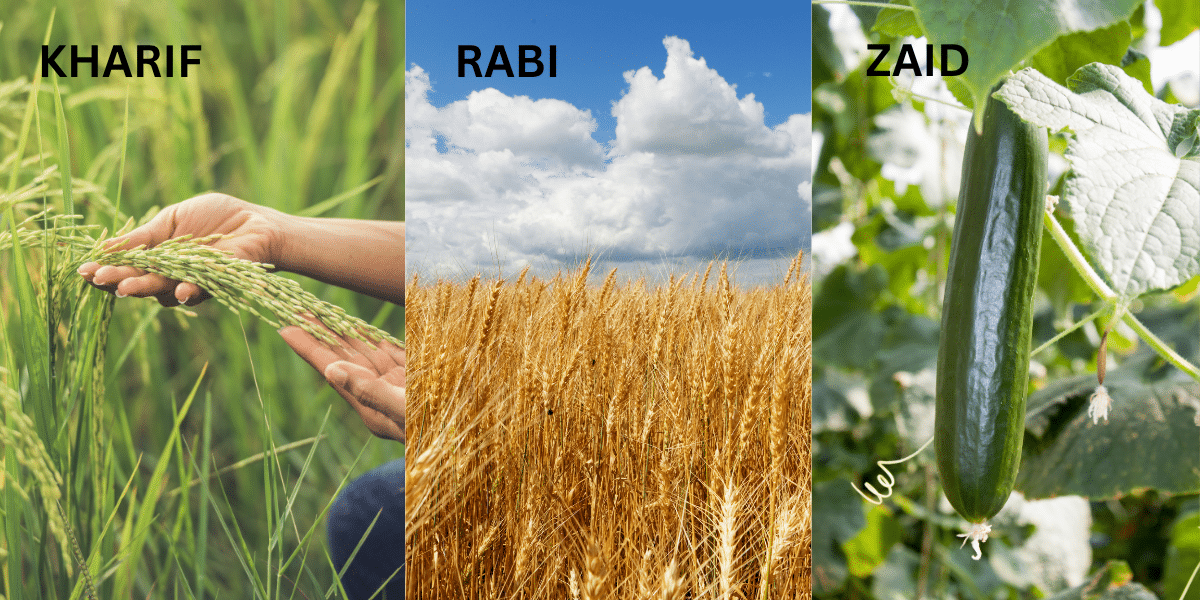
India has three main cropping seasons: Zaid, Rabi, and Kharif. India’s vast and varied geographical settings, with distinct seasons for each, are home to crops. These crops significantly impact India’s agricultural economy and account for over 18% of India’s GDP, making them a vital industry for the stability of India’s economy. Crop seasons in India include wheat, rice, pulses, spices, fruits, and vegetables, making it the second-largest producer of agricultural produce worldwide.
| Aspect | Kharif | Rabi | Zaid |
|---|---|---|---|
| Duration | July – October | October – March | March – June |
| Main Crops | Rice, Millets, Maize, Soybeans, Cotton | Wheat, Barley, Mustard, Gram, Lentils | Watermelon, Muskmelon, Cucumber, Bitter Gourd |
| Climate | Monsoon | Winter | Pre-monsoon, Early Summer |

| Kharif Cropping | |
| What is meant by the Kharif season? | In India, the Kharif season is when the monsoon crops are grown and harvested throughout the harvesting season of India, typically from June to October. |
| What are some Kharif Crops examples? | Some important kharif crops examples: Bajra Barley Cotton Jowar Oats Maize Millet Rice (paddy and deepwater rice) Soybean Castor |

| Rabi Cropping | |
| What are some rabi crops examples? | Certainly, Rabi season is when crops are usually sown in mid-November and harvested in April or May. |
| Is coffee considered a rabi crop? | No, crops like coffee and tea are plantation crops. |
| What is Rabi season? | Certainly, the Rabi season is when crops are usually sown in mid-November and harvested in April or May. |

Let us look at the critical crop seasons and types of crops cultivated and grown in India.
The term “Rabi” originates from the Arabic word for spring. Farmers plant Rabi crops in October or mid-November, following the wet season, and harvest them in April or May, with the timing varying by crop. The crops are commonly known as “winter crops.” The leading producers of Rabi crops include Jammu & Kashmir, Uttar Pradesh, Punjab, Himachal Pradesh, and Uttarakhand. Following Uttar Pradesh, Punjab, and Haryana are the two states responsible for bulk wheat production during the Rabi season.
“Kharif” originates from an Arabic word meaning fall, referring to the crop season dedicated to Kharif crops. This season, also known as the monsoon crop season in India, involves sowing at the onset of the rainy period and harvesting at its conclusion. Typically spanning from May to October, with variations depending on the crop, the Kharif season is prominent in states like Tamil Nadu, Kerala, Maharashtra, and Assam. Notably, rice, a key Kharif crop, thrives in primary growing regions such as West Bengal, Punjab, Uttar Pradesh, Andhra Pradesh, and Bihar, requiring ample heat and water for optimal development when transitioning from rabi and kharif crops.
Between Rabi and Kharif crops, “filler” crops grow, while Zaid crops, such as cucumbers and pumpkins, flourish in the summer from March to June. These crops require warm, dry weather and are primarily cultivated in India’s Gangetic regions, including some fodder crops. The productivity of Kharif, Rabi, and Zaid crops depends on factors like rainfall timing, volume, and soil conditions. Alluvial soils are suitable for millets and cotton, while loamy and clayey soils suit rice and wheat. Farmer revenues depend on prices, with the Indian government setting minimum support prices (MSP); for example, the MSP for grain increased from 1,400 per quintal in 2013–2014 to 2,015 per quintal in 2022.

The country can cultivate various crops, and India can achieve this because of its large geographic area and varied climate conditions. India produces multiple agricultural products, from food grains to cash and plantation crops, thanks to its rich soils, pleasant climate, and plenty of labor. The main crops grown in India are:
Rice is India’s staple food and the country is the second-largest producer worldwide after China. It is mainly grown in the plains of northern and northeastern India, with West Bengal, Punjab, and Uttar Pradesh leading production. Rice requires a warm and humid climate (22–32°C), high rainfall (150–300 cm), and thrives in loamy or deep clay soils.
Farmers in states like Assam, West Bengal, and Odisha cultivate rice in three crop seasons: Boro, Aman, and Aus. Government programs like the National Food Security Mission and Rashtriya Krishi Vikas Yojana further support rice farming.
Wheat is the second most important food crop in India, grown mainly in northern states such as Uttar Pradesh, Punjab, Madhya Pradesh, Haryana, and Rajasthan. Like rice, India ranks second globally in wheat production after China.
The crop grows best with cool temperatures (10–15°C at sowing, 21–26°C at harvest), moderate rainfall (75–100 cm), and in fertile loamy or clayey soils. Wheat is the chief Rabi crop and expanded rapidly during the Green Revolution. Government schemes like the National Food Security Mission and RKVY continue to promote its production.
| Rabi Crops | Kharif Crops |
| Rabi crops are often harvested in late spring, after being sown in the winter. | Kharif crops are harvested by the end of October after being sown during the monsoon season. |
| Rabi crops are also called monsoon crops. | Kharif crops are commonly known as winter crops. |
| These crops are best grown in dry conditions with timely irrigation facilities. | These crops require a moist climate to complete their full growth. |
| The word “Kharif” means “autumn season” in Arabic. | The word “Rabi” means “spring season” in Arabic. |
| Harvesting months for Rabi crop are either March or April. | Harvesting months for the Kharif crop are either September or October. |
| Some examples of Rabi crop are wheat, gram, pulses, oats, linseed, and barley. | Some examples of Kharif crops are sugar cane, rice, maize, bajra, cotton, sorghum, and paddy. |
Farmers refer to the methods they use to grow, arrange, and rotate crops on a plot of land over time as a cropping pattern in India need to adapt to the changing cropping seasons. The primary factors influencing these patterns are:
Understanding these patterns may be extremely important for controlling pests, avoiding soil erosion, increasing agricultural productivity, and preserving soil fertility.
Depending on the resources and technology available, farmers utilize various cropping strategies. The following explains the many essential types of crops used in India:
Farmers practice monocropping when they cultivate the same crop on the same plot of land year after year in the cropping seasons in India. By this time, farmers had grown regular crops on their whole farm. Then, to maximize farm profitability overall, the farmers plant only their most profitable crop, utilizing the same machinery, pest control, seed, and growing techniques across the whole farm in the crop seasons in India.
This is the method of cultivating two or more crops on the same plot of land simultaneously. The mixed cropping method increases crop productivity during crop seasons in India.
In India, crop seasons follow intercropping, a type of farming technique that refers to the simultaneous growth of two or more crops on the same land. Intercropping is the practice of growing two or more crops close together, either in the same row or bed, or in adjacent rows or strips, near enough. Intercropping techniques include mixed cropping, companion planting, relay cropping, plant polycultures, interseeding, overseeding, smother cropping, underseeding, and employing live mulch. Examples include planting soybeans and wheat in alternate rows or alternating crops.
Effective planning for mixed fruit and intercropping technology requires considering crop type, climate, soil type, and market demand. A well-designed crop sowing plan, including various crops, legumes, and other crops, can further enhance the benefits of mixed cropping and intercropping during the cropping season in India.
Many factors influence the cropping pattern in agriculture. In this section, we will discuss these factors.
A company that sells and stocks items must prioritize preservation and warehousing. One effective way for firms to keep their products is through warehousing. Conversely, preservation strategies refer to companies’ actions to guarantee that the items they hold do not lose freshness over time. If businesses do not follow proper storage and preservation practices, they may experience substantial financial losses due to ruined or damaged goods.
Agriculture remains a vital sector in India, supporting nearly half of the population and contributing significantly to the nation’s economy. Here’s a breakdown of its importance:
India’s diverse geography, climates, and soil conditions support various crops. While food crops occupy the majority of cultivated land, the country also produces a variety of tropical, subtropical, and temperate crops.
Understanding the importance of agriculture in India is crucial for UPSC aspirants as it is a frequently covered topic in the Geography syllabus. By grasping the key aspects of agricultural production and its contribution to the Indian economy, you can enhance your understanding of India’s development and challenges.
In conclusion, crop seasons and agriculture play a vital role in India, with 49% of the population relying on them. Agriculture significantly influences crop seasons and income distribution, contributing 14% to the country’s GDP. During crop seasons, India boasts a net sown area of 141 million hectares and a gross cropped area of 195 million hectares across its geographical expanse.
Read More:-

Rabi, Kharif, and Zaid are the three main cropping seasons in India:
Rabi crops: Sown in winter (Oct–Dec) and harvested in summer (Apr–June). Example: wheat, barley, mustard.
Kharif crops: Sown with the onset of monsoon (Jun–Jul) and harvested in autumn (Sep–Oct). Example: rice, maize, cotton.
Zaid crops: Grown in the short season between Rabi and Kharif (Mar–Jun). Example: watermelon, cucumber, fodder crops.
The Kharif season is ongoing. It is known to start in June and continue until October. During this time, crops like rice, cotton, and maize are planted in June-July and harvested in September-October.
Rabi crops, known as winter crops, are sown in October-December and harvested in April-June. Key examples include wheat, barley, and mustard, primarily grown in regions like India’s Indo-Gangetic Plains.
The Kharif farming season spans from July to October, coinciding with the southwest monsoon, while the Rabi farming season extends from October to March, encompassing the winter months.
Kharif crops, or monsoon crops, are sown with the onset of the first rains in June-July and harvested in September-October. Major examples include:Rice, Maize (Corn), Cotton, Soybean, Groundnut, Bajra (Pearl Millet), Tur (Pigeon Pea), Moong (Mung Bean), Urad (Black Gram), Jowar (Sorghum), Arhar (Red Gram), Jute, Sugarcane, Chillies, Turmeric, Bitter Gourd (Karela), Okra (Bhindi), Cowpea (Lobia), Sesame (Til), Castor.These crops are predominantly grown in regions with heavy monsoon rains, such as Punjab, Haryana, and across the Indo-Gangetic Plain.