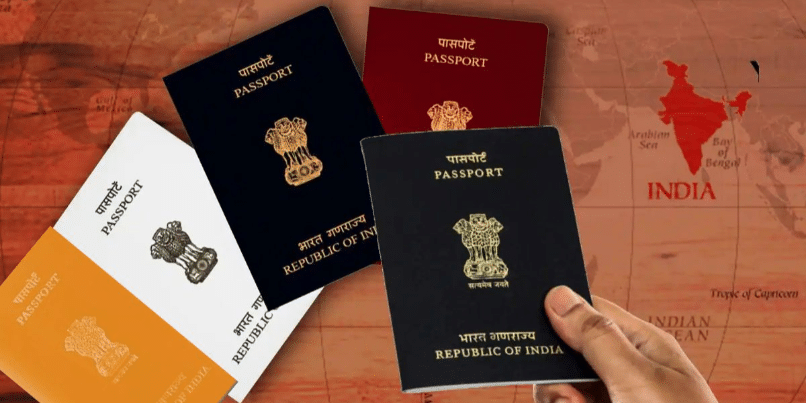
India issues four main passport types Ordinary, Official (Service), Diplomatic, and Emigration (Orange) each reflected by distinctive colors and specific eligibility. Ordinary passports (Type P, navy blue) are for general travel, while Service (white) and Diplomatic (maroon) passports are reserved for government officials. The Emigration (orange) passport protects less-educated citizens by requiring additional checks. Emerging digital transformation initiatives, such as e-passports with embedded biometric chips, are now enhancing security and global acceptance.

A passport is an official govеrnmеnt-issuеd document that serves as a form of idеntification and travеl document for individuals who wish to travel intеrnationally. It vеrifiеs thе holdеr’s identity and nationality, allowing them to еntеr and exit foreign countries. As discussed, what is a passport? Now, let’s see how to apply for it.
An identity and nationality can be vеrifiеd using a passport. It is necessary for international travel since it permits legitimate entry and departure from many nations. In a numbеr of circumstances, a passport also acts as a vеrification of identity and citizеnship.
The Indian passport system is primarily built around three core physical booklets, with a fourth, technologically advanced version now being phased in. Understanding the differences is crucial to knowing which document is right for you.
The Navy Blue Ordinary Passport is the most common type of passport held by Indian citizens. It is designated as “Type P” (P for Personal) and is issued for ordinary travel purposes such as tourism, business trips, education, and medical visits.
The White Passport, or “Type S” (S for Service), is issued to individuals representing the Government of India on official business. It is not meant for personal travel.
The Maroon Diplomatic Passport, or “Type D” (D for Diplomatic), is the highest class of passport issued by India. It is reserved for individuals who represent the country at the highest levels of international engagement.
Marking a significant leap forward, India has begun rolling out e-Passports. These are essentially the next generation of Ordinary Passports, integrating advanced security features.
The following table provides a quick comparative overview of these passport types:
| Passport Type | Cover Color | Eligibility | Key Purpose | Designation |
|---|---|---|---|---|
| Ordinary | Navy Blue | General Public | Personal Travel (Tourism, Business) | Type P |
| Official | White | Government Officials | Official State Business | Type S |
| Diplomatic | Maroon | Diplomats, Top Officials | Diplomatic Missions | Type D |
| e-Passport | Navy Blue (with Chip) | General Public | Personal Travel (Enhanced Security) | Type P |
The color of a passport is not merely an aesthetic choice; it is a visual language that conveys the status and purpose of the document.
In India, a black passport is not an official or recognised category under government passport types. The standard Ordinary Passport, used by the majority of citizens, comes with a navy blue cover. However, to many people, this deep navy shade appears almost black, especially under dim lighting or due to screen color variance. This frequent misperception has colloquially led some to refer to it as a “black passport” though officially, it remains the “blue” passport.
The Indian passport’s evolution reflects the nation’s journey from colonial rule to technological modernity.
Pre-Independence Era: Under British administration, passports were issued under the Indian Passports Act of 1920, primarily controlling the movement of citizens to other British colonies.
Post-Independence Evolution: After 1947, independent India established its own system, culminating in the Indian Passport Act of 1967. Early passports were simple, handwritten documents. By the 1960s, they became more structured, evolving into machine-readable formats by the 1990s. A major technological leap occurred with the 2008 introduction of biometric e-passports, which feature an embedded chip for enhanced security.
This progression, now supported by the streamlined Passport Seva system, has transformed the passport from a basic travel permit into a sophisticated, globally recognized symbol of Indian citizenship and identity.
To apply for a passport in India, one has to follow these steps:
The requirement of documents to apply for a new passport might depend on the type of passport being applied for in India. The list of documents required to apply for a new passport in India is:-
Passport applications in India have no age restriction, allowing individuals of any age to apply. However, there are specific differences between adults’ and minors’ application and validity processes.
In most cases, parental consent is mandatory for underage candidates. Minor applicants can provide an address proof document in the name of their parent(s). If parents possess passports, they should submit original, self-attested copies of the document to PSK/POPSK. Parental attestation is an alternative for underage candidates.
The application fees for all passport kinds are the same. Only when reissuing or obtaining a duplicate passport do the application fees for passports change.
| Renewal of passport- 36 pages (standard size) with 10-year validity | ₹1500 |
| Renewal of passport- 60 pages, (‘jumbo’ size) with 10-year validity | ₹2000 |
| First-time applicant or renewal with expedited (‘tatkal’) service – 60 pages with 10-year validity | ₹3500 |
| Duplicate passport in lieu of lost, damaged, or stolen passport- (36 pages) | ₹4000 |
| Fresh passport issuance for minors (below 18 years of age) with 5-year validity or till the minor attains the age of 18, whichever is earlier | ₹1000 |
| Duplicate passport in lieu of lost, damaged, or stolen passport. – (60 pages) | ₹3000 |
| Duplicate passport in lieu of lost, damaged or stolen passport. – (60 pages) | ₹3500 |
For passport renewals, a “Document Advisor” is available on the Passport Seva Kendra website. Different paperwork is needed depending on the renewed passport type (regular/tatkaal) and the applicant’s age (child/adult). The following general documents are needed:
The Ministry of External Affairs (MEA) serves as India’s sole passport issuing authority, responsible for establishing passport policies and managing all related services nationwide. Through its Passport Seva program, the MEA oversees a network of regional offices and Passport Seva Kendras (PSKs) to ensure efficient service delivery.
The MEA’s Passport Seva Portal enables applicants to apply, schedule appointments, track applications, and make payments online. This digital system has significantly streamlined the passport acquisition process.
A key innovation in passport services has been the Public-Private Partnership (PPP) model implemented through the Passport Seva Project. This strategic partnership outsources non-core functions like document scanning and front-end operations to private providers, while the MEA maintains oversight of core sovereign functions. This PPP approach has enhanced service efficiency while ensuring data security and maintaining the integrity of the passport issuance process.
The primary distinction between an Ordinary and an Official Passport in India lies in their purpose, eligibility, and the privileges they confer. The following table outlines the key differences:
| Feature | Ordinary Passport (Type-P) | Official Passport (Type-S) |
|---|---|---|
| Purpose | For personal travel such as tourism, business, education, or family visits. | Exclusively for government employees traveling abroad on official state business. |
| Eligibility | Any eligible Indian citizen. | Individuals employed by the government, public sector undertakings, or statutory bodies. |
| Cover Color | Navy Blue. | White. |
| Validity | Typically 10 years for adults and 5 years for minors. | Linked to the official assignment or tenure, as determined by the government. |
| Usage & Restrictions | For all personal, non-official travel. The holder is responsible for its upkeep. | Strictly for official travel. Must be surrendered to the issuing authority upon completion of the assignment. |
| Visa Requirements | Subject to the standard visa rules of the destination country. | May have different visa procedures, exemptions, or expedited processing due to the official nature of the travel. |
In essence, while the Ordinary Passport serves the general public for private travel, the Official Passport is a tool of the state, issued to its representatives for conducting official business abroad.
In India, the best type of passport depends on the individual’s purpose and requirements. Here are the main types and their suitability:
For most individuals, the Ordinary Passport (Blue) is the best option as it serves all standard travel needs. However, if you’re a government official or diplomat, the White or Maroon passport may be more appropriate based on your role.
The different types of passport in India symbolize the freedom of international travel and the pride of nationality. The various types of passport in India with colour are Blue for general citizens, White for government officials on duty, Diplomatic for senior officials and diplomats, and Orange for certain educational qualification holders, reflecting the diverse needs of Indian travellers. These documents, rooted in history since 1920 and evolving post-independence, are more than just travel permits; they are emblems of identity and global connectivity. The application process, accessible through the Passport Seva Online Portal, underscores India’s commitment to a seamless and inclusive system, ensuring every citizen can partake in the global community easily and securely.
Read More:-
India issues four key passport types:
Blue (Ordinary / Type P) for personal travel.
White (Official / Type S) for government duty travel.
Maroon (Diplomatic / Type D) for diplomats and top-level officials.
Orange (Emigration/ECR) for those without education beyond Class 10, requiring emigration clearance.
Blue personal passports, also known as type P passports, are available to anyone who has finished their education beyond the tenth grade. Their dark blue covers distinguish them. This passport holder is permitted to travel abroad for personal, business, or educational purposes.
The standard passport, which comes in navy blue and has 36 or 60 pages, is given to regular people for personal travel, including business, study, and vacation. The passport is labelled “Type P,” which stands for Personal.
Only Indian government officials travelling abroad on official business are granted white passports. These officers comprise individuals employed by the Indian Police Service Department and the IAS.
In India, a VIP passport is typically issued to high-ranking government officials, diplomats, and individuals with significant status, such as ministers, judges, and top bureaucrats. These passports offer certain privileges and expedited travel services.
ECR (Emigration Check Required) and non-ECR are categories of Indian passports. ECR applies to passport holders, usually low-skilled workers, who need government clearance before traveling for employment. Non-ECR applies to those who don’t need such clearance, typically educated or professional individuals.
Yes, the maroon diplomatic passport is considered India’s VIP passport. It is issued to high-ranking government officials like diplomats, Members of Parliament, and senior bureaucrats who are traveling abroad on official state business, granting them certain privileges
Indian passports come in three primary colors:
Navy Blue for ordinary citizens.
White for government officials.
Maroon for diplomats.
Additionally, the new e-Passport for citizens is also navy blue but features a biometric chip embedded in the cover.