National Symbols of India are the visual representation of the nation’s identity, culture, and values. These symbols, such as the national flag, emblem, or anthem, capture centuries of history, collective struggles, and shared aspirations in easily recognizable forms. For example, the tricolor flag with the Ashoka Chakra reflects India’s unity, justice, and progress, while inspiring pride among citizens across diverse backgrounds. The National Emblem of India, adapted from the Lion Capital of Ashoka at Sarnath and adopted on January 26, 1950, is one of the most significant symbols.
It features four lions standing back-to-back on a circular abacus, with carvings of an elephant, a galloping horse, a bull, and a lion, along with the Dharma Chakra (Wheel of Law) at the center. Below the abacus, the national motto “Satyameva Jayate” (Truth Alone Triumphs) is inscribed in Devanagari script, reminding citizens of India’s timeless values of truth, unity, and righteousness.
The original national emblem of India in English is an adaptation of the Lion Capital of Ashoka, a sculpture erected initially at Sarnath. In this place, Gautama Buddha first taught the Dharma. The statue is a three-dimensional emblem showing four lions. It became the emblem of the Dominion of India in December 1947 and later the symbol of the Republic of India. The State Emblem of India is an official seal of the Government of India. The national emblem of India is used on official documents, currency, and passports. The Union government, many state governments, and other government agencies utilize it.
The State Emblem of India is an adaptation of the Lion Capital of Asoka at Sarnath. In the original emblem, four lions stand back to back on a circular abacus resting on a bell-shaped lotus. The frieze of the abacus has sculptures in high relief of an elephant, a galloping horse, a bull, and a lion, separated by intervening Dharma Chakras.
The current State Emblem of India was adopted on January 26, 1950. It depicts four Asiatic lions standing back to back on the abacus. The lions are mounted on a circular abacus with the Dharma Chakra in the center, a bull on the right, and a galloping horse on the left. Outlines of Dharma Chakras are also visible on the extreme right and left. The final design omitted the bell-shaped lotus. The motto Satyameva Jayate, which means ‘Truth Alone Triumphs,’ is written in Devanagari script below the profile of the Lion Capital and constitutes an integral part of the State Emblem of India.

The emblem of India, which shows the Ashoka Chakra, is vital to government work and official papers. It can be seen in government buildings and currency notes, often on official documents. However, the emblem’s use is regulated and restricted under the State Emblem of India (Prohibition of Improper Use) Act, 2005, under which no individual or private organization can use it for official correspondence. This is because it’s a prominent symbol of India’s power and control.
It also reminds everyone that India follows rules and democracy. It’s a way to say this is important and real on official papers. The national emblem is like a flag for the Indian government. It shows that they are in charge, follow specific values, and are here to make things fair and united.

The Indian national emblem, featuring the Ashoka Chakra, was incorporated into official use on January 26, 1950, coinciding with the noteworthy enactment of the Indian Constitution. This pivotal decision marked India’s transition to a republic, which meant a transition towards sovereignty and democracy.
The emblem is a unifying force, bringing together India’s diverse regions and cultures. It transcends linguistic and geographical boundaries, functioning as a cohesive symbol that binds the nation. Its design, notably the Ashoka Chakra with 24 spokes, symbolizes democratic principles like justice, truth, and equality, reflecting a pivotal moment in India’s political evolution.
While based on a historical sculpture, India’s national emblem has a relatively short evolutionary path.
The original national emblem of India, which prominently displays the Ashoka Chakra, is featured on Indian currency notes and coins. Its appearance on these financial instruments goes beyond aesthetics, carrying significant symbolic weight. The emblem’s inclusion on currency notes and coins is a tangible representation of India’s economic stability and strength. This interconnected relationship between currency and the national emblem underscores the dynamic connection between economic prosperity and national pride. It serves as a continuous reminder to citizens that their financial well-being is closely tied to the broader ideals and principles embodied in the emblem.
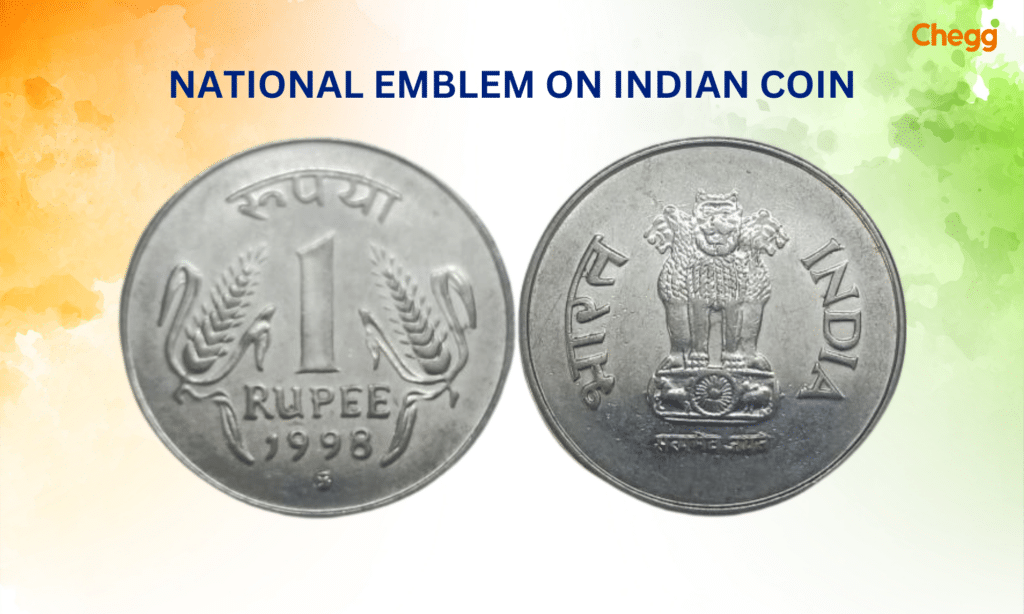
The National Emblem of India has significant symbolic and official purposes. It serves as:
It is displayed in prominent public locations such as:
Additionally, the emblem can be placed:
Specific laws and regulations govern the use of the National Emblem of India:
| Fact | Detail |
|---|---|
| What is the name of the Indian National Emblem? | The official name is the National Emblem of India, also called the State Emblem. |
| Where was the National Emblem of India adapted from? | The emblem is adapted from the Lion Capital of Ashoka at Sarnath and was adopted on 26th January 1950, the day the Constitution came into effect. |
| How many animals are depicted in the National Emblem? | There are four animals: |
| – Four Asiatic Lions | |
| – One Elephant | |
| – One Bull | |
| – One Horse | |
| How many National Emblems does India have? | India has only one National Emblem. |
| Who designed the National Emblem of India? | Dinanath Bhargava sketched and illuminated the National Emblem of India. |
| How many lions are depicted on the Ashoka Pillar? | The Ashoka Pillar features four Asiatic Lions, also represented in the National Emblem. |
| What does the Ashoka Chakra signify? | The Ashoka Chakra is a symbol of the Buddhist Dharmachakra, represented by 24 spokes, symbolizing Buddhist teachings. |
The National Emblem of India, adapted from the Ashoka Pillar of Sarnath, features four Asiatic lions standing back-to-back, symbolizing power, courage, confidence, and pride. Along with the lions, the emblem also features a horse, bull, elephant, and lion, each associated with Buddhist symbolism and the life of the Buddha.
This emblem reflects India’s rich heritage, Buddhist influence, and values of strength and dignity.
The National Emblem of India is a stylized adaptation of the Lion Capital of Ashoka, located at Sarnath and preserved in the Sarnath Museum. The Ashoka Pillars are a series of stone columns erected across North India by Emperor Ashoka during the 3rd century BC, representing a significant part of Mauryan architecture.
The National Emblem and other national symbols of India, like the National Anthem and Official Language, are critical topics for UPSC exams and are often featured in the India Yearbook. Understanding the origins and meanings of these symbols is essential for comprehensive preparation.
For further information on state and union territory symbols, refer to the dedicated Government National Emblem of India. These facts encapsulate the significance, history, and legal aspects of the Indian National Emblem, which are vital for any UPSC aspirant’s knowledge.
The national emblem of India, featuring the Ashoka Chakra, symbolizes unity and reflects India’s commitment to justice, truth, and democracy. While the U.S. emblem represents its recent history and democratic values, India’s emblem echoes its ancient roots and cultural heritage. Both emblems embody their nations’ core values and cultural uniqueness. India’s emblem inspires national pride and unity, guiding the country towards a brighter, more united future.
Read More:-

The National Emblem of India, adopted on January 26, 1950, is adapted from the Lion Capital of Ashoka at Sarnath. It features four lions symbolizing strength and courage, a circular abacus with animal figures and Dharma Chakras, and the motto “Satyameva Jayate” (Truth Alone Triumphs).
The name of our national emblem is Dharma Chakra, or the Wheel of Law.
The Indian national emblem has 4 lions. The four lions stand on a cylindrical base adorned with four Ashoka Chakras and reliefs of a lion, bull, elephant, and galloping horse. The National Emblem represents India’s sovereignty.
The elephant is located on the abacus of the national emblem.
The original National Emblem of India is the Lion Capital of Ashoka.
Dinanath Bhargava is said to have drawn inspiration from a visit to the Alipore Zoo in Kolkata, where he observed lions before creating the design.
The National Emblem of India was not “written” by anyone but is an adaptation of the Lion Capital of Ashoka at Sarnath, built by Emperor Ashoka in the 3rd century BCE. It was officially adopted as the national emblem on January 26, 1950. The motto “Satyameva Jayate” (Truth Alone Triumphs) inscribed below the emblem is taken from the Mundaka Upanishad, an ancient Vedic text.