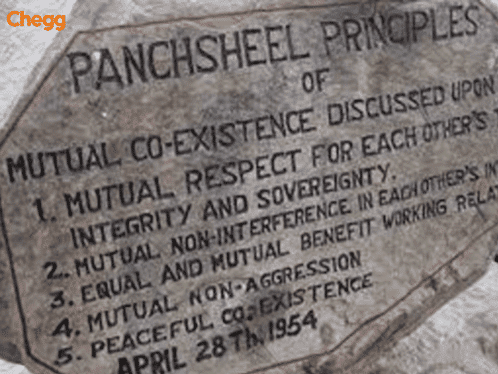
The Panchsheel Agreement was signed between India and China on April 29, 1954, to establish the five principles of peaceful coexistence.
Its core tenets are mutual respect for sovereignty, non-aggression, non-interference, equality, and peaceful coexistence.
Despite its idealistic goals, the agreement failed to prevent the 1962 Sino-Indian War due to unresolved border disputes and the 1959 Tibetan uprising.
Table of Contents
What is the Panchsheel Agreement?
The Panchsheel Agreement, signed between India and China on April 29, 1954, established a foundational framework of five principles to govern relations between states. These principles emphasize mutual respect for sovereignty, non-aggression, non-interference in internal affairs, equality and mutual benefit, and peaceful coexistence. Conceived in the wake of decolonization, the agreement aimed to foster economic collaboration and security cooperation between the two nations. Over time, these principles have gained international recognition, influencing major global platforms such as the Non-Aligned Movement and being enshrined in a United Nations General Assembly resolution.
The word Panchsheel comes from an ancient Buddhist philosophy in which the word “Panch” means “five” and the word “Sheel” means “principles.” The term initially referred to ethical behavior for monks and was adapted to tell the five principles of peaceful coexistence among states. The five principles of Panchsheel, as articulated in the treaty’s preamble, were designed to promote trust, respect, and cooperation between India and China.
The Five Principles of Panchsheel
The Panchsheel Agreement is built upon five core principles designed to govern relations between states. More than just a list, each principle carries a specific diplomatic weight:
Mutual respect for each other’s territorial integrity and sovereignty: This is the cornerstone of the agreement, acknowledging each nation’s right to exist within its own borders without external threats to its authority.
Mutual non-aggression: This principle commits both nations to refrain from using force or initiating armed attacks against one another, making it a formal non-aggression pact.
Mutual non-interference in each other’s internal affairs: This clause ensures that neither country will meddle in the domestic, political, or social issues of the other, a key concern for newly independent nations guarding their autonomy.
Equality and mutual benefit: This principle moves beyond mere coexistence to promote a relationship where both countries engage as equals and work together for shared prosperity, particularly in trade and economic matters.
Peaceful co-existence: This overarching principle encapsulates the spirit of the agreement, that nations with different political systems and ideologies can and should live alongside one another in peace rather than conflict.
Key Provisions of Panchsheel Agreement
While famous for its five principles, the formal “Agreement on Trade and Intercourse Between the Tibet Region of China and India” also laid out practical regulations. These articles were the functional core of the treaty, establishing the rules for trade and travel :
Article I designated six border passes and routes for traders and pilgrims from both countries to use for transit.
Article II outlined the diplomatic and trade infrastructure, allowing the Government of India to establish trade agencies in key Tibetan towns (Yatung, Gyantse, Gartok) and vice-versa for the Chinese government in India.
Article III dealt with the regulations governing traders and pilgrims, specifying the routes they must use and the procedures for obtaining travel documents.
These articles show the agreement was not just an ideological statement but also a functional treaty aimed at regulating the complex relationship concerning the Tibet region.
The Breakdown of the Agreement: The Road to War
Despite the lofty “Hindi-Chini Bhai Bhai” (Indians and Chinese are brothers) sentiment that followed the agreement, relations quickly deteriorated. The principles of non-interference and respect for sovereignty were put to the test and failed, culminating in war.
The primary catalyst was the 1959 Tibetan Uprising. After the failed revolt against Chinese rule, the Dalai Lama fled Tibet and was granted political asylum in India. The Indian government’s decision to welcome the Tibetan spiritual leader was viewed by Beijing as a direct violation of the principle of “non-interference in each other’s internal affairs”. This single event shattered the trust that the Panchsheel Agreement was meant to build.
This breakdown in diplomatic trust, combined with long-standing and unresolved border disputes over Aksai Chin and Arunachal Pradesh, led directly to the Sino-Indian War of 1962. The war exposed the agreement’s fundamental weakness: its principles were not enough to prevent conflict when core territorial and strategic interests were at stake.
History of the Panchsheel Agreement
The Panchsheel Agreement, signed on April 29, 1954, was a key milestone in India-China relations. It marked the beginning of formal diplomatic ties between the two countries. The agreement established a five-point framework to govern their interactions, focusing on mutual respect, non-aggression, non-interference, equality, and peaceful coexistence. This framework was designed to promote friendly relations and avoid conflicts. The agreement reflected the post-colonial desire for quiet diplomacy and cooperation among newly independent nations. It was a significant step in shaping the diplomatic and political landscape between India and China during the early years of their relationship.
In June 2014, China welcomed Vice President of India Hamid Ansari in Beijing’s Great Hall of the People to commemorate the 60th anniversary of signing the Panchsheel Treaty.
What Is the Panchsheel Agreement? Panchsheel was established fifty years ago to address global calls for new principles in international relations promoting peaceful coexistence and mutual prosperity.
It was initially articulated as one of the Ten Principles of International Peace and Cooperation in the Bandung Declaration of April 1955 by 29 Afro-Asian countries.
Panchsheel’s principles gained international recognition when integrated into a UN resolution on peaceful coexistence, jointly proposed by India, Yugoslavia, and Sweden. The UN General Assembly unanimously adopted them on December 11, 1957.
It became the foundational philosophy of the Non-Aligned Movement during the Conference of Non-Aligned Nations in Belgrade in 1961.
Panchsheel was a significant topic in diplomatic discussions, including talks between Atal Bihari Vajpayee, India’s Foreign Minister in 1979, and Chinese officials.
Criticisms and Limitations
The failure of the Panchsheel Agreement has led to significant criticism, which can be summarized as a conflict between idealism and pragmatism:
Overly Idealistic: Critics argue that the agreement was based on a noble but naive belief that moral principles could override the hard realities of geopolitics and strategic competition.
Lack of Enforcement Mechanisms: The treaty included no concrete mechanisms to resolve disputes or penalize violations. When disagreements arose over the border and Tibet, there was no established process to de-escalate tensions.
Ambiguity on Borders: The agreement deliberately sidestepped the specifics of the contentious border issues, hoping that a spirit of friendship would resolve them later. This ambiguity allowed disputes over Aksai Chin and other areas to fester and ultimately erupt into open conflict.
Panchsheel Agreement Legacy
Reviving Principles: Despite the difficulties, the tenets established in the Panchsheel Agreement are still applicable in international relations. India, China, and other countries often refer to these principles in bilateral and multilateral treaties and in diplomacy.
Influence on Bilateral Agreements: Panchsheel principles and their underlying values have impacted many treaties and bilateral and multilateral agreements over the decades. They continue to remind us of the importance of mutual respect, non-aggression, and peaceful coexistence in international diplomatic relations.
Contemporary Relevance: In the present, Panchsheel principles are seen as important for global peace and stability. Reaffirming the principles to avoid conflicts or to cooperate together might become even more important when both India and China grow as important global powers.
Panchsheel Agreement Mission
The agreement aimed to alleviate tensions between India and China amid ongoing border conflicts since the early 1950s.
However, relations deteriorated sharply in the late 1950s and early 1960s, leading to the 1962 Sino-Indian War.
Despite its inability to prevent conflict, the Panchsheel Agreement remains a significant symbol of India-China relations.
In 2003, Chinese President Jiang Zemin and Indian Prime Minister Atal Bihari Vajpayee reaffirmed their commitment to the five principles during a summit in Delhi.
Recently, there has been renewed interest in the Panchsheel Agreement to improve bilateral relations.
In 2013, Chinese Premier Li Keqiang proposed a “new type of relationship” based on the five principles during a visit to India.
Indian Prime Minister Narendra Modi has also emphasized the importance of the Panchsheel Agreement in shaping India-China relations.
Who were the key parties involved in signing the Panchsheel Agreement?
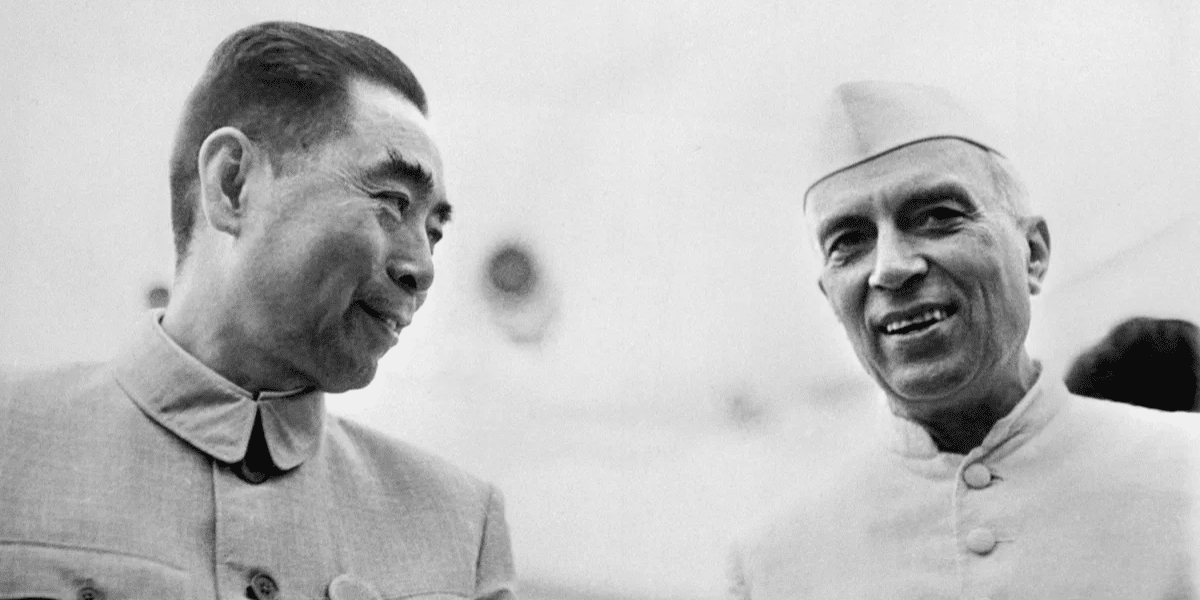
On April 29, 1954, Jawaharlal Nehru and Zhou Enlaisigned the Panchsheel Agreement.
They emphasized the five principles of the Panchsheel Agreement.
It was a broadcast speech at the Asian Prime Minister Conference in Colombo, Sri Lanka.
They reaffirmed the spirit of brotherhood that unites the two countries.
Premier Zhou Enlai and Prime Minister Jawaharlal Nehru elaborated on their vision of Panchsheel. They aimed to establish a framework for their relations with all other nations.
On June 28, 1954, Premier Zhou Enlai visited India two months later to lay a strong foundation for world peace and security.
Why was the Panchsheel Agreement Signed?
The Panchsheel Agreement, signed on April 29, 1954, between India and China, aimed to foster peaceful relations and cooperation between the two countries. This agreement was built on five key principles: mutual respect, sovereignty and territorial integrity, non-aggression, non-interference in each other’s internal affairs, equality and mutual benefit, and peaceful coexistence. These principles were intended to guide the diplomatic and political interactions between India and China, promoting stability and friendship. The Panchsheel Agreement laid the groundwork for a cooperative relationship and set a positive example for managing international relations based on mutual respect and understanding. The five key principles on which it was based are –
Respect each other’s borders and sovereignty
No attacks on each other
No interference in each other’s internal matters
Equality and mutual benefits
Peaceful coexistence
The principles of the Panchsheel Agreement were designed to address border disputes and establish trade relations between India and China. The agreement aimed to resolve conflicts and build a strong foundation for cooperation by focusing on mutual respect, non-aggression, and non-interference. Signed on April 29, 1954, it marked a new phase in India-China relations, highlighting both nations’ commitment to working together peacefully. The agreement set the stage for constructive dialogue and collaboration, fostering a more stable and friendly relationship between the two countries. It represented a significant step towards resolving issues and enhancing mutual benefits through cooperative efforts.
Did China comply with the Panchsheel Policy?
Despite China’s initial acceptance of the Panchsheel principles, it later asserted territorial rights over Bara Hoti in Uttarakhand, violating the agreement.
Throughout the late 1950s, China continued constructing highways and intrusions into disputed territories, undermining the spirit of peaceful coexistence.
The undefined border between India and China, signatories of the Panchsheel treaty, favored China’s assertions and hindered resolution efforts.
India benefited from historical customs and treaties, yet China’s actions challenged this status quo.
China obstructed bilateral talks aimed at resolving border disputes with India.
The escalation of tensions led to the outbreak of the 1962 War, a clear violation of the Panchsheel principles.
The Colombo Conference, convened by six non-aligned countries, aimed to address the India-China border dispute through resolutions.
Despite China’s reservations, India’s acceptance of the Panchsheel principles was inconsistent, reflecting an ambivalent stance.
The five decades of relative peace were more a result of mutual awareness of the high costs of war than a genuine commitment to peace.
Panchsheel Agreement UPSC
The Panchsheel Agreement is a crucial topic for the UPSC Civil Services Main Examination, particularly in the following papers:
GS Paper
Subject
How it’s Relevant
GS Paper 1
Post-Independence Indian History
Understanding Nehru’s foreign policy and the initial phase of India-China relations.
GS Paper 2
International Relations
Analyzing India’s foreign policy principles, its relationship with neighboring countries, and the evolution of bilateral treaties.
UPSC Prelims: Multiple Choice Questions (MCQs)
The ‘Panchsheel Agreement’ for peaceful coexistence was signed between which two countries? A) India and Bhutan B) India and Nepal C) India and China D) India and Pakistan
Which of the following is NOT one of the five principles of the Panchsheel Agreement? A) Mutual non-aggression B) Non-alignment C) Peaceful co-existence D) Mutual non-interference in each other’s internal affairs
The Panchsheel Agreement was signed in 1954 primarily to govern the relationship and trade concerning which region? A) Aksai Chin B) The Tibet region of China C) Arunachal Pradesh D) Sikkim
Who were the two primary leaders who signed and promoted the Panchsheel Agreement in 1954? A) Sardar Patel and Mao Zedong B) Jawaharlal Nehru and Zhou Enlai C) Indira Gandhi and Deng Xiaoping D) Morarji Desai and Hua Guofeng
UPSC Mains: Descriptive Answer Questions
Critically examine the principles of the Panchsheel Agreement. To what extent did its failure to prevent the 1962 Sino-Indian War reveal the limitations of idealism in foreign policy? (250 words)
Discuss the relevance of the Panchsheel principles in the context of contemporary India-China relations. Have they become mere diplomatic rhetoric, or do they still hold value? Justify your answer with recent examples. (250 words)
“The Panchsheel Agreement was a product of its time, reflecting the aspirations of newly independent nations to forge a third path during the Cold War.” Elaborate on this statement, explaining how the principles influenced the foundation of the Non-Aligned Movement. (150 words)
Conclusion
China bases its foreign policy on the Panchsheel Agreement’s Five Principles of Peaceful Coexistence, which continue to serve as guiding norms for international interactions. These principles mutual respect, sovereignty, non-aggression, equality, and peaceful coexistence have left a lasting impact on modern multinational relations. The Panchsheel Principles represent a unique and forward-looking approach to international diplomacy, designed to promote global peace, safeguard sovereignty, and strengthen cooperation among nations. Their relevance endures even today, shaping global policies and fostering harmony in a world of growing interdependence.
The Five Principles of Panchsheel are mutual respect for sovereignty and territorial integrity, mutual non-aggression, mutual non-interference in internal affairs, equality and mutual benefit, and peaceful coexistence. These principles were first laid down in the 1954 Panchsheel Agreement between India and China and serve as the foundation of peaceful international relations. By emphasizing respect, equality, and cooperation, the Panchsheel principles continue to guide global diplomacy and promote harmony among nations.
Who signed the Panchsheel agreement from China?
The Panchsheel Agreement was signed on 29 April 1954 between India and China. From the Chinese side, it was signed by Premier Zhou Enlai, while from India, it was signed by Prime Minister Jawaharlal Nehru. Zhou Enlai represented China in formalizing the agreement, which laid down the Five Principles of Peaceful Coexistence that became a cornerstone of both nations’ foreign policy.
What is meant by Panchsheel?
Panchsheel: Respect for each other’s sovereignty and geographical integrity. Exchange of non-aggression. Mutual refraining from meddling with one another’s matters.
When was the Panchsheel Agreement signed?
The Panchsheel Agreement was signed on April 29, 1954, following India-China negotiations from December 1953 to April 1954 on border disputes like Aksai Chin and Arunachal Pradesh.
What was the result of the Panchsheel agreement?
The Panchsheel Agreement helped prevent conflict between India and China by promoting peaceful coexistence and mutual respect. It strengthened diplomatic ties and contributed to stability in Asia.
Who was the father of Panchsheel theory?
Jawaharlal Nehru, India’s first Prime Minister, is often regarded as the father of the Panchsheel theory. He conceptualized the five principles of peaceful coexistence to guide India’s foreign policy during the Cold War era. These principles aimed at maintaining sovereign equality, avoiding aggression, and promoting mutual respect among nations, especially with neighboring China.
What is the Panchsheel agreement?
The Panchsheel Agreement, signed in 1954 between India and China, outlines five core principles for peaceful coexistence. These include mutual respect, non-aggression, non-interference, equality, and peaceful coexistence. It was designed to build trust between the two nations while regulating their relations concerning Tibet, promoting diplomatic cooperation in Asia during the post-colonial period.
What are the five principles of Panchsheel Agreement?
The Panchsheel Agreement is founded on five principles for governing relations between nations. They are: Mutual respect for each other’s territorial integrity and sovereignty. Mutual non-aggression. Mutual non-interference in each other’s internal affairs. Equality and cooperation for mutual benefit. Peaceful co-existence. These tenets were designed to create a framework for peaceful diplomatic and economic engagement.
Authored by, Muskan Gupta Content Curator
Muskan believes learning should feel like an adventure, not a chore. With years of experience in content creation and strategy, she specializes in educational topics, online earning opportunities, and general knowledge. She enjoys sharing her insights through blogs and articles that inform and inspire her readers. When she’s not writing, you’ll likely find her hopping between bookstores and bakeries, always in search of her next favorite read or treat.