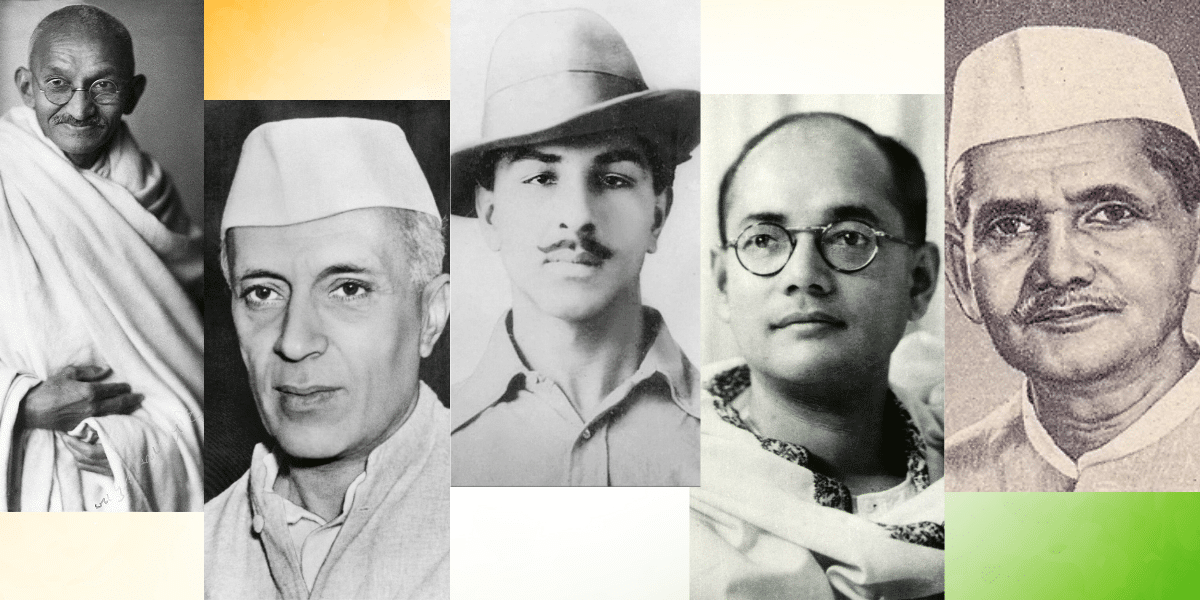
The story of India’s independence is not a singular narrative but a grand tapestry woven with the threads of countless sacrifices, unyielding courage, and profound idealism. The freedom fighters of India were the master weavers of this tapestry. They came from every corner of the subcontinent, from varied backgrounds, religions, and ideologies, yet they were united by one common dream, a free and sovereign India. Their struggle against the British Raj was one of the longest and most impactful anti-colonial movements in world history, spanning over nine decades and culminating in the hard-won Indian independence on August 15, 1947.
This article delves into the lives and contributions of these extraordinary individuals. We will celebrate the iconic national leaders of India, honor the immense contribution of all freedom fighters name that contributed to the Indian independence, shed light on the unsung freedom fighters of india images with names, and pay a special tribute to the courageous women freedom fighters of India who shattered societal norms to claim their nation’s liberty. This journey is a testament to the spirit of resilience that defines the national heroes of India.
The British East India Company’s victory at the Battle of Plassey in 1757 marked the beginning of British colonial rule in India. What started as a trading enterprise soon morphed into a full-fledged imperial administration, exploiting Indian resources and people. The response was a series of rebellions, each one stronger and more organized than the last.
The first major eruption was the Revolt of 1857, often termed the First War of Independence. While it was suppressed, it sowed the seeds of nationalist fervor. The late 19th and early 20th centuries saw the rise of organized political bodies, primarily the Indian National Congress (1885) and the Muslim League (1906). The freedom movement evolved through distinct phases:

The freedom fighters of India operated within these frameworks, each choosing their own path to the same destination. The movement was a complex interplay of non-violent protests, revolutionary activities, diplomatic negotiations, and the relentless spirit of millions of common Indians.
While every contributor was vital, some figures emerged as the towering pillars of the movement. Their ideologies and actions shaped the course of the struggle. Here are the top 10 freedom fighters of india, whose names are eternally etched in the nation’s memory.
| Name | Contribution | Legacy |
|---|---|---|
| Mahatma Gandhi | Led Non-Cooperation, Salt Satyagraha, and Quit India Movement with non-violence. | Father of the Nation, symbol of truth and ahimsa. |
| Jawaharlal Nehru | Advocated modern India, led Congress, became India’s first Prime Minister. | Architect of modern India. |
| Subhas Chandra Bose | Formed Indian National Army (INA), slogan “Give me blood, and I will give you freedom.” | Inspired militant nationalism. |
| Bhagat Singh | Revolutionary, executed for killing Saunders, symbol of youthful courage. | Martyrdom inspired generations. |
| Sardar Vallabhbhai Patel | Key leader in Quit India, integrated princely states post-independence. | “Iron Man of India.” |
| Rani Lakshmibai | Leader of 1857 revolt in Jhansi, symbol of women’s bravery. | Inspired women freedom fighters. |
| Bal Gangadhar Tilak | “Swaraj is my birthright,” mobilized youth through newspapers and Ganesh festivals. | First radical nationalist leader. |
| Lala Lajpat Rai | Led Punjab protests, died after lathi charge. | Known as Punjab Kesari. |
| Annie Besant | Theosophist, social reformer, and Home Rule Movement leader. | First woman President of INC. |
| Mangal Pandey | Sparked 1857 Revolt by rebelling in the British army. | First martyr of Indian independence. |
The undisputed father of the nation, Mohandas Karamchand Gandhi, or Mahatma Gandhi, was the moral compass of the freedom struggle. He pioneered the concept of Satyagraha (truth-force), transforming the movement into a mass uprising. His leadership in iconic campaigns like the Non-Cooperation Movement (1920), the Dandi March or Salt Satyagraha (1930), and the Quit India Movement (1942) mobilized millions. His unwavering commitment to non-violence and civil disobedience proved to be a powerful weapon against the British Empire.
A charismatic leader and Gandhi’s closest confidant, Jawaharlal Nehru was the voice of modern, socialist India. As the first Prime Minister of independent India, he shaped the nation’s destiny. During the freedom struggle, he was imprisoned multiple times for his passionate advocacy of complete independence (Purna Swaraj). His famous “Tryst with Destiny” speech on the eve of independence remains a defining moment in Indian history.
Known as the “Iron Man of India,” Sardar Patel was a formidable organizer and leader. He played a crucial role in the Bardoli Satyagraha and was a key figure in the Quit India Movement. His most monumental contribution to Indian independence came after 1947, when he successfully integrated over 562 princely states into the Union of India, a herculean task that ensured the nation’s geographical unity.
A symbol of youthful rebellion and revolutionary zeal, Bhagat Singh embraced martyrdom at the age of 23. His execution turned him into a legend and an inspiration for generations. He believed in armed resistance and famously bombed the Central Legislative Assembly in 1929 to protest repressive laws. His courage, intellect, and defiance in the face of death galvanized the movement.
A fiery and dynamic leader, Subhas Chandra Bose, or Netaji, believed that freedom could not be won through non-violence alone. He famously broke away from the Congress and formed the Forward Bloc. Seeking international support, he organized the Indian National Army (INA) with Japanese help to militarily confront the British. His slogan “Give me blood, and I shall give you freedom!” ignited a new kind of passion among Indians.
The Queen of Jhansi, Rani Lakshmibai, was one of the leading figures of the 1857 Revolt. She became a symbol of resistance against British rule after the Doctrine of Lapse was applied to deny her adopted son the throne. She fought valiantly on the battlefield, sword in hand, and her heroism made her an immortal figure in Indian history and a foremost icon among the women freedom fighters of India.
Affectionately known as “Punjab Kesari” (Lion of Punjab), Lala Lajpat Rai was a key member of the Lal-Bal-Pal extremist trio. He was a fierce nationalist, author, and reformer. He led a non-violent protest against the Simon Commission in 1928 and was brutally lathi-charged by the police. His subsequent death from injuries fueled nationwide anger and spurred revolutionaries like Bhagat Singh to seek revenge.
“Lokmanya” Tilak was the first major leader of the Indian independence movement who called for Swarajya (self-rule) as a birthright. His famous declaration, “Swaraj is my birthright and I shall have it,” resonated across the country. He used festivals like Ganesh Chaturthi to organize people and foster a sense of national unity.
A staunch revolutionary, Chandrasekhar Azad was a key organizer of the Hindustan Socialist Republican Association (HSRA). He vowed to never be captured alive by the British. True to his word, he engaged in a gunfight with police at Alfred Park in Allahabad and shot himself with his last bullet to remain “Azad” (free). His fearlessness is the stuff of legend.
While primarily known as the architect of the Indian Constitution and a champion of social justice, Dr. Babasaheb Ambedkar was a formidable critic of the British Raj and the oppressive caste system. He fought for the rights of the depressed classes and ensured that the principles of liberty, equality, and fraternity were enshrined in the foundation of independent India.
For every famous name, there were hundreds who fought and sacrificed in anonymity. Their stories are equally powerful and deserve to be told. Here are the top 5 unsung heroes of freedom struggle.
| Hero’s Name | Role & Contribution | About Freedom Fighters |
|---|---|---|
| Birsa Munda | A tribal freedom fighter from the Chota Nagpur Plateau, he led the Munda Rebellion (Ulgulan) against British land acquisition laws and missionary activities. He fought to protect tribal land and identity. | Tribal revolts are often sidelined in mainstream nationalist narratives focused on the plains and cities. |
| Matangini Hazra | A brave septuagenarian from Bengal, known as “Gandhi Buri” (old lady Gandhi). She was shot dead by police during the Quit India Movement in 1942 while leading a procession, holding the Indian flag aloft and shouting “Vande Mataram.” | Her story is a local legend in Bengal but is less known on a national scale compared to other martyrs. |
| Tiruppur Kumaran | A revolutionary from Tamil Nadu, he founded the Desa Bandhu Youth Association. He was killed in 1932 during a protest march against the British. He was found dead holding a flag of Indian nationalism that had been banned by the British. | His sacrifice is celebrated in Tamil Nadu but his name is not widely recognized in pan-Indian accounts. |
| Surya Sen (Masterda) | The mastermind behind the famous Chittagong Armoury Raid of 1930. He led a group of revolutionaries to capture the port city of Chittagong. He was eventually captured and hanged, but his raid was a major act of armed defiance. | Often overshadowed by the narratives of Bhagat Singh and Chandrashekhar Azad from North India. |
| Potti Sreeramulu | A devout follower of Gandhi, he is known for his hunger strike that led to the creation of the separate linguistic state of Andhra Pradesh. His sacrifice became a catalyst for the linguistic reorganization of states in India. | His contribution is remembered regionally but his role in shaping modern India’s federal structure is understated. |
The freedom struggle saw unprecedented participation from women who broke the shackles of patriarchy to stand shoulder-to-shoulder with men. Their contribution to Indian independence was multifaceted, from leading protests and facing lathis to spying and managing organizations. Here is a list of 20 remarkable women freedom fighters of india.
The contribution of freedom fighters in Indian independence cannot be quantified. It was a multi-dimensional effort:
Their collective efforts created an unrelenting pressure that made British rule economically unviable and politically unsustainable.
The national leaders of India left behind lessons that continue to inspire:
The freedom fighters of India were more than historical figures; they were the foundational pillars of justice, hope, and national identity. Their collective sacrifice forged the free, democratic, and sovereign nation we live in today. It is our enduring duty to ensure their legacy inspires future generations. This includes honoring the most prominent leaders, often listed among the top 10 freedom fighters of India, as well as seeking out the stories of the top 5 unsung heroes of the freedom struggle.
The narrative is profoundly enriched by the courage of the top 20 female freedom fighters of India and the countless unknown martyrs whose names are lost to history. Remembering each one is essential, for the history of Indian independence is incomplete without them. These national heroes of India remain eternal guiding lights, championing the principles of democracy and equality for all.
Read More:-
Mahatma Gandhi
Jawaharlal Nehru
Sardar Vallabhbhai Patel
Bhagat Singh
Lal Bahadur Shastri
Ram Prasad Bismil
Subhas Chandra Bose
Rani Laxmi Bai
Mangal Pandey
Nana Sahib
Mahatma Gandhi, regarded as the Father of the Nation, was a leading proponent of Indian independence and one of the greatest freedom fighters of all time.
Sarojini Naidu, Aruna Asaf Ali, Kamala Nehru, Kasturba Gandhi, and Rani Lakshmibai were the top five female freedom fighters of India.
Maveeran Alagumuthu Kone (11 July 1728 – 19 July 1759) was the first Indian freedom fighter.
One of the youngest revolutionaries during the early stages of the Indian independence movement was Khudiram Bose, an Indian Bengali revolutionary who lived from 3 December 1889 to 11 August 1808. He was eighteen years, eight months, and eight days old on the day of his hanging.
Mahatma Gandhi is known as the national hero of India for leading the freedom movement with peace and truth. Other heroes like Bhagat Singh and Subhas Chandra Bose also played important roles in India’s fight for independence.
Mahatma Gandhi, Jawaharlal Nehru, and Sardar Vallabhbhai Patel were key freedom fighters active around India’s independence in 1947. Gandhi led the final phase of the struggle through non-violent civil disobedience, while Nehru and Patel played crucial roles in shaping the newly independent nation and guiding its political and administrative transition.
The top two freedom fighters of India are Mahatma Gandhi and Subhas Chandra Bose. Gandhi led the independence movement through non-violent civil disobedience, inspiring millions with his principles of truth and ahimsa. Bose, known as Netaji, organized the Indian National Army and fought for independence through armed resistance. Together, their leadership shaped India’s freedom struggle.