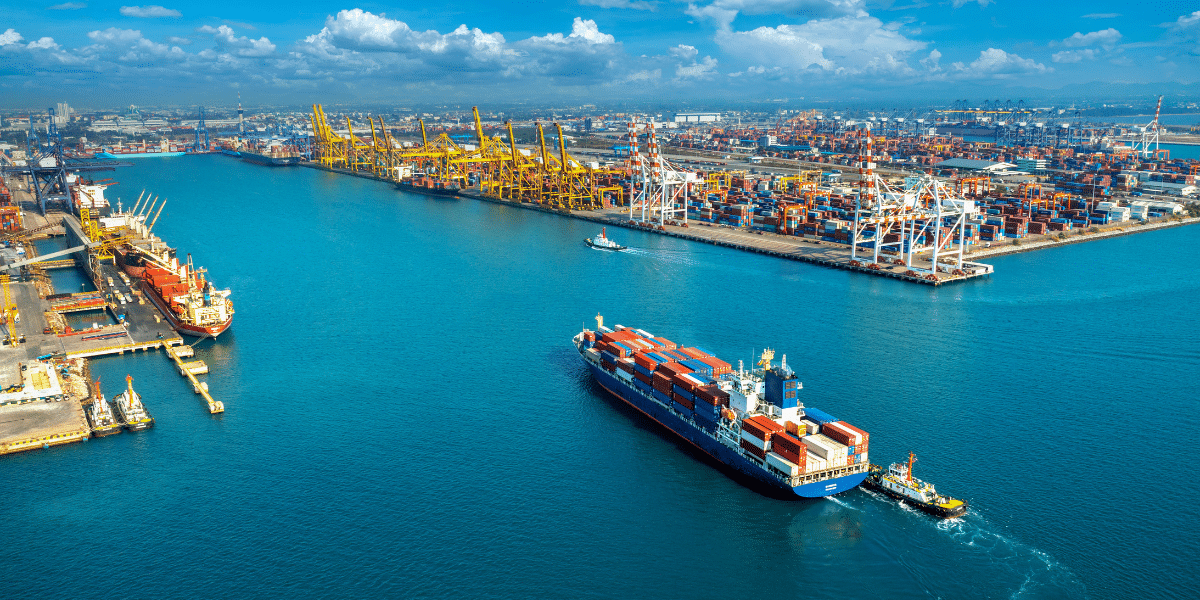
India’s 13 major ports, strategically located along its 7,517 km coastline, handle over 95% of trade by volume and 70% by value, serving as vital gateways for exports, imports, and regional development.
Key ports like JNPT, Mumbai, Chennai, and Visakhapatnam specialize in container, bulk, and liquid cargo, while initiatives like Sagarmala and Maritime India Vision 2030 aim to modernize port infrastructure, improve connectivity, and attract private investments.
Congestion, outdated infrastructure, environmental concerns, and global competition are challenges that make port development crucial for India’s economic growth and strategic security.
Table of Contents
Major ports in India form the backbone of the nation’s maritime trade and logistics. With a 7,517 km long coastline along the Arabian Sea, Bay of Bengal, and Indian Ocean, India enjoys a strategic location on global shipping routes. Nearly 95% of trade by volume and around 70% by value is carried out through sea ports in India, making them critical to the country’s economy.
These ports in India reduce logistics costs and boost exports, imports, and regional development. The Union Government centrally manages the 13 major ports in India, while more than 200 minor and intermediate ports are under the respective State Governments’ control.
This article provides a complete guide to the list of 13 major ports in India, highlights the largest and smallest ports, and explores recent initiatives such as the Sagarmala Project and Maritime India Vision 2030, which aim to modernize and expand India’s port infrastructure for future growth.
Importance of Major Ports in India
Ports are not just entry and exit points for goods; they are the lifelines of India’s economy and play a pivotal role in trade, connectivity, and development. The 13 major ports in India, along with 200+ minor ports, collectively support the country’s growth in multiple ways.
1. Role in International Trade and Economy
Nearly 95% of India’s trade by volume and 70% by value is handled through ports.
Major ports enable the smooth flow of exports like petroleum, iron ore, coal, textiles, and agricultural products, while also handling imports like crude oil, machinery, and electronics.
They act as gateways to the global market, strengthening India’s position in international commerce.
2. Contribution to Employment and GDP
Ports generate direct employment (dock workers, port authorities, logistics staff) and indirect employment (shipping, transport, warehousing, and manufacturing).
Port-led growth under initiatives like Sagarmala is estimated to create 10 million jobs.
Maritime trade contributes significantly to India’s GDP, as ports facilitate domestic and international supply chains.
3. Strategic and Defense Significance
Many ports are of strategic military importance due to their location on crucial sea lanes.
Ports like Mumbai, Visakhapatnam, and Kochi are also used as naval bases, enhancing India’s maritime security.
In conflict or disaster, ports are essential hubs for supply chains, relief materials, and defense logistics.
4. Relevance for UPSC / SSC / GK Exams
Questions about the list of 13 major ports in India, their locations, and their features are common in UPSC Prelims, SSC CGL, Railways, and state exams.
Current affairs topics like Sagarmala Project, Maritime India Vision 2030, and India’s Blue Economy are often featured in UPSC Mains and Essay papers.
Knowledge of ports is also crucial for geography and general studies students, as ports are directly linked to trade, the economy, and strategic affairs.
Classification of Sea Ports in India
India’s ports are not uniform; they are classified differently depending on administrative control, geographical location, and physical features. This classification helps understand how ports function and their role in trade, defense, and regional development.
1. Major vs. Minor (Intermediate) Ports
Major Ports
13 major ports in India are of national importance.
The Union Government centrally administers them under the Ministry of Ports, Shipping, and Waterways.
These ports handle the largest share of India’s cargo traffic, container shipments, and bulk trade.
Examples: Mumbai Port, Chennai Port, Jawaharlal Nehru Port (Nhava Sheva), Visakhapatnam Port.
Minor/Intermediate Ports
Over 200 minor and intermediate ports are managed by State Governments.
Handle smaller vessels, fishing, local cargo, passenger ferries, and coastal shipping.
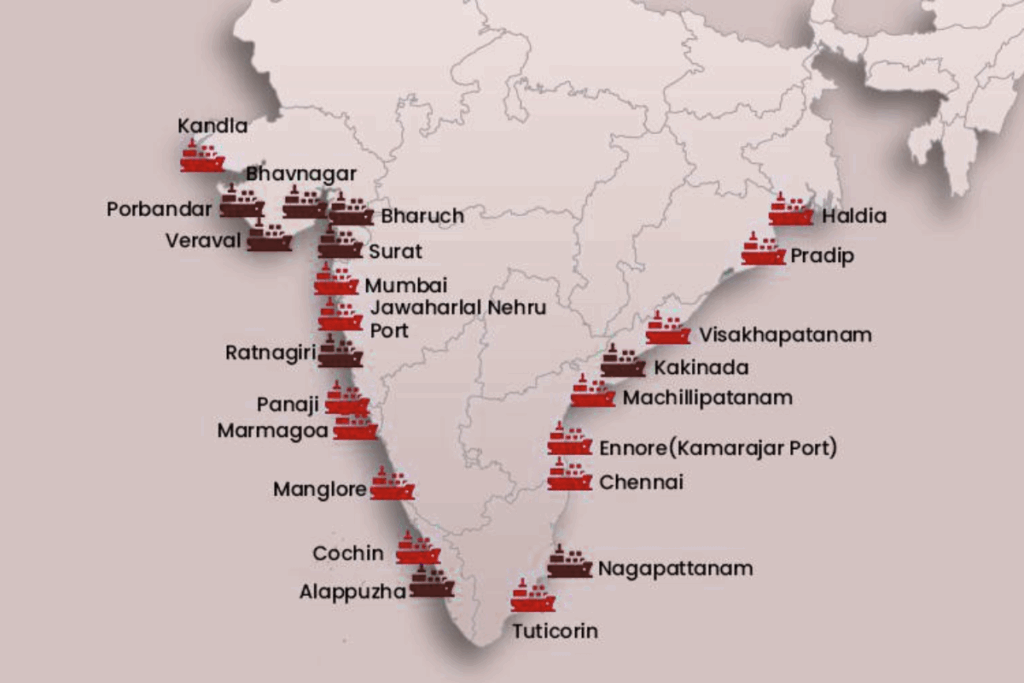
India has a 7,500 km long coastline with 13 major ports, serving as vital trade gateways. These sea ports in India are centrally administered under the Major Port Authorities Act, 2021, while states manage minor ports. They ensure balanced maritime connectivity and support India’s growing economic and commercial activities across the east and west coasts.
Here is the complete list of the 13 major ports in India:
Port Name
State/UT
Coastline
Deendayal Port (Kandla)
Gujarat
West Coast
Mumbai Port
Maharashtra
West Coast
Jawaharlal Nehru Port (JNPT)
Maharashtra
West Coast
Mormugao Port
Goa
West Coast
New Mangalore Port
Karnataka
West Coast
Cochin Port
Kerala
West Coast
Chennai Port
Tamil Nadu
East Coast
Ennore Port (Kamarajar Port)
Tamil Nadu
East Coast
Visakhapatnam Port
Andhra Pradesh
East Coast
Paradip Port
Odisha
East Coast
Haldia Port
West Bengal
East Coast
Kolkata Port (Syama Prasad Mookerjee Port)
West Bengal
East Coast
V.O. Chidambaranar Port (Tuticorin)
Tamil Nadu
East Coast
These major sea ports in India handle a wide range of cargo, including petroleum products, coal, iron ore, fertilizers, containers, and general merchandise. Their strategic location ensures smooth trade flow within the country and with international markets.
Detailed Overview of the 13 Major Ports in India
India’s 13 major ports are the backbone of its maritime trade and logistics. Each port has a unique role based on location, specialization, cargo handling capacity, and regional importance.
1. Deendayal Port (Kandla) – Gujarat
Location: Kandla, Gujarat (West Coast)
Established: 1950
Type: Tidal, natural harbor
Specialization: Crude oil, petroleum products, grains, salt
Highlights: Deendayal Port, formerly Kandla Port, is a central cargo hub near the Gulf of Kutch. It handles large volumes of petroleum and agricultural goods, serving as a vital gateway for trade to North and Central India’s hinterland regions.
Highlights: Mumbai Port is one of India’s oldest ports, handling general and liquid cargo and cruise and ferry services. Located in central Mumbai, urban congestion has led to a shift of much commercial traffic to the nearby JNPT port.
3. Jawaharlal Nehru Port (JNPT) – Maharashtra
Location: Navi Mumbai, Maharashtra (West Coast)
Established: 1989
Type: All-weather tidal port
Specialization: Container cargo
Highlights: JNPT (Nhava Sheva) is India’s largest container port, handling over 50% of the country’s containerized cargo. Known for its automation and efficiency, it operates multiple terminals and has strong rail and road links to major industrial and trade hubs.
4. Mormugao Port – Goa
Location: Goa (West Coast)
Established: 1885
Type: Natural harbor
Specialization: Iron ore exports
Highlights: Located at the mouth of the Zuari River, Mormugao Port plays a vital role in mineral exports, particularly iron ore from Goa’s mining belt. It’s equipped with berths and mechanized handling systems. However, declining mining activity has impacted its cargo volumes.
Highlights: New Mangalore Port supports industrial and agricultural trade in Karnataka and Kerala. It also facilitates crude imports for Mangalore Refineries. The port’s container traffic is growing steadily with modernized terminals and improved hinterland connectivity.
Highlights: Cochin Port is a substantial commercial and tourist port in southern India. It connects to the International Container Transshipment Terminal (ICTT) at Vallarpadam, making it vital for cargo moving between the Middle East and Southeast Asia.
7. Chennai Port – Tamil Nadu
Location: Chennai, Tamil Nadu (East Coast)
Established: 1881
Type: Artificial harbor
Specialization: Automobiles, iron ore, containers
Highlights: One of the oldest ports on the East Coast, Chennai Port handles a mix of containerized and bulk cargo. It is India’s second-largest container port and a central automobile export hub from Tamil Nadu’s manufacturing sector.
8. Ennore Port (Kamarajar Port) – Tamil Nadu
Location: Ennore, near Chennai (East Coast)
Established: 2001
Type: Corporate port (only government-owned company under the Companies Act)
Specialization: Coal, limestone, automobiles
Highlights: Unlike other ports managed by port trusts, Ennore Port is India’s first corporatized major port. It focuses on energy-related cargo and bulk goods. Recent expansions have diversified its operations to handle containers and automobiles as well.
Specialization: Iron ore, steel, fertilizers, coal
Highlights: Visakhapatnam Port is one of India’s deepest and most versatile ports. It handles various cargo and has dedicated terminals for dry and liquid bulk. Its deep draft and mechanized systems make it suitable for handling large vessels.
10. Paradip Port – Odisha
Location: Paradip, Odisha (East Coast)
Established: 1966
Type: Artificial deep-water port
Specialization: Coal, iron ore, crude oil
Highlights: Paradip is one of the fastest-growing major ports in India, thanks to its proximity to mineral-rich eastern states. It handles bulk cargo for power plants and steel industries, and is being modernized with rail-road connectivity and storage facilities.
11. Haldia Port – West Bengal
Location: Haldia, West Bengal (East Coast)
Established: 1967
Type: Riverine port
Specialization: Petroleum, chemicals, bulk cargo
Highlights: Haldia is a satellite port of Kolkata, primarily serving the eastern and northeastern hinterlands. It’s located at the confluence of the Hooghly River and handles industrial cargo, particularly for the Haldia industrial complex.
12. Kolkata Port (Syama Prasad Mookerjee Port) – West Bengal
Location: Kolkata, West Bengal (East Coast)
Established: 1870
Type: Riverine port
Specialization: General cargo, jute, containers
Highlights: This is the only riverine major port in India and one of the oldest. Due to siltation, it requires constant dredging. Despite this, it is a critical node for northeastern states and landlocked neighboring countries like Bhutan and Nepal.
13. V.O. Chidambaranar Port (Tuticorin) – Tamil Nadu
Location: Tuticorin, Tamil Nadu (East Coast)
Established: 1974
Type: Artificial harbor
Specialization: Salt, sugar, fertilizers, coal
Highlights: This rapidly developing port has container and bulk cargo handling capabilities. It connects with Sri Lanka and Southeast Asia and supports the thriving salt and fertilizer industries of southern Tamil Nadu.
Each of the 13 major ports in India plays a distinct role in facilitating trade, supporting regional economies, and strengthening India’s position in global maritime commerce. From the largest port in India (JNPT) to the smallest major port (Port Blair), the port system offers robust infrastructure, growing capacity, and a roadmap for future expansion under national programs like Sagarmala and Maritime India Vision 2030.
Largest Port in India – Jawaharlal Nehru Port (JNPT)
The largest port in India regarding container traffic is Jawaharlal Nehru Port (JNPT), also known as Nhava Sheva Port, located in Navi Mumbai, Maharashtra. Commissioned in 1989, it was built to decongest Mumbai Port and boost container handling capacity. JNPT handles over 5 million TEUs annually, managing more than 50% of India’s containerized cargo.
The port spans 2,700 acres and features four modern terminals, including GTI and BMCT, operated under public-private partnerships. The Western Dedicated Freight Corridor (WDFC) enhances its connectivity. Strategically positioned, it plays a crucial role in trade with Europe, Africa, and the Middle East.
Smallest Port in India – Port Blair
Port Blair Port, located in the Andaman and Nicobar Islands, is generally considered the smallest port in India regarding cargo volume and scale of operations.
Port Blair was declared a major port in 2010 due to its strategic importance in the Bay of Bengal and the Indo-Pacific region. However, its operational capacity remains limited because of its geographic isolation, infrastructure constraints, and relatively lower commercial traffic. The port mainly handles coastal shipping, defense-related logistics, and island supplies.
Port Development in India – Past to Present
Sagarmala Project – Focuses on port-led development, creation of new terminals, coastal shipping, and industrial clusters to enhance India’s maritime trade.
Bharatmala & Dedicated Freight Corridors (DFC) – Improve connectivity between ports and hinterlands through efficient road and rail networks, reducing cargo transit time.
Smart Ports & Digitalization – Adoption of automation, e-port systems, AI-based logistics, and green technologies for transparency, efficiency, and sustainability.
Public-Private Partnerships (PPP) – Encourage private investment in terminals, port infrastructure, and logistics parks to meet global standards.
Maritime India Vision 2030 – Aims to transform Indian ports into world-class maritime hubs, boosting India’s share in global shipping and ensuring long-term growth of trade and logistics.
Challenges Faced by Indian Ports
Infrastructure Bottlenecks – Many ports face outdated infrastructure, limited draft depths, and insufficient cargo-handling capacity, restricting large vessels and slowing efficiency.
Port Congestion – High cargo volumes, inadequate berths, and poor evacuation facilities often lead to delays, higher turnaround times, and increased logistics costs.
Environmental Issues – Dredging, oil spills, and coastal pollution impact marine ecosystems. Meeting sustainability and climate goals adds further pressure on port authorities.
Global Competition – Competing with advanced ports like Singapore, Shanghai, and Dubai requires India to upgrade efficiency, technology, and international connectivity.
Regulatory & Policy Hurdles – Multiple agencies, overlapping policies, and slow clearances delay modernization and private investments.
Conclusion
The 13 major ports in India are vital to the nation’s maritime trade and economic growth. Strategically located along the east and west coasts, these sea ports in India handle more than half of the country’s cargo traffic and support industries across regions. Each port has a unique role, from the high-capacity, largest port in India, JNPT, to the geographically significant but modest smallest port in India, Port Blair.
As India’s global trade expands, so does the need for robust port development in India. Government initiatives like Sagarmala and Maritime India Vision 2030 drive modernization, innovative technology adoption, and green port practices.
Improving hinterland connectivity, digitizing operations, and attracting private investments are key to making India’s ports globally competitive. With these strategic developments, India is well on its way to transforming its major sea ports into world-class maritime hubs, powering economic growth for decades.
Frequently Asked Questions(FAQs)
What are 13 major ports in India?
The 13 major ports in India are Deendayal (Kandla), Mumbai, JNPT, Mormugao, New Mangalore, Cochin, Chennai, Ennore (Kamarajar), Visakhapatnam, Paradip, Haldia, Kolkata (Syama Prasad Mookerjee), and V.O. Chidambaranar (Tuticorin). These ports are centrally managed and handle most of India’s maritime trade.
What is the 14th major port of India?
As of 2025, India officially has 13 major ports. However, the proposed 14th major port is the Vadhavan Port in Maharashtra.
How many major ports are there in India in 2025?
As of 2025, there are 13 major ports in India, managed by the Central Government. These ports are strategically located along the east and west coasts, handling a significant share of the country’s maritime trade and supporting economic development.
Which is the oldest port in India?
India’s oldest operating port is the Syama Prasad Mookerjee Port in Kolkata, which was developed by the British East India Company. Unlike ancient ports such as Lothal, which are now archaeological sites, it has remained active and continuously operational since colonial times.
What is the biggest port in the world?
The Port of Shanghai in China is the world’s largest cargo tonnage and activity port. Dominating global trade for over a decade, it handles an enormous volume of goods and containers, making it a critical international shipping hub.
Authored by, Muskan Gupta Content Curator
Muskan believes learning should feel like an adventure, not a chore. With years of experience in content creation and strategy, she specializes in educational topics, online earning opportunities, and general knowledge. She enjoys sharing her insights through blogs and articles that inform and inspire her readers. When she’s not writing, you’ll likely find her hopping between bookstores and bakeries, always in search of her next favorite read or treat.