

Have you ever wondered if adding a declaration in resume is still relevant in 2025? As hiring practices change, the declaration section remains essential for many job seekers, particularly in India and traditional sectors. A declaration in your resume confirms that all the information you provide is true and accurate. This boosts your credibility and helps you build trust with employers.
This guide explains what a declaration in a resume is, why it matters, and how to write one that meets current employer expectations. Whether a recent graduate or an experienced professional, you’ll find practical tips, sample formats, and insights to help you create a trustworthy professional resume that stands out in today’s competitive job market.

Your resume is your first chance to make a good impression. And while many people focus on what to include, how you present that information matters just as much. A clean and well-organized format helps employers quickly see why you’re a good fit for the job. Here are some easy tips to help you build a strong, readable resume.
You might feel tempted to add fancy designs or graphics to make your resume stand out, but the truth is simple is better. Hiring managers usually spend just a few seconds scanning each resume, so make it easy for them to spot the important details.
Use clear headings, bold your job titles, and list your experience using bullet points. Leave enough space between sections so everything looks clean and not crowded. Use a basic font like Arial, Calibri, or Times New Roman.
Many companies use software called an Applicant Tracking System (ATS) to filter resumes. These tools turn your resume into plain text, and they can miss important info if your design is too complicated.
To avoid issues, stick with a simple format and clear section headings. Save your resume as a PDF or Word file. Also, include keywords from the job description—words related to skills, job titles, or tools the company is looking for. Just make sure to use them naturally in your experience or skills section.
At the top of your resume, include a few sentences to introduce yourself. A professional summary gives a quick look at your background, skills, and experience. A career objective is more about your goals and what you’re looking for, which is helpful if you’re just starting out.
Keep this part short—just two to three sentences that give hiring managers a quick idea of who you are.
This might seem small, but your email address says a lot. Avoid using nicknames or outdated platforms. Choose something simple that includes your name. If your name is already taken, you can try adding a dot or a number—but keep it clean and easy to remember.
There’s no need to write “References available upon request.” Employers usually don’t check references until later in the hiring process. Use that space to add more useful information, like accomplishments or skills. If a company wants your references, they’ll ask you.
This is the section where you show what jobs you’ve done and what you’ve achieved. Here’s how to write it in a way that stands out.
List your jobs in reverse order, with your current or most recent position at the top. This helps employers see your latest experience first, which is usually the most relevant.
Instead of listing everything you did in your past roles, focus on the tasks that are most related to the job you’re applying for now. Read the job description carefully and include similar responsibilities and skills.
This shows that you understand what the company is looking for—and that you’re a good match.
If you work in a field that uses a lot of technical terms, try to explain your work in a way that someone outside your industry could understand. Focus on the results you achieved, not just the tools or systems you used.
For example, instead of saying “Designed SQL-based automation for CRM integration,” you could say “Created a system that helped 300 employees manage customers more easily.”
If the job description asks for a specific technical skill, do include it—just explain it clearly.
It’s one thing to say what you did—it’s another to show the results of your work. Try to include outcomes where possible.
For example, rather than saying “Made client calls,” say “Increased company sales by 20% through regular client communication.”
Numbers, percentages, or results help employers see the impact you made.
Action words make your resume more powerful. Instead of writing “responsible for,” use direct verbs like managed, improved, created, led, organized, or delivered.
These kinds of words help bring your experience to life and make it easier for hiring managers to picture you in the role.
Your education is an important part of your resume, especially if you’re just starting out or switching fields. Here’s how to include it properly.
If you’ve been working for a while, your work experience matters more—so put it first. But if you’re still studying or recently graduated, put your education near the top so it gets more attention.
If you’re still in school, you can also mention a few important courses you’ve completed that relate to the job you’re applying for.
If you received any academic awards, scholarships, or recognitions, feel free to include them in this section. It shows you were dedicated and stood out among your peers.
You don’t need to list your GPA unless it’s something you’re proud of—usually 3.9 or above. Most employers care more about your experience than your grades, so it’s fine to leave this out unless asked.
The skills section shows what you’re good at and what tools or abilities you bring to the job.
Some people only list technical skills like programming or software tools. But soft skills—like teamwork, communication, and time management—are just as important.
A mix of both shows that you not only know how to do the work but also how to work well with others.
Don’t just list every skill you have. Go through the job posting and include the ones that match what the employer is looking for. This helps both hiring managers and resume scanning tools see that you’re a good fit.
If you have a special skill that could be useful for the job—even if it’s not listed in the job description—go ahead and add it. For example, knowing a second language or using a niche software tool can help you stand out.
A declaration in a resume is an important statement that ensures the accuracy of the information provided. It confirms that all details are true to the best of the candidate’s knowledge. Here are the key points:
Including a declaration in your resume is a simple yet important step that enhances the overall credibility of your application. It serves as a final confirmation of the accuracy of the information provided, ensuring that both you and the employer are on the same page. A well-crafted declaration can set you apart and showcase your professionalism.
Here are some reasons why you should include the declaration for your resume:
A declaration adds credibility to your candidature by confirming that the information you’ve provided is authentic. It assures the employer that all details shared are accurate and truthful. Additionally, it shows that you take responsibility for the information presented in your resume, reflecting your commitment to honesty and transparency. This helps build trust with the employer and enhances your professionalism during the hiring process.
The declaration helps prevent fraud and misconceptions in the application process. It assures the employer that you are not providing false information to secure the job. By including this statement, you demonstrate your honesty and transparency, reducing the risk of misunderstandings or deception. It shows your commitment to integrity, making it a crucial element for building trust with the employer during the hiring process.
The declaration is crucial when submitting your application to a potential employer. It affirms the authenticity of the information in your resume, ensuring that all the details provided are accurate and truthful. This statement helps build trust with the employer, showing your commitment to transparency and honesty. Including it reinforces your professionalism and increases the chances of your resume being taken seriously during the hiring process.
Including this statement as the closing line of your resume gives it a professional and formal appearance. It adds a touch of credibility and showcases your commitment to accuracy and honesty. This small yet impactful detail helps enhance your professional image, making a positive impression on prospective employers and highlighting your transparency and integrity, which can set you apart in the hiring process.
A declaration in the resume creates a strong first impression with employers by demonstrating honesty and professionalism. For first-time job seekers, adding this statement is essential as it confirms the accuracy of the information provided. It not only shows your integrity but also adds credibility to your application, helping you stand out in a competitive job market by assuring employers of the authenticity of your details.
There are various situations where sending a declaration in resume proves to be a helpful step. For instance, educational institutions, government organizations, and companies with a formal corporate ladder often require candidates to confirm the accuracy of the details shared in their resumes. A resume declaration ensures that all provided information is truthful, which is essential for maintaining transparency during the hiring or admission process.
In formal job applications, including a declaration in resume adds professionalism and accountability. The resume declaration serves as an assurance to the employer that the candidate’s qualifications, skills, and experience are authentic and verifiable. This helps build trust and credibility with potential employers.
In short, adding a declaration can give you a competitive edge and contribute to building trust with potential employers.
Whether you’re a newcomer or an experienced professional, including a statement in your resume is beneficial. It helps confirm the accuracy of the information provided and adds credibility to your application. This simple yet important step demonstrates your honesty and professionalism, making a positive impact on potential employers during the hiring process.
You can use the following template when writing your declaration statement –
[Candidate’s Name]
[Address]
[City, State, PIN Code]
[Contact Number]
[Email Address]
[Date]
Declaration
I hereby declare that the information provided in the resume is true and accurate to the best of my knowledge. I understand that any misrepresentation or inaccurate information may result in my disqualification from employment.
[Candidate’s Signature]
Here are some examples of statements for your resume that you can use as inspiration. These examples can guide you in crafting your own declaration to confirm the accuracy and authenticity of the information provided. Customizing them to fit your details can help present a professional and trustworthy image to potential employers.
In this declaration for resume, I certify that the information provided in the resume is true and accurate to the best of my knowledge.
I declare that the provided details in the resume are complete and authentic. I understand that any discrepancy may lead to the rejection of my application.
I hereby affirm in this resume declaration, that the contents of this resume, including my qualifications, experiences, and achievements, are genuine and have not been misrepresented in any way.
I strongly declare that the statements and skills mentioned in the resume are genuine and accurate to the best of my knowledge.
I hereby proclaim that the information provided in the resume is an accurate depiction of my professional profile, encompassing my qualifications, employment history, and achievements.
I hereby confirm that the data and statements included in this resume are a true reflection of my abilities, experiences, and qualifications.
In this declaration for my resume, I attest that all the information furnished in this document is original and authentic to the best of my knowledge.
I hereby declare that the information contained in this resume is accurate and complete.
The ideal locations for your declaration statement are:
Avoid placing it in the middle of your core resume cont
When crafting a declaration in resume or CV, it’s essential to approach it with clarity and professionalism. A resume declaration is a formal statement that confirms the authenticity of the details you’ve provided and reflects your accountability. It serves as an important element, highlighting your honesty and integrity as a candidate. A well-written declaration in resume not only adds credibility but also leaves a positive impression on potential employers, showcasing your commitment to transparency and accuracy in presenting your qualifications and experiences.
When thinking about writing a declaration for a resume or a CV, it is important to keep five important tips in mind, these are as follows –
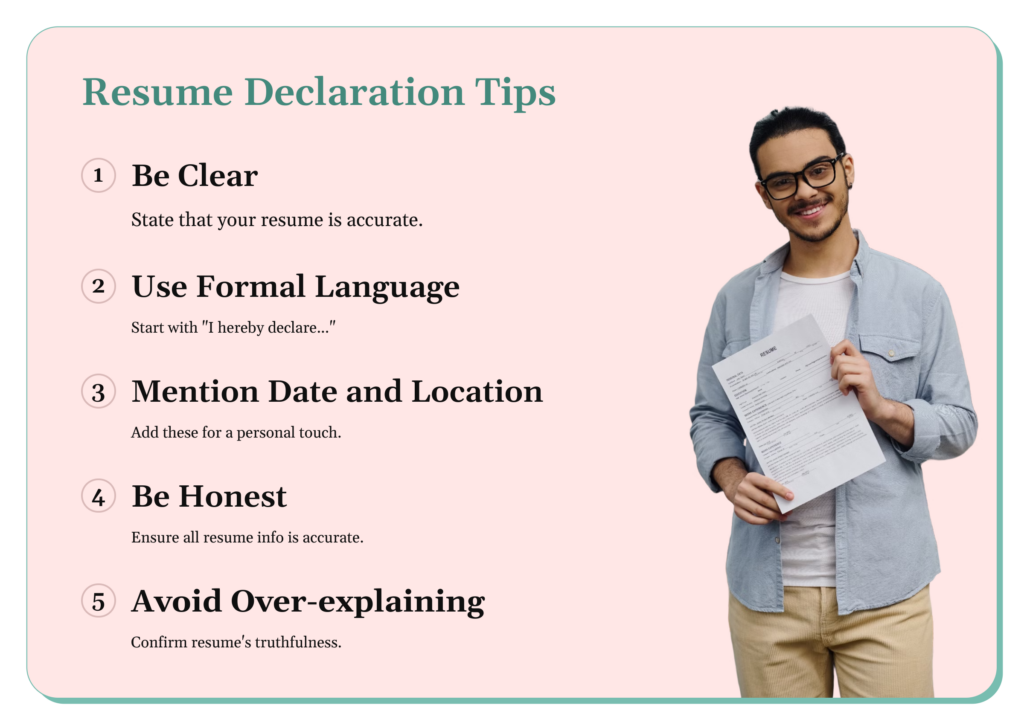
Example:
“I hereby declare that the information provided above is true and accurate to the best of my knowledge.
Date: [Insert Date]
Location: [Insert Location]”
In the government sector, the information provided by a candidate, including documents, educational details, skills, and previous experience, is thoroughly verified before confirming their candidature. To ensure the accuracy of the details, it is mandatory to include a declaration in the resume. This declaration confirms that all the information shared is truthful and accurate, demonstrating the candidate’s integrity and commitment to providing honest details during the application process
Many large organizations use applicant tracking systems to shortlist the best resumes. These systems often include forms that require candidates to sign a declaration statement or resume declaration before submitting their job applications. The declaration confirms that all the information provided is accurate and truthful, ensuring that candidates are accountable for the details they present. This step helps organizations maintain the integrity of the hiring process and ensure the authenticity of applicant information.
While including a declaration can strengthen your resume, there are several common mistakes to avoid:
A declaration in a resume has been a long-standing practice to confirm the accuracy of a candidate’s information. It ensures the candidate is accountable for the details provided, showcasing integrity and reliability. Employers use the declaration in resume to assess trustworthiness during the hiring process.
Including a declaration in your resume is essential for any job application. By placing it at the end, you emphasize the authenticity of the information and add a professional touch. A well-crafted declaration in resume reinforces your commitment to honesty and transparency.
Now that you know the importance of a declaration in a resume, confidently craft one that suits the job you’re applying for. A resume declaration is a simple yet powerful tool to highlight your credibility and present yourself as a trustworthy candidate. Adding a clear and concise declaration in resume for freshers helps establish credibility and ensures employers that all information is accurate and truthful.
Including a clear and concise statement in your resume can improve your professionalism and help you stand out from other candidates. In 2025, employers value transparency and integrity more than ever. A well-written statement shows your honesty and attention to detail. Ensure your statement is brief, accurate, and tailored to the job you’re applying for. Regularly update your resume to match the latest standards.
Seek feedback from career experts or mentors. With the right approach, your statement builds trust and increases your chances of landing interviews and advancing your career in today’s changing job market.

A declaration in a resume is a brief statement at the end where the candidate confirms that all the information provided is true.
Example: “I declare that the information above is true to my knowledge.”
Tip: Keep it professional and avoid extra details.
No, it’s not required in most countries, but some traditional sectors and government jobs may still expect it.
For example, a candidate applying for a PSU job in India includes a declaration in the standard format.
Tip: Check the job requirements before deciding to include it.
It usually goes at the bottom of the resume, after personal details and other sections.
Example: A recent graduate places the declaration at the end, followed by the date and signature.
Tip: Use a neat layout to keep it professional and easy to read.
Keep it short, clear, and free from mistakes. Use straightforward language that shows honesty.
Example: “I confirm that the information above is accurate to my knowledge.”
Tip: Avoid long sentences. One to two lines is enough.
Yes, freshers often add a declaration, especially when applying to traditional companies, colleges, or government jobs.
Example: A B.Com fresher includes a declaration in their resume when applying for a banking exam.
Tip: If you apply to startups or MNCs, you can leave it out unless they specifically ask.
Yes, experienced professionals usually don’t need it. Today’s resumes focus more on skills, achievements, and experience.
Example: An IT professional applying to a multinational company submits a resume without a declaration.
Tip: Use that space instead for a stronger skills or achievements section.