

Landing a sales job isn’t just about having a persuasive personality or a winning smile. It’s about showing the skills and mindset that drive real results. Sales interview questions aim to go beyond your resume. They explore how you handle objections, close deals, and build lasting relationships with clients. Employers want to see how you perform under pressure and what strategies you use to meet targets.
In today’s competitive market, being ready for various sales interview questions can help you stand out. From scenario-based questions to inquiries about your past achievements, knowing what to expect and how to respond can boost your confidence and help you leave a lasting impression. This guide will walk you through common sales interview questions and offer tips to help you highlight your selling skills and land the job you want.
Sales professionals drive revenue, build customer relationships, and expand a company’s market share. A strong sales team helps businesses grow by identifying prospects, closing deals, and maintaining customer loyalty. This makes hiring the right sales talent a top priority for organizations looking to stay competitive.
To succeed in a sales interview, candidates must demonstrate:
Employers want candidates who can meet quotas and adapt to different customer needs. These are essential qualities, especially for those preparing for entry-level sales interview questions, where hiring managers assess potential over experience.
Most sales interview questions follow a structured format to evaluate different competencies:
By preparing thoroughly with these sales interview tips, candidates can confidently navigate the hiring process and improve their chances of securing a sales role.

Behavioral questions assess how you’ve handled situations in the past and provide insight into your interpersonal skills, problem-solving ability, and adaptability.
Situational questions test your ability to think on your feet and handle sales challenges effectively.
These questions evaluate your sales knowledge, experience with tools, and ability to implement successful sales strategies.
By preparing well for these sales interview questions and answers, you can confidently demonstrate your skills and knowledge, making a strong impression during the hiring process. Understanding entry-level sales interview questions and advanced strategies will help you navigate different roles effectively.
Read more: Sell me This Pen Answer & Tips
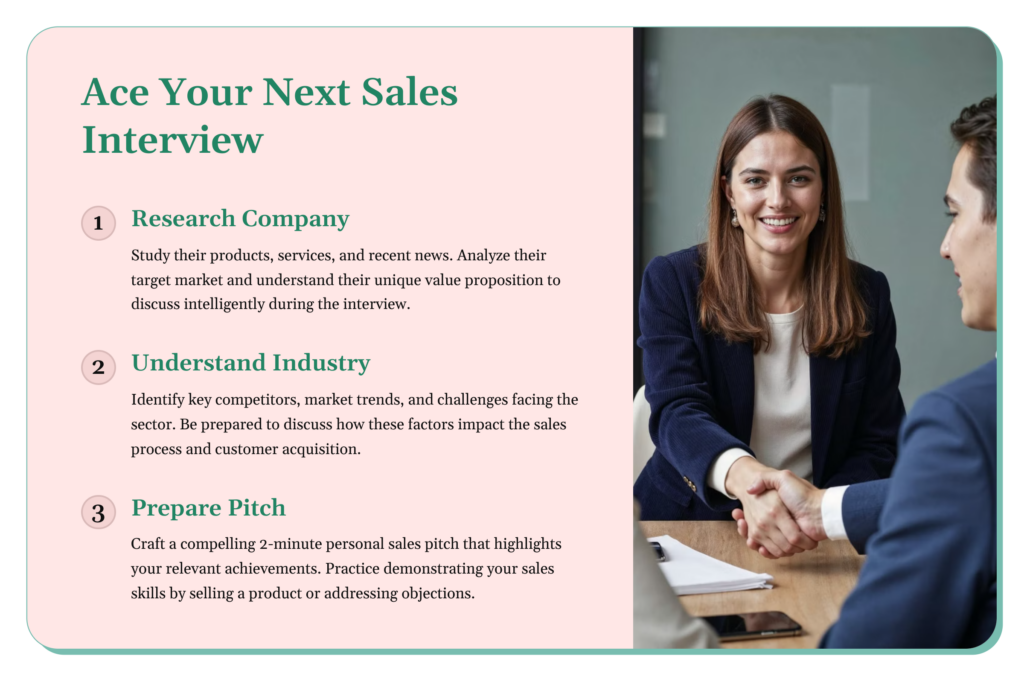
Thorough research is crucial when preparing for sales interview questions. Employers expect candidates to have a solid understanding of the company, its products, target market, and competition. To stand out, take the following steps:
One of the best sales interview tips is to practice answering sales interview questions and answers through mock interviews. Doing so helps refine communication skills, improve confidence, and receive constructive feedback. Consider:
Sales professionals must be able to articulate a persuasive pitch. Interviewers often ask candidates to demonstrate their selling ability, making preparation essential:
Implementing these sales interview tips can significantly enhance your performance and increase your chances of success in securing a sales role.
For entry-level sales interview questions, hiring managers focus more on potential, work ethic, and passion for sales rather than extensive experience. They aim to identify candidates with essential qualities for a successful sales career. Employers assess:
1. “Why do you want to work in sales?”
Example Answer:
“I’ve always been drawn to roles that involve communication, persuasion, and relationship-building. During a college fundraiser, I successfully convinced multiple sponsors to contribute, which made me realize I enjoy engaging with people and finding solutions. Sales provides the perfect opportunity to build connections, challenge myself, and grow in a results-driven environment.”
2. “How do you handle rejection?”
Example Answer:
“I understand that rejection is a natural part of sales. During a part-time retail job, I encountered customers who hesitated to purchase. Instead of getting discouraged, I asked follow-up questions to understand their concerns. This helped me refine my approach and increase conversions. I see rejection as a learning opportunity rather than a setback.”
3. “What strategies would you use to meet your sales target?”
Example Answer:
To meet my sales targets, I first ensure I understand my product and its value to customers. I’d focus on lead generation through networking, referrals, and researching potential clients. Effective follow-ups and active listening would help me tailor my sales pitch to each customer’s needs. Additionally, I’d use CRM tools to track interactions and optimize my approach.”
By preparing thoroughly for sales interview questions and answers, especially entry-level sales interview questions, you can confidently showcase your skills and secure your first sales job. You’ll be well-prepared to make a lasting impression using these sales interview tips!
As you progress in your sales career, interview questions become more complex, focusing on strategic thinking, leadership, and problem-solving. Mastering these sales interview questions and answers will help you stand out whether you prepare for mid-level or senior roles.
1. “Describe a time you turned a ‘no’ into a ‘yes.’”
Example Answer:
“A key prospect initially rejected our product due to pricing concerns. I revisited their pain points, demonstrated ROI using data, and offered a flexible payment plan. This approach convinced them to sign a long-term contract.”
2. “How do you prioritize your leads?”
Example Answer:
“I prioritize leads based on urgency, potential deal size, and fit with our solution. I use CRM tools to categorize leads and focus on high-value prospects first.”
1. “How do you develop and implement a sales strategy?”
Example Answer:
“I analyze market trends, define clear targets, and align sales processes with company goals. I also train my team on best practices and track performance metrics for continuous improvement.”
2. “Describe a time you led a sales team to exceed targets.”
Example Answer:
“By implementing a structured sales pipeline and weekly coaching sessions, I helped my team increase conversions by 30% in six months.”
Mastering these sales interview questions and applying these tips will position you for success in advanced sales roles. Preparation is key in transitioning from entry-level sales interview questions to leadership roles!
Asking insightful questions during your sales interview demonstrates your interest in the role and helps you assess if the company aligns with your career goals. Hiring managers expect candidates to engage in meaningful discussions, so prepare a few well-thought-out questions to make a strong impression.
By incorporating these sales interview tips, you’ll leave a lasting impression and gain valuable insights into the role. Proper preparation for sales interview questions and answers, whether for entry level sales interview questions or senior roles, is key to securing the right opportunity!
Your performance doesn’t end when the interview is over. Effectively following up can reinforce your interest in the position and leave a positive impression on hiring managers.
After your interview, send a thank-you email within 24 hours. Express gratitude for the opportunity and reiterate your enthusiasm for the role. Reference key points discussed during the interview to personalize your message.
If you haven’t received an update within a week, send a polite follow-up email. Express continued interest and inquire about the hiring timeline. This demonstrates persistence—a valuable trait in sales.
Reflect on your responses to sales interview questions and assess what went well and what could be improved. Use this insight to refine your approach for future sales interview questions and answers, whether preparing for entry-level sales interview questions or senior roles. Applying these sales interview tips will enhance your chances of success!
Excelling in sales interviews involves more than just discussing your achievements. It’s about demonstrating your drive, resilience, and ability to connect with clients. By preparing thoughtful answers and real-life examples, you can confidently show the qualities that make you a top sales professional.
Keep in mind that each question is a chance to highlight your unique approach to challenges and your passion for delivering results. With preparation and enthusiasm, you’ll make a lasting impression and get closer to landing your ideal sales role.
Evaluate numerous career choices to choose the right career path for yourself. Dive into our guide on Career Advice.

The five P’s of an interview are: Preparation, Presentation, Punctuality, Politeness, and Professionalism.
You can sell a pen by showing its value. Identify the buyer’s needs. Show how the pen meets those needs. Create urgency. Demonstrate its quality, comfort, or uniqueness to make it appealing.
Prepare for a sales interview by researching the company. Understand its products. Practice common sales questions. Review your sales achievements. Get ready to role-play scenarios. Show strong communication, persuasion, and relationship-building skills.
You should hire me because I have the skills, experience, and motivation to succeed in this role. I have a proven history of achieving results and a strong commitment to helping your team succeed.
The 5 C’s in an interview are: Confidence, Communication, Clarity, Credibility, and Connection.
To sell any product, understand the customer’s needs. Highlight the benefits instead of the features. Build trust and address any objections. Create urgency and clearly show how the product solves their problem or improves their situation.
Read more: What are Your Weaknesses