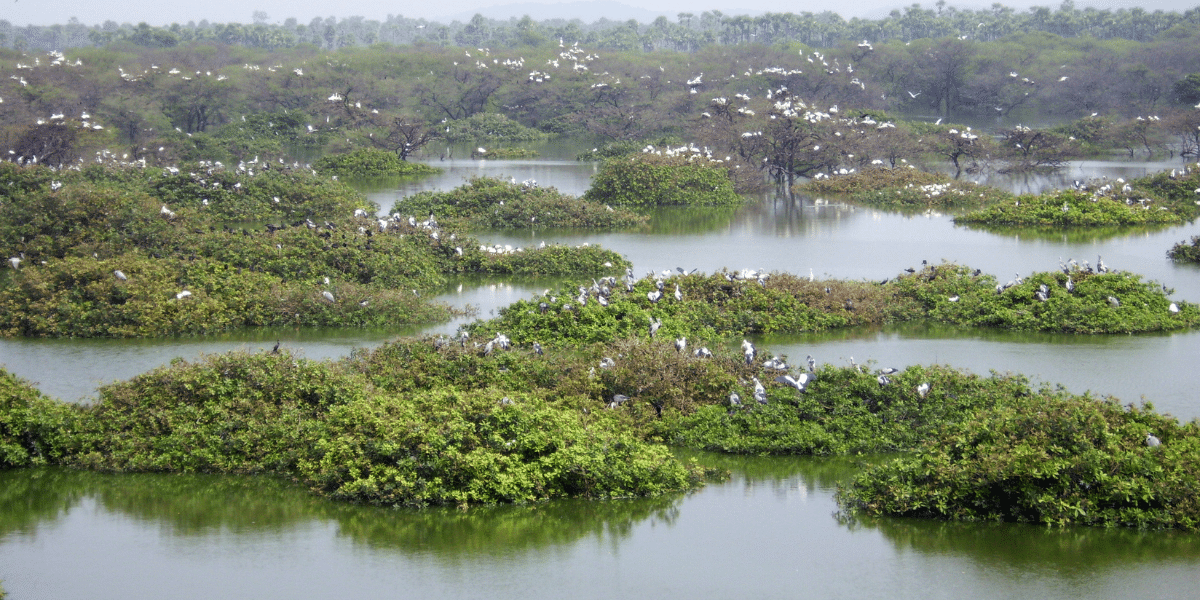
Wetlands rank among the planet’s most productive ecosystems, performing irreplaceable ecological functions, from water purification to flood regulation. Under the Ramsar Convention of 1971, wetlands of “international importance” are designated as Ramsar sites in India, signaling a nation’s commitment to their protection. These Ramsar sites in India span diverse landscapes: Himalayan lakes, riverine floodplains, coastal mangroves, and man‑made reservoirs.
As of 2025, India boasts 91 Ramsar sites in India, covering roughly 1.4 million hectares, approximately 4.7 percent of the country’s land area. This network safeguards critical habitats for migratory birds on major flyways, endemic fish species in freshwater lakes, and unique plant communities in salt marshes. Beyond biodiversity, Ramsar sites in India provide socioeconomic benefits: they recharge aquifers, buffer floods, sequester carbon, and sustain fisheries and agriculture for millions.
For UPSC/SSC aspirants and history enthusiasts, understanding Ramsar sites in India means appreciating India’s ecological heritage and governance. The Ramsar Convention, the first global treaty on wetland conservation, sets nine rigorous criteria for designation, ensuring only the most vital and vulnerable wetlands receive this international stamp of importance. By exploring Ramsar sites in India, we uncover the intersections of science, policy, culture, and livelihoods that define India’s approach to sustainable development.

Global Treaty: First intergovernmental treaty on conservation of natural resources.
To qualify, a wetland must meet at least one of nine scientific criteria, such as supporting rare or endangered species, sustaining significant waterbirds (≥1% of a species’ flyway population), or providing critical fish spawning grounds. These criteria ensure that Ramsar sites represent globally important ecological functions.
In India, the total wetland area exceeds 7.7 million hectares, but only a fraction, currently 91 sites, hold Ramsar status. These sites are selected through a rigorous nomination process involving ecological surveys, hydrological assessments, socio‑economic studies, and a Ramsar Information Sheet (RIS) formulation. Once the Ramsar Secretariat approves, the site joins an international network dedicated to the “wise use” and conservation of wetlands.
By designating Ramsar sites in India, policymakers ensure these fragile ecosystems receive legal protection under the Wetlands (Conservation and Management) Rules, 2017, and are managed via site‑specific conservation plans that engage local communities and scientific experts.
| Metric | Value |
|---|---|
| Total Wetlands (ha) | 7,700,000 ha (approx.) |
| Percentage of Land Area | ~4.7 % |
| Ramsar Sites in India (2025) | 91 sites |
| Ramsar Area Coverage (ha) | 1,400,000 ha (approx.) |
India’s journey with the Ramsar Convention began even before formal accession in 1982, when it designated its first two sites: Chilika Lake in Odisha and Keoladeo National Park in Rajasthan. Chilika, Asia’s largest brackish lagoon, supports over 160 migratory and resident bird species and sustains local fisheries. Keoladeo, a UNESCO World Heritage site, hosts more than 370 bird species annually on the Central Asian Flyway.
After accession, India steadily added wetlands: by 2000, a dozen sites, from Harike Wetland in Punjab to Loktak Lake in Manipur, were listed. The early 2000s saw growing recognition of mangrove ecosystems (e.g., Bhitarkanika, Sundarbans) and high‑altitude lakes (e.g., Tso Moriri). From 2011 onward, an aggressive push saw some 30 new sites, reflecting ecological priorities and geopolitical factors, such as conserving cross‑border riverine wetlands.
In the most recent phase (2022–2025), India added 22 sites in rapid succession, including the floodplain Sirpur Wetland (MP), urban Mahadevapura Wetland (Karnataka), and Bihar’s Kanwar Lake, Asia’s largest oxbow lake. This acceleration underscores India’s enhanced policy focus, bolstered by the Wetlands Rules (2017) and the MoEFCC’s National Wetland Conservation Programme, to align domestic wetland policy with international obligations.
| Site | State | Year Designated | Key Features |
|---|---|---|---|
| Chilika Lake | Odisha | 1981 | Asia’s largest brackish lagoon; migratory birds |
| Keoladeo National Park | Rajasthan | 1981 | UNESCO World Heritage; over 370 bird species |
| Period | # Sites Added | Notable Sites |
|---|---|---|
| 1981–2000 | 12 | Harike, Loktak, Wular |
| 2001–2010 | 18 | Bhitarkanika, Ashtamudi, Sambhar |
| 2011–2021 | 30 | Sundarbans, Vembanad‑Kol, Keoladeo expansions |
| 2022–2025 | 22 | Sirpur, Mahadevapura, Kanwar, Nanda Lake, Pala |
Designating a Ramsar site in India is a multistep procedure rooted in science and policy collaboration. It begins at the state level, where State Wetland Authorities identify candidate wetlands based on ecological surveys and stakeholder consultations. These authorities compile baseline data on hydrology, species inventories, land use patterns, and socio‑economic interdependencies.
The central nodal agency, the Ministry of Environment, Forest & Climate Change (MoEFCC), oversees these nominations. Experts evaluate the site against the Ramsar Convention’s nine criteria, ensuring it meets at least one internationally defined threshold. A Ramsar Information Sheet (RIS) is drafted, detailing ecological character, threats, management measures, and local community roles.
Upon MoEFCC approval, the RIS is submitted to the Ramsar Secretariat in Switzerland, which conducts its technical review. If any data gaps emerge, the Secretariat requests clarification. Once satisfied, it formally adds the wetland to the Ramsar List, conferring international recognition.
Post‑designation, the site receives legal protection under the Wetlands (Conservation and Management) Rules, 2017. MoEFCC, state authorities, NGOs, and local communities develop site-specific management plans collaboratively, detailing restoration actions, zoning, and monitoring frameworks. This process ensures that ecological integrity and human well‑being are balanced in wetland governance.
| S.No. | Ramsar Site | State | Year | Area (km2) |
| 1 | Kolleru Lake | Andhra Pradesh | 2002 | 901 |
| 2 | Deepor Beel | Assam | 2002 | 40 |
| 3 | Kanwar (Kabar) Taal | Bihar | 2020 | 26.2 |
| 4 | Nanda Lake | Goa | 2022 | 0.42 |
| 5 | Khijadia WLS | Gujarat | 2021 | 6 |
| 6 | Nalsarovar BS | Gujarat | 2012 | 123 |
| 7 | Thol Lake | Gujarat | 2021 | 6.99 |
| 8 | Wadhvana Wetland | Gujarat | 2021 | 10.38 |
| 9 | Bhindawas WLS | Haryana | 2021 | 4.11 |
| 10 | Sultanpur NP | Haryana | 2021 | 142.5 |
| 11 | Chandra Taal | Himachal Pradesh | 2005 | 0.49 |
| 12 | Pong Dam Lake | Himachal Pradesh | 2002 | 156.62 |
| 13 | Renuka Lake | Himachal Pradesh | 2005 | 0.2 |
| 14 | Ranganathituu BS | Karnataka | 2022 | 5.18 |
| 15 | Magadi Kere Conservation Reserve | Karnataka | 2024 | 0.5 |
| 16 | Ankasamudra Bird Conservation Reserve | Karnataka | 2024 | 0.98 |
| 17 | Aghanashini Estuary | Karnataka | 2024 | 4.8 |
| 18 | Ashtamudi Wetland | Kerala | 2002 | 614 |
| 19 | Sasthamkotta Lake | Kerala | 2002 | 3.73 |
| 20 | Vembanad-Kol Wetland (Longest Lake in India) | Kerala | 1905 | 1512.5 |
| 21 | Bhoj Wetland | Madhya Pradesh | 2002 | 32 |
| 22 | Sakhya Sagar | Madhya Pradesh | 2022 | 2.48 |
| 23 | Sirpur wetland | Madhya Pradesh | 2022 | 1.61 |
| 24 | Yashwant Sagar | Madhya Pradesh | 2022 | 8.22 |
| 25 | Lonar Lake (Impact Crater Lake) | Maharashtra | 2020 | 4.27 |
| 26 | Nandur Madhameshwar | Maharashtra | 2019 | 14 |
| 27 | Thane Creek | Maharashtra | 2022 | 65.21 |
| 28 | Loktak Lake | Manipur | 1990 | 266 |
| 29 | Pala Wetland | Mizoram | 2021 | 18.5 |
| 30 | Ansupa Lake | Odisha | 2021 | 2.31 |
| 31 | Bhitarkanika Mangroves | Odisha | 2002 | 650 |
| 32 | Chilika Lake (Oldest Ramsar Site in India) | Odisha | 1981 | 1165 |
| 33 | Hirakud Reservoir | Odisha | 2021 | 654 |
| 34 | Satkosia Gorge | Odisha | 2021 | 981.97 |
| 35 | Tampara Lake | Odisha | 2021 | 3 |
| 36 | Beas CnR | Punjab | 2019 | 64 |
| 37 | Harike Wetland | Punjab | 1990 | 41 |
| 38 | Kanjli Wetland | Punjab | 2002 | 1.83 |
| 39 | Keshopur-Miani CmR | Punjab | 2019 | 34 |
| 40 | Nangal WLS | Punjab | 2019 | 1 |
| 41 | Ropar Wetland | Punjab | 2002 | 13.65 |
| 42 | Keoladeo National Park | Rajasthan | 1981 | 28.73 |
| 43 | Sambhar Lake | Rajasthan | 1990 | 240 |
| 44 | Chitrangudi BS | Tamil Nadu | 2021 | 2.6 |
| 45 | Gulf of Mannar Marine BR | Tamil Nadu | 2022 | 526.72 |
| 46 | Kanjirankulam BS | Tamil Nadu | 2022 | 0.96 |
| 47 | Karikili BS | Tamil Nadu | 2022 | 0.584 |
| 48 | Koonthankulam BS | Tamil Nadu | 2021 | 0.72 |
| 49 | Pallikaranai Marsh Reserve Forest | Tamil Nadu | 2022 | 12.475 |
| 50 | Pichavaram Mangrove | Tamil Nadu | 2022 | 14.786 |
| 51 | Point Calimere WLS & BS | Tamil Nadu | 2002 | 385 |
| 52 | Suchindram Theroor Wetland Complex | Tamil Nadu | 2022 | 0.94 |
| 53 | Udhayamarthandapuram BS | Tamil Nadu | 2022 | 0.44 |
| 54 | Vaduvur BS | Tamil Nadu | 2022 | 1.12 |
| 55 | Vedanthangal BS | Tamil Nadu | 2022 | 0.4 |
| 56 | Vellode BS | Tamil Nadu | 2022 | 0.77 |
| 57 | Vembannur Wetland Complex | Tamil Nadu | 2022 | 0.2 |
| 58 | Karaivetti Bird Sanctuary | Tamil Nadu | 2024 | 4.5 |
| 59 | Longwood Shola Reserve Forest | Tamil Nadu | 2024 | 1.16 |
| 60 | Rudrasagar Lake | Tripura | 2005 | 2.4 |
| 61 | Hokera Wetland | UT of JK | 2005 | 13.75 |
| 62 | Hygam Wetland CnR | UT of JK | 2022 | 8.02 |
| 63 | Shallbugh Wetland CnR | UT of JK | 2022 | 16.75 |
| 64 | Surinsar-Mansar Lakes | UT of JK | 2005 | 3.5 |
| 65 | Wular Lake | UT of JK | 1990 | 189 |
| 66 | Tso Kar (High Altitude Ramsar Site) | UT of Ladakh | 2020 | 95.77 |
| 67 | Tsomoriri (High Altitude Ramsar Site) | UT of Ladakh | 2002 | 120 |
| 68 | Bakhira WLS | Uttar Pradesh | 2021 | 28.94 |
| 69 | Haiderpur Wetland | Uttar Pradesh | 2021 | 69 |
| 70 | Nawabganj BS | Uttar Pradesh | 2019 | 2 |
| 71 | Parvati Arga BS | Uttar Pradesh | 2019 | 7 |
| 72 | Saman BS | Uttar Pradesh | 2019 | 5 |
| 73 | Samaspur BS | Uttar Pradesh | 2019 | 8 |
| 74 | Sandi BS | Uttar Pradesh | 2019 | 3 |
| 75 | Sarsai Nawar Jheel | Uttar Pradesh | 2019 | 2 |
| 76 | Sur Sarovar (Keetham Lake) | Uttar Pradesh | 2020 | 4.31 |
| 77 | Upper Ganga River (Brijghat to Narora) | Uttar Pradesh | 2005 | 265.9 |
| 78 | Asan Barrage | Uttarakhand | 2020 | 4.44 |
| 79 | East Kolkata Wetlands | West Bengal | 2002 | 125 |
| 80 | Sundarban Wetland (Largest Ramsar Site in India) | West Bengal | 2019 | 4230 |
| 81 | Nagi Bird Sanctuary | Bihar | 2009 | 791 |
| 82 | Nakti Bird Sanctuary | Bihar | 1984 | 3.33 |
| 83 | Kazhuveli Bird Sanctuary | Tamil Nadu | 2024 | 51.516 |
| 84 | Nanjarayan Bird Sanctuary | Tamil Nadu | 2024 | 1.25865 |
| 85 | Tawa Reservoir | Madhya Pradesh | 2024 | 200.50 |
| 86 | Therthangal Bird Sanctuary | Tamil Nadu | 2025 | 29.29 |
| 87 | Sakkarakottai Bird Sanctuary | Tamil Nadu | 2025 | – |
| 88 | Khecheopalri Wetland | Sikkim | 2025 | – |
| 89 | Udhwa Lake | Jharkhand | 2025 | – |
| 90 | Khichan | Rajasthan | 2025 | – |
| 91 | Menar | Rajasthan | 2025 | – |
Ramsar sites are not merely designated tracts of land but living laboratories where complex ecological processes sustain local and global life. Wetlands provide a suite of ecosystem services. Humans derive benefits from nature, including water purification, flood mitigation, and climate regulation. By acting as natural filters, wetlands trap sediments, absorb excess nutrients (nitrogen and phosphorus), and break down harmful pollutants, ensuring cleaner water for downstream communities and wildlife.
Moreover, wetlands serve as biodiversity hotspots. India’s Ramsar sites host over 30 percent of the country’s avian diversity, with sites like Keoladeo National Park and Chilika Lake recognized globally for their bird populations. These areas also support critical life stages for fish and amphibians, offering spawning and nursery habitats. In arid and semi‑arid regions, such as the Sambhar Lake in Rajasthan, wetlands provide oases of moisture, underpinning the survival of both flora and fauna under extreme conditions.
From a climate perspective, wetlands are among the most efficient carbon sinks on Earth. Peatlands, mangroves, and marshes store organic carbon in waterlogged soils where decomposition is slow, sequestering greenhouse gases that would otherwise contribute to global warming. Inhabited and agricultural landscapes, wetlands maintain water tables and reduce the severity of droughts and flash floods, thereby bolstering climate resilience.
Ramsar sites are living laboratories offering vital ecosystem services:
These ecological functions underscore why Ramsar sites in India are indispensable to both nature and society.
India’s Ramsar sites reflect its remarkable geographical diversity, from high‑altitude lakes in the Himalayas to mangrove forests along the Bay of Bengal. Each state’s wetlands display unique ecological and cultural features that demand tailored conservation approaches.
Odisha leads in coastal and estuarine wetlands:
Tamil Nadu has the highest number of Ramsar sites (14) in India, encompassing:
Recognizing these threats, the Government of India has launched several programs to protect Ramsar sites in India and the broader network of wetlands in India:
These initiatives, backed by robust legal frameworks and grassroots engagement, aim to reverse degradation trends and ensure the long‑term viability of Ramsar sites in India, from the smallest Ramsar sites in India to the biggest Ramsar site in India 1.2025,” and Ministry of Jal Shakti, “National Wetland Conservation Programme Annual Report, 2023–24.”
India’s 91 Ramsar sites form a globally significant network of wetlands, each vital for biodiversity, human well‑being, and climate resilience. From the inaugural designations in 1981 to the recent additions through 2025, these sites exemplify India’s evolving environmental stewardship.
Sustaining them requires robust legal frameworks like the Wetlands Rules, integrated governance, scientific research, and empowered communities. For aspirants, policymakers, and citizens alike, understanding Ramsar sites is key to safeguarding India’s natural heritage for future generations.
Read More:
There are a total of 91 Ramsar Sites in India.
As of June 2025, there are 91 Ramsar sites in India, most of which are in Tamil Nadu.
In 2025, two wetlands in Rajasthan, Khichan and Menar, were added to the list of Ramsar sites in India.
Renuka Wetland in Himachal Pradesh is known as the smallest Ramsar site in India.
These are declared under the Ramsar Convention on Wetlands, which was signed under the Convention. Countries that have signed the Convention themselves declare such sites as Ramsar Sites based on the framework provided by the Convention.