

Making a strong first impression in an interview begins with a confident self-introduction. This moment is your chance to show your personality, share your skills, and set the tone for the conversation. Knowing how to introduce yourself well in today’s competitive job market can make a big difference. A good self-introduction goes beyond just stating your name and background. It should reflect your enthusiasm, professionalism, and connection to the role. Whether you are a recent graduate or an experienced professional, mastering this skill helps you stand out.
In this guide, you’ll find helpful tips and practical examples to create a memorable self-introduction for any interview. Are you ready to boost your confidence and impress your next employer? Let’s dive in and learn how to introduce yourself effectively.
A self-introduction is a simple yet essential way of presenting yourself to others. In other words, it is a brief statement that initiates a conversation and allows you to introduce yourself the way you prefer. It typically includes your name, some personal background, and your profession.
Additionally, when introducing yourself in English, you provide insights into your personality, identity, and other key details concisely and structured. Did you know that self-introductions also follow a specific format? If not, keep reading to learn more!
Answer- Hello, thank you for giving me the opportunity for the self-introduction. My name is [ Your Name], I am a [Name of Profession] professional. As someone who has worked in this field for the past 3 years, I have gained great expertise. Through this, I have accomplished [ Mention Key Accomplishment or Results] and equipped myself with the necessary skills and experience that are similar to the role I have applied for. That’s why I’m excited about using my skills and expertise towards the growth of your organization.
I am proud to mention in my introduction that I was born and raised in [Mention Name of City/State]. I have also lived in different cities for my work; this change in place and culture has helped me understand people better. Which ultimately made me an adaptable person and a candidate who is a fit for your company’s culture.
I hold a degree in [Mention Your Highest Degree] in [Mention the Field] from [Mention Institute Name]. Throughout my educational journey, I have emphasized learning skills and gaining knowledge about [Mention Your Field]. Along with that I also took up various Certification courses, Workshops and Internships to understand the various aspects of this field. All this has helped me stay updated with all the latest changes in the field.
Thank you for asking me this question in this self-introduction for the job. There are several factors which have attracted me to apply for this job. The primary reason is the reputation and name of your organization for [Mention the Positive Attributes and Achievements]. And as I have been following your organization’s work for quite some time. I am glad to say that your initiatives and future plans match with my personal and professional goals; giving me a chance to grow with your organization.
As I mentioned earlier in my introduction, I possess skills like [Mention Your Skills], and along with that I bring additional skills like [Mention Your Additional Skills and Expertise] that will enable me to [ Mention the Result You Can Make]. Additionally, my strengths like [Mention Your Abilities] help me in taking action [Mention Actions You Would Take] resulting in the achievement of organizational growth and project results.
In five years, I envision myself as [Name of Job Position] in your company, where I would be taking up [ Mention Responsibilities and Duties]. I will continue to upskill myself and gain more experience related to industry and work. Moreover, I would like to take on leadership roles to inspire and train new talents of the company; helping them achieve their and the company’s goals.
Some candidates might not have experience working in a corporate environment. Such applicants should be extra careful while giving a self-introduction in an interview. They can follow the below-mentioned sample to draft a self-introduction for the interview:
Hello Sir/Ma’am,
My name is (Mention your Name). I belong to the beautiful (Name of the City/State). I graduated from school and got a bachelor’s degree in (Name of the course) from (Name of the University) in my hometown. I shifted to (Name of the city) to get a master’s degree in (Name of the course) from (Name of the University).
I enjoy reading biographies and poetry books. I also write short stories, articles, and poems. I have published some of my poems and essays in (Name of the Publications/Websites).
I worked as the President of the Debate Society and the Dramatics Club during my graduation. As President, I led the debate team in various inter-college competitions. I also participated in many zonal and state-level debate competitions and won medals and certificates.
I am confident and love to explore new avenues for learning and upgrading. My adaptive and adjusting personality helps me keep a positive mindset during challenging situations.
I wish to apply for the job vacancy as I have the same work ethic and morals as promoted by your organization. It is my belief that I would be a valuable addition to your organization as I have a zeal for learning and growing as a professional.
Candidates who have experience working in a corporate environment must carefully draft their self-introduction for the interview. During the self-introduction process, the interviewers would judge them on their confidence level. Such candidates should answer all questions confidently. Here’s an example for you:
Hello Sir/Ma’am,
My name is (Mention your Name). I have worked as a Senior Manager in (Name of the Company) for the last ten years, where I joined as an Executive. During this period, I have worked on several projects relating to the handling and production of (Name of the product/service). I got promoted to the team leader position in the same organization. As a team leader, I handled a team of 10 people. I worked and implemented (Name of the service). This resulted in increasing the company’s productivity and generated a profit of about 30%.
I have developed and marketed (Name of the product/Service). Due to this, the company would earn a profit of about 32% in the next quarter.
As a Science undergraduate, I participated in several quizzes and exhibitions organized by the (Name of the society). I worked as the president of the (Name of the society) and have represented my college at (Name of the event), where I won a gold medal.

You should balance thoroughness and conciseness when it comes to the length of your self-introduction during a job interview. Ideally, your self-introduction should be no more than two to three minutes. This should give you enough time to address the most important aspects of yourself and your qualifications, while also allowing the interviewer to ask questions and engage in conversation.
While interviewing, the candidates should clear all their doubts and appear confident. They must prepare to face the self-introduction in the interview. The interview introduction is one of the most critical aspects of the selection procedure.
Even the most knowledgeable candidate should practice for the self-introduction round. This would help them face their competitors. In the self-introduction round, the candidate must talk about their uniqueness. There might be more than one interviewer. The main aim of the interviewer is to get information about the candidates not mentioned in their resumes.
Read More: Best Resume Format for Freshers with Samples
Candidates must keep certain things in mind while preparing for the self-introduction round:
They should write down the important points for the self-introduction round. By doing so, candidates would not miss out on any important information. They should do this a few days before the interview date to avoid any nervousness. If one is a fresh graduate, they should write the self-introduction in fewer words. Candidates with work experience need to include all critical points. Some of the points to include in the self-introduction for the interview are:
Maintain natural and steady eye contact to demonstrate confidence and engagement. However, avoid prolonged staring—occasionally shifting your gaze ensures a comfortable and natural interaction.
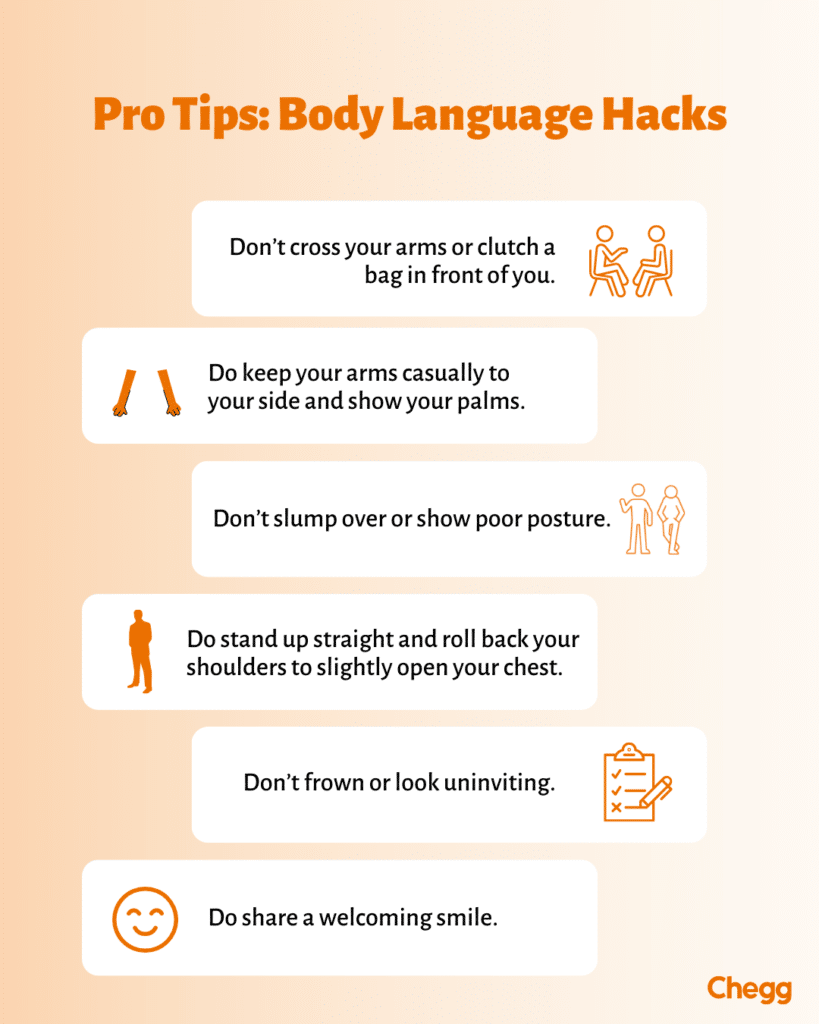
While telling the interviewer about themselves, the candidates must use positive body language. Body language plays an important role in determining a person’s confidence level. It can give a positive or negative impression of the candidate.
Candidates should wear formal clothes and shoes for the interview. They should wear clean and ironed clothes and polished shoes that are not torn or damaged. Those who do not come in formal clothes leave a negative impression.
Candidates must be punctual for their interviews. They should reach the interview venue within the time mentioned in the job advertisement or announcement. Punctuality is one of the most important qualities of a good candidate. The interviewers might not hire a candidate who does not understand the value of time.
Candidates must bring all the documents and certificates that they need for the interview. While giving the self-introduction, the interviewer might ask for supporting documents.
The experienced candidates also need to bring records from their previous employers:
Candidates should make the self-introduction a two-way communication with the interviewer. They should wait for the interviewer to ask questions about the self-introduction. Doing so will help the candidate connect with the interviewer. That way, the self-introduction will not sound mechanical.
While giving the self-introduction, the candidate should mention facts that are not there in their resume. Since the interviewer has a resume, the self-introduction should have unique facts. Candidates can talk about their professional achievements in brief. In the self introduction, they must talk about the lessons that they learned. They should describe how these lessons helped them to become better professionals.
Candidates that have work experience should talk about their future goals in self-introduction. They should also mention how the job vacancy would help them achieve these goals. This would help the interviewer in knowing that the candidate is a good choice for the job. The fresher candidates can also talk about their future goals as a professional. They can mention the reason why they want to start their career with a particular organization.
The applicant should smile and maintain eye contact with the interviewer during the self-introduction round. Doing so would help them establish a friendly connection with the interviewer. Although it would not affect their selection, it would create a positive first impression on the interviewer.
Read More: Tips on How to Introduce Yourself in an Interview
The candidate should give the self-introduction round the same importance as the main interview. Following are some common mistakes to avoid while giving an introduction for an interview:
Whether offline or online, preparing for any interview can be an overwhelming experience, whether you are a fresher or an experienced candidate. And the most important thing that matters for the success of your interview is how you give a self-introduction. Using the right self-introduction tips, you can confidently introduce yourself in any professional setting. How you represent yourself makes all the change, and now with the help of the tips, tricks, and examples provided in the article, you can make that positive change in your next interview.
And if you are looking for some other opportunities to earn some extra cash for your knowledge and expertise then there is no better platform than Chegg India. As Chegg’s Subject Matter Expert, you can earn for every student query you solve correctly. You just need to fulfil the eligibility; choose the subject you want to teach and start earning.
Chegg is one platform where candidates can become subject matter experts (SMEs). They can work from the comfort of their homes. If they have adequate subject knowledge and willingness to help others, Chegg will provide them with the opportunity. They can earn from the comfort of their home.
Grab the opportunity to help learners across the globe. As an SME, you can interact and learn from fellow SMEs across the globe. Interested candidates must register on Chegg’s home page and qualify for the screening test for the subject of their choice.

Ace your job interviews with tailored tips for a great first impression! Explore our guide on Interview Tips.
Non-verbal communication is the most important form of making a great impression in job interviews. Here are some practical tips for candidates to communicate confidence, professionalism, and enthusiasm through non-verbal communication:
A strong self-introduction can lead to interview success. You create a positive conversation by preparing ahead of time, highlighting your strengths, and connecting your introduction to the job requirements. Keep it short, genuine, and relevant; steer clear of memorized scripts and let your personality show. Practice makes perfect, so rehearse your introduction until it feels natural and confident. As interviews change in 2025 and beyond, employers look for candidates who can communicate clearly and make a strong impression.
Take the time to improve your self-introduction, and you will open doors to new opportunities. Go into your following interview ready to show your best self; your path to career growth begins with a great introduction.
A self-introduction is a short presentation about yourself. It highlights your name, background, skills, and goals. You often use it in interviews, classrooms, or networking situations.
Example: “Hi, I’m Aisha. I recently graduated in Computer Science and I’m passionate about AI and data analysis.”
Tip: Keep your introduction short, relevant, and confident.
It creates the first impression, sets the tone for communication, and helps others quickly understand who you are.
Example: A strong self-introduction builds confidence and rapport with the interviewer.
Tip: Tailor your introduction to the situation, whether professional, academic, or casual.
Mention your name, education, work experience, key skills, and career goals clearly and briefly.
Example: “I’m Rahul, a Marketing graduate with 2 years of digital marketing experience. I am skilled in SEO and Google Ads.”
Tip: Match your introduction to the job description.
Be confident, make eye contact, use positive body language, and focus on your strengths.
Example: Smiling while introducing yourself in a group discussion makes you friendly.
Tip: Practice in front of a mirror or record yourself to improve your delivery.
A 1-minute introduction is a brief self-introduction used in interviews, networking events, public speaking, or classroom settings. It typically lasts around 60 seconds and highlights the most important things about you.
Students can include their name, course, interests, achievements, and future goals.
Example: “I’m Meera, studying for my B.Com. I’m interested in finance and hoping to become a chartered accountant.”
Tip: Include a unique hobby or interest to stand out.
Avoid being too lengthy, irrelevant, or lacking confidence. Don’t repeat what’s on your resume word-for-word.
Example: Speaking for 5 minutes in an interview may bore the panel.
Tip: Limit your introduction to 1 to 2 minutes.
Read More: