Graphic designer interview questions often examine your design philosophy and process, technical skills (software proficiency and understanding of design principles), soft skills (like time management, handling feedback, and collaboration), and your grasp of industry and client needs. Be prepared to discuss your portfolio of work, define key design concepts such as typography and color theory, and explain how you stay current with design trends.
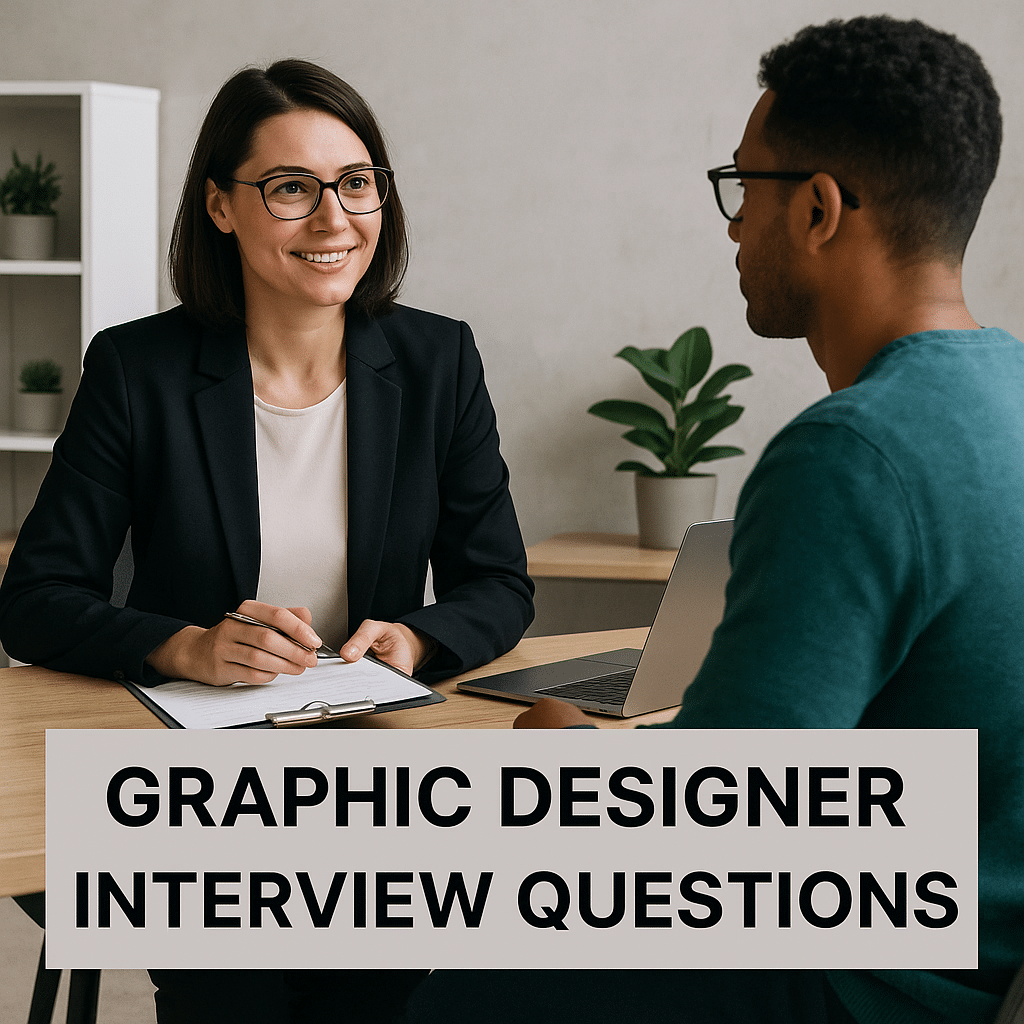
These general questions help interviewers understand your background, motivation, and passion for design. Be ready to discuss your experience, creative process, and what inspires your work.
Question: “Can you tell us a bit about yourself and your background in graphics design?”
Answer: “Of course! I have a Bachelor’s degree in Graphic Design from XYZ University, where I learned the basics of design and software tools. For the past five years, I’ve worked with a range of clients, from startups to big companies, creating everything from logos to digital marketing materials. My experiences have taught me how to blend creativity with practicality to make designs that stand out.”
Question: “What made you decide to pursue a career in ‘graphics designing’?”
Answer: “I’ve always loved art and technology; graphic design lets me mix both meaningfully. I enjoy the challenge of turning complicated ideas into simple, eye-catching visuals that connect with people. It’s exciting to create something that communicates effectively and resonates with an audience.”
Question: “How would you describe your design style?”
Answer: “I’d say my design style is clean and modern, with a strong emphasis on minimalism. I believe that less can be more, so I aim for designs that are not only beautiful but also easy to understand. I focus on typography, color choices, and layout to make sure every element has a purpose and adds to the overall message.”
Question: “Where do you find inspirations in graphics designing?”
Answer: “I find inspiration all around me, nature, architecture, and everyday objects often spark my creativity. I also keep up with design trends by reading industry blogs, attending webinars, and joining design communities. Plus, looking at other designers’ work inspires me to try new styles and techniques.”
These questions focus on how well you understand the company’s brand, values, and design style. Be prepared to explain why you want to work there and how your skills align with their creative goals.
Question: “What do you know about our company and why do you want to work here?”
Answer: “I’ve looked into your company and am impressed by your creative approach to graphic design and your focus on sustainability. Like the rebranding of the XYZ product, your recent project shows a great mix of creativity and strategic thinking that aligns with my design style. I’m excited about the chance to work with a team that values artistic quality and social responsibility.”
Question: “Why do you think you are a good fit for this role?”
Answer: “I think I’m a great fit for this role because I have a lot of experience in graphic design, especially in creating attractive and user-friendly designs. I’m skilled in Adobe Creative Suite and work well with different teams, which matches what you’re looking for. Plus, I’m always eager to learn, so I stay updated on the latest design trends and tools.”
Question: “This role requires frequent client interactions. Are you comfortable with that?”
Answer: “Definitely! I have a lot of experience working directly with clients to understand what they need and turn their ideas into effective designs. I believe that clear communication and listening closely are essential for successful client relationships. I enjoy working together with clients, as it often leads to more innovative and satisfying results.”
Question: “Where do you see yourself in five years, and how does this role align with your career goals?”
Answer: “In five years, I hope to take on more leadership roles, maybe as a senior designer or art director. I want to mentor junior designers and lead bigger projects that challenge me creatively. This role fits well with my goals because it offers opportunities for growth, exposure to different projects, and the chance to work with a talented team that can help me improve my skills.”
These frequently asked questions explore your design approach, software skills, and ability to handle feedback. Practicing these will help you communicate your strengths and experience confidently.
To land a creative graphic design job, you must have more than an impressive portfolio. During the interview process, you must make an impression on potential employers with your knowledge, abilities, and personality. The best graphic designer interview questions evaluate your technical proficiency, aesthetic sense, communication skills, and fit with company culture.
Q1: What makes an effective logo?
An effective logo is simple, memorable, and communicates the brand’s essence. It should have a clear concept and utilize bold shapes, creative negative space, and eye-catching colors. The choice of font, shape, and symbols should align with the brand image, ensuring longevity and versatility.
Q2: How would you design an adaptable logo?
To create an adaptable logo, I use a minimal color scheme and focus on scalable shapes that remain readable at any size. I design in vector format, starting with simple outlines to ensure clarity across various applications.
Q3: How would you create a cutting-edge pamphlet?
For a modern pamphlet, I would employ an asymmetrical layout with vibrant colors and ample white space, using striking photography. A black or white sans-serif font would enhance the contemporary feel, and I’d opt for unique folds or die-cut shapes to stand out.
Q4: Can you describe your graphics design process?
I start by discussing project goals and target audiences with the client, followed by research to inform my design. My process begins with rough sketches, which I refine digitally using Adobe Illustrator and Photoshop. After finalizing the design, I create a mockup and deliver polished files in the required formats.
Q5: What design software are you proficient in?
I have over five years of experience with Adobe Illustrator, Photoshop, and InDesign. I’m also skilled in HTML and CSS, with experience in UI/UX design using Sketch. I stay updated by exploring new tools like Figma and Canva.
Q6: How do you stay updated with design trends?
To keep up with trends, I read design blogs like Dribbble and AIGA Eye on Design. I take online courses on platforms like Lynda.com, experiment with side projects, and participate in local design networking events to connect with industry professionals.
This concise format keeps the information clear and relevant for interview preparation!

These best graphic designer interview questions and answers evaluate your strategic approach to problem-solving and visual communication. Display both your logical and creative thinking.
As a graphic designer, I see constructive criticism as key to improving my work. When I receive feedback, I try to step back and understand the perspective behind it. I engage with clients to ensure I fully grasp their needs and implement changes accordingly. I appreciate the time taken to critique my designs, and I actively look for patterns in the feedback to enhance my future projects. This openness not only helps me grow but also ensures I deliver designs that truly meet client expectations.
One project I’m particularly proud of is the rebranding for a local non-profit organization. They needed a fresh, modern look to attract a younger audience, so I researched their mission and target demographic to guide my creative graphic design. The project included a new logo, color scheme, and promotional materials. The biggest challenge was balancing modern aesthetics with their established identity. The final design was a success, significantly boosting their engagement and donations, and it felt great to see my work positively impact their mission.
To effectively manage multiple graphics designing projects with tight deadlines, I break each project into smaller tasks and estimate how long each will take. I use tools like Trello or Asana to create detailed timelines and set clear milestones, prioritizing tasks by urgency and importance. Keeping clients updated helps manage expectations, and I stay flexible to adjust my schedule as needed. I also make sure to allocate time for reviews and revisions to maintain the quality of my work, even when things get busy.
Best Graphic designer technical interview questions and answers will help you understand how they should be answered. These questions test your ability and creative thinking.
Describe how to create vector graphics. What type of software have you used, basic steps in the process, and how would you ensure that the final product becomes scalable and of high quality?
Vector graphics are created using special software, including Adobe Illustrator. First, I start modelling from the very basic forms and either combine or modify them according to my needs. Then, I use colours and gradient exaggeration, add details, and organise elements with layers. Finally, I export the design in SVG or PDF format for scalability without losing quality.
Talk in-depth about both models. Mention the appropriate situations in which to utilise each of them.
RGB stands for red, green, and blue, which are the primary colours of light. These three colours are mixed in different ways to produce a wide range of colours in the RGB colour model. Cyan, Magenta, Yellow, and Key (black), or CMYK, is the standard colour model used in colour printing. In contrast to the RGB model, which adds light to produce colours, the CMYK model subtracts the light that inks absorb. For any project design intended to be printed out rather than viewed on a screen, use CMYK. Use the RGB colour mode if your design project will ultimately be displayed on a digital screen.
Mention how you can make the best creative graphic designs easy to navigate and comprehend. Also, discuss how the designs can avoid overcrowding the website and become more attractive.
A website should be simple to navigate and comprehend to ensure it is easy to use. I ensure the layout is tidy and orderly, avoiding overcrowding the website with design elements. I employ a straightforward color scheme and font to make the content more readable and stand out. Additionally, I optimize images for web use, use responsive design techniques, and ensure fast load times to improve user experience and SEO.
These behavioural graphic design test questions and answers are important for assessing a graphic designer’s soft skills and cultural fit within the team. They give insight into how candidates handle real situations, treat others, and overcome obstacles.
Give a thorough description of the circumstances you encountered. Mention the abilities you have acquired throughout the entire ordeal.
The client once made all the changes a few days before the project deadline. I collaborated closely with the team and worked through the night to ensure the design was of the highest caliber. I also learned how to effectively prioritize tasks. The result was delivered on time, and it delighted the client. This experience taught me the importance of flexibility and time management. I maintained a positive outlook, remained goal-focused, and established clear priorities to transform a stressful situation into a successful outcome. To guarantee that everyone stays on task and completes the task within a constrained time frame, I also learned how crucial excellent communication is.
Q2. How do you take feedback from clients or your team?
Feedback is as important as criticism. Mention how positively you incorporate these changes into your work.
I view feedback as an opportunity for growth. Whenever I receive feedback, I listen actively, ask a few related graphic designer questions to clarify, and apply the suggestions to my work. This ensures the final design meets or exceeds expectations and fosters positive working relationships. I believe constructive feedback enables skill refinement and keeps my mind open to various opinions and viewpoints, leading to the best possible solution for the client and the team. As a result, the designs improve, and trust and collaboration within the team strengthen.
Q3. Example of successful collaboration with a Marketing Team.
Talk about your experience in detail. Also, mention how teamwork and proper communication helped you complete the project.
I have worked on a campaign where the marketing team brainstormed with me to align the design with the brand’s message. By understanding the marketing team’s goals and incorporating their input into the design process, we created visuals that appealed to our target market. This project was a huge success, proving that teamwork, creative thinking, and strategic planning are key ingredients for a successful project. This experience reinforced my belief in the power of cross-functional collaboration.
Even though graphics design job interviews can be nerve-racking, there are steps you can take to stand out from the competition. Start by reviewing graphics designing questions for students to understand the types of questions you might encounter.
Question: “What are some of the biggest challenges a graphic designer might face in this role?”
Follow-Up: “How does the team usually deal with these challenges?”
Question: “Can you tell me about the team I’d be working with?”
Follow-Up: “How does the team work together, and what’s the group dynamic like?”
Question: “What opportunities for learning and development are available for graphic designers here?”
Follow-Up: “Are there any specific programs or resources to support growth and learning?”
These graphic designer interview questions show you’re interested in both the job and growing within the company.
Gaining confidence in graphics design will help you present yourself effectively and secure your ideal graphics design position. Practice and preparation are essential; approach the process with the same care you give your portfolios. To speak intelligently about the company’s brand and industry position, familiarise yourself with its work and mission. Review sample web graphic designer interview questions, answers, and practice answering them succinctly, politely, and strategically with examples that highlight your expertise. Asking thoughtful questions shows your interest in finding the perfect mutual fit. Appearance matters in visual communication, so ensure your look conveys respect. While technical proficiency is important, personality also matters.
Acing graphic designer interview questions requires poise and experience. With careful planning, you can project yourself as the best candidate. Start your design career with these questions and tips. Also, look up graphic designer interview questions to ask employers to clarify any doubts. Utilising these resources and efforts will increase your self-assurance and make you a desirable candidate. Keep learning, growing, and honing your abilities. Your perseverance and hard work will pay off.
Concentrate on articulating your thinking instead of only what you created.
Example: In one interview, I discussed how I reimagined the logo of a nonprofit organization to have a more modern feel while still maintaining a sense of trust, explaining my color choices and font. The person interviewing me thought it was nice to hear why I landed on that.
Tip: Practice walking through why you made confident design choices, much like you would tell a story.
The four key rules of graphic design are alignment, contrast, repetition, and proximity. Together, they make designs clear and compelling.
For example, aligning text and images to a grid (alignment), using bold colors for headlines (contrast), repeating font styles across pages (repetition), and grouping related elements like captions near images (proximity) all help guide the viewer’s eye.
Tip: Always step back and check if your design looks balanced, readable, and consistent. These rules make that happen.
The three C’s of graphic design are Contrast, Consistency, and Clarity.
Example: Bold headlines (contrast), matching colors/fonts (consistency), and clear messaging (clarity) make a design effective.
Tip: Always check if your design stands out, feels unified, and is easily understood.
Balance – Even distribution of visual weight.
Contrast – Differences to create focus.
Emphasis – Highlight the most important part.
Movement – Guide the viewer’s eye through the design.
Proportion – Size relationships between elements.
Repetition – Repeat elements for unity.
White Space – Use empty space to avoid clutter.
The three types of graphics are:
Raster – Pixel-based (e.g. photos) – JPEG, PNG
Vector – Scalable shapes – SVG, AI
3D – Realistic, 3D objects – OBJ, FBX
Tip: Use vector for logos, raster for photos, and 3D for models or animation.