“So, what motivates you?” This question may seem simple, but it holds a lot of importance during an interview. Hiring managers are not looking for a standard reply; they want to discover the real you. What inspires you to perform, grow, and contribute to your workplace? Your answer helps employers understand how your motivations match the role and company culture.
Whether you’re a recent graduate, a professional with some experience, or changing careers entirely, being clear about what drives your ambition is essential to standing out. This guide will show you how to answer this question effectively, avoid common pitfalls, and customize your response for specific roles and cultures. We will include sample answers, preparation techniques, and expert tips to make your motivation memorable.
Let’s get started and help you transform a challenging question into a memorable moment in your following interview.

Motivation is a personal experience, but its impact and drive are very similar in all of us. It could be Intrinsic or Extrinsic. Either way, it can impact your life and career differently.
Whether your source of motivation is Intrinsic or Extrinsic, it leads you to take the required action for needed results. Both serve the purpose of keeping you on track and bringing you closer to your goals.
What motivates you in life can directly impact your life and career. Hence, identifying your drive becomes an essential step. It will provide you with a clear compass for decision-making. It also helps you align your values and passions, which can lead you to achieve your goals in life. This will lead you to greater fulfillment and motivate you, resulting in overall career satisfaction.
Most of us are driven by a few common motivators to use our time more effectively. These motivators are essential for us to lead happy and fulfilled lives.
Personal Growth, Financial Rewards, Recognition, and Purpose are considerable motivators in today’s competitive and fast-paced world. These motivators keep us energetic and ready daily to reach our goals. Our ways to achieve those goals can vary, but the motivators are usually the same.
Answering “What motivates you?” well in an interview shows your enthusiasm, fit for the role, and capacity to succeed in the organization. Here’s how to respond to this question in four steps:
Think deeply about what truly excites you about your work. Familiar sources of motivation include:
Tip: Write down a few examples from past experiences when you felt energized and fulfilled.
Once you know your key drivers, connect them to the job description and the company’s mission. Research the company’s values, goals, and work environment.
Example:
If you’re applying for a data analyst role at a mission-driven company, and you’re motivated by problem-solving and making a difference, relate those to how you enjoy using data to make strategic decisions that create change.
Use a real-life story that shows your motivation in action. Follow a mini STAR format (Situation, Task, Action, Result):
Example:
“I’m motivated by opportunities to learn and grow. In my last role, I took the initiative to enroll in an analytics course to improve our marketing funnels. The insights I gained helped increase lead conversion by 18%. It was gratifying.”
Avoid vague statements like “I just love to work.” Be clear and confident, but don’t go off on tangents. Show genuine enthusiasm for the job you’re applying for.
“I’m driven by solving complex problems and seeing the real effects of my work. In my last job, I led a team effort to improve our reporting system. This cut manual errors by 40% and helped the team make quicker decisions. I enjoy challenges requiring analytical thinking and teamwork, so I’m excited about this role.”
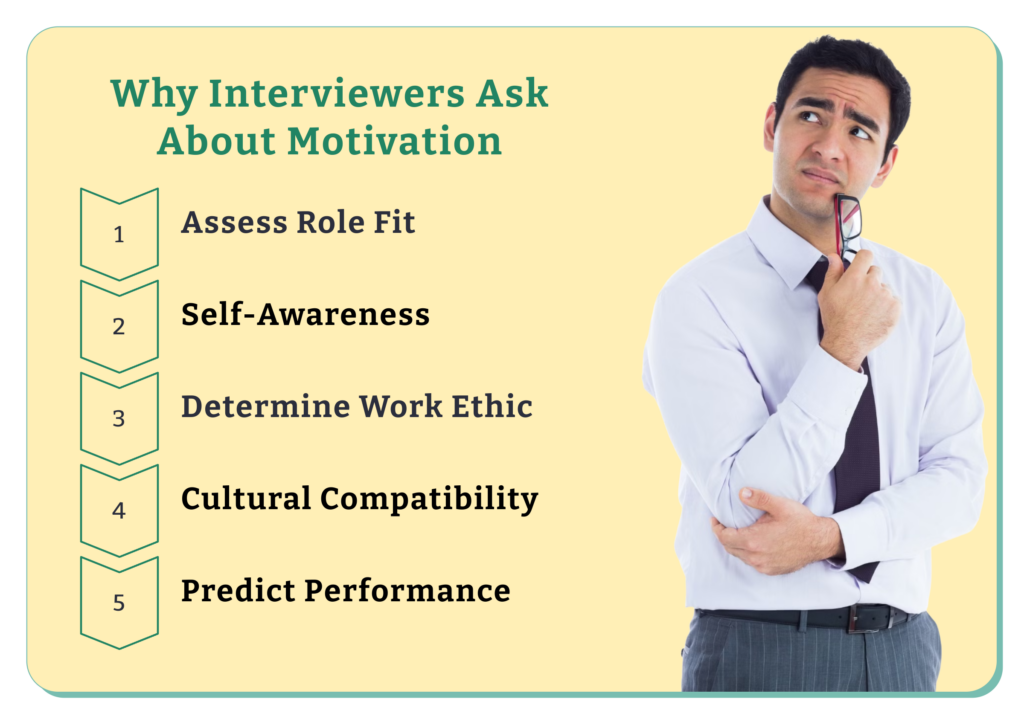
Employers ask what motivates you to understand what drives your passion, work ethic, and long-term career goals. They want to assess whether your motivations align with the job role and company culture. Here are the key reasons why they ask this question:
Combining your values, passions, and core drivers can motivate you. Breaking your old patterns is necessary to build new ones. These patterns encourage you to keep going and lead you to fulfillment.
Personal values and passions are core to motivation. They give shape to life goals and also help you achieve them.
Setting short-term and long-term goals will make it easier for you to track and achieve them. Both play essential roles in motivation and achievement in life.
They are achieved within weeks or months and are smaller and achievable objectives. They get you closer to your long-term goals with small and measurable steps. They provide immediate gratification that can boost your confidence and motivate you further.
Long-term goals take years to achieve. They require larger aspirations to give you direction and demand sustained efforts to accomplish them. This leads you to keep your focus on the big picture.
Staying motivated at work for a prolonged period is essential. That’s why asking yourself, ‘What motivates you at work?’ is necessary. There are a few factors to keep in mind to find answers to what motivates you to work:
A few key drivers motivate you to do a good job.
When your job role is aligned with your motivation, dedication, and interest increase, you can quickly excel.
For example, if you are creative, you can stay easily motivated in job roles that demand innovation. If you are goal-oriented, structured roles can be more suited for you.
What motivates your interview question is the most common to ask. It can come in several forms.
What motivates you to work? Sample answers can vary from those of your competitors or be similar. However, it is an important question to answer, and your answer could drive the result of the interview.
Answering what motivates you effectively requires self-awareness and alignment with the job role. Follow these steps to craft a strong response:
Reflect on what drives you at work—solving problems, teamwork, achieving goals, or learning new skills.
Align your motivation with the role. If it’s a sales job, emphasize hitting targets; for creative roles, highlight innovation and problem-solving.
Show your motivation in action with a real-life example.
Example:
“I’m motivated by problem-solving and helping others. In my last role, I resolved a complex customer issue, improving retention and customer satisfaction. Seeing the impact of my work drives me to excel.”
For example, being motivated by leading a team and interacting with others is different from enjoying mainly working alone, crunching numbers, or researching data. Neither option is better; it’s about what suits you best for that specific role.
Getting this question right can set you apart. Here’s a simple guide to what works and what doesn’t.
Quick Tip: Practice until your answer sounds confident, clear, and natural, not rehearsed.
Want to give a genuine answer? Use motivational interviewing, a technique that helps reveal your true, underlying motivations.
What It Is:
A self-reflection method that uses open-ended “why” questions to explore deeper motivations.
How to Use It:
Why It Works:
This process increases self-awareness and helps you respond with clear, confident answers during interviews.
Tailor Your Message to the Region:
Pro Tip:
Understanding what motivates you to work can help you craft a compelling interview response. Here are some sample answers and tips to frame your motivation to work effectively:
“I love expanding my skill set and continuously improving. In my last job, I actively sought training opportunities, even funding some myself, because I believe staying up to date makes me more innovative and valuable in any role.”
“I’ve been fascinated by coding since middle school, thanks to my mother, a Software Developer. Now, as an expert in Java and C++, I thrive on solving complex coding challenges. Every problem I tackle pushes me to grow and fuels my motivation.”
“Planning and organizing keep me at my best. I ensure my workload is structured so I meet deadlines without compromising quality. Having a clear roadmap allows me to stay productive and focused on delivering the best results.”
“Customer service motivates me. In my last role, I enjoyed answering customer queries and resolving issues. Seeing their satisfaction and earning positive feedback reassured me that I was making a meaningful impact.”
“Leading a team of 10 was one of my most rewarding experiences. I focused on optimizing workflows and ensuring collaboration, which led to improved efficiency. Helping my team succeed together is what keeps me motivated.”
“Building strong, productive teams is what excites me. I’ve managed software development teams, improving processes to ensure 100% on-time project completion for six months straight. Seeing a team perform at its best is my biggest motivator.”
“I’m results-driven. Having clear targets and developing a strategy to hit them excites me. In my current role, my team and I set aggressive goals, and I thrive on crafting step-by-step plans to achieve them successfully.”
“Numbers tell a story, and I love uncovering insights through data analysis. At my current job, I create monthly sales reports that directly influence business decisions. Knowing my work contributes to strategy keeps me motivated every day.”
Feeling motivated at the moment and staying motivated over some time is a whole different thing. Staying motivated over a long time is crucial to delivering your best efforts in the long run. You can do that by building resilience and cultivating positive habits in your daily life.
Positive habits such as regular reflection, self-care, and celebrating small wins will help you stay motivated for a long time.
Understanding what motivates you in both your personal and professional life is key to long-term satisfaction and growth. When your goals align with your values, ethics, and passions, you develop a strong sense of purpose that keeps you engaged and driven. This self-awareness helps make informed decisions and ensures that your career path is fulfilling and meaningful.
For many, the answer to what motivates me could be the desire to learn, solve challenges, contribute to a team, or make a difference in the world. By identifying your key motivators, you can take strategic steps to push past obstacles, stay committed to your aspirations, and confidently achieve success.
Now is the time to reflect on what motivates you and use that insight to shape a rewarding and purposeful future. Start today, and let your motivation drive you to new heights!
Understanding what motivates you isn’t just about giving a good answer in an interview. It’s about discovering the deeper “why” behind your career path. Knowing what drives you makes your response more genuine, confident, and relevant to your desired role.
By looking at different ways to ask the question, practicing with real examples, avoiding common mistakes, and using self-reflection tools like motivational interviewing, you are preparing for more than one question. You are creating a story that resonates with hiring managers and helps you stand out.
So, the next time someone asks, “What motivates you?” and “Who motivates you?” don’t just respond—own it. Let your passion, purpose, and potential shine. That’s how great careers begin.

I am motivated by the opportunity to learn and grow, the challenge of solving complex problems, and the desire to make a positive impact in my work and for others.
I am motivated by the opportunity to learn and grow, the chance to solve challenges creatively, and the desire to make a positive impact in my work and the lives of others.
Motivation is the internal drive that pushes me to reach meaningful goals, face challenges, and grow continuously. It comes from my desire to make a difference, learn new things, and contribute to something bigger than myself.
I’m motivated to do my best work when I see purpose in what I’m doing. This could be solving problems, helping others, or making a meaningful impact. Recognition, chances for growth, and being part of a team that works together towards goals also inspire me.