

A BSc degree in Botany is more than just a stepping stone into plant science-it can unlock a spectrum of academic, research, and professional opportunities both in India and abroad. Contrary to the common belief that the only path after Botany is pursuing an MSc in the same subject, graduates today are exploring diverse options in specialized sciences, interdisciplinary studies, and even non-science fields.
Take the example of Ananya Sharma, a BSc Botany graduate from Delhi University. While many of her peers opted for MSc programs, she pursued Environmental Science for her Master’s and later joined a global NGO working on climate change initiatives. Similarly, some graduates have transitioned into Pharmaceutical Management (MBA), Bioinformatics, or even Sustainability Consulting, proving that Botany can lead to unconventional yet rewarding careers.
Depending on your interests, you can choose postgraduate-level degrees (like MSc Biotechnology, Microbiology, or Horticulture), professional diplomas, or even pivot to non-science domains such as journalism, computer applications, or hospitality.
In this guide, we’ll break down the best courses after BSc Botany and the career paths they lead to—helping you make an informed choice aligned with your strengths and future goals.
Botany is the scientific discipline dedicated to the study of plants, including their physiology, structure, genetics, and biochemistry. This field is fundamental to advancements in agriculture, environmental conservation, and pharmaceutical research, playing a critical role in sustaining ecosystems and human well-being.
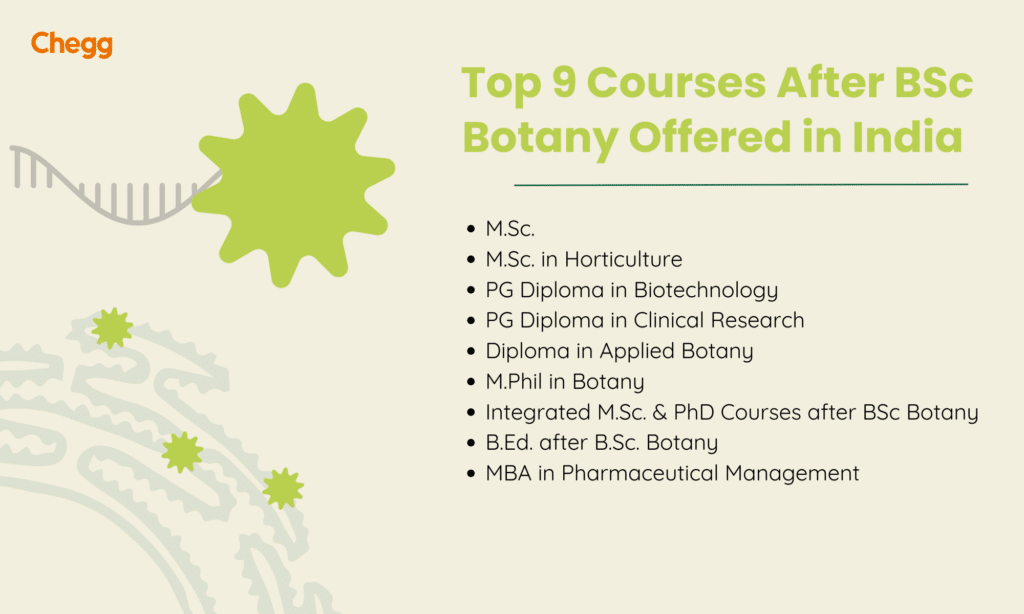
There are several courses after BSc botany that you can pursue. Here is the list of courses:
Now let’s explore them one by one in detail:
You can pursue your higher education after completing your bachelor’s degree. Master of Science is a master’s degree awarded by universities or colleges for study in a specific branch of science, technology, mathematics, etc. Typically, it is an academic degree that is higher than a bachelor’s degree and lower than a doctorate PhD degree. After MSc, students can go for various options.
| Course Duration | 2 years |
| Eligibility Criteria | Bachelor’s degree in science |
| Admission Criteria | Entrance Exam |
| Top Colleges | • IIT Bombay – Indian Institute of Technology • St. Stephen’s College, New Delhi • All India Institute of Medical Sciences, Delhi • Manipal University, Jaipur |
If you are interested in plant life and agriculture, you can pursue an MSc degree in horticulture or explore various Courses after BSc Botany. It opens many job opportunities as a Forest Officer, Horticulture Specialist, Horticulture Supervisor, etc.
| Course Duration | 2 years |
| Eligibility Criteria | Bachelor’s degree in science with a minimum of 60% marks |
| Admission Criteria | Entrance Exam |
| Top Colleges | • SRM University, Chennai • BHU, Varanasi • Gujarat University, Ahmedabad |
After obtaining a BSc in Botany, there is excellent scope in Courses after BSc Botany, particularly in Biotechnology. You can do a PG Diploma in Biotechnology to gain in-depth knowledge about the subject. After completing this one-year course, you can work as a biologist, geneticist, molecular biologist, etc. You can also go for an MSc in Biotechnology.
| Course Duration | 1 year |
| Eligibility Criteria | Bachelor’s degree in science |
| Admission Criteria | Merit Basis |
| Top Colleges | • Amity Institute of Biotechnology, Noida • SIES College of Management-Studies, Mumbai • MITCON, Pune |
If want to make your career in bioethics, then PG Diploma in Clinical Research will be one of the best courses after BSc Botany.
After completing your PG Diploma in Clinical Research, you can work as a Clinical Research Associate, Senior Clinical Research Associate, Medical Writer, Safety Manager, etc.
| Course Duration | 10-12 months |
| Eligibility Criteria | Bachelor’s degree in science with 55% marks |
| Admission Criteria | Merit Basis |
| Top Colleges | • IGNOU, Delhi • Bioinformatics Institute of India, Noida • ICRI Mumbai |
Diploma in Applied Botany is one of the best courses after a BSc Botany for those who want to work and study at the same time. This Diploma course will save you time and make you eligible for job profiles like Assistant Professor, Management Executive, Biotech Marketing Executive, and more.
| Course Duration | 1 year |
| Eligibility Criteria | Bachelor’s degree in Botany |
| Admission Criteria | Merit Basis |
| Top Colleges | • Jawaharlal Nehru Technological University, Hyderabad • Utkal University, Bhubaneswar • RTMNU, Nagpur |
M.Phil in Botany is a pre-doctoral degree program where students learn about the scientific study and evolution of plant life, as well as various Courses after BSc Botany. After completing an M.Phil degree, students can enter the research field.
| Course Duration | 2 years |
| Eligibility Criteria | Master’s degree in Botany |
| Admission Criteria | Entrance exam & counselling |
| Top Colleges | • University of Calicut, Calicut • Guru Nanak Dev University, Amritsar • University of Delhi, Delhi |
There is also scope present after completing a BSc Botany degree in Courses after BSc Botany at institutions like IISER, TIFR, and NCBS. They offer MSc-integrated PhD courses for biological sciences (microbiology, biotechnology, zoology, life sciences, botany, molecular biology, genetics, and so on). IISER and TIFR also offer Int-PhD courses for subjects other than Biological Sciences.
Special MSc courses (related to Biology and other subjects like Chemistry, Physics, Nanotechnology, Mathematics, etc.) from top universities like JNU, HCU, BHU, PU (Pondicherry University), MSU-Baroda, Pune University etc., entrance examinations. This saves time and helps you get the post you want after your studies. There is no dearth of career options after a B.Sc. Botany.
| Course Duration | 3-6 years |
| Eligibility Criteria | Bachelor’s degree in Science |
| Admission Criteria | Entrance exam |
| Top Colleges | • IIT Bombay • Rajiv Gandhi University, Itanagar • IISER-Bhopal • National Institute of Science Education and Research, Bhubaneswar |
Teaching has always been regarded as one of the greatest professions. The Bachelor of Education (B.Ed.) program is a substantial and popular course in the field of education and is designed to develop a deeper understanding of the teaching-learning process at the secondary and higher secondary levels. Generally, the B.Ed. distance/correspondence program is for two years. B.Ed. is one of the best courses after BSc Botany. Students can easily consider teaching as an option.
| Course Duration | 2 years |
| Eligibility Criteria | Bachelor’s degree in Botany |
| Admission Criteria | B.Ed. Entrance Exams |
| Top Colleges | • SRM University, Chennai • Kasturi Ram College of Higher Education, Delhi • Jamia Millia Islamia University, New Delhi |
There are many courses and scopes after BSc Botany that you can pursue, and one of them is an MBA in Pharmaceutical Management. This 2-year course will open many career paths for you. One of the best Master’s degrees to pursue, this MBA degree focuses on preparing professionals for managerial positions.
| Course Duration | 2 years |
| Eligibility Criteria | Bachelor’s degree in Botany with a minimum of 60% marks |
| Admission Criteria | Entrance Exam & Interview |
| Top Colleges | • NMIMS, Mumbai • S.C.S. College of Pharmacy, Harapanahalli (Karnataka) • ITM Business School, Mumbai • Indian Management Institute, Mumbai |
Here is the list of BSc botany job opportunities that you can pursue, along with their salary in India:
| Job Profile | Description | Average Salary |
|---|---|---|
| Ecologist | An ecologist’s job involves analyzing ecosystems and providing insights into environmental management and conservation. | ₹3.0 – ₹9.2 Lakhs |
| Plant Biochemist | A plant biochemist can choose to work in the health industry. A plant biochemist studies chemical reactions in plants. | ₹1.4 Lakh – ₹4 Lakhs |
| Researcher | The researcher’s tasks include working in a research institute and discovering new aspects related to botany. | ₹1.6 – ₹22 Lakhs |
| Environmental Consultant | This type of job requires the individual to suggest the best possible methods for environmental protection, and are usually consulted before construction practices. | ₹2.2 – ₹16 Lakhs |
| Park Ranger | They mostly work in wildlife sanctuaries and national parks. They ensure the safety and cleanliness of the area and assist in any disaster. | ₹4.2 – ₹6.4 Lakhs |
| Botanist | A botanist studies different plants and flowers and explains how they affect different species and the environment. | ₹9.8 – ₹16.9 Lakhs |
| Green House Manager | This is a managerial career that deals with managing the nursery. | ₹8.6 – ₹14.5 Lakhs |
| Farming Consultant | An expert who works as a consultant related to farming queries on the molecular or physical level. | INR 8 LPA |
| Geneticist | As a geneticist, you will be responsible for researching and studying the inheritance of features at the molecular and organismal levels. | ₹21.1 – ₹22.8 Lakhs |
| Paleobotanist | A paleobotanist works on the retrieval and identification of plants from a geological context. | ₹11.3 – ₹19.8 Lakhs |
Pursuing higher studies or certifications after completing your BSc in Botany can:
The field of Botany is experiencing a resurgence in interest and importance, driven by the growing need for sustainable solutions and environmental conservation. A Bachelor of Science in Botany (BSc Botany) offers a comprehensive understanding of plant biology, ecology, genetics, and their practical applications. Here’s a look at the promising future of BSc Botany:
Graduates with a BSc in Botany have a wide range of career options. They can work as Botanists, Ecologists, Environmental Consultants, Geneticists, Plant Biochemists, and Researchers. The demand for professionals in these fields is expected to grow as industries and governments prioritize eco-friendly practices and the protection of natural resources.
Advancements in biotechnology and genetic engineering are opening new frontiers in plant sciences. BSc Botany graduates can contribute to cutting-edge research in areas such as genetic modification, bioremediation, and sustainable agriculture. These technologies are crucial for addressing global challenges like food security and climate change.
With increasing awareness of environmental issues, there is a heightened focus on conserving biodiversity and protecting ecosystems. BSc Botany graduates play a vital role in conservation efforts, restoration projects, and sustainable land management. Their expertise is essential for developing strategies to preserve plant species and their habitats.
A BSc in Botany is an excellent foundation for further studies in specialized fields such as Plant Pathology, Plant Ecology, and Ethnobotany. Graduates can pursue higher degrees like MSc and PhD, leading to careers in academia, research institutions, and government agencies.
Plants are fundamental to life on Earth, providing oxygen, food, and medicine. BSc Botany graduates contribute to global efforts to understand and harness the potential of plant life for the betterment of humanity. Their work supports sustainable development, agricultural innovation, and environmental stewardship.
The future of BSc Botany is bright and full of opportunities for those passionate about plant sciences and committed to making a positive impact on the world.
During a BSc in Botany, students explore various subjects, including:
A BSc in Botany opens diverse career opportunities across research, environmental management, agriculture, pharmaceuticals, and biotechnology. Botanists contribute to sustainable farming, environmental conservation, and plant-based medical innovations. Graduates can also explore careers in education, horticulture, and scientific research.

Becoming an online tutor is much easier because you can do it from the comfort of your home, have lots of resources available to you, and work through a variety of online teaching platforms.
Become an expert at Chegg, one of the most profitable online earning sites for anyone with a bachelor’s degree and expertise in any discipline, like biology, physics, chemistry, engineering, math, social science, etc. Chegg connects millions of students across the globe with thousands of subject experts who provide solutions to students’ questions. You will get many benefits like working from anywhere, anytime, pay per correct answer, no hassle, timely payments, networking with other experts etc.
Choosing the right course after a BSc in Botany is not just about following a trend-it’s about aligning your interests, strengths, and long-term career goals. Whether you want to advance into higher studies like MSc, dive into specialized fields such as Biotechnology or Environmental Science, or pivot into interdisciplinary areas like Bioinformatics or Pharmaceutical Management, the opportunities are abundant. This guide has highlighted both conventional and emerging paths to help you make an informed decision.
Tip: Before finalizing your next step, review placement statistics and alumni outcomes of the programs you are considering. For instance, NIRF rankings, UGC-approved course lists, or reports from institutions like ICAR (Indian Council of Agricultural Research) and DBT (Department of Biotechnology) can give you credible insights into career prospects. Doing this extra research ensures your choice is backed by real data and industry demand.
With dedication, strategic planning, and the right resources, your BSc in Botany can open doors to a rewarding and future-proof career.

Yes, B.Sc. Botany is a good course, especially for those who want to get into the public sector. You can join government organizations like:
1. Botanical Survey of India
2. National Institute of Oceanography
3. Indian Agricultural Research Institute
4. Indian Council of Forestry Research and Education
Consider pursuing a Master’s degree in Environmental Science, Conservation Biology, Plant Ecology, or Horticulture. Alternatively, explore options in related fields such as Agricultural Science, Biotechnology, or Pharmacognosy.
There are many career options available for the students who have done B.Sc. Botany such as
1. Ecologist
2. Botanist
3. Park ranger
One of the best courses after BSc Botany is MBA. You can do MBA in any specialization like Marketing Management, Finance Management, Hospital and Healthcare Management etc. After scoring a good GMAT score you can take admission to any MBA college and choose the institute as per your specialization.
There are many competitive exams you can take after your BSc in Botany. Some popular ones include the Joint CSIR-UGC NET, GATE, and the Indian Forest Service Exam. You can also explore state-level exams conducted by various universities and institutions.
The best fields in Botany include plant biotechnology, environmental consulting, forestry, agriculture research, and plant breeding. These offer a mix of research, fieldwork, and opportunities in sustainable development.
After BSc Botany, the best courses include MSc in Botany, Biotechnology, Environmental Science, or Microbiology. You can also explore courses in Horticulture, Plant Genetics, and Bioinformatics for specialized career paths.
Government job options after BSc Botany include roles in the Indian Forest Service (IFS), Botanical Survey of India, and positions in government research institutes. You can also apply for state-level forest officer exams or environmental consultancy roles in public sector units.
Diploma courses after BSc Botany include diplomas in Horticulture, Floriculture, Plant Tissue Culture, and Environmental Management. These short-term courses can help you gain practical skills and enter specialized fields quickly.
The highest-paying jobs in Botany often involve research and development in the pharmaceutical or biotechnology sectors. Positions like Research Scientist, Senior Scientist, and Biotechnologist in leading companies can offer competitive salaries and benefits. However, your earning potential will also depend on your experience, skills, and the specific role you choose.