

Courses after BTech CSE is significant for every aspiring computer science nig for a future professional field that is very highly competitive. With over 1.5 million engineering graduates in India every year according to Wikipedia, the need to have additional specializations with skills has become more prevalent than before. It does not matter if you want to pursue a particular stream and become a subject matter expert in emerging applications and technologies, facilitate an entry into another domain or simply increase your chances at getting hired, the best course to pursue after completing your B.Tech in Computer Science Engineering has huge ramifications on your future endeavours.
After you complete your B.Tech in Computer Science and Engineering (CSE) there are options available that will assist your transition to advance study and continue to be something you can be a subject matter expert / defend when your career provides you with the opportunity. The most common courses / course offerings include;
Certifications in subject specific skills such as Data Science, Artificial Intelligence, Cybersecurity, and Cloud Computing.
As an example, an MTech in Computer Science Engineering can lead to job designs such as Software Engineer, System Analyst, Database Administrator, Network Administrator, etc. On the other hand, an MS in Computer Science can lead to career work in Research and Development, Data Science, Machine Learning, etc. An IT MBA may help you advance to professional roles like Project Manager, Business Analyst, IT Manager, etc. A PhD in Computer Science can advance your career in Academia, Research and Development, and so on.
BTech CSE stands for Bachelor of Technology in Computer Science and Engineering. It is an undergraduate academic program focused on the fundamentals and advanced concepts of computer science, software development, and engineering principles. The program typically spans four years and is designed to provide students with a solid foundation in both theoretical and practical computing and software engineering.
As graduates consider what to do after BTech CSE, they have numerous options to research specialization courses in the ever-growing tech industry. There are courses available to earn advanced knowledge and skills in areas such as artificial intelligence, data science, cloud computing, and cyber security. The right specialization can help graduates determine their niche and differentiate themselves in a competitive landscape.
BTech CSE programs are suitable for students who are enthusiastic about technology and have ambitions of a computer science and engineering career. The tech industry continues to shift every day and continues to be fluid. It is imperative for graduates to remain educated about those changes. Selecting the right courses after the BTech CSE program allows graduates to build core competencies in emerging technologies or build capabilities to assume managerial roles in tech-centric organizations.
If you are here contemplating what to do after BTech computer science, looking into your career options and various further programs can be a good start. From technical certifications, like a Cisco Certified Network Associate (CCNA), to postgraduate opportunities, there are endless courses after BTech CSE covering diverse interest areas. Taking some time to assess your goals and interests will help you make an informed decision when it comes to launching a successful, fulfilling career!
Read More: Top 20 Careers after Computer Science Engineering (CSE)
Selecting the appropriate option after completing a BTech in CSE is important for developing a successful career. As the tech sector continues to change rapidly, many people are wondering what to do after BTech computer science to remain competitive. Consider studying advanced programs such as data science, artificial intelligence, and cloud computing. Each of these fields in tech boasts a multitude of positions for people with specialized skills, which is an advantage in securing positions skilled technologists are often more readily employable than their non-specialized counterparts. Specialization in a field of learning will also mean expanded knowledge for jobs in the today’s environment of evolving technologies.
Some of the top courses after BTech CSE include machine learning, cybersecurity, blockchain technology, and software development. While each of the fields offers unique services and direction of growth, we suggest that if one wished to enter into a management track, an MBA in Technology Management is also worth exploring. Using your skills and interests to determine the best opportunity for you should be the first step in your future development.

If you’re still on the fence about what to study after a BTech computer science,
you can consider DevOps, full-Stack development, or IT project management certifications.
There are several programs which developed with respect to industry demand and improving chances of employability. Though you may want to develop a career in a technical area that has a foundation, or you may want to move into leadership, well-chosen courses after BTech CSE will help you develop a very satisfying and, indeed, lucrative career.
Let us guide you in exploring all the possible courses available for BTech CSE:
Let’s explore them one by one in detail & Salary sourced from – AmbitionBox, Payscale:
Post Graduate Diploma in Data Science is a one-year diploma program that focuses on developing expertise in the field of data science. The course is designed to provide a comprehensive understanding of various techniques and tools used in data analysis, data modeling, and data visualization.
The curriculum includes topics such as probability and statistics, data mining, machine learning, deep learning, big data analytics, and data visualization. The course is designed to equip students with the necessary skills and knowledge required to work with large datasets and analyze them to derive meaningful insights.
To be eligible for a Post Graduate Diploma in Data Science, candidates should have a Bachelor’s degree in a relevant field such as computer science, engineering, mathematics or statistics. Additionally, some institutions may require candidates to have work experience or knowledge of programming languages such as Python or R.
After completing Post Graduate Diploma in Data Science, job profiles include Data Analyst, Data Scientist, Business Analyst, Data Engineer, Machine Learning Engineer, Data Visualization Expert, and Big Data Analyst.
The average salary for a Data Scientist with a Post Graduate Diploma in Data Science is around Rs. 9.69 lakhs per annum in India.
This is a preferred option for students looking for courses after BTech CSE and wanting to explore in-depth concepts in Computer Science. B. Tech students get an edge over BCA students. It provides in-depth knowledge of core fields in computer science, like Android programming, data science, and web analytics. Subjects include networks, system integration, algorithms, software engineering, and digital systems.
Students have to appear for a GATE exam. To pursue your MTech course from IIT, you need to have a BTech in CSE with at least a 55% score in it.
You can work in organizations, do research, work as a Software Engineer, Data Scientist, Product Architect, Project Manager, etc.
The salary of a computer science graduate depends on the field they are working in. The annual pay can be anywhere around INR 8 lakhs per annum.

This professional degree is two years and is one of the most valuable courses after BTech CSE. The student will study subjects like embedded systems, data science, and software engineering.
This degree is almost like MTech in Computer Science, but the syllabus is slightly different. The main difference is that while studying for an MTech degree in CS you will learn about both the software and the hardware aspect. In comparison, IT will have more emphasis on the software part.
To be eligible for this course, candidates must have completed their BE/BTech in relevant from a recognized university with an aggregate of 60% of their students.
MTech Information Technology graduates can work as IT specialists, quality analysts, computer programmers, and technical consultants.
The average salary can be anywhere around INR 6 LPA.
Cybercrimes have increased with an increase in the usage of the internet. Thus, the demand for graduates in cybersecurity is increasing day by day. This is also one of the most interesting courses after BTech CSE.
The subjects you will study in this degree contain a blend of computer science and security. It includes Data Structures, VOIP security, Blockchain, Malware analysis, etc. The money you make depends on the projects you have in your hand. Hence, this makes it one of the best courses after BTech CSE.
Students must have completed a Bachelor’s degree with at least 55% marks in relevant subjects or equivalent examinations.
You can work as a Cyber Lawyer, Cyber Assistant, Cybersecurity Specialist, and Cyber Security Manager.
An average salary cybersecurity graduate makes INR 8.19 LPA.
After completing your bachelor’s, if you are looking for the best courses after BTech CSE and want to acquire business-related skills, then an MBA in IT will help you out.
An MBA in IT will provide you with skills related to management and technology that blend to market your products to desired customers. You will learn how to manage finances, deal with profit and loss, company Data, and relevant employees to hire. It is a wholesome degree for you to enter the business world.
To get admission to an MBA, you need to consider three aspects of a good academic record work experience, communication skills, and CAT score. Colleges like FMS emphasize CAT scores and interviews instead of your academic record.
Candidates who want to pursue post-graduation in MBA IT in India often appear for CAT, MAT, XAT, and GMAT.
You can work in an e-commerce company, or IT company as an IT manager, consultant, and director.
On average you will make INR 14.9 LPA.
Read More: Salary after MBA
This degree has a philosophical approach to the computer science domain. It provides deep and in-depth knowledge of the computer science field. It also boosts your analytical skills and enhances your power to think. Usually, M.Phil is a year-long program that teaches you a wide range of subjects about computer science.
Also, it is one of the best courses after BTech CSE. Subjects you study in this degree vary for each college. The subjects also include networks, system integration, Algorithms, software engineering, digital systems, etc. After BTech CSE, students usually opt for this course to improve their pay scale.
Students must have a post-graduate degree with at least 55% marks from a recognized university.
Computer Science graduate can work as a freelance coder, computer scientist, software architect, computer system analyst and an android developer.
On average you will make INR 10.8 LPA.
Data science methods help in getting useful data to make better business decisions. A Data Scientist uses machine learning and various tools to get useful information from raw data. This field exposes you to various complex problems every day, and thus, it is one of the best courses after B.Tech in Computer Science.
To succeed as a Data Scientist, you need to have good knowledge of coding, Maths, and reasoning. The more experience you earn, the more you will become fluent in your work.
Students should have a Bachelor’s degree in Information Technology, Computer Science, Mathematics, or Statistics with a minimum of 50% marks from a recognized university.
You can work as a Business Intelligence Analyst, Data Analyst, Data Scientist, or Data Engineer Operations Analyst.
On average you will make INR 6 LPA.
This is a rarely chosen course after BTech CSE but after the degree, many new opportunities will open for you. Nanotech is a diverse course that will help you study nanomaterials and nano-sciences. Students will study fabrication and semiconductors, etc. Nanotech students usually end up working in electronic industries and aerospace. With so many work options available, a Master’s in Nanotech can turn out to be the best course option after BTech CSE.
Many IITs and NITs offer this reputed course via the GATE exam. To be eligible for admission in nanotech, one must have a total of at least 55% in their BTech degree.
Nano Technology students work in material sciences, pharmaceuticals, Food Sciences, and Forensic technology. Many students even go into research and work as professors.
An average Nanotech graduate in India makes INR 4-6 LPA.
This 2-year post-graduation course where you will learn about internetworking services required to develop hardware and software. You will gain in-depth knowledge of various topics including technical systems, hardware sizing, system architecture, and network design. There are several top MBCs like Cisco, TATA hires network engineers. This is one of the finest courses after BTech CSE.
Students must have a Bachelor’s degree in science stream with Mathematics, Physics, and Computer Science with a minimum of 60% marks.
Desktop and Network Engineer, Network Planning and Optimization Engineer, Network Data Engineer.
An average salary Network Engineer makes INR 12.9 LPA.
If you are more inclined to research, you can consider PhD courses after BTech CSE. The degree will expose you to the research field to develop and improve technology.
You need to apply to colleges and sit for GATE for a PhD degree to get admission. You will study research methodology, Data Mining, Web engineering, artificial intelligence, etc. This will prepare you to present your research papers qualitatively.
PhD is tough to crack but still is one of the best courses after BTech CSE as it provides you with a plethora of opportunities.
Colleges offering a PhD degree include IITs, NITs, JNU, etc.
Master’s in computer science with 60% Marks. Students with a GATE score can also apply.
Most of the PhD holders in India work at colleges as professors while working on their research. You can also work as a Computer Scientist, Computer Network Architect, Research and Development, Senior Developer and Architect, and Senior Professor.
On average you will make INR 11.2 LPA
Due to the swift pace of digital transformation, the Horizons of CSE all branches continue to expand, this includes a variety of different specialties such as Artificial Intelligence impacting multiple industries and information security which protects vital systems.
Whatever you choose be it AI/ML, Cloud Computing, or Cybersecurity your specialization can lead to a high-impact and rewarding career. If you enroll in a CSE branch in engineering at UPES you will become a future-focused tech professional ready to take advantage of the developments in this highly competitive environment.
In no particular order, when picking a course post BTech CSE, you should consider how the coursework will impact your career. Here is a basic summary of average salaries and top recruiters for the popular courses after BTech CSE:
| Course | Average Starting Salary (INR) | Top Recruiters |
|---|---|---|
| M.Tech in Computer Science | ₹6–10 LPA | Infosys, TCS, Wipro, ISRO |
| Data Science Certification | ₹7–12 LPA | Mu Sigma, Fractal, Amazon |
| MBA (Tech Management) | ₹10–18 LPA | Google, Accenture, Deloitte |
| Cybersecurity | ₹8–14 LPA | Cisco, EY, KPMG |
| Full Stack Development | ₹5–10 LPA | IBM, Zensar, Capgemini |
| Course | Duration | Fee Range | Ideal For | Industry Demand |
|---|---|---|---|---|
| M.Tech | 2 years | ₹1–3 Lakhs | Academically inclined | High |
| MBA (Tech Mgmt) | 2 years | ₹6–20 Lakhs | Leadership roles | Very High |
| Data Science | 6–12 months | ₹50k–2 Lakhs | Analytics roles | High |
| Cybersecurity | 6 months – 2 years | ₹40k–2 Lakhs | Security enthusiasts | Rising |
| AR/VR Design | 1 year | ₹1–4 Lakhs | Creative tech lovers | Moderate but growing |
Students nowadays require adaptable learning options. Emphasizing various delivery methods enables them to organize their studies more effectively.
| Course | Mode | Institutions |
|---|---|---|
| M.Tech (CSE) | Offline/Distance | IITs, BITS Pilani, IGNOU |
| Data Science | Online/Hybrid | Great Learning, UpGrad, IIIT-B |
| MBA (Tech Mgmt) | Online/Part-Time | NMIMS, IIMs (ePGP), Symbiosis |
| Cybersecurity | Online | Stanford Online, Simplilearn, SANS Institute |
| Course | Entrance Exam | Eligibility |
|---|---|---|
| M.Tech | GATE | BTech/BE in CSE or IT |
| MBA | CAT/XAT/MAT | Graduation (any stream) |
| MS Abroad | GRE, TOEFL/IELTS | BTech with min. GPA |
| Data Science (Certifications) | None (optional aptitude test) | BTech/Working Professionals |
Beyond formal education, certifications can be an essential part of your career path. Many courses after BTech CSE provide certifications that are recognized by industry as an outcome of the course. These certifications allow you to show your expertise in particular areas to not only enhance your resume but to create distinction for yourself in job interviews.
If you are considering enrolling in courses after your BTech CSE, being able to complete courses in a specialized area – like data science, cloud computing, or cybersecurity – is worth noting as these areas can give you tools for in-demand skills and certifications. Certificates from specialized courses are often sought after by employers, and obtaining certificates during courses will help you find
Top Certifications to Consider:
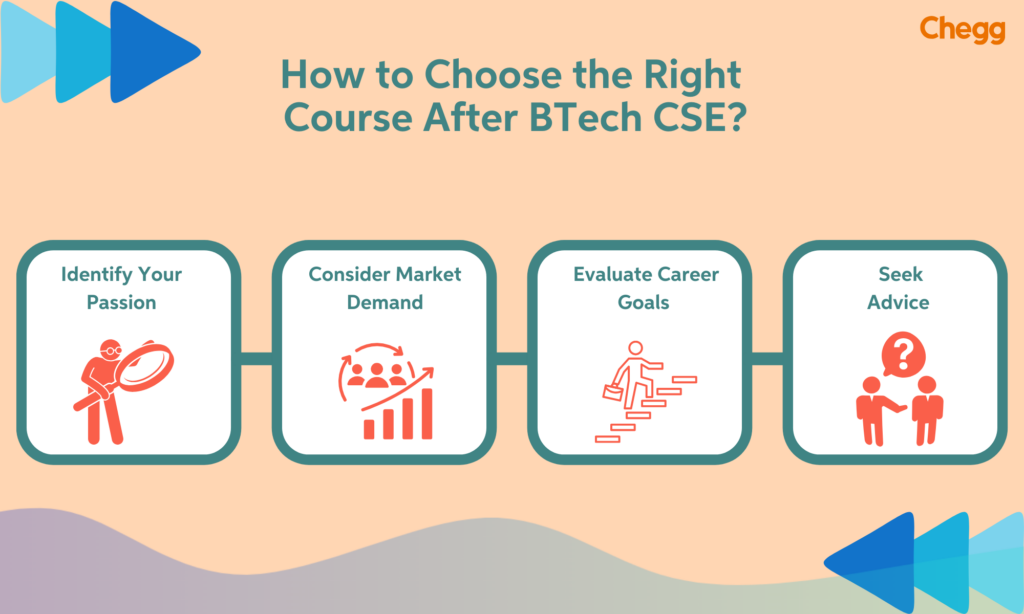
Selecting the right course after BTech CSE depends on your interests, career goals, and the current job market. Here are a few tips to help you make an informed decision:
Chegg India offers a fantastic platform where you can make money by working as a Subject Matter Expert or SME. Your task will be to respond to questions asked by students about the subject. By becoming an SME, you get to choose your hours, work at your own pace and deepen your knowledge on the subject of choice. Engineering, math, science, medicine, business, and a variety of other subjects are available on the platform.
Benefits of Working as an Expert:
Making the right call for yourself after BTech CSE is a key decision that will impact your career in technology. There are many routes to go down and it is important to determine which paths best suit your interests and desired goals. Whether you want to dive into the most modern technologies, or transition into management, the first step to a solid start to your future is to look into courses after BTech CSE. The right course after BTech CSE will give you the qualification, skills, and knowledge you need in order
After completing your BTech in Computer Science, there are many exciting paths to travel. You may want to build intelligent systems, lead product teams, or do research in some area, and a good course can open your world of possibilities. You should let your passion take you in your next step.

Pursue a Master’s degree (MTech, MSc) in a specialised field, consider an MBA, explore certifications in Data Science or Cybersecurity, or enter the workforce in software development, IT consulting, or startups.
After completing a BTech in CSE, you can pursue an MS, MBA, or specialized certification in data science, machine learning, cloud computing, or cybersecurity. Choose a course that aligns with your career goals and industry trends.
After BTech in CSE, you can pursue higher studies like an MS, MBA, or MTech, start your career in software engineering, data analysis, or system architecture, or earn certifications in AI, cybersecurity, or cloud computing to enhance your skills.
With the growing technology and IT industry, BTech CSE graduates will find many new job opportunities in the future. If you want to do CSE then you should go ahead with the degree. After graduating, you can work as a computer systems analyst, software developer, online tutor, technical blogger, and more. BTech CSE graduates can earn an average salary of INR 1.3 LPA.
The best MS courses after BTech CSE include MS in Computer Science, Data Science, Artificial Intelligence, Cybersecurity, and Software Engineering. These fields are in high demand and can lead to advanced career opportunities.
The best specialization courses after BTech CSE include Artificial Intelligence, Data Science, Cybersecurity, Cloud Computing, and Machine Learning. These fields offer excellent career prospects and are in high demand.
After completing BTech in Computer Science, you can either pursue higher education, such as an MTech or MS in a specialized area of computer science, or opt for professional certifications in fields like data science, AI, cybersecurity, or cloud computing. Alternatively, you can enter the workforce in roles like software developer, data analyst, or IT consultant.
The scope of computer science engineering (CSE) after 4 years can be quite broad. Graduates may find employment in software development, network administration, data analysis, cybersecurity, and various other IT-related roles across diverse industries.
Yes, BTech in Computer Science Engineering (CSE) is in high demand due to the increasing reliance on technology and the growing tech industry.
Yes, you can take MCA after BTech CSE, but MCA is often considered a good option for graduates with BSc/ BCA backgrounds. For BTech in CSE backgrounds, BTech graduates usually prefer MTech, MS and also a relevant certifications for better career growth.