
Summary
- Speech data annotation for ASR training data fails most often in two specific places: accent and dialect coverage, and overlapping speech, not in plain transcription accuracy.
- Commercial speech recognition systems have been shown to carry a large word error rate gap by speaker accent and dialect, averaging 35% against 19% in one study, traced to the acoustic models themselves (Koenecke et al., 2020).
- Overlapping speech carries a measurable, separately studied cost: one major multispeaker ASR challenge found that diarization alone added roughly 15 percentage points of absolute word error (Watanabe et al., 2020).
- Accent-aware annotation means deliberate sampling and tagging; overlap-aware annotation means timestamped, attributed markers, not a single flag.
- A worked support-call example walks through what a transcription-only vendor delivers against what properly scoped speech data annotation adds for both problems.
Ask a vendor to quote speech data annotation for a speech recognition project, and the brief that comes back usually reads like plain transcription with a new label on it. The two things that actually break a speech recognition model once it’s in production rarely show up on a transcript at all: how a speaker’s accent or dialect changes their pronunciation, and what happens when two people talk at the same time. A model trained mostly on one accent, recorded mostly as clean, single-speaker audio, looks accurate in testing and then falls apart the moment it meets a real call centre, a real meeting room, or a real customer in Hyderabad instead of Ohio.
I’ve reviewed enough speech recognition training sets to recognise the pattern. The general case for audio annotation, diarization, tone, the sounds between the words, covers that broader job well. Speech recognition has its own narrower version of the same problem, and it concentrates almost entirely in two places: accent and dialect coverage, and overlapping speech. This piece stays inside those two, not because the rest of audio annotation doesn’t matter, but because these are the two places a speech-to-text model actually fails once it leaves the lab.
What speech data annotation means for a speech recognition model
Automatic speech recognition, or ASR, is the technology that turns spoken audio into text: the system behind a voice assistant, a live caption, or a call-centre transcript. Data annotation, in plain terms, is a person listening to or looking at raw data and attaching a label that says what’s true about it. Speech data annotation applies that same work to audio bound for an ASR model’s training or evaluation set, which is a slightly different job from annotating a finished recording for its own sake.
For a general audio project, that labelling can mean tone tags, speaker diarization, or marking the background sounds a transcript can’t carry on its own, ground I’ve already covered in the broader piece on audio annotation. ASR training data narrows that list considerably. What a model actually needs to learn is how sound maps to words, reliably, across every voice it will ever hear in production. That narrower goal is exactly where two problems concentrate: a speaker’s accent changing how the words sound, and more than one speaker talking at once.
Why accents and dialects are the first hard problem
An accent is the way a speaker’s pronunciation, rhythm and vowel sounds differ by region or background, even when the words and grammar stay identical. A dialect goes a step further and changes some of the words and grammar too. Both change the raw sound a model has to map back to text, and most ASR training sets still skew heavily toward a narrow slice of that range.
Independent research on five commercial speech recognition systems, the same technology layer behind most consumer and enterprise ASR tools, found an average word error rate of 35% on Black speakers against 19% on white speakers, tested on matched audio for age, gender and recording quality (Koenecke et al., 2020). The gap held across every system tested. The researchers traced it back to the acoustic models themselves: how the systems heard the sound, not what vocabulary they expected to find in it.
Training data that mostly captures one accent teaches a model what one voice sounds like, and quietly treats every other voice as a deviation from it. That’s not a problem transcription accuracy alone can fix, because the transcript can read as perfectly correct while the underlying model is still only confident on a narrow range of speech.
What accent-aware speech data annotation actually requires
- Deliberate sampling across accents, dialects and regions, planned into the dataset from the start, not left to whichever recordings happened to be easiest to collect.
- Reviewers who can tell a genuine mispronunciation from a feature of how someone’s accent or dialect actually sounds, which takes real training against a written standard, not a private judgement call.
- Accent and dialect recorded as metadata on each clip, so a model’s weak spots can actually be found later, rather than normalised away before anyone can see them.
- A clear rule for when a transcript should match what was regionally said, and when it should match a single “standard” spelling, instead of leaving that call to each annotator individually.
Why overlapping speech is the second hard problem
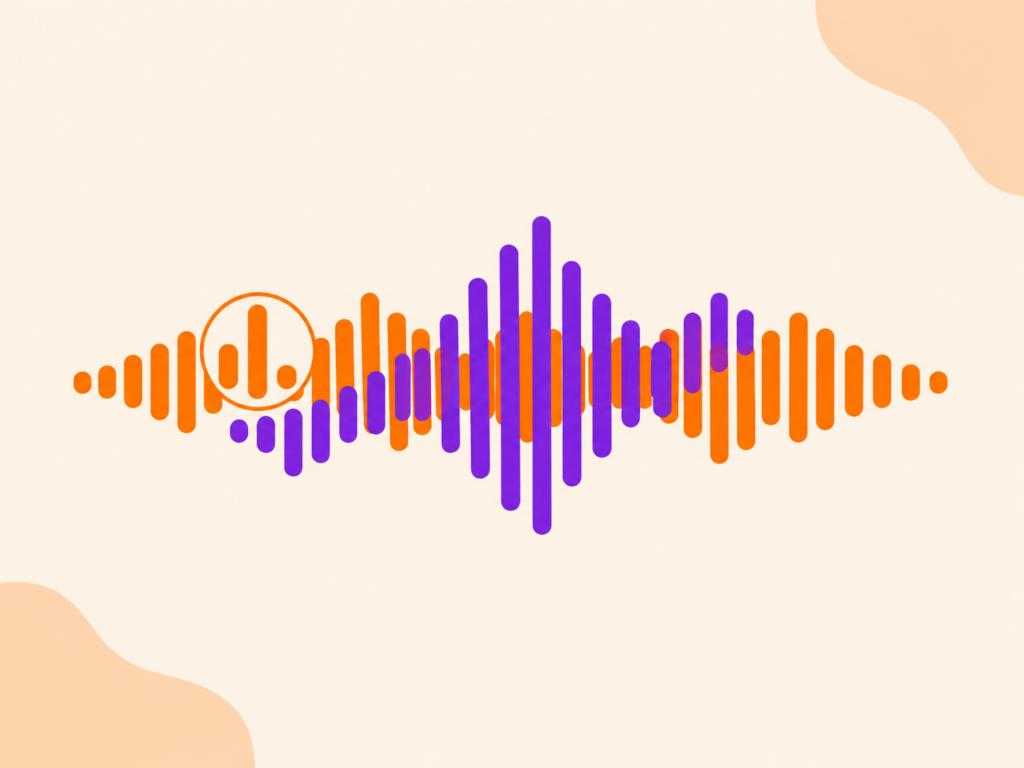
Overlapping speech is exactly what it sounds like: two or more speakers talking at the same time, for anything from a half-second interruption to a long stretch of crosstalk in a lively meeting. Most speech recognition training data is still recorded, or at least cleaned, to avoid it, which leaves models with almost no real exposure to how common it actually is.
Research built specifically around this problem shows what it costs. The CHiME-6 Challenge, which set multiple speech recognition systems against real, unscripted dinner-party recordings, found that adding speaker diarization, working out who is speaking and when, to an already-noisy conversational recording added roughly 15 percentage points of absolute word error on top of transcription alone, with baseline diarization error running above 60% (Watanabe et al., 2020). That’s not an edge case. It’s close to the default once real speakers start talking over each other.
A support call where an agent interrupts a frustrated customer, a meeting where two people answer the same question at once, a classroom recording with several voices overlapping: none of that is rare in the audio a production ASR system actually has to handle. A model that’s never seen labelled overlap in training has no real way to learn what to do with it, beyond guessing.
What annotating overlapping speech actually requires
- Marking the exact start and end time of every overlap, not a single flag somewhere in the file that says overlap happened.
- Attributing each overlapping word to the right speaker wherever that’s genuinely recoverable from the audio.
- Reviewers trained to catch a brief, half-second interruption, not only the long, obvious stretches of crosstalk.
- A written policy for what to do when overlapping words can’t be reliably separated, marking the segment as unclear rather than guessing at a transcript that sounds plausible.
A worked example
Say a company is training a speech recognition model to transcribe calls for a support operation that spans several regions and English dialects, with agents and customers calling in from across the country. The brief given to a vendor says “transcribe 10,000 calls.” A transcription-only vendor delivers exactly that: a clean block of text for every call, reasonably accurate on a good day.
On its own, that dataset teaches the model very little it can actually use in production. Every call gets averaged into whichever accent happened to dominate the sample, so the model ends up strong on one regional accent and noticeably weaker on the rest, without anyone noticing until it’s already live and customers start complaining that it keeps mishearing them. When an agent interrupts a frustrated customer mid-sentence, which happens constantly on a real support line, the transcript still reads as one tidy, non-overlapping stream. The training data is quietly telling the model that interruptions don’t exist.
Properly scoped speech data annotation adds both missing layers. Each clip gets tagged by region or dialect, with deliberate sampling so no single accent dominates the set by accident. Every overlap, down to a half-second interruption, gets marked with its own start and end time and attributed to a speaker wherever that’s recoverable. The model that comes out the other side has actually been shown what one region’s accent sounds like next to another’s, and what a real interruption sounds like, instead of being trained, by omission, to treat both as noise.
What to ask a vendor about speech data annotation
If outsourcing this work already makes sense for your team, the next step is reading past the word “annotation” on the quote itself. Vendors sell this work under several names, speech data annotation, speech to text annotation services, voice annotation services, and the label on the quote matters far less than whether these four questions get a real answer.
- Does the quote name accent and dialect sampling as a deliberate step, with a method behind it, or does it just say “diverse speakers” with nothing to back that up?
- Is overlapping speech timestamped and attributed to a speaker, or just flagged as “present” somewhere in the delivered file?
- Can reviewers explain how they’re trained to tell a dialect feature from a mispronunciation, rather than leaving that call to instinct?
- Is there a written standard for what happens when overlapping speech genuinely can’t be separated cleanly?
None of these four questions are about negotiating the price down. They’re about finding out whether the number in front of you covers the two problems that actually decide whether a speech recognition model holds up once real speakers, with real accents and real interruptions, start using it.
How Chegg approaches this
Chegg scopes speech data annotation for ASR training sets around exactly these two problems, not around a generic “speech annotation” line item. Dialect and accent coverage get planned into the sampling before a single clip is reviewed, not patched in after the fact. Overlapping speech gets timestamped and attributed by reviewers trained to listen for it, with a written standard for what to do when it genuinely can’t be separated. The underlying process is the same expert-vetting and calibration used across the annotation work Chegg does more broadly, aimed here at the two specific places a speech recognition model tends to break once it leaves the lab.
A buyer shouldn’t have to guess what’s actually covered. The real test for any vendor is whether they can describe their accent sampling method and their overlap-handling policy in one sentence each. If they can’t, the quote in front of you is probably pricing something narrower than what it’s calling itself.
Key takeaways
- Speech data annotation for speech recognition fails most often in two specific places, accent and dialect coverage, and overlapping speech, not in plain transcription accuracy.
- Commercial speech recognition systems have been shown to carry a large word error rate gap by speaker accent and dialect, averaging 35% against 19% in one study, and the researchers traced it to the acoustic models themselves.
- Overlapping speech carries its own measured cost: one major multispeaker challenge found that diarization alone added roughly 15 percentage points of absolute word error on top of transcription.
- Accent-aware annotation means deliberate sampling and tagging, not quietly correcting a transcript toward a single standard accent.
- Overlap-aware annotation means timestamped, attributed overlap markers, not a single flag saying overlap happened somewhere in the file.
- A vendor’s “speech data annotation” label means little until they can describe both their accent sampling method and their overlap-handling policy in plain terms.
FAQs
What is speech data annotation for speech recognition models?
Speech data annotation is the process of labelling audio so a speech recognition, or ASR, model can learn from it. That includes transcription, but also accent and dialect tagging, marking where speakers overlap, and flagging anything a transcript alone can’t capture about how the audio actually sounds.
How is speech data annotation for ASR different from general audio annotation?
General audio annotation covers a wider set of tasks: tone, diarization, non-speech events, across any audio use case. Speech data annotation for ASR narrows that down to the two problems that most affect a speech recognition model specifically, accent and dialect coverage, and overlapping speech.
Why do accents and dialects cause so many speech recognition errors?
Most ASR training data still skews toward a narrow range of accents, so a model learns one voice well and treats every other voice as a deviation from it. Independent research on five commercial systems found word error rates nearly double for one group of speakers against another, tested on matched audio, with the gap traced to the acoustic models themselves rather than vocabulary.
What counts as overlapping speech, and why does it matter?
Overlapping speech is any stretch of audio where two or more speakers talk at the same time, from a brief interruption to extended crosstalk. It matters because most training data is recorded or cleaned to avoid it, so models get little real exposure to something that happens constantly in genuine calls, meetings and conversations.
Are speech to text annotation services and voice annotation services the same thing as speech data annotation?
Largely, yes. Vendors use speech data annotation, speech to text annotation services and voice annotation services fairly interchangeably. All three describe the same underlying work: labelling spoken audio so a model can learn from it, not just transcribing the words.
How does Chegg handle accent and overlap challenges in speech data annotation?
Accent and dialect sampling is planned into a project before review starts, rather than patched in afterwards, and overlapping speech is timestamped and attributed by reviewers trained specifically to catch it, with a written standard for the cases that can’t be cleanly separated. That’s how both pieces of this work run at Chegg.