
Summary
- Human-in-the-loop (HITL) means a person reviews, corrects, or approves an AI system's output at defined points, rather than letting it run fully automated.
- HITL shapes training data itself (annotation, RLHF), not just how a finished model is used day to day.
- “Human-in-the-loop” and “human-on-the-loop” describe different levels of human control and are often confused.
- HITL is now central to keeping AI agents safe, pausing for approval before a consequential action.
- At Chegg, HITL principles are built directly into how the expert-reviewer network is run.
Human-in-the-loop (HITL) means a person actively reviews, corrects, or approves an AI system’s output at defined points in its workflow, rather than letting the system run on its own from start to finish. The phrase shows up constantly in AI discussions right now, often without a clear definition attached to it.
This article covers what HITL actually means, how it differs from the related idea of “human-on-the-loop,” where it shows up in practice, and why it matters specifically for the training data behind a model, not just how a finished model gets used day to day.
What is human-in-the-loop (HITL)?
At its core, HITL is a design choice: build a checkpoint into an AI system’s workflow where a person reviews or acts before the system proceeds, instead of letting it run fully automated. That checkpoint can sit almost anywhere in the system’s life. It can mean a reviewer checking a label before it’s used to train a model. It can mean a content moderator confirming a flagged post before it’s removed. It can mean an AI agent pausing mid-task to ask a person to approve a step before it continues.
What ties all of these together is the same structural idea: the human is a planned, permanent part of how the system is meant to work, not a fallback that only matters once something fails.
Human-in-the-loop vs. human-on-the-loop: what’s the difference?
The two terms get confused constantly, and the difference is worth being precise about, since they describe genuinely different levels of human control.
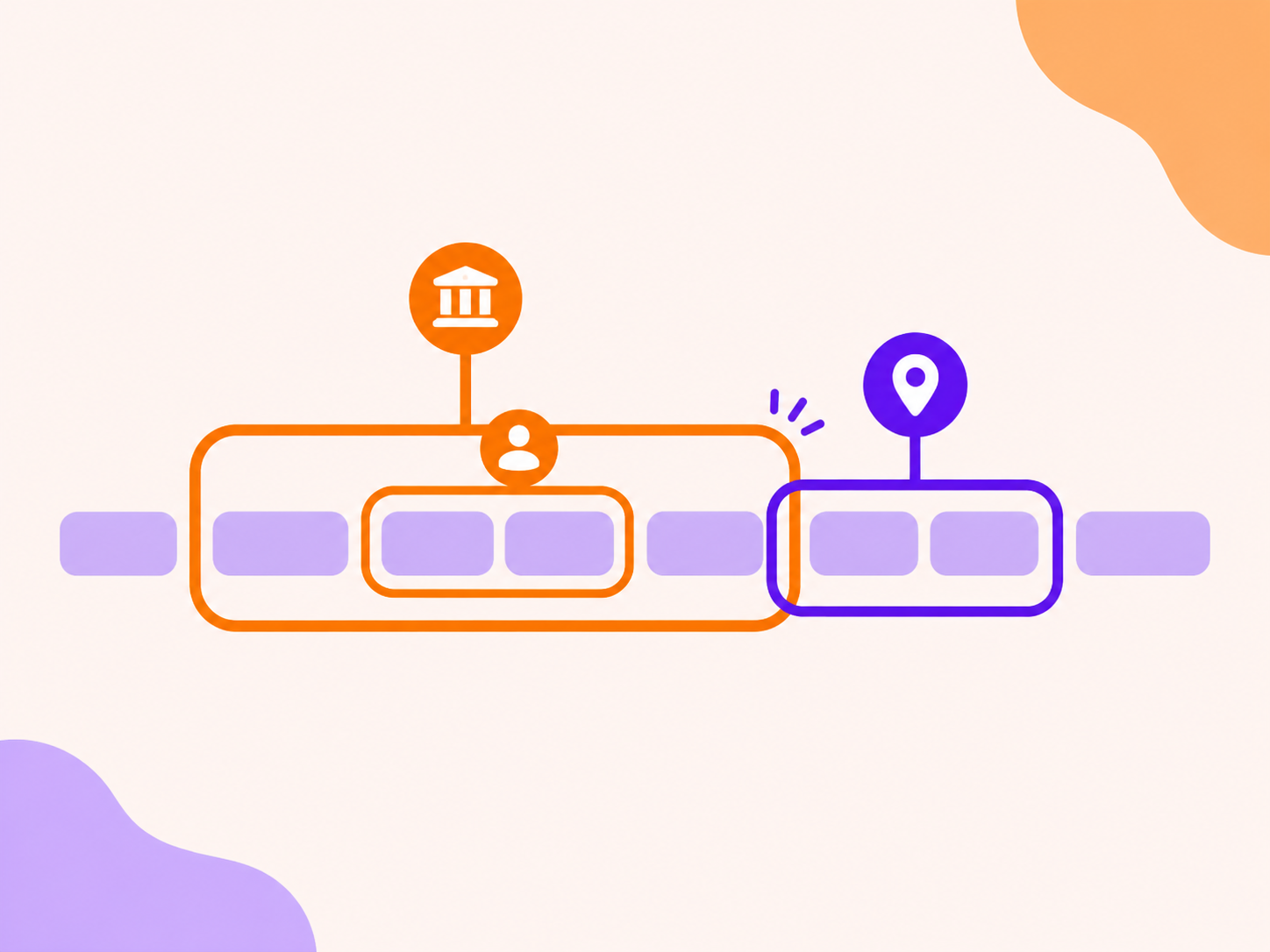
Human-on-the-loop describes a system that runs on its own, with a person monitoring it and able to intervene, but not required to approve each step. Think of a supervisor watching a dashboard and stepping in only if something looks wrong.
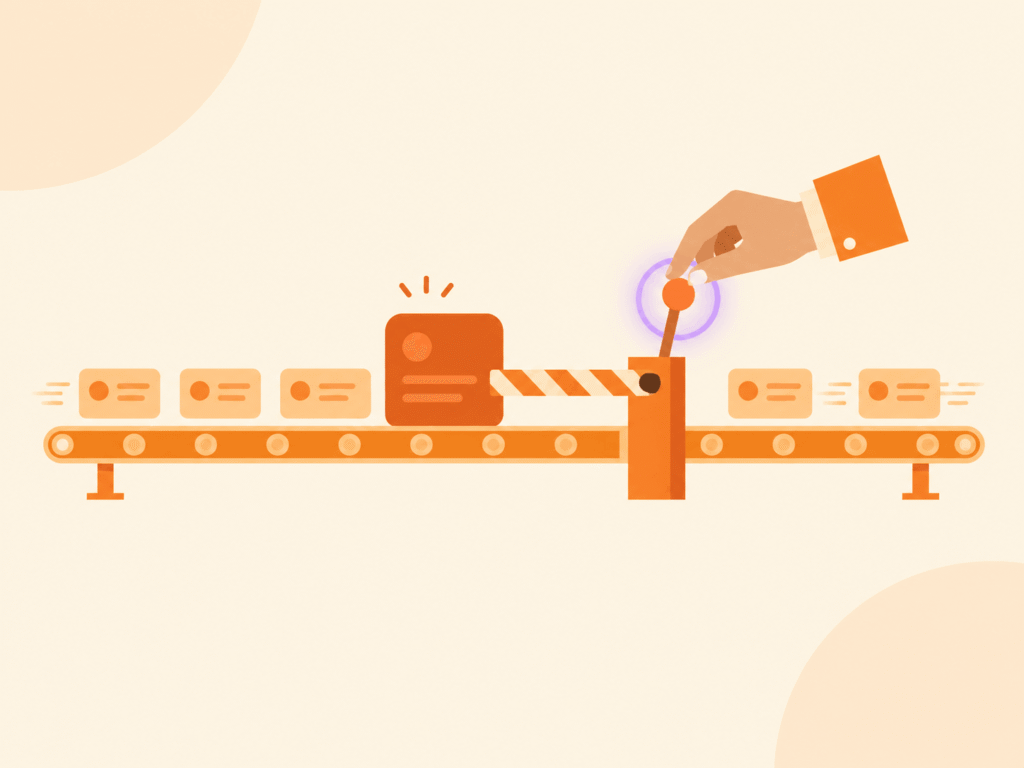
Human-in-the-loop describes a system that cannot proceed past a given point without a person’s input. The system waits. It doesn’t act unless a person tells it to.
This spectrum, from a human doing everything manually, through various shades of oversight, to a system running with no human involvement at all, was formally mapped out in a widely cited paper on levels of automation, which described automation as a continuum rather than a simple on/off switch (Parasuraman, Sheridan & Wickens, 2000, doi:10.1109/3468.844354). HITL and HOTL sit at different points on that same continuum, not as two unrelated ideas.
Why you’ll also see this called just “HITL”
HITL is simply the abbreviation, and in practice it shows up in writing about as often as the full phrase does, sometimes more. Vendors, tool documentation, and job postings all use it interchangeably with the spelled-out version. We use the full phrase through most of this piece for clarity, but don’t be thrown if a source you’re reading drops straight into “HITL” without ever spelling it out first.
It also predates the current wave of AI entirely. HITL as a term comes from robotic process automation and industrial control systems, where a person approving or correcting an automated step has been standard practice for decades. AI discussions borrowed the term rather than inventing it, which is worth knowing if you run into it in an automation or RPA context that has nothing to do with machine learning at all.
Why HITL matters for training data specifically
Most explanations of human-in-the-loop focus on how a finished model gets used: a chatbot escalating a tricky question to a person, a fraud system flagging a transaction for review. That’s real, but it’s only half the picture. HITL is just as central to how a model gets built in the first place.
Every label applied during data annotation is a human-in-the-loop decision: a person looking at a piece of data and saying what’s true about it. Every comparison made during reinforcement learning from human feedback, the technique behind getting a large language model to actually behave the way a product needs it to, is also HITL in action: a reviewer comparing two possible answers and saying which one is better. OpenAI’s own published research on this technique found a model 100 times smaller than its base version, trained purely on this kind of human comparison data, produced answers people preferred over the much larger original (Ouyang et al., 2022, arXiv:2203.02155).
The training data itself is a product of human-in-the-loop work, long before anyone talks about a model “using” HITL in production.
It compounds, too. A content-moderation model that escalates uncertain cases to a human reviewer isn’t just getting a safer decision in the moment. That reviewer’s decision, recorded correctly, becomes a new labeled example the next version of the model can actually learn from. Production HITL and training-data HITL aren’t two separate systems. Done well, the first one feeds the second.
A quick example
Say an AI agent is handling customer refund requests. For a $15 request that clearly matches the return policy, the agent processes it automatically. For a $4,000 request, or one that doesn’t clearly match policy, the agent stops. It drafts the refund, states its reasoning, and waits. A person reviews what the agent is about to do and either approves it or sends it back.
This is human-in-the-loop in its most literal, current form: not a person doing the work instead of the AI, but a person deciding, at a specific moment that actually matters, whether the AI’s proposed action should go ahead. The agent doesn’t ask permission for the $15 case. It does for the $4,000 one. That distinction, deciding where the checkpoint actually needs to sit, is most of the real design work.
Where HITL shows up
HITL shows up in a few genuinely different contexts, not as a single fixed workflow:
Training data and model development
Annotation, labeling, and human-feedback comparisons: the work that produces the dataset a model learns from in the first place. A medical-imaging annotation project, for example, typically has a radiologist or trained clinical reviewer confirm every label before it ever reaches the training set, since the cost of a wrong label here is categorically different from mislabeling a product photo.
Live monitoring and escalation
A deployed model handles routine cases on its own and hands off anything uncertain, high-stakes, or policy-sensitive to a person. Content moderation is the clearest example: obviously-fine and obviously-violating posts get handled automatically, and the genuinely ambiguous middle gets routed to a human reviewer rather than left to the model’s best guess.
Agentic AI and automation
An AI agent capable of taking real-world actions, sending an email, processing a payment, modifying a record, pauses before anything consequential and waits for a person to approve it. This is the newest and fastest-growing of the three, and the one most of the current conversation about HITL is actually about, largely because agents are the first AI systems routinely given the ability to take actions with real consequences, not just produce text.
Industries where HITL is non-negotiable
HITL shows up everywhere AI is used, but it stops being optional, and starts being a compliance or safety requirement, in a few specific industries:
- Healthcare, where a diagnostic or triage model’s output is reviewed by a licensed clinician before it affects patient care, not just before it affects a training set.
- Autonomous vehicles and robotics, where a remote human operator can take over or a safety driver can intervene, and where “disengagement” data, the moments a human had to step in, is itself some of the most valuable training data a self-driving programme collects.
- Financial services, where a fraud or lending decision above a certain risk threshold routes to a human underwriter rather than resolving automatically.
- Content moderation and trust and safety, where borderline cases (harassment, misinformation, self-harm content) go to a trained human reviewer rather than an automated classifier’s first guess.
Benefits of human-in-the-loop
- Catches errors before they become permanent, since a person reviews before an action is final, not after something’s already gone wrong.
- Builds trust for anything high-stakes or regulated, where a fully automated decision is hard to justify on its own.
- Gives a system a real path to improve, since every human correction is direct signal about where the automated part is still getting it wrong.
- Keeps accountability traceable: a decision with a named reviewer behind it is a very different thing from a decision no one can explain.
None of these benefits are automatic, though. They’re what a checkpoint provides when it’s designed and staffed properly, not a property of adding a human step for its own sake.
Drawbacks and limits of human-in-the-loop
- Costs real time and real people – a checkpoint that requires human review is, by definition, slower than one that doesn’t.
- Only works if the reviewer is actually qualified to make the call. A checkpoint staffed by someone without the right judgment adds a delay, not safety. The same mistake still happens, just later.
- Doesn’t scale by simply adding more reviewers indefinitely. At high enough volume, the review step itself becomes the bottleneck, which is usually when teams start asking which checkpoints can be safely removed.
These are arguments for being deliberate about where a checkpoint goes, rather than adding human review everywhere out of caution and discovering later that half of it was never actually catching anything, not arguments against HITL itself.
Why the human part is harder than it sounds
Putting a human in the loop sounds like it should fix the hard problem, but it mostly just relocates it. The actual difficulty moves from “can the AI get this right” to “will the reviewer get this right, consistently, under real conditions.”
A reviewer who’s rushed, under-briefed, or handed an ambiguous case with no real guidance will make an inconsistent call just as easily as an under-trained model would. The checkpoint only works if the person staffing it has the standing to actually make the judgment, clear guidance for the genuinely ambiguous cases, and enough time to look properly rather than rubber-stamp whatever the system proposes.
A checkpoint that exists on paper but gets approved in under two seconds, every time, without exception, isn’t actually a human in the loop. It’s a human-shaped delay.
What makes a HITL checkpoint actually work
Three things separate a checkpoint that genuinely catches problems from one that just adds latency without adding safety.
Where it sits matters more than how many checkpoints exist. One well-placed review step, right before the highest-consequence action in a workflow, does more than five checkpoints scattered across low-stakes steps nobody was worried about. The refund-agent example earlier works because the checkpoint sits exactly at the point where the dollar amount actually changes the risk, not at every step along the way.
Who staffs it matters as much as whether it exists. A checkpoint only earns its place when the person running it has the standing to actually evaluate the case; swap in someone without that background and the step turns into a formality that just takes longer. This is the same principle that applies to data annotation more broadly: the review is only as good as the reviewer’s standing to make the call.
And it has to be measured, not assumed. Override rates (how often a human actually changes the AI’s proposed outcome), time-to-review, and agreement between reviewers on the same case are the numbers that tell you whether a checkpoint is doing real work or quietly rubber-stamping. A checkpoint nobody is measuring is a checkpoint nobody can actually vouch for.
How this work actually gets done at Chegg
At Chegg, human-in-the-loop shows up in how the review work itself is staffed and run, not as a feature bolted onto a finished pipeline afterward: a network of vetted subject-matter experts, tested against a real graded standard before they review a single example, not assigned the work based on availability alone.
Every reviewer’s judgment is checked against a written guideline, not left to individual interpretation, and ambiguous cases get resolved once, by someone who understands the project, rather than re-litigated by whoever hits that case first. Inter-rater agreement, how often independent reviewers reach the same call on the same case, gets tracked as an actual number rather than assumed, so a checkpoint that’s quietly becoming a rubber stamp shows up in the data before it shows up as a real mistake.
That’s what turns “a human looked at it” into a checkpoint actually worth trusting, instead of a formality on the way to a decision the system had already made.
A buyer evaluating a vendor’s claim of “human-in-the-loop quality control” can’t verify that claim from the outside without asking how the checkpoint is actually staffed and measured. “A human reviews it” and “the right human reviews it, against a real standard, and we can show you the numbers” are very different promises, even though they sound identical in a sales conversation.
Key takeaways
- Human-in-the-loop (HITL) means a system cannot proceed past a defined point without a person’s input – not just a person who happens to be watching.
- Human-in-the-loop and human-on-the-loop sit on the same, formally established continuum of human involvement in automation, not two unrelated ideas.
- HITL shapes training data itself (annotation, RLHF) just as much as it shapes how a finished model gets used.
- Agentic AI is the newest and fastest-growing context for HITL: an agent pausing for approval before a consequential action.
- A human-in-the-loop checkpoint only works if the reviewer is genuinely qualified and given real time to look, not just a formality.
FAQs
Is human-in-the-loop the same as human-on-the-loop?
No. HITL requires approval before the system proceeds; HOTL means a person monitors a system that’s making its own decisions and can intervene, but isn’t required to approve each step. They sit at different points on the same continuum.
What does HITL stand for?
It’s simply the abbreviation for human-in-the-loop, used interchangeably with the full phrase across vendor content, documentation, and job postings.
Does agentic AI use human-in-the-loop?
Yes, and it’s currently the fastest-growing context for it: an agent capable of taking real actions pauses before anything consequential and waits for a person’s approval, rather than acting fully autonomously.
Why does human-in-the-loop matter for training data, not just finished models?
Because every label applied during annotation, and every comparison made during RLHF, is itself a human-in-the-loop decision. The training data is a product of HITL work before a finished model ever reaches a user.
What are the main drawbacks of human-in-the-loop?
Time and cost: a checkpoint that requires human review is slower by definition, and it only adds real safety if the reviewer is actually qualified to make the call it’s being asked to make.
Can human-in-the-loop scale?
To a point. Adding more reviewers works until the review step itself becomes the bottleneck, which is usually the point where teams start deciding which checkpoints can be safely automated away.
Is human-in-the-loop only an AI term?
No. It originated in robotic process automation and industrial control systems, where a person approving or correcting an automated step has been standard practice for decades. AI discussions borrowed an existing term rather than coining a new one.
How do you know if a human-in-the-loop checkpoint is actually working?
Measure it rather than assume it: override rates (how often a human actually changes the AI’s proposed outcome), time spent per review, and agreement between reviewers on the same case. A checkpoint nobody is measuring is a checkpoint nobody can actually vouch for.