
Are you unsure whether to send a Curriculum Vitae (CV) or a resume to an employer? It’s a common confusion, as the terms “CV” and “resume” are often used interchangeably. However, understanding the difference between CV and resume can help you decide which one to send.
The main difference between a CV (Curriculum Vitae) and a resume lies in their length, content, and purpose. A CV is a detailed document that covers your entire academic and professional history, including education, research, publications, and achievements. It is typically used for academic, research, or teaching positions.
In contrast, a resume is a shorter, targeted summary of your work experience, skills, and qualifications, usually limited to one or two pages. It is designed for general job applications in corporate or non-academic fields.
A CV follows a fixed chronological format, while a resume is flexible and tailored to highlight the most relevant experiences for each job. Understanding these differences helps ensure you submit the correct document for the role you’re applying for.
A Curriculum Vitae (CV) is a detailed document that outlines your entire career, including academic and professional achievements. It can range from a few pages to over ten and is typically used for academic roles, fellowships, and high-level positions like PhDs or research jobs. A CV includes contact info, education, work history, skills, publications, and more.
In contrast, a resume is a concise, one-page document tailored to a specific job, focusing on relevant skills and work experience. The key difference between CV and resume is that a CV provides a comprehensive career history, while a resume is a summary for a particular role. CVs are common in Europe and Canada, while resumes are standard in the U.S.
Used for academic, research, or international positions. It is longer and goes into more detail than a resume.
A resume is a concise, one-page document designed to showcase your qualifications for a specific job. It highlights key information such as your work experience, education, skills, and achievements. The primary goal of a resume is to capture an employer’s attention and secure an interview by focusing on the most relevant details for the role.
The key difference between CV and resume lies in their scope. A resume is brief and job-specific, emphasizing the qualifications that match the requirements of a particular position. On the other hand, a CV, or Curriculum Vitae, is a more detailed document that covers your entire career. It includes comprehensive information about your academic background, professional experience, research, publications, and other accomplishments, often used for academic or high-level roles.
In conclusion, the difference between CV and resume is crucial when applying for jobs. A resume is tailored to a specific position and provides a quick snapshot of your qualifications, while a CV offers a complete overview of your career, typically used for academic or research-oriented roles. Understanding this difference can help you choose the right document for your application.
This approach, used mainly in business and industry hiring, focuses on brevity and the specific needs of the job.
Recommended Read :

Now that you know what a CV and a Resume are, let’s explore the difference between CV and resume. A resume is a concise, one-page document that focuses on your work experience, skills, and education relevant to a specific job. It is tailored to the role you’re applying for and highlights only the most important information.
The difference between CV and resume becomes clear when you consider their scope. A resume is brief and job-specific, while a CV provides a detailed account of your entire career, including academic achievements, research, and publications. Understanding the difference between CV and resume will help you choose the right one for your job application.
The comparative table shows the difference between CV and Resume –
|
Basis of Difference |
CV |
Resume |
|
Type of Document |
A CV is usually a descriptive document that includes details about the candidate, like academics, working history, achievements, etc. |
A resume is a summarised document including a candidate’s work history and experience details. |
|
Focus On |
It focuses more on a person’s academic growth. As most people applying for research positions need CVs, they require a CV focused on academics rather than skills. | The length makes a difference between cv and resume. A CV could be more than two pages long, depending upon one’s experience. |
|
Used To |
It is mainly used while applying for academic or research positions. |
It is used mainly to apply for corporate, non-profit, and government positions. |
|
Customization |
A CV is more general, and the information stays the same mostly. |
Candidates can make changes to a resume according to the job position they’re applying for. |
|
Information Included |
In a CV, a candidate must include all the information, publications lists, and education history. |
In a resume, one needs to include information only if it is relevant to the job you are applying for. |
|
Content Order |
A CV needs to be in chronological order. |
The resume does not need to be in chronological order |
|
Length | The length makes a difference between CV and resume. A CV could be more than two pages long, depending upon one’s experience. |
Resume should be limited to a maximum of two pages. |
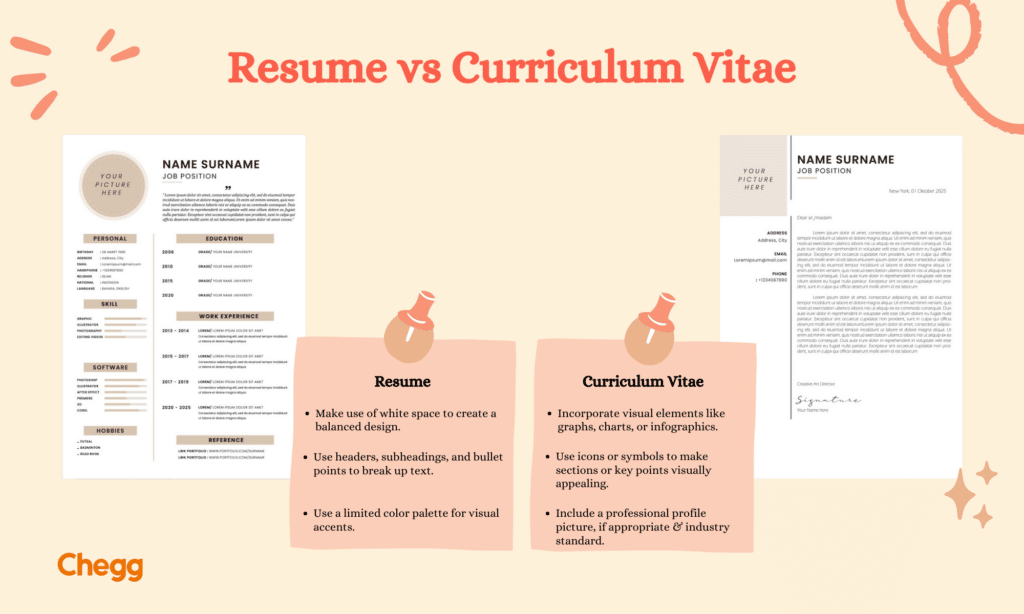
Here is an explanation of the difference between CV and resume with examples. A resume is a brief, one-page document tailored to a specific job, highlighting your skills, experience, and education relevant to that position. It is concise and job-specific, focusing only on the most essential information for employers.
On the other hand, the difference between CV and resume lies in their scope. A CV is a detailed, comprehensive document that covers your entire career, including academic achievements, research, and publications. It is often used for academic or high-level roles. Understanding the difference between CV and resume can help you choose the right document for your next job application.
Use these examples as a guideline for your next job application –
In a CV, one should also start with information like name, contact information, personal statement, professional experience, academic qualifications, skills, etc. It could also include certifications, language fluency, publications, awards or honors, and volunteer work.
Riya Sharma
YZ, Nehru Colony, New Delhi (Add the link to Twitter/Blog/Portfolio)
84758xxxxx | riya.kumari@gmail.com
Objective: Getting admitted to a premier institution for research work. It will help me attain the experience I would require for further education.
Education
1. Bachelor’s in Business Management | Amity University| 2015-2018 GPA: 8.9
2. Master’s in Business Administration | IMM Ahmedabad | 2020-2022 GPA: 8.0
Certifications and Awards
1. I completed a Human Resources certification course from IIT, Bombay. I also worked as a research intern at the same institution for 3 months.
2. Awarded a medal and a certificate for passing with distinction in my Bachelor’s course.
3. I have participated in inter-college debate competitions and won various awards for my college.
Experience
Human Resource Manager | Cognizant | 2018-2020
I managed the employees’ internal communication and recruitment for the organization.
Skills
1. Human Resource Management
2. Time Management
3. Research Work
4. Know MS Word, Excel, and Adobe PhotoShop
5. Good with managing clients.
Activities
I’m highly focused and dedicated to any projects that I take up, and that has been the case with my work as well as my academic studies. Also, I work hard to provide premium quality work in the given time.
References
Birendra Sharma, Professor, Amity University
Akash Banerjee, Senior Professor, IIM Ahmedabad
One must include basic information in the resume like name, contact information, resume summary, objective statement, employment history, accomplishments, skills, and certifications for the job.
Preeti Sharma
ABCD Area, Connaught Place, New Delhi | 84958xxxxx | Preeti.@email.com
Objective: I aim to work with an organization that could utilize my skills and help me to grow simultaneously.
Education
Degree | College | Date Earned
1. Graduation: Bachelor in English, Kirorimal College Delhi University, 2015
2. Post Graduation: Master’s in Journalism, Asian College of Journalism, 2017
Skills & Abilities
1. Writing
I have written for premiere organizations for more than 4 years and attained more than 200 bylines.
2. Editing
It is one of my core skills. I have edited articles for college magazines as well as for the organizations I worked for.
3. Research
Research is one of the critical skills I have. I use it for writing articles on different subjects.
Experience
1. Sub-Editor| The Hindu | 2017-2019
I edited articles on Education, Art & Culture, and Politics. Also, edited at least 3-4 articles a day while working in this organization.
2. Reporter| The Indian Express | 2019-2021
I have written articles on politics, crime, education, and entertainment. Wrote a minimum of two pieces per day. Their research work included on-ground reporting, attending press conferences, and conducting interviews.
A CV is used for roles that require specific expertise, such as academic or research positions. It provides detailed information about your education, skills, work experience, and accomplishments, making it ideal for jobs in the education sector.
The key difference between CV and resume is the level of detail. A CV offers a comprehensive overview of your career, including academic achievements, while a resume is shorter and focuses on relevant skills and experience for a specific job.
A resume is sent when you are applying for non-academic or non-research jobs. It is mainly used to apply for government, non-profit, and corporate job openings. A one-page resume provides complete information about the applicant but is much less descriptive. This highlights the difference between CV and resume, as a CV tends to be more detailed. Keep your resume short with all the relevant information, making it easy for the employer to scan your profile and determine if you fit the job description.
If you are unsure whether to choose a CV or a resume, it’s important to understand their different purposes. A CV provides a comprehensive overview of your entire career, including education and work experience, while a resume offers a summary of your skills, achievements, and work history. Resumes are concise and easy for HR to review quickly, whereas a CV is more detailed and typically used in academic settings to showcase a candidate’s knowledge and expertise in their field. This highlights the key difference between the two: resumes are job-specific and short, while CVs are comprehensive and academic.
Understanding the difference between CV and resume is crucial when applying for jobs. A CV (Curriculum Vitae) is typically longer, often detailed, and used for academic, research, or education-related positions. It provides a comprehensive overview of your career, including your qualifications, experiences, and publications. On the other hand, a resume is shorter—usually one page—and focuses on relevant skills, work experience, and achievements for corporate, public sector, or non-profit roles.
Before applying, research what the employer expects—whether a CV or resume. Tailor your application accordingly, keeping it clear, concise, and focused on the qualifications the employer seeks. For resumes, using keywords from the job description is essential to stand out.
In conclusion, understanding the difference between CV and resume is essential for creating the right document for your job application. A resume is a short, concise overview that highlights your qualifications tailored to a specific job. It focuses on skills and work experience, making it ideal for most job applications.
On the other hand, the difference between CV and resume becomes clear when considering the level of detail. A CV is more comprehensive and includes a complete record of your career, academic history, and achievements. Knowing the difference between CV and resume will ensure you choose the correct document based on the job and industry you’re applying for.
Ready to take the next step in your job search? Create a standout resume and cover letter with Chegg’s expert tips and guidance.

Yes, you can use a CV instead of a resume. However, a CV usually gives a more detailed overview of your academic and professional background. In contrast, a resume is generally shorter and focused on specific job applications.
A CV is usually better for detailed academic or professional backgrounds. A resume is more suitable for concise job applications that focus on specific roles.
Length: A CV is usually longer than a resume and often spans multiple pages, while a resume is typically one page.
Detail: A CV gives a complete overview of a person’s academic and professional background, including publications and research. In contrast, a resume summarizes relevant skills and experiences for a specific job.
Purpose: A CV is often used for academic, research, or international positions. A resume is more common for job applications in the corporate sector.
A CV is useful when applying for jobs, internships, academic positions, or volunteer opportunities. It is usually needed in formal job applications. It can also help in networking events or when seeking professional memberships.
Curriculum Vitae.
No, a CV and a resume are not the same. A CV (Curriculum Vitae) is a detailed document that covers your entire career history. It includes your education, work experience, skills, and achievements. A resume is usually shorter and focuses on specific skills and experiences that relate to a particular job.