

Are you curious about what you can earn with a BSc in Agriculture? As India’s agriculture sector undergoes rapid modernization, there’s a growing demand for skilled graduates, which means competitive salaries are on the rise. Whether you’re a student eyeing this exciting field or a recent grad figuring out your next steps, it’s crucial to understand the latest salary trends, including the bsc agriculture salary, to make informed career choices.
In this comprehensive guide, you’ll find the average BSc Agriculture salary of graduates across different roles, industries, and regions in India. We’ll dive into the factors that affect pay, spotlight the highest-paying positions, and share expert advice to help you boost your earning potential. With real data and insights from the industry, this article will empower you to set realistic expectations and plan for a financially rewarding future in agriculture.
So, are you ready to discover what your degree is truly worth in today’s job market? Let’s dive into the opportunities that await BSc Agriculture graduates in 2025!
BSc Agriculture stands for Bachelor of Science in Agriculture, a 4-year undergraduate program that teaches students everything about farming, crops, soil, animal husbandry, and more. This degree opens doors to many careers in agriculture, including working in both the public and private sectors.
A Bachelor of Science in Agriculture can be so much more than a degree; it can help you develop the skills you need to be a future-ready agriculturist. Agriculture is vital not just to global food security but also to economic secure development, and a BSc in Agriculture has a number of advantages. The following outlines the rationale for studying BSc in Agriculture as a smart and future-proof degree:
BSc Agriculture covers diverse areas such as horticulture, animal husbandry, rural development, environmental science, and agricultural economics. With the growing need for sustainable farming and food production, the sector is booming-making this a high-potential career path.
According to Agribusiness Global, technology-driven agriculture is set to revolutionize the industry. Revenue from agri-supply chain technology is expected to reach $204 billion, and the output market could hit $12.1 billion by 2025. This growth ensures exciting opportunities in agri-tech and smart farming.
Agriculture remains the main livelihood for nearly 40% of India’s population. Entry-level roles such as Seed Technologist earn around INR 3 LPA, while roles like Agriculture Officer can command salaries up to INR 9.6 LPA. With experience and specialization, the earning potential increases significantly.
One of the major advantages of pursuing BSc Agriculture is its affordability. Course fees typically range between INR 15,000 and INR 1,00,000, even in reputed colleges, making it accessible for students from diverse backgrounds.
This program offers flexibility with multiple specializations including Fisheries, Forestry, Agronomy, Plant Pathology, Veterinary Science, and more. This variety opens doors to numerous niche careers and advanced study options.
With international exposure increasing in agri-business, graduates can explore opportunities abroad in research, teaching, or consultancy roles. BSc Agriculture equips you to contribute meaningfully to global food systems, access cutting-edge innovations, and even take on roles as lecturers or trainers at higher salary packages.
The BSc Agriculture Salary graduate can earn in India typically ranges between ₹2,50,000 to ₹4,50,000 per annum for freshers and between ₹4,00,000 to ₹6,00,000 per annum for those having 2-5 years of experience. Those having more than 10 years’ of experience can earn between ₹8,00,000 to ₹15,00,000 per annum depending on the job role, location, and sector of employment (government or private).
Here’s a list of common job roles for BSc Agriculture graduates and their average salaries:
| Job Role | Average Salary (INR LPA) |
|---|---|
| Agriculture Officer | 9.60 |
| Agriculture Development Officer | 4.80 |
| Agriculture Analyst | 4.2 |
| Assistant Plantation Manager | 5.25 |
| Agricultural Research Scientist | 6 |
| Agriculture Technician | 3.5 |
| Seed Technologist | 3 |
| Plant Breeder | 7.76 |
| Animal Breeder | 5 |
| Agricultural Engineer | 4.9 |
| Sericulturist | 2.9 |
| Food Safety Officer | 4.2 |
| Food Critic | 6 |
| Food Technologist | 4.1 |
| ICAR Scientist | 7 |
| Research Assistant | 3 |
| Marketing Executive | 3.5 |
After completing your BSc Agriculture, you can choose to work in either the government or private sector. Both sectors offer good opportunities, but the salary, perks, and growth prospects can differ.
BSc Agriculture graduates can find work in many departments of government organizations like the Agricultural Department, Banking Sector (as Agricultural Officers), or Research Institutes. A good thing about government jobs is that they are accompanied by other benefits like pensions, allowances, and job security.
The following are some of the various positions available in govt jobs after BSc Agriculture and the BSc salary per month entailed in those govt jobs:
| Government Job Roles | Average Salary (LPA) | Job Details |
|---|---|---|
| Agricultural Officer | ₹4.5 – ₹6 LPA | Works with farmers and agricultural departments to implement government schemes, improve crop production, and promote modern farming techniques. |
| Agricultural Development Officer | ₹3.5 – ₹5.5 LPA | Helps develop and implement agricultural programs in rural areas, assisting farmers in enhancing their productivity and crop quality. |
| Food Safety Officer | ₹3 – ₹4.5 LPA | Ensures food safety standards are met by monitoring food production, processing, and distribution. Works in food safety departments. |
| Research Scientist (Government) | ₹6 – ₹8 LPA | Conducts research in government agricultural research institutions to develop improved crop varieties and innovative farming methods. |
| Forestry Officer | ₹3.5 – ₹5 LPA | Manages forests, wildlife, and natural resources, ensuring sustainable use and conservation efforts. Works with state or central government. |
| Horticulture Officer | ₹3 – ₹4.5 LPA | Focuses on fruit, vegetable, and flower cultivation, advising farmers and implementing government horticulture programs. |
| Agricultural Field Officer (Banks) | ₹4 – ₹6 LPA | Works in public sector banks to provide loans and financial support to farmers, helping them adopt modern farming techniques and technologies. |
Read More: Govt Jobs after Graduation
The private sector provides opportunities in agribusiness companies, food processing sectors and agrochemical companies. Starting salaries in the private sector may be slightly lower compared to government employment, however, private industry often offers quicker salary progression based on your ability to generate effective performance measures.
The private profiles for agriculture jobs in India graduates and their salary include:
| Private Sector Job Roles | Average Salary (LPA) | Job Details |
|---|---|---|
| Agronomist | ₹3 – ₹5 LPA | Works with agricultural companies to improve crop production and soil management, helping farmers increase yield and efficiency. |
| Farm Manager | ₹3 – ₹4 LPA | Manages the operations of a farm, including crop planning, labor management, and machinery handling, ensuring efficient production. |
| Agricultural Consultant | ₹5 – ₹7 LPA | Provides expert advice to farmers, agribusinesses, and agricultural companies on improving farming methods, production, and profitability. |
| Sales Manager (Agri-Products) | ₹3 – ₹6 LPA | Oversees the sales of agricultural products, such as seeds, fertilizers, and machinery, working with agribusinesses or agrochemical companies. |
| Food Processing Manager | ₹4 – ₹6 LPA | Manages food production and processing activities, ensuring quality control, safety, and adherence to industry standards in food companies. |
| Agrochemical Sales Executive | ₹3 – ₹5 LPA | Promotes and sells agrochemicals (fertilizers, pesticides) to farmers and agribusinesses, providing technical advice and solutions. |
| Plant Breeding Specialist | ₹4 – ₹6 LPA | Develops and enhances plant genetics to produce better crop varieties, working in private seed companies or research institutions. |
Bank jobs are one of the most desired job prospects for graduates in agriculture apart from central government departments. Below are the job profiles after BSc Agriculture along with salaries received per month.
| Job Profile | Average Salary (LPA) | Job Details |
|---|---|---|
| Agricultural Field Officer (AFO) | ₹4 – ₹6 LPA | Works in public or private sector banks to provide loans, financial assistance, and support to farmers, helping them adopt modern agricultural practices. |
| Rural Development Officer | ₹3.5 – ₹5.5 LPA | Focuses on implementing and promoting rural development programs, including agricultural finance schemes in rural areas. |
| Loan Officer (Agriculture) | ₹3 – ₹5 LPA | Evaluates loan applications from farmers and agribusinesses, assessing their financial viability and approving loans for agricultural projects. |
| Credit Officer | ₹4 – ₹6 LPA | Manages credit risk and evaluates the repayment capacity of farmers applying for agricultural loans, working closely with financial institutions. |
| Relationship Manager (Agri Loans) | ₹4 – ₹6 LPA | Builds and maintains relationships with farmers and agribusinesses, providing tailored financial solutions such as loans and insurance. |
| Bank Officer (Agriculture Loans) | ₹5 – ₹9 LPA | Specializes in processing and managing agricultural loans, ensuring farmers get timely access to finance for crop production and farm improvements. |
Career Path: Positions in banks often require good communication and analytical skills, and entry-level roles usually start at the probationary officer level. With experience, professionals can advance to managerial positions, often leading to substantial salary increases.
Overall, the banking sector provides stable and rewarding career options for B.Sc. Agriculture graduates, combining their agricultural knowledge with financial services
Read More: Common Bank Interview Questions and How to Answer Them

The location of employment can greatly affect your salary. The BSc Agriculture following graduates in areas of agriculture such as Punjab, Haryana, and Maharashtra tend to have higher salaries than their counterparts in rural or less-developed areas.
Here’s a breakdown of how salaries vary by region in India:
| Region | Average Salary (LPA) |
|---|---|
| Punjab, Haryana | ₹4 – ₹6 LPA |
| Maharashtra, Gujarat | ₹3 – ₹5 LPA |
| Tamil Nadu, Kerala | ₹3 – ₹4.5 LPA |
| West Bengal, Bihar | ₹2.5 – ₹4 LPA |
| Karnataka, Andhra Pradesh | ₹3 – ₹5 LPA |
Typically urban areas provide better compensation with the presence of agribusiness companies or research centers, concerning salaries. In contrast rural areas offer lower salaries, but may include housing or subsidy allowances.
The opportunities available to a BSc Agriculture degree holder are immense in both the public and the private sectors. As an agrarian economy, India has a wide scope for agriculture graduates. From competitive exams, to postgraduate courses, and reaching elite organisations- there are a spectrum of opportunities for BSc Agriculture graduates. So now let us delve into opportunities:
| Job Sector | Details |
|---|---|
| Indian Forest Service (IFS) | Esteemed all-India union service like IAS and IPS. Roles include Chief Conservator of Forests, Assistant Inspector, and Deputy Inspector. Candidates must pass the UPSC exam to qualify. |
| Indian Council of Agricultural Research (ICAR) | A central government organization under DARE, GOI. Roles available include Technologists and Research Fellows in agricultural research and innovation. |
| Food Technology Companies | Offers positions like Quality Food Technologist, Process Technologist, Food Safety Technologist, and Organic Chemist for graduates in food technology. |
| Research Centres | Opportunities in private or government research centers with roles like Research Scientist and Project Associate for those interested in agricultural research. |
| Fertilizer Manufacturing Firms | Positions such as Assistant Plantation Manager, Seed Officer, and Agricultural Research Scientist are available in fertilizer manufacturing companies. |
| Staff Selection Commission (SSC) | SSC conducts state-level exams, offering positions like Agriculture Officer, Scientific Assistant, Laboratory Assistant, Senior Technical Assistant, and Foreman in state government departments. |
| NGOs and Non-Profit Organizations | Work with organizations promoting sustainable agriculture and rural development as Agriculture Consultant or Development Officer. |
The possibilities for B.Sc. Agriculture graduates are extensive and diverse, shaped by increasing importance placed on sustainable farming practices, food security, and technology development in agriculture. Once equipped with the necessary skills and connected in the agriculture profession, graduates will have opportunities to succeed in their career and make a valuable contribution to the agricultural industry.
After completing a B.Sc. in Agriculture, graduates can pursue various competitive exams to secure jobs in government and public sectors. Here are some prominent exams:
| Exam Name | Job Role | Details |
|---|---|---|
| Indian Council of Agricultural Research (ICAR) | Scientist/Researcher | ICAR conducts exams for various research and scientist positions in agricultural research institutes. |
| UPSC IFoS (Indian Forest Service) | Forest Officer | Recruits for forest conservation and management roles. Requires knowledge of agriculture and forestry. |
| NABARD Grade A/B Officer | Agricultural Development Officer, Manager | NABARD conducts exams for recruiting officers to manage agricultural finance and rural development. |
| State Agricultural Department Exams | Agricultural Officer, Extension Officer | State-level exams for recruiting officers in state agricultural departments to work with local farmers. |
| Food Corporation of India (FCI) | Technical Officer, Manager | Recruits for roles in food procurement, storage, and distribution, ensuring food security. |
| IBPS AFO (Agricultural Field Officer) | Agricultural Field Officer in Banks | Recruits officers to help farmers get access to credit, loans, and financial advice for modern farming. |
These exams provide various pathways into government and public sector roles, emphasizing the importance of preparation and knowledge of the agricultural domain
Read More:
If you are wondering, ‘What can I do after BSc agriculture?’ Here are a few courses to uplift your career after a BSc in agriculture in the industry and these courses help to boost your salary too.
| Course Name | Course Details | Duration |
|---|---|---|
| M.Sc. in Agriculture | A postgraduate degree focusing on specialized fields such as Agronomy, Horticulture, or Plant Pathology. | 2 years |
| MBA in Agribusiness Management | A management program that combines agricultural practices with business principles and management skills. | 2 years |
| M.Sc. in Horticulture | Specialization in the cultivation and management of fruits, vegetables, and ornamental plants. | 2 years |
| M.Sc. in Soil Science | Advanced study of soil properties, management, and its role in agriculture. | 2 years |
| Ph.D. in Agriculture | Research-based program aimed at producing new knowledge in various agricultural domains. | 3-5 years |
| Diploma in Agriculture | Short-term course focusing on practical skills and knowledge in various agricultural practices. | 1-2 years |
| Post Graduate Diploma in Organic Farming | Covers techniques and management practices for organic agricultural systems. | 1 year |
| Certificate Courses in Agriculture | Various short courses available in areas like pest management, sustainable farming, and agricultural policies. | 6 months to 1 year |
| M.Sc. in Plant Breeding | Specialization aimed at improving plant varieties through genetic techniques. | 2 years |
| M.Sc. in Agricultural Economics | Focuses on the economic aspects of agriculture, including policies, marketing, and farm management. | 2 years |
Pursuing these courses can significantly boost salary prospects and open doors to specialized roles in agriculture.
Read More:
Several prominent organizations in India recruit BSc Agriculture graduates for various roles in agribusiness, research, and development. Below are some top recruiters:
| Organization | Sector | Details | Average Salary (LPA) |
|---|---|---|---|
| National Bank for Agriculture and Rural Development (NABARD) | Banking and Finance | NABARD offers roles such as Agricultural Officers and Development Managers to support rural finance and agriculture. | ₹4 – ₹6 LPA |
| Indian Council of Agricultural Research (ICAR) | Research and Development | Recruits for research-oriented roles, helping advance agricultural practices and innovations. | ₹6 – ₹8 LPA |
| Food Corporation of India (FCI) | Government | Ensures food security through procurement, storage, and distribution, offering roles in food management. | ₹3.5 – ₹5.5 LPA |
| IFFCO (Indian Farmers Fertiliser Cooperative Limited) | Fertilizers and Agrochemicals | One of India’s largest agricultural cooperatives, offering jobs in production and distribution of fertilizers. | ₹4 – ₹6 LPA |
| Bayer CropScience | Agribusiness | A global leader in seeds, crop protection, and biotechnology, Bayer recruits for roles in agronomy and sales. | ₹5 – ₹7 LPA |
| Mahindra Agribusiness | Agribusiness | Part of the Mahindra Group, providing opportunities in agri-tech, farm machinery, and agriculture marketing. | ₹4 – ₹6 LPA |
| Syngenta | Agrochemicals and Seeds | A global company offering roles in seed development, crop protection, and agricultural research. | ₹5 – ₹7 LPA |
| State Agricultural Departments | Government | State governments recruit Agricultural Officers and Extension Officers to work directly with farmers. | ₹3.5 – ₹5.5 LPA |
Here’s a list of some of the top BSc Agriculture colleges in India, known for their quality education, experienced faculty, and strong placement records:
| College/University | Location | Fee (Approx. per annum) |
|---|---|---|
| Indian Agricultural Research Institute (IARI) | New Delhi | ₹30,000 – ₹40,000 |
| Punjab Agricultural University (PAU) | Ludhiana, Punjab | ₹25,000 – ₹35,000 |
| Tamil Nadu Agricultural University (TNAU) | Coimbatore, Tamil Nadu | ₹20,000 – ₹40,000 |
| G.B. Pant University of Agriculture and Technology | Pantnagar, Uttarakhand | ₹30,000 – ₹50,000 |
| National Dairy Research Institute (NDRI) | Karnal, Haryana | ₹25,000 – ₹35,000 |
| Acharya N. G. Ranga Agricultural University (ANGRAU) | Guntur, Andhra Pradesh | ₹15,000 – ₹30,000 |
| University of Agricultural Sciences (UAS) | Bangalore, Karnataka | ₹20,000 – ₹40,000 |
| Dr. Panjabrao Deshmukh Krishi Vidyapeeth (PDKV) | Akola, Maharashtra | ₹25,000 – ₹35,000 |
| Kerala Agricultural University (KAU) | Vellanikkara, Kerala | ₹20,000 – ₹40,000 |
| Bihar Agricultural University (BAU) | Sabour, Bihar | ₹15,000 – ₹30,000 |
These institutions are recognized for their commitment to agricultural education and research, helping students gain the skills necessary to excel in the agriculture sector.
B.Sc. Agriculture graduates can find numerous job opportunities abroad, often with attractive salary packages. Here’s an overview of the potential job roles and their corresponding salary ranges in various countries:
| Job Roles | Average Salary (LPA) | Scope |
|---|---|---|
| Agricultural Engineer | $55,000 – $85,000 | Focus on designing agricultural machinery and infrastructure |
| Agricultural Scientist | $60,000 – $100,000 | Conduct research to improve agricultural practices and productivity |
| Business Development Executive | $50,000 – $70,000 | Work within agricultural companies to expand their market reach |
| Agronomy Consultant | $60,000 – $90,000 | Advise farmers on crop production, soil management, and sustainability |
| Crop Trial Coordinator | $50,000 – $80,000 | Manage and oversee crop trials for agricultural research |
| Agricultural Sales Officer | $45,000 – $75,000 | Sell agricultural products and services, expand customer relationships |
| Farm Manager | $60,000 – $90,000 | Oversee daily farm operations and manage resources effectively |
The job opportunities for B.Sc. Agriculture graduates abroad are promising, with competitive salaries that can vary based on experience, job role, and location. Graduates often find fulfilling careers in research, consultancy, management, and agribusiness, contributing significantly to advancing agricultural practices globally.
Read More:- Best Career Options and Scope after BSc Physics
The Bachelor of Science in Agriculture degree opens up new avenues to a prosperous career because many government banks are continually looking for new graduates to fill their officer positions. The degree is based on project learning with emphasis not only on agricultural development through practical application, but also allows you to complete the degree with the skills taught in the degree and salary expectations out in the real world. To maximize the benefits of this degree it is important to go to good colleges or universities. Graduates with a BSc in Agriculture can expect to be in a position to compete for various officer roles while enjoying their time on the job.
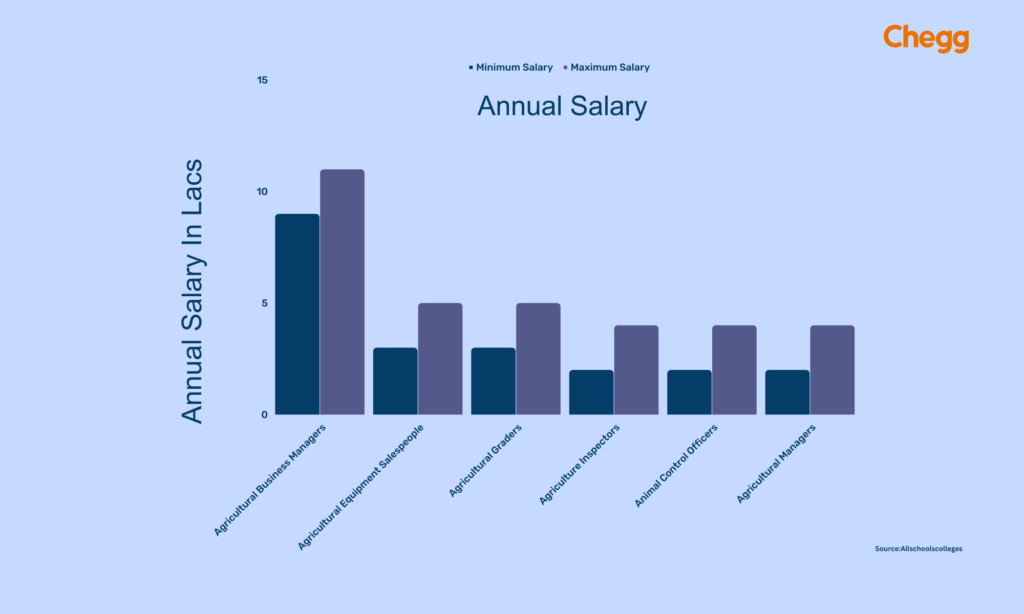
New graduates holding a BSc in Agriculture have access to a diverse array of sought-after job positions. Below is a summary of some of the leading roles within this sector:
For individuals with experience and a BSc in Agriculture, there are several attractive job options available, including:
Experience and education level are one of the biggest factors in determining your salary. You continue to gain experience as you earn your salary, and if you pursue higher education, you can earn a salary fit for higher levels of education.
There are many graduates of a BSc Agriculture program that choose to obtain higher studies such as an MSc Agriculture and/or a PhD. This can allow you to dabble in more specialized positions with higher salaries. Let’s show you how far your salary can progress through higher education:
| Degree | Average Salary (LPA) |
|---|---|
| BSc Agriculture | ₹2.5 – ₹4.5 LPA |
| MSc Agriculture | ₹6 – ₹8 LPA |
| PhD Agriculture | ₹8 – ₹12 LPA |
Understanding the salary landscape after earning a BSc in Agriculture is crucial for making informed choices about your education and career path. As the agriculture sector in India continues to evolve at a rapid pace, graduates are now presented with a broader array of opportunities, competitive salaries, and potential for growth across various industries. By keeping yourself updated on current salary trends, necessary skills, and emerging growth areas, you can set realistic expectations and position yourself for long-term financial success.
It’s important to remember that your earning potential is influenced not just by your degree, but also by your skills, experience, and your eagerness to keep learning. Take the time to explore different roles, seek advice from industry experts, and invest in your ongoing development. With the right mindset, your BSc in Agriculture can pave the way for a fulfilling and prosperous career in 2025 and beyond.
Evaluate numerous career choices to choose the right career path for yourself. Dive into our guide on Career Advice.
The starting salary after BSc Agriculture in India is around ₹20,000 to ₹30,000 per month, depending on the job role, location, and employer.
The highest salary for BSc Agriculture professionals can go up to ₹1,00,000 per month or more, especially in roles like agriculture consultancy or senior management positions in agribusiness companies.
Yes, BSc Agriculture offers good salary prospects, especially with increasing demand for experts in agriculture technology, farming consultancy, and agribusiness. Salaries start modestly but can grow significantly with experience.
The highest-paid jobs for BSc Agriculture graduates often include positions like Agriculture Officer, Plantation Manager, or roles in agribusiness firms. These can offer salaries upwards of ₹50,000 to ₹1,00,000 per month.
In the private sector, the salary for BSc Agriculture graduates typically ranges from ₹25,000 to ₹50,000 per month, depending on the company and expertise.
The average salary per month for BSc Agriculture graduates in India is between ₹20,000 to ₹40,000, with potential for growth over time.
For those working abroad, the salary after BSc Agriculture can range from $3,000 to $6,000 per month (₹2,50,000 to ₹5,00,000), depending on the country and role.
The top-paying industries for BSc Agriculture graduates in India include agricultural research, agri-tech companies, food processing, fertilizers and pesticides, banking and financial services, and government sectors.
After completing a BSc in Agriculture, potential job options include:
Agricultural Consultant
Farm Manager
Agronomist
Food Safety Officer
Agricultural Scientist
Crop Production Specialist
Livestock Manager
Agricultural Business Manager
Soil Scientist
Environmental Consultant
Consider internships or further studies to enhance career prospects.