

Dreading the “What is your weakness?” question in interviews? You’re not alone. This common interview prompt often makes even the most prepared candidates feel anxious. But here’s the good news: discussing your weaknesses, when done honestly and thoughtfully, can actually improve your chances of landing the job. Employers don’t expect perfection. They want to see self-awareness, a willingness to grow, and the ability to turn challenges into learning opportunities.
In this guide, you’ll discover effective strategies for answering the weakness question with confidence and authenticity. Based on real interview experiences and recruiter insights, we’ll show you how to pick the right weakness, frame it positively, and demonstrate your commitment to personal and professional growth. Whether you’re just starting out or have years of experience, this article will help you build trust and credibility in your next interview by turning a tricky question into a valuable opportunity.
Weakness in an interview refers to a candidate’s areas of improvement or professional challenges. Interviewers ask this question to evaluate your self-awareness and honesty. A strong answer acknowledges a genuine weakness and highlights the steps you’ve taken to overcome it.

When an employer asks, “What is your weakness in interview?”, they’re not looking for perfection—they’re testing your ability to recognize and reflect on your own limitations. Candidates who can thoughtfully identify a weakness show emotional intelligence, which is critical for adapting and succeeding in dynamic work environments.
Discussing a weakness in interview helps employers evaluate a candidate’s honesty. Dodging the question or giving overly cliché answers can appear insincere. On the other hand, openly discussing a real but manageable weakness shows transparency and integrity—traits valued in any professional setting.
Employers are interested not just in what your weakness is, but how you’re working to improve it. Especially when asking “What is your weakness in interview?”, they want to see if you’re proactive in addressing your shortcomings. This is particularly important for roles that demand continuous learning and adaptability.
The weakness in interview for freshers often reveals how open a candidate is to learning and mentorship. Since freshers lack experience, their attitude toward growth becomes a key selection factor. A fresher who acknowledges a soft skill gap and shows eagerness to improve is more likely to thrive in a corporate environment.
Sometimes, the answer to “What is your weakness in interview?” helps recruiters determine if a candidate’s current skill gaps can be bridged on the job. If the weakness doesn’t critically hinder the core responsibilities, employers may still consider the candidate, especially if there’s a strong learning trajectory in place.
Weakness:
I have a tendency to take on too much myself instead of delegating effectively.
Context:
This became evident while leading a team project in college—I tried to manage both planning and technical execution, which led to stress and reduced team involvement.
Action Steps:
I studied basic project management, started using Trello to assign tasks, and encouraged team ownership through regular check-ins and feedback loops.
Result:
Our projects became more efficient, and the team performed better. I now lead more confidently by trusting others and distributing work appropriately.
Weakness:
I used to struggle with public speaking, often avoiding group presentations or formal talks.
Context:
During college and internships, I found myself getting nervous during reviews or class seminars, which impacted my confidence.
Action Steps:
I joined a public speaking workshop, began practicing in smaller meetings, and recorded myself to improve posture and tone based on feedback.
Result:
I recently presented a seminar to over 50 students successfully and now feel more composed and prepared during public speaking engagements.
Weakness:
Initially, I lacked strong skills in Microsoft Excel, particularly in advanced formulas and data handling.
Context:
In my internship, I faced difficulty preparing automated reports and performing data analysis, which slowed down my contributions.
Action Steps:
I enrolled in an Excel course on Coursera, practiced with sample datasets, and consulted experienced teammates for feedback.
Result:
Within a month, I could build automated dashboards and use complex functions confidently. By the end of the internship, I had optimized multiple reporting processes.
Weakness:
I have a habit of overanalyzing my work and striving for perfection, which can lead to unnecessary revisions.
Context:
While freelancing, I noticed I was spending too much time perfecting deliverables—even when they already met the client’s expectations.
Action Steps:
I adopted timeboxing to limit over-editing, defined “good enough” quality benchmarks, and sought external feedback to avoid second-guessing.
Result:
My productivity improved, I met deadlines more easily, and client satisfaction remained high without over-polishing every task.
Weakness:
I found it difficult to say no to additional work, often overloading myself.
Context:
This happened during my time as an event coordinator in college, where I took on more responsibilities than I could handle—leading to missed sleep and last-minute work.
Action Steps:
I learned to prioritize tasks using urgency matrices, practiced assertiveness in communication, and set clearer personal limits with teammates.
Result:
My stress levels dropped, and I was able to deliver higher-quality work by managing my bandwidth better and maintaining team trust.
How to Tackle It:
“In the past, I was uncomfortable speaking in front of large groups, especially during presentations. To overcome this, I joined a local Toastmasters club and started volunteering to present in college seminars. I’m still improving, but I’m far more confident now than I was a year ago.”
Why It Works: Shows willingness to face a common fear and take proactive steps to improve communication skills.
How to Tackle It:
“I used to take on more tasks than I could handle, thinking it would show initiative. While my intentions were good, it affected my productivity. I’ve since learned to prioritize, delegate when needed, and use planning tools like Trello to manage my workload better.”
Why It Works: Demonstrates growth in time management and setting healthy work boundaries.
How to Tackle It:
“Early in my internships, I often tried to do everything myself, fearing others wouldn’t meet the same standards. I realized this limited team efficiency. Now, I focus on building trust in collaboration and assigning tasks based on team members’ strengths.”
Why It Works: Highlights leadership development and the ability to function in a team.
How to Tackle It:
“I used to spend excessive time perfecting every detail, even for small tasks. While accuracy is important, I’ve learned that time efficiency and meeting deadlines are equally crucial. I now set time limits for each task to balance quality with productivity.”
Why It Works: Turns a weakness into a valuable learning about time vs. quality trade-offs.
How to Tackle It:
“As a fresher, I thought asking questions would make me look inexperienced. But I’ve learned that seeking guidance when needed actually accelerates learning. Now, I approach peers or mentors early on when something is unclear.”
Why It Works: Especially great for freshers—shows maturity, eagerness to learn, and adaptability.
How to Tackle It:
“In the beginning of my career, I found it difficult to say ‘no’ to requests, even when I was overloaded. This led to unnecessary stress and reduced efficiency. I’ve since learned to set realistic expectations and prioritize tasks to protect my productivity and well-being.”
Why It Works: Reflects emotional intelligence and professional maturity in managing workload.
How to Tackle It:
“Providing constructive feedback was initially uncomfortable for me, especially in team projects. I worried about hurting someone’s feelings. Over time, I’ve practiced giving respectful, solution-oriented feedback, and now see it as a tool for collaboration and growth.”
Why It Works: Shows development of leadership and interpersonal skills.
How to Tackle It:
“As a fresher, I hesitated to volunteer for tasks outside my scope, fearing I’d mess up. But with experience and mentorship, I’ve started taking initiative on small projects and have seen it build my confidence and visibility.”
Why It Works: Perfect for freshers; shows growth mindset and readiness to step out of the comfort zone.
How to Tackle It:
“I realized I often defaulted to emails or chats instead of picking up the phone or setting up quick calls, which sometimes slowed down collaboration. I’m now working on improving my verbal communication and initiating more direct conversations when needed.”
Why It Works: Addresses a common modern workplace habit and shows effort toward efficiency.
How to Tackle It:
“In group assignments, I used to get impatient if others worked slower than my pace. I’ve since learned to respect different working styles and support team members rather than rush outcomes. It’s made me a better collaborator.”
Why It Works: Demonstrates self-control, empathy, and team adaptability—key for collaborative roles.

When preparing to talk about your weakness in interview, it’s crucial to choose an area that is authentic yet not a dealbreaker for the role. Avoid saying you’re a perfectionist or that you work “too hard”—these are often perceived as insincere. Instead, pick something you’ve genuinely struggled with but have made efforts to improve. This shows realism and personal growth.
One key strategy while preparing for the strength and weakness in interview discussion is to ensure your chosen weakness doesn’t directly impact the core responsibilities of the job. For example, if you’re interviewing for a client-facing role, avoid saying you’re uncomfortable speaking to people. Your weakness should reflect a secondary skill that can be improved with experience or training.
Interviewers aren’t just interested in what your weakness is—they want to know what you’re doing about it. This is especially important when tackling questions like “what is your weakness in interview?” Always follow up your answer with specific steps you’ve taken to overcome the issue. Whether it’s enrolling in a course, seeking feedback, or practicing regularly, your efforts show initiative.
Understanding how to frame a weakness in interview for freshers is important because you might lack job experience. Instead of technical gaps, focus on soft skills or adaptability issues, such as time management or public speaking. Then, back it up with examples from college projects or internships to illustrate how you’re working to improve.
When discussing strength and weakness in interview, balance is key. Don’t let your weakness overshadow your strengths. Prepare to pivot smoothly from your weakness to your strengths to leave a confident impression. This shows that while you’re aware of your areas of improvement, you also recognize the value you bring to the table.
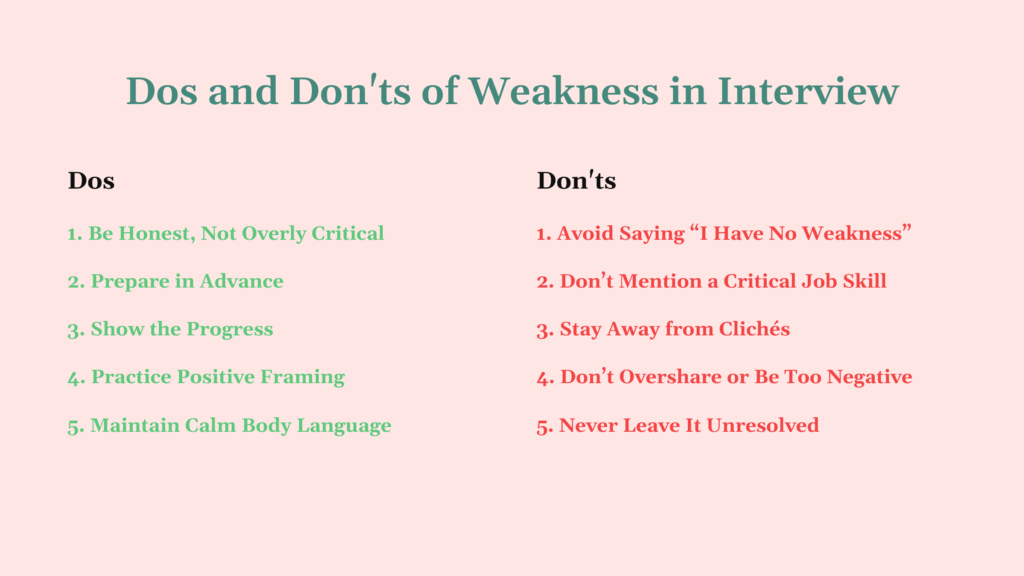
Answering the weakness in interview question can feel intimidating, but with the right approach, it becomes a chance to impress recruiters with your self-awareness and growth mindset. Here are some practical tips to help you respond confidently and authentically:
Choose a real weakness, but one that doesn’t sabotage your suitability for the job. Avoid saying things like “I’m bad at teamwork” or “I miss deadlines.” Instead, pick a soft skill you’re actively improving—this keeps your answer honest without being negative.
Confidence comes from preparation. Think through your answer before the interview and rehearse it. Whether you’re a fresher or experienced professional, crafting a thoughtful response helps you avoid fumbling when asked, “What is your weakness in interview?”
Always highlight what you’re doing to improve. For example, if your weakness was time management, mention how you’re now using tools like calendars or planners. Turning a weakness into a growth story instantly adds confidence to your delivery.
The way you frame your weakness in interview for freshers matters. Say, “I used to struggle with public speaking, but I’ve been practicing through webinars and presentations” instead of “I’m terrible at speaking in public.” Stay constructive.
Smile, keep eye contact, and maintain a steady tone. Nervous energy is natural, but don’t rush your answer. A calm and composed demeanor reinforces that you’re comfortable discussing challenges—just like a professional would.
The “weakness in interview” question is a common one—and while it offers a chance to show self-awareness, it can also backfire if handled poorly. To make a positive impression, here are key things you should absolutely avoid:
Claiming you have no weaknesses shows a lack of self-awareness and may come off as arrogant. Every professional, fresher or experienced, has areas to improve—and acknowledging them signals maturity.
If the job requires strong communication, don’t say your weakness is public speaking. Choose a weakness that’s real but not central to the role, especially when answering weakness in interview for freshers.
Avoid overused responses like “I’m a perfectionist” or “I work too hard.” These may sound rehearsed and inauthentic. Recruiters appreciate original, thought-through answers with a personal touch.
This isn’t a therapy session. Avoid going into too much detail or framing your weakness as a personality flaw. Stay professional and focus on how you’re addressing the weakness.
A major mistake is stating a weakness without mentioning how you’re improving it. Interviewers want to hear not just the problem but the progress—so always pair your weakness with a solution or learning step.
Read More: Examples to Address Weakness in Interview
Handling the “What is your weakness?” question honestly and with self-reflection can help you stand out as a thoughtful and trustworthy candidate. Choose a real weakness, explain the steps you’re taking to improve, and show that you have a growth mindset. This shows maturity and a willingness to learn, which are qualities that every employer values.
Interviews aren’t about proving your perfection; they’re about demonstrating your ability to adapt and grow. Practice your response, ask for feedback from mentors, and see each interview as a chance to learn. With the right preparation and mindset, you can turn this tough question into an opportunity to showcase your self-awareness and commitment to continuous improvement. This will help you stand out in the competitive job market of 2025 and beyond.

My weakness is that I sometimes overthink details. However, I’m improving by focusing more on efficiency and managing my time well.
Here are five examples of weaknesses you can mention in an interview:
Overthinking details.
Difficulty saying no.
Public speaking anxiety.
Taking on too much work.
Impatience with delays.
5 Strengths:
Strong communication skills
Problem-solving ability
Leadership qualities
Adaptability
Teamwork
5 Weaknesses:
Overthinking details
Public speaking anxiety
Difficulty saying no
Impatience with delays
Taking on too much work
The most common weakness in interviews is anxiety about public speaking or communication.
Weaknesses are areas where you have difficulty. These can include overthinking, problems with time management, anxiety during public speaking, impatience, or trouble saying no.
You should hire me because I have the skills and dedication for this role. I’m confident I can help your team succeed.