

A self appraisal examples is a reflective statement made by an employee during a performance review process, where they evaluate their own work, achievements, challenges, and areas for improvement. This practice not only fosters self-awareness but also encourages accountability and open communication between employees and managers. A well-written self-appraisal comment showcases an employee’s ability to recognize their contributions and take ownership of their professional development. For instance, a self-appraisal comments by employee example could be: “I successfully led the redesign of our client onboarding process, reducing turnaround time by 20%, and I look forward to exploring new project management tools to further streamline our workflow.”
The importance of self appraisal examples lies in their power to shape career growth and development. When employees take the time to critically assess their performance, they are more likely to identify skill gaps and set clear goals for the future. Moreover, these insights help managers tailor feedback and support to align with the employee’s aspirations and strengths. By contributing thoughtful self-appraisal comments, employees demonstrate initiative and a growth mindset—key attributes for professional advancement. A thoughtful self-appraisal comments by employee example might read: “I’ve made significant progress in team collaboration and conflict resolution this year, but I aim to enhance my public speaking skills to contribute more effectively in leadership meetings.”
Self-appraisal comments by employees play a crucial role in the performance review process, serving as a personal reflection on an individual’s achievements, challenges, and growth opportunities over a given period. Unlike traditional evaluations where feedback flows only from managers, self-appraisals encourage employees to actively participate in assessing their own contributions. This process fosters greater self-awareness, accountability, and professional development, allowing employees to highlight their strengths while honestly acknowledging areas where improvement is needed. Well-crafted self-appraisal comments provide valuable insights that can help managers tailor their feedback and support, making performance discussions more balanced and meaningful.
A self-appraisal comment by an employee is a personal evaluation statement reflecting on one’s performance, achievements, and growth areas, used during reviews to communicate progress, set goals, and foster accountability and professional development within the organization.

Encourages Self-Reflection: Self-appraisal helps employees honestly evaluate their own performance, strengths, and areas for growth, fostering greater self-awareness.
Promotes Personal Accountability: When individuals assess their own work, they take more ownership of their progress and development.
Facilitates Clear Communication: It provides a structured way for employees to share their perspective with managers, ensuring their contributions and challenges are recognized.
Supports Goal Setting: Self-appraisals help identify areas for improvement and set realistic, personalized goals for future growth.
Enhances Career Development: By understanding their achievements and skills, employees can better plan training, seek opportunities, and align their career path with their aspirations.
Here are 50 self-appraisal comments by employee examples, structured across various performance categories. These can be used as inspiration or directly inserted into performance review documents:
Begin your self-appraisal by objectively reviewing your accomplishments over the review period. Focus on specific goals you met, projects you contributed to, or milestones you achieved. Be factual and confident without exaggeration. This reflection helps build a solid foundation for the rest of your evaluation. A useful self-appraisal comments by employee example could be: “I successfully led the marketing campaign that increased client engagement by 35% over three months.”
Support your comments with measurable outcomes whenever possible. Using data not only strengthens your appraisal but also shows your awareness of performance metrics and results. Managers value quantifiable impact. A relevant self-appraisal comments by employee example might be: “I resolved over 150 customer support tickets, maintaining a 98% satisfaction rate throughout the quarter.”
Demonstrating self-awareness by recognizing where you can grow is a sign of maturity and professionalism. Avoid vague statements and focus on areas you are actively working to improve. For instance, a constructive self-appraisal comments by employee example is: “While I met my sales targets, I plan to enhance my presentation skills to better communicate value propositions during pitches.”
Today’s workplaces thrive on collaboration. Use this section to show how you’ve contributed to a positive team environment or supported your colleagues. Highlighting soft skills alongside technical achievements paints a well-rounded picture. A good self-appraisal comments by employee example would be: “I collaborated with cross-functional teams to streamline workflow, which improved project delivery times by 15%.”
Conclude your self-appraisal with a future-focused mindset. Identify your professional development goals and how they align with the company’s objectives. This demonstrates vision and commitment to growth. A forward-thinking self-appraisal comments by employee example is: “In the upcoming year, I aim to complete a leadership certification to prepare for managerial responsibilities.”
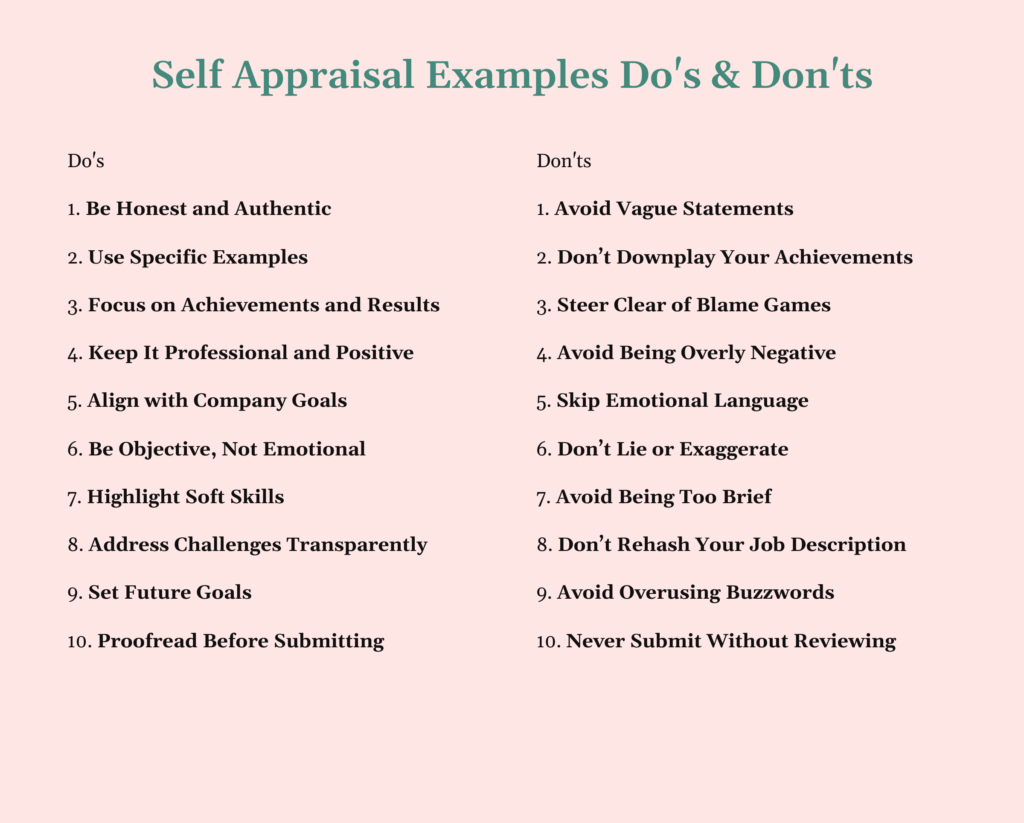
Genuine reflections resonate more than exaggerated praise. A self-appraisal should be a balanced account of your achievements and areas for growth, demonstrating integrity and self-awareness.
Avoid vague language. Back up your statements with real examples of your work. This adds credibility and helps managers understand the impact of your contributions.
Highlight measurable outcomes to show the value you’ve added. For instance, mention improved KPIs, revenue growth, or successful project completions.
Maintain a respectful and confident tone. Even when discussing challenges, frame them constructively by emphasizing lessons learned and improvements made.
Demonstrate how your work supports the broader goals of the organization. This shows that you understand your role within the larger mission.
Stick to facts and outcomes rather than feelings. Use data and performance indicators where possible to support your statements.
In addition to technical achievements, mention interpersonal strengths such as communication, leadership, and teamwork. These skills are equally valuable in most roles.
Mentioning a setback isn’t a weakness—it’s an opportunity to show resilience. Explain what you learned and how you overcame the issue.
Use the self-appraisal to show initiative by outlining your development goals. This reflects ambition and a commitment to continuous growth.
Always check for clarity, grammar, and professionalism. A well-written appraisal reflects attention to detail, an important quality in any role.
Generic phrases like “I did a good job” lack impact. Be specific about what you accomplished. A poor self-appraisal comments by employee example would be: “I worked hard all year.” Instead, mention exact projects or outcomes.
Being overly modest can undersell your contributions. While humility is good, ensure your accomplishments are clearly highlighted. Avoid comments like: “I just did my part.”
Self-appraisals are not the place to criticize coworkers or blame others for failures. Focus on your own actions and learning instead of shifting responsibility.
Being too critical of yourself can reflect a lack of confidence. If mentioning weaknesses, always pair them with a plan for improvement. A poor self-appraisal comments by employee example is: “I failed at managing my time well and always missed deadlines.”
Keep your tone professional. Avoid language that is too emotional, such as expressing frustration or disappointment in a dramatic way.
Inflating achievements can be easily spotted by managers and may hurt your credibility. Stick to factual accomplishments that can be verified.
One-sentence responses don’t provide enough insight. Take time to explain your contributions thoughtfully. A weak self-appraisal comments by employee example is: “I contributed to several projects.”
Simply repeating your job duties isn’t helpful. Focus instead on how you added value, solved problems, or improved processes beyond your core responsibilities.
Phrases like “synergy,” “go-getter,” or “team player” sound cliché if not backed by examples. Use concrete results to illustrate your contributions.
Errors in grammar or spelling can make a bad impression. Always proofread to ensure your self-appraisal is polished and professional.
Read More: What is Performance appraisal
1. “I did everything perfectly and didn’t make any mistakes.”
This statement is unrealistic and shows a lack of self-awareness. Nobody is flawless, and acknowledging areas for improvement is important.
2. “I worked hard but I’m not sure if it made any difference.”
This vague comment lacks specifics and fails to highlight actual achievements or results.
3. “My coworkers didn’t support me, so I couldn’t perform well.”
Blaming others in a self-appraisal reflects poorly on professionalism and does not focus on personal accountability.
4. “I didn’t meet my goals because the tasks were too difficult.”
Excuses without showing effort or learning demonstrate a lack of ownership and growth mindset.
5. “I’m happy with my performance; no improvements needed.”
This shows complacency and a reluctance to develop, which can hinder career growth and misses the opportunity for constructive feedback.
Read More: 50 Self appraisal examples comments for employees
In conclusion, self appraisal examples for employees are a powerful tool for personal and professional growth. They allow individuals to reflect on their contributions, recognize their strengths, and identify areas for improvement in a structured and meaningful way. When thoughtfully written, these comments open a valuable dialogue with managers, promoting transparency and mutual understanding. A well-crafted self-appraisal comments by employee example not only highlights accomplishments but also demonstrates accountability, such as: “I enhanced team productivity by introducing a shared task tracker, which improved project visibility and reduced delays by 25%.”
Moreover, self appraisal examples empower employees to take ownership of their career trajectory. They encourage goal-setting, foster a proactive mindset, and help align individual efforts with organizational objectives. By using clear, specific, and constructive language, employees position themselves as engaged and forward-thinking professionals. A future-oriented self-appraisal comments by employee example might read: “In the next quarter, I aim to mentor two junior colleagues and pursue certification in advanced data analytics to support strategic decision-making.” Ultimately, self-appraisal comments are not just a formality—they are a vital element in driving meaningful performance conversations and long-term career development.
Moreover, self appraisal examples by employees are an excellent opportunity to set future goals and demonstrate initiative, aligning personal ambitions with organizational objectives. For example, a thoughtful self-appraisal comment by employee example might detail successful project completions or skills acquired, while also outlining plans for continued growth. Ultimately, self-appraisals empower employees to take charge of their career progression and contribute more effectively to their team and company’s success.
To showcase your achievements in self-appraisal examples, focus on specific outcomes and quantify your impact. For instance:
“I consistently exceeded my sales targets by 15%, directly contributing to a significant increase in company revenue.”
This approach not only demonstrates your accomplishments but also provides measurable evidence of your contributions.
In self-appraisal examples, highlight your key skills and strengths by emphasizing competencies and their positive impact, such as:
“I effectively communicate complex technical information to non-technical stakeholders, ensuring clarity and alignment across teams.”
This shows your ability to facilitate collaboration and contribute effectively.
Yes, well-crafted self-appraisal comments by employee example provide tangible proof of an employee’s value to the organization. They showcase the scope of work, problem-solving ability, and team contributions, helping managers make informed decisions regarding promotions, raises, or new responsibilities.
In self-appraisal examples, acknowledging areas of improvement shows self-awareness and commitment to growth. For example:
“I recognize the need to enhance my project management skills and am actively pursuing relevant training to improve in this area.”
This demonstrates a proactive attitude toward professional development.
Including specific examples in self-appraisal examples provides concrete evidence of your performance and makes your appraisal more credible. For instance:
“By implementing a new filing system, I improved departmental efficiency, saving approximately 20 hours per week.”
Specific details make your appraisal compelling and trustworthy.
To showcase continuous learning and adaptability in self-appraisal examples, mention recent training or certifications that improve your skills. For example:
“I completed two certification courses this year, enhancing my technical skills and enabling me to contribute more effectively to team projects.”
This highlights your growth mindset and ability to adapt to new challenges.