
What is Group Discussion? A Group Discussion (GD) is an essential component of college and job interviews. It evaluates critical thinking, collaboration, and communication abilities. Participants engage in structured discussion of a particular subject, exchanging ideas and opinions.
You should strive to participate actively in a group discussion while also listening with respect. The three main “dos” are to practice active listening, clearly communicate your thoughts, and respectfully disagree when necessary. The primary “don’ts” are talking over other people, interrupting them, and making personal comments.
Students and candidates can improve their confidence, teamwork, and performance in this round by being aware of the important dos and don’ts of group discussions. Your chances of succeeding in competitive selections can be greatly increased by becoming proficient in GD techniques.
Many people confuse group discussions with debates. These two are very different from each other and have their own respective guidelines. Do’s and Don’ts of Group Discussion? We know that employers and educational institutions, use several types of group discussions to select the ideal applicant. Hence, we need to know thoroughly about group discussion before going for one.
Factual group discussions test candidates’ ability to analyze common issues and concentrate on practical issues. They have to do with socioeconomic issues and current events. Promoting educational conversations is the main objective of a factual discussion. Group Discussion Dos and Don’ts: These discussions help people grasp the subject matter better.
Usually, opinions are more important than facts. Group Discussion Dos and Don’ts Making sure that everyone has an opportunity to speak while actively listening and respecting others’ opinions is crucial. Here, the panelists focus on your teamwork abilities and presentation skills. During a discussion, an individual’s leadership abilities are also taken into account. The goal of an opinion-based group discussion is to promote critical thinking.
It challenges your ability to think creatively and lateral. The candidate’s overall communication abilities are assessed during this group discussion. Group Discussion Dos and Don’ts thinking critically and creatively is crucial when participating in these kinds of conversations, providing unique viewpoints without deviating from the subject. Participants can talk about abstract ideas like metaphysics, ethics, and the nature of consciousness. This gives them a forum for hypothetical conversations or thought experiments.
in a group discussion centered on a case study. In order to participate, participants must analyze and discuss a problem or scenario from real life. Participants in this kind of discussion format are required to look at every facet of the case at hand. In a cooperative process, participants can examine the cases that are put forth. Group Discussion Dos and Don’ts intended to address current issues. By putting theoretical ideas into practice, these conversations aim to develop not only critical thinking abilities but also decision-making abilities.

In this section, we will dive into the features of group discussion:
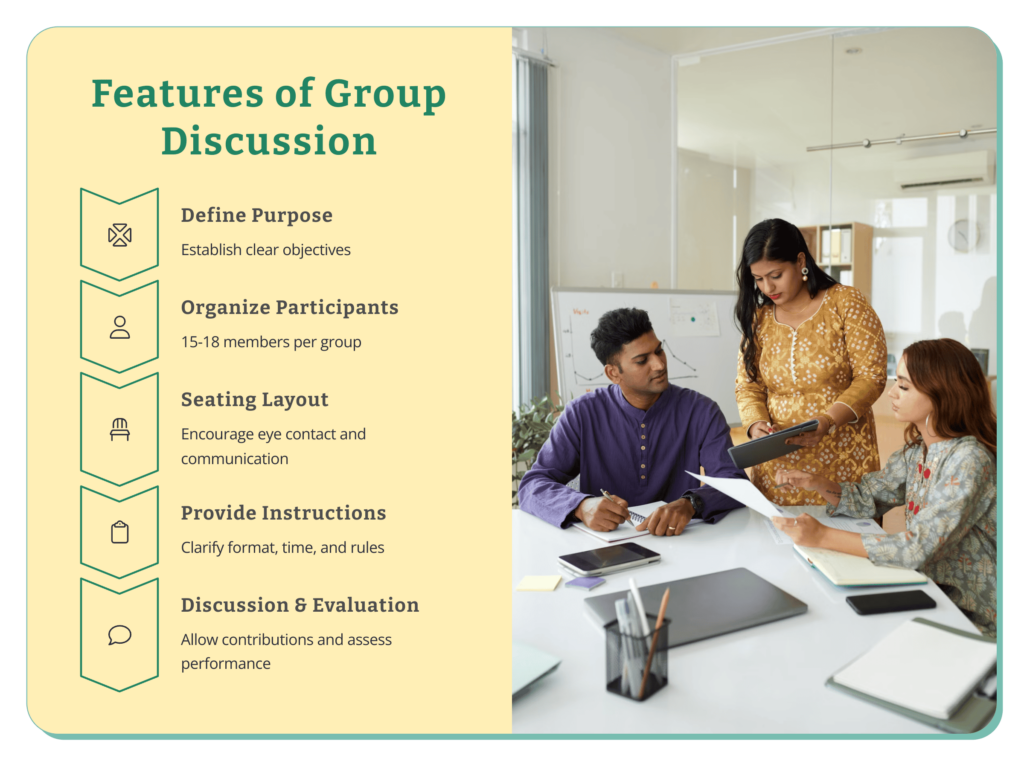
Establishing the goal of the group discussion before it begins is crucial. It may serve as a compass to help steer the conversation in the right direction. A goal can serve as a foundation for assessing the group discussion’s efficacy. It improves long-term retention and facilitates a thorough understanding of the subject. Additionally, keep in mind the group discussion Dos and Don’ts.
Finding out how many people are in each group and how many groups there are is the next step. For discussion, a group should consist of 15–18 people. Group Discussion Dos and Don’ts: Maintaining focus and making sure that everyone has a chance to contribute are crucial in such a big group.
All of the candidates should be seated appropriately to foster a suitable atmosphere for group discussions. Good communication is facilitated by a well-designed seating arrangement.
Setting clear expectations for each participant before the discussion starts is crucial for the moderator. This entails laying out the parameters of the discussion, the time constraints, and the important guidelines. Respecting other people’s opinions and listening intently without interjecting are two of the most important Dos and Don’ts of group discussions. A constructive and upbeat atmosphere is created by encouraging participants to respectfully voice their opinions and take into account all viewpoints. Moderators should also make sure that everyone stays on topic and that everyone has an equal chance to speak.
Usually, the topics are announced a few minutes beforehand so that the candidates can organize their thoughts. The topic can be factual, technical, or case-study based.
At this stage, the moderator permits us to begin the discussion. All participants try to present their points of view, and a healthy discussion occurs. All participants get the chance to speak in the discussion.
At the end of the interview, the interviewer evaluates the candidates’ performance, like their group behavior, communication, knowledge of the topic, and leadership skills. After evaluating the candidate’s performance, the final score is calculated. The candidates are selected based on their scores.
Let’s explain do’s and don’ts of group discussion to help you communicate effectively, stay confident, and make a strong impression.
Here is a list of do’s of group discussion that will help you succeed at your next interview:
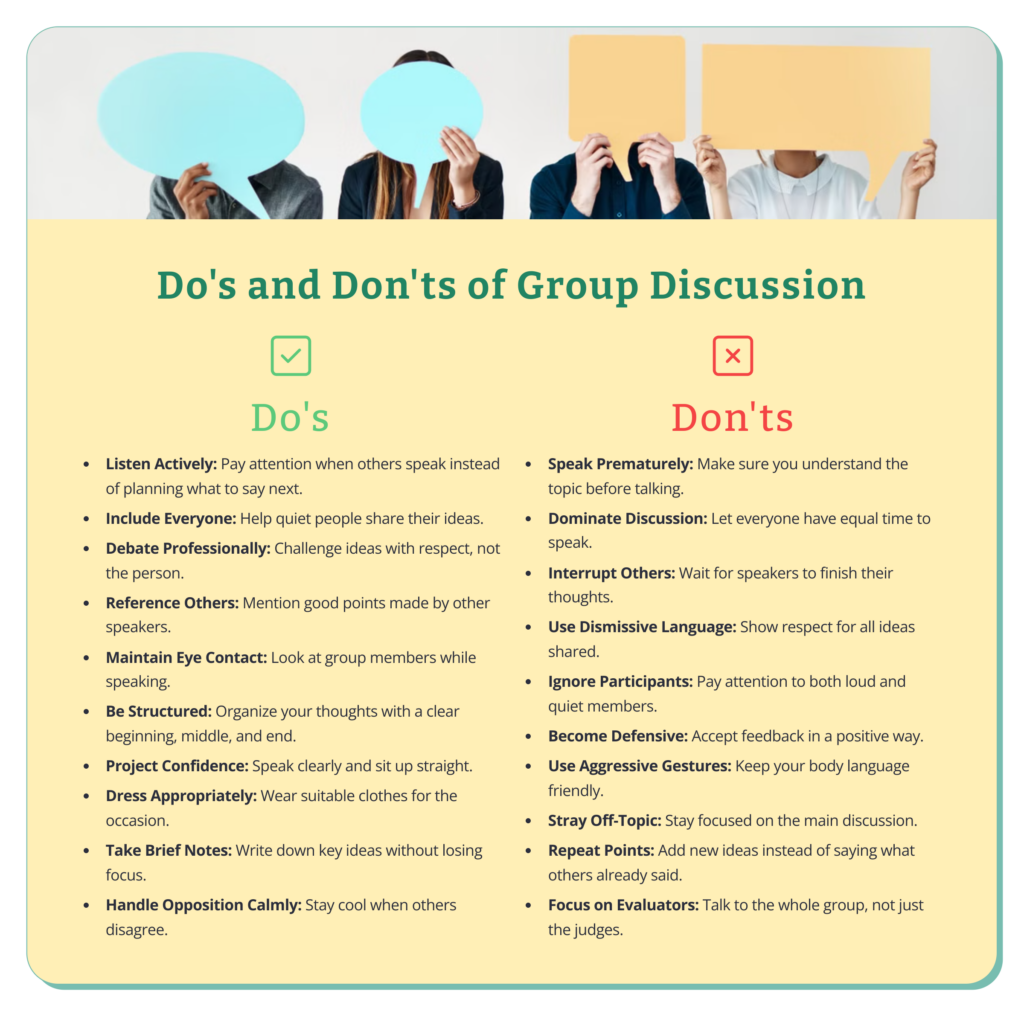
Hearing the perspectives and expertise of others helps the candidate broaden the conversation beyond shared ideas. Listening skills are very important during a group discussion. Hearing carefully what others say can help the candidate learn and understand the topic well in the discussion. Do’s and Don’ts of Group Discussion? It also shows respect for the other members because they see you value what they say. Additionally, if you show others you are willing to listen to them, the same will be reciprocated during your turn.
Do’s and Don’ts of Group Discussion: Letting others have their say in a discussion will tell you what ideas they share. It also lets you know if they agree with the topic. Set limits for 30-40 seconds before letting someone else speak. If you notice a member of your group who hasn’t been able to speak yet, try to encourage them. Ask for their views on the topic being discussed.
Being able to respectfully disagree with the opposition candidate demonstrates maturity, which is crucial in group discussions. Group Discussion Dos and Don’ts- As you carry on the conversation, it demonstrates that you are aware of your differences. Make sure you fully comprehend the speaker’s points of view before starting a debate. Be sure to give them credit for some of their opinions. This makes you more likely to be accepted. In a conversation, you can use the following expressions to respectfully disagree with someone:
When it is your turn to speak after another person, it’s respectful to acknowledge what has been said before you begin to explain your views. Do’s and Don’ts of Group Discussion? The discussion gives a platform to exchange actions and reactions. Not acknowledging the previous speaker may nullify the reaction part. This shows the other person that you have heard their ideas. It also communicates respect for their thoughts and viewpoints. Here are some statements one can use to acknowledge another speaker:
Do’s and Don’ts of Group Discussion? Always plan your exit point so you know when to stop speaking in the discussion. During a discussion, it is important to hold the conversation and end with valuable points. If you are clear and concise, you can quickly share your thoughts and exit. During the conversation, if it takes you more than two minutes to discuss a topic, try breaking it up into parts. That way, you can rejoin the discussion at a later time.
A confident demeanor in a discussion will lead others to listen to you. One way to show confidence is to speak in a strong and even tone. Good posture makes you appear more confident during the discussion. Another way to seem confident is to stay calm and control one’s emotions.
When speaking in a group discussion, make eye contact with different members to create a more personal and engaging interaction. Hold each person’s gaze for a few seconds before shifting to the next, making everyone feel included. Eye contact also signals confidence and helps capture the group’s attention. When listening, maintain eye contact with the speaker to show engagement and respect for their input.
Your attire plays a key role in how you are perceived and can impact your performance in a group discussion. Dressing professionally shows that you take the conversation seriously and respect the setting. A well-put-together appearance can also boost your confidence, helping you feel more empowered and perform better during the discussion.
Taking notes during a group discussion helps you retain key information and review important points later. Jot down main ideas, topics for further research, and any new insights gained from the conversation. Keeping track of your thoughts and potential questions can also help you contribute more effectively to the discussion.
In a group discussion, others may challenge your points by either disagreeing entirely or questioning your supporting evidence. One of the key do’s and don’ts of group discussion is to handle counterarguments respectfully. Acknowledge opposing viewpoints politely, take a moment to consider their perspective, and, if relevant, provide additional details or data to support your stance while maintaining a professional tone.
Here is a list of don’ts in a group discussion that will help you succeed at your next interview:
Don’t jump right into the discussion. It’s crucial to first pay close attention to what other people are saying in order to comprehend their viewpoint during a group discussion. Give it some thought if you’re not sure what to contribute but believe it’s essential. Instead of speaking out of the blue, wait for the appropriate moment to express your opinions.
To avoid over speaking, try to keep your points short. Do’s and Don’ts of Group Discussion-If you’re speaking too much in the discussion, try asking others about their viewpoint. It will help you share your point and allow others to showcase their point of view. Over speaking can get you in trouble. So, try to speak limited and on the point.
Always wait for others to speak before contributing your thoughts during the discussion. Listening to and thinking about what others say is essential so everyone can share their views. Interrupting others can make you score negative marks in the discussion.
A group discussion is where there is a possibility that others have more or less knowledge than you. To avoid judging others, understand that everyone has a range of knowledge. Always try to share your knowledge with the group rather than judging them.
Try to relax if you are unsure about the discussion topic. Before speaking anything, take a few deep breaths, and try to get familiar with the topic. Try finding opportunities to share your views or ask questions to learn more about the topic.
One of the key do’s and don’ts of group discussion is to ensure that your contributions add value to the conversation. If the facilitator requires each participant to speak, take a moment to assess whether your input is relevant and meaningful. If not, it’s better to wait for a more appropriate moment to share a thought that positively contributes to the discussion.
Your body language plays a crucial role in how you are perceived during a discussion. Avoid closed-off gestures like crossing your arms or looking disinterested, as they can signal a lack of engagement. Instead, use open posture, maintain eye contact, and mirror the body language of others to show attentiveness and active participation.
When making eye contact in a group discussion, avoid directing your attention to only one person. Instead, engage with everyone by shifting your gaze across the group. This ensures all members feel included and encourages a more dynamic and interactive conversation.
Repeating what others have already said in a group discussion may not add value to the conversation. As part of the do’s and don’ts of group discussion, it’s important to actively listen, analyze the points made by others, and contribute fresh insights or perspectives rather than simply echoing previous statements.
Making eye contact is a great way to show confidence, but avoid directing it toward the evaluators during a group discussion. Instead, focus on your fellow participants, as they are actively engaged in the conversation. As part of the do’s and don’ts of group discussion, maintaining eye contact with your peers demonstrates genuine involvement and keeps the discussion natural and engaging.
You can formulate more intelligent answers and avoid interruptions by actively listening to others. Discussions in groups are crucial for personal growth. The important dos and don’ts of group discussions should be remembered in order to guarantee success. These consist of open-mindedness, cooperation, active engagement, and effective communication. It’s also critical to foster a positive atmosphere and respect others’ viewpoints.
In a group discussion, it’s critical to adhere to specific dos and don’ts. Participants should be knowledgeable about the subject and good listeners. Be receptive to the opinions of others and make constructive contributions. Make sure your points contribute to the conversation while speaking succinctly and clearly. Steer clear of personal attacks or biases that could unfairly influence the conversation, and refrain from interrupting or controlling it.
Group discussions provide an invaluable learning experience. Individuals can engage in in-depth conversations that lead to both problem-solving and personal growth. Dos and Don’ts for Group Discussions:The importance of effective time management in group discussions cannot be overstated. It’s critical to keep an eye on the allotted time while ensuring that everyone contributes fairly. This approach promotes an equitable dialogue in which all points of view are respected and carefully considered. Use these tips to confidently ace your next group discussion, speak clearly, and leave an impression.
Ace your job interviews with tailored tips for a great first impression! Explore more Interview Tips with us.
Recommended Read: How to Improve Listening Skills in Professional Life?
Factual group discussion, opinion-based group discussion, and group discussion based on case studies are the three types of group discussion. Many companies and educational institutes use these types to test the candidates’ skills and abilities. It helps the interviewer to find the best candidate for the available opportunities.
Do’s and Don’ts of Group Discussion: The three main aspects of group discussion are collaboration, communication, and creative thinking. These three aspects contribute to making a group discussion effective. If the candidates have all three aspects, it will become easy for the interviewer to give him the deserving opportunity.
The six types of small group discussion are problem-solving, Decision-making, brainstorming sessions, Debates, reflective discussions, and meetings. Small group discussion is a student-centered methodology. Students interact with peers and instructors and share ideas during discussions.
Group discussions are used by companies and institutions to assess candidates’ skills and abilities, often as the final step in selection. Case-based group discussions are common. Knowing the do’s and don’ts is essential for success in interviews, as communication skills play a crucial role in selection.
Mastering a group discussion requires key do’s and don’ts. Do listen actively, speak confidently, stay on topic, and respect others. Don’t interrupt, repeat points, dominate, or show disrespect. Focus on group interaction, not evaluators. Following these tips helps you communicate effectively and make a strong impression.