

Curious about how businesses and researchers extract useful insights from large datasets? Data mining techniques are central to today’s digital changes. They help organizations find patterns, predict trends, and make informed decisions. In the tech-focused world of 2025, mastering data mining is crucial for anyone interested in data science, analytics, or artificial intelligence. From classification and clustering to association rule mining and regression, these techniques turn raw data into useful information that influences strategy, innovation, and growth.
This expert-backed guide looks at the most important data mining methods, their real-world uses, and practical tips for using them effectively. Whether you’re a student, an aspiring analyst, or a business leader, you’ll learn how to use the latest tools and methods to get value from your data and keep up in a fast-changing digital world.
Data mining techniques are methods used to discover patterns, trends, and relationships within large datasets. Common techniques include classification, clustering, regression, and association rule learning. These techniques help businesses make data-driven decisions by turning raw data into actionable insights.
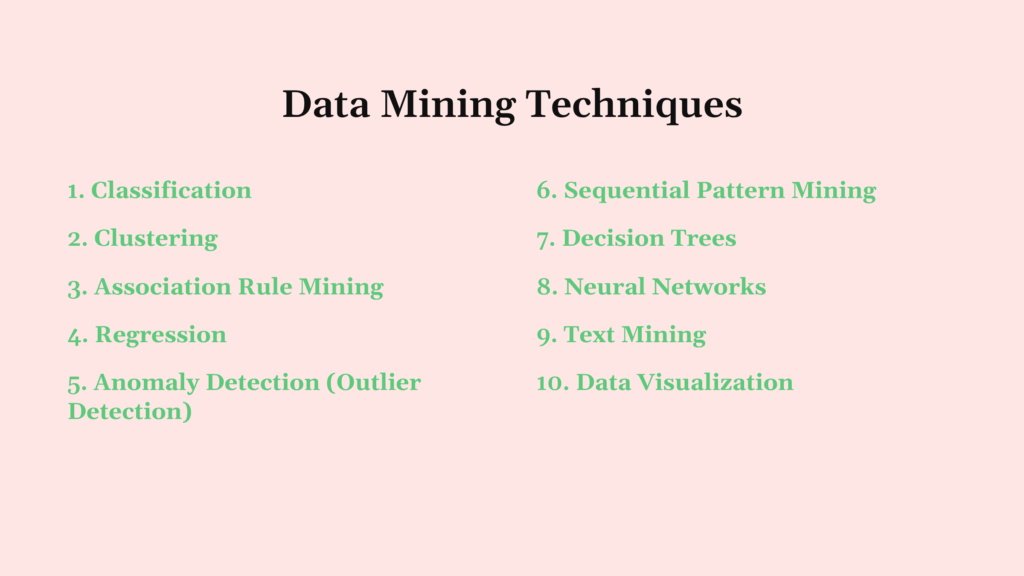
Classification is one of the most widely used data mining techniques in both academic research and industry applications. It involves categorizing data into predefined labels or classes based on input variables. This technique is essential when trying to predict outcomes like customer churn, credit approval, or email spam detection. Algorithms such as Decision Trees, Support Vector Machines (SVM), and Naive Bayes are popular tools used in this method.
Among unsupervised data mining techniques, clustering stands out for its ability to discover hidden groupings in large datasets. It groups similar data points based on characteristics or behavior without prior labeling. Businesses use clustering to segment customers, detect fraud patterns, or even analyze social networks. Common clustering algorithms include K-means, DBSCAN, and Agglomerative Clustering.
Association rule mining is a powerful data mining technique used to discover interesting relationships among variables in transactional data. For example, it can identify product pairings in market basket analysis, such as customers who buy coffee often buying sugar as well. Apriori and FP-Growth are the most used algorithms for generating association rules, helping businesses optimize cross-selling strategies.
Regression is another fundamental data mining technique used to predict continuous outcomes based on historical data. It helps model the relationship between dependent and independent variables, such as forecasting revenue, pricing strategies, or temperature trends. Linear Regression, Ridge Regression, and Logistic Regression (for binary outcomes) are common variants used in different business scenarios.
Anomaly detection, also known as outlier detection, is a crucial data mining technique used to identify unusual patterns that deviate from expected behavior. It plays a vital role in sectors like banking (fraud detection), IT (intrusion detection), and healthcare (disease outbreak monitoring). Techniques such as Isolation Forest, Local Outlier Factor (LOF), and One-Class SVM are employed to spot anomalies effectively.
Sequential pattern mining focuses on discovering patterns where data is arranged in a sequence, such as time-series or transactional data. It’s commonly used in web usage mining, stock market prediction, and retail. For example, identifying that customers who buy smartphones often purchase accessories within a week. Algorithms like GSP (Generalized Sequential Pattern) and SPADE are used to mine sequential patterns effectively.
Decision Trees are both a data mining technique and an algorithm used for classification and regression tasks. They represent data in a tree-like structure, where each node tests an attribute, and branches represent outcomes. This technique is simple to interpret and highly effective for rule-based decision-making. It is often used in financial forecasting, customer segmentation, and medical diagnosis.
Neural networks mimic the human brain’s functioning to recognize complex patterns and relationships in data. They are the foundation of deep learning and are particularly powerful in image recognition, natural language processing, and predictive analytics. Neural networks require large datasets and are computationally intensive but offer high accuracy in tasks involving unstructured data like text and images.
Text mining (or text data mining) extracts useful information from unstructured textual data. It combines techniques from natural language processing (NLP), information retrieval, and machine learning to derive insights from sources like social media, customer reviews, or emails. Applications include sentiment analysis, topic modeling, and keyword extraction, making it crucial for businesses monitoring brand reputation.
Although not a data mining technique in the strictest sense, data visualization plays a critical role in interpreting mining results. It helps represent complex patterns, trends, and relationships through charts, graphs, and dashboards. Tools like Tableau, Power BI, and matplotlib in Python help stakeholders make data-driven decisions by simplifying insights into visually digestible formats.

Retailers use data mining techniques like market basket analysis and customer segmentation to understand buying behavior, optimize product placement, and personalize marketing campaigns. For example, Amazon and Walmart analyze purchase patterns to recommend products and manage inventory.
Banks and financial institutions apply data mining techniques to detect fraudulent transactions, assess credit risk, and predict loan defaults. Techniques like classification and anomaly detection help ensure secure and profitable operations.
Hospitals and healthcare providers use data mining to predict disease outbreaks, personalize treatments, and manage patient data efficiently. Techniques such as clustering and regression help in early diagnosis and treatment planning.
Telecom companies use data mining techniques to analyze call records, reduce churn, and improve customer service. Clustering and predictive modeling are commonly used to segment users and tailor service plans.
In manufacturing, data mining is used for quality control, predictive maintenance, and supply chain optimization. By analyzing machine data and production logs, companies can forecast equipment failures and improve production efficiency.
E-commerce platforms use data mining tools to analyze customer behavior, recommend products, personalize user experiences, and optimize pricing strategies. Tools help track clicks, searches, and purchase history to increase conversions and customer retention.
Educational institutions apply data mining tools for student performance analysis, dropout prediction, and personalized learning paths. These tools help educators identify learning patterns and improve academic outcomes through data-driven insights.
The energy sector uses data mining to forecast energy demand, detect faults in smart grids, and manage resource distribution efficiently. Tools help analyze historical consumption data, weather patterns, and usage trends for better energy management.
Logistics companies leverage data mining tools to optimize delivery routes, manage fleet operations, and predict shipment delays. Analyzing GPS data, traffic conditions, and delivery times enables more efficient and cost-effective transportation systems.
Streaming platforms and media companies use data mining to recommend content, analyze viewer preferences, and detect piracy. Tools analyze user watch history and engagement to improve content delivery and advertising strategies.
Read More: How to Become a Data Scientist in India: The Ultimate Guide in 2025
Data mining empowers organizations to make informed decisions by uncovering hidden patterns and trends in large datasets. It transforms raw data into actionable insights that help guide business strategies and operational improvements.
Using advanced data mining techniques, companies can analyze customer behavior, preferences, and purchasing patterns. This enables targeted marketing campaigns, better customer service, and improved customer retention strategies.
Data mining streamlines internal processes by identifying bottlenecks, inefficiencies, and opportunities for automation. Businesses can reduce costs, allocate resources more effectively, and optimize workflows for better productivity.
One of the critical applications of data mining techniques is in detecting anomalies that could signal fraud or high-risk activities. Banks and insurance companies use these methods to monitor transactions and identify suspicious behavior in real time.
By applying data mining techniques, businesses can stay ahead of industry trends and shifts in consumer demand. This helps in product development, inventory planning, and entering new markets with confidence.
Data mining enables hyper-personalized marketing by segmenting customers based on preferences and past behavior. Companies can tailor promotions, content, and recommendations to individual users, boosting engagement and conversion rates.
With insights gathered through data mining techniques, organizations can understand what features or services are most valued by customers. This helps in refining existing offerings and developing new ones that meet actual market needs.
Organizations that effectively use data mining techniques gain a significant competitive edge. They can anticipate market changes, respond faster to consumer demands, and deliver superior value compared to their competitors.
Data mining supports accurate forecasting by analyzing historical trends and seasonal patterns. It is particularly useful in demand forecasting, financial planning, and supply chain optimization, reducing uncertainty in planning processes.
In healthcare, data mining helps identify patterns in patient data that lead to early diagnosis, personalized treatment, and improved patient outcomes. It supports public health research and resource allocation for better healthcare delivery.
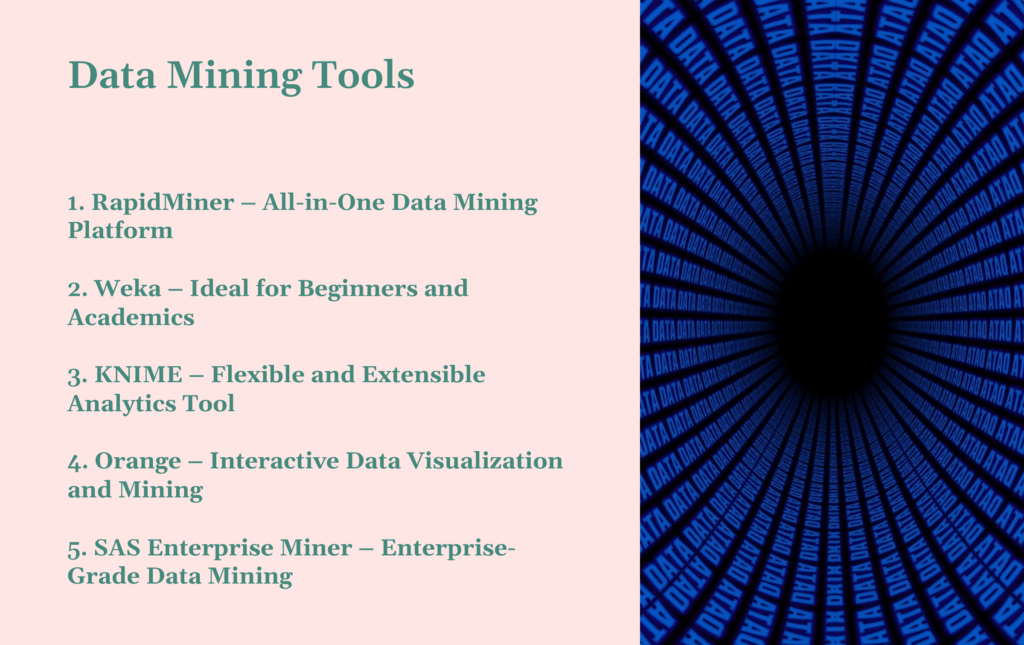
RapidMiner is a powerful tool that supports a wide range of data mining techniques including classification, regression, clustering, and text mining. Its user-friendly, drag-and-drop interface makes it ideal for data scientists and business analysts to quickly build, test, and deploy predictive models.
Weka is a popular open-source software suite that provides easy access to machine learning algorithms and data mining techniques. It’s widely used in academic settings for teaching and research due to its intuitive interface and strong visualization features.
KNIME allows users to create visual workflows for data analytics and supports integration with R, Python, and deep learning frameworks. It is well-equipped for a variety of data mining techniques, including anomaly detection, predictive modeling, and data preprocessing.
Orange is an open-source data mining tool focused on visual programming and data visualization. It allows users to apply data mining techniques such as classification, clustering, and association rule mining through easy-to-use widgets and workflows.
SAS Enterprise Miner is a comprehensive solution for advanced analytics and data mining techniques in large organizations. It offers automated modeling, variable selection, and robust statistical tools that help businesses uncover patterns and make data-driven decisions.
Data mining tools can handle raw, unstructured, or inconsistent data by performing tasks like data cleaning, normalization, and transformation. This ensures high-quality input for accurate analysis and modeling.
Modern tools support a wide range of data mining techniques such as classification, clustering, regression, association rule mining, and anomaly detection. These capabilities help uncover patterns, relationships, and trends within large datasets.
Many data mining tools are equipped with predictive modeling features that allow users to forecast future outcomes based on historical data. This is widely used in sales forecasting, risk assessment, and customer behavior prediction.
Visualization is a core capability of data mining tools. They convert complex analytical outputs into easy-to-understand charts, graphs, and dashboards, enabling faster insights and better decision-making.
Advanced data mining tools can integrate with big data ecosystems (like Hadoop or Spark) and machine learning frameworks (like TensorFlow or Scikit-learn). This enhances their scalability and allows for real-time data mining on massive datasets.
Mastering data mining techniques can change the game for anyone wanting to succeed in today’s data-driven world. By understanding and using methods like classification, clustering, and association rule mining, you can transform raw data into actionable insights that lead to smarter decisions and innovations. Organizations in every industry are increasingly depending on data, so professionals with strong data mining skills are in high demand.
Keep in mind that success in data mining isn’t just about technical skills. It also involves continuous learning, ethical data use, and staying current with the latest tools and trends. Look for real-world projects, work with experts, and keep exploring new methods. With dedication and the right approach, you’ll be well-prepared to uncover hidden value in data and excel in analytics and business intelligence in 2025 and beyond.
Read More: What is Data Mining? Key Techniques

Data mining techniques help find patterns, relationships, and insights in large datasets. These methods include classification, clustering, regression, association rule learning, anomaly detection, and prediction modeling.
Each technique has a specific use. For instance, classification organizes data into categories, clustering groups similar records, and regression forecasts numerical outcomes. Together, these methods assist businesses in making informed decisions based on data.
The five most commonly cited techniques in data mining are:
1. Classification is assigning data into predefined categories.
2. Clustering is grouping similar data points without predefined labels.
3. Regression, predicting numerical values from data trends.
4. Association rule learning, finding relationships between variables (e.g., market basket analysis).
5. Anomaly detection, identifying unusual or unexpected patterns.
These five methods are widely used across industries like retail, healthcare, finance, and telecommunications.retail, healthcare, finance, and telecommunications industries
A typical data mining process follows seven steps:
1. Data cleaning, removing errors and inconsistencies.
2. Data integration is the process of combining information from multiple sources.
3. Data selection, identifying relevant datasets for analysis.
4. Data transformation, converting data into usable formats.
5. Data mining, applying algorithms and models.
6. Pattern evaluation, identifying meaningful results.
7. Knowledge presentation, visualizing, and interpreting insights.
These steps form the standard KDD (Knowledge Discovery in Databases) framework.
Yes, Python is one of the most popular programming languages for data mining. While it is not a “tool” itself, it provides powerful libraries like Pandas, NumPy, Scikit-learn, and TensorFlow. These libraries help with data preprocessing, modeling, clustering, and visualization tasks.
Its flexibility, large community, and compatibility with big data platforms make Python a top choice for beginners and experienced data mining users.
The main techniques include classification, clustering, regression, association analysis, and anomaly detection. More recent methods like text mining, web mining, and deep learning are also becoming popular.
Each technique addresses different business challenges. For example, classification is used for fraud detection, clustering helps with customer segmentation, and regression is used for sales forecasting.
Some frameworks simplify data mining into five key steps:
1. Problem definition, understanding business objectives.
2. Data preparation, cleaning, and organizing raw data.
3. Data exploration, analyzing datasets to find trends.
4. Modeling, applying algorithms to extract patterns.
5. Evaluation and deployment, testing models, and applying insights.
This streamlined process is standard in practical industry projects.
Another simplified approach divides data mining into four main stages:
1. Data collection and preprocessing involve gathering and cleaning raw data.
2. Data analysis and modeling, where statistical and machine learning methods are applied.
3. Pattern discovery, focusing on identifying significant trends and correlations.
4. Knowledge representation, presenting findings through dashboards or reports.
This four-stage model highlights clarity and usability for businesses using analytics.