

Data preprocessing is a vital part of the data science and machine learning journey, ensuring that raw data gets transformed into a usable and accurate format. As we look ahead to 2025, effective data preprocessing is more crucial than ever, especially as organizations lean more on data-driven decision-making. This process includes cleaning, normalizing, transforming, and organizing data to eliminate inconsistencies, address missing values, and boost overall quality. When done right, preprocessing enhances model accuracy, cuts down on errors, and saves precious time during analysis.
Whether you’re just starting or a seasoned pro, getting a grip on data preprocessing techniques is key to nailing your machine learning projects. With the ever-increasing volume and complexity of data, keeping up with the latest tools and best practices will help you stay ahead in the competitive data science landscape. Ready to tap into the full potential of your data? Let’s jump into the essentials of data preprocessing!
Data preprocessing removes noise and inconsistencies, making datasets reliable and ready for training algorithms. In data mining, data preprocessing enhances pattern detection by standardizing data inputs. Machine learning relies on effective data preprocessing to ensure high-quality predictive outcomes.
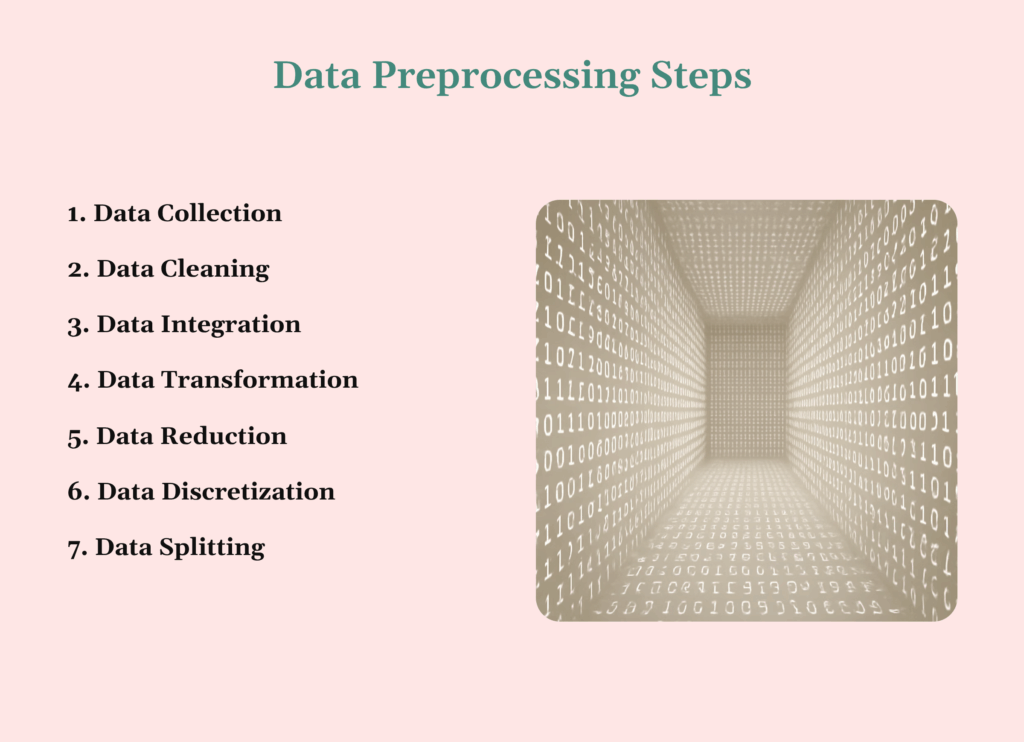
The first step in data preprocessing is data collection. This involves gathering raw data from various sources such as databases, spreadsheets, online repositories, sensors, or web scraping. The quality and relevance of collected data directly influence the effectiveness of the final analysis. At this stage, it is crucial to ensure that data is acquired ethically and complies with data privacy regulations.
Once the data is collected, the next step is data cleaning. Real-world data is often incomplete, inconsistent, or contains errors. This step focuses on handling missing values, correcting inaccuracies, removing duplicate records, and standardizing data formats. Data cleaning helps in eliminating noise and ensures the dataset is accurate and reliable for further analysis.
In many cases, data comes from multiple sources, and integrating these datasets into a single, unified view is essential. Data integration involves merging data files and aligning schema to ensure consistent and non-redundant information. This step also helps in resolving data conflicts that may arise due to different formats or naming conventions across sources.
After integration, the data must be converted into a suitable format for analysis through data transformation. This process includes normalization (scaling data to a specific range), encoding categorical variables, and aggregating data. Transformation ensures that the data structure aligns with the requirements of machine learning models or analytical tools.
Data reduction involves minimizing the volume of data while preserving its integrity. This can be achieved through dimensionality reduction techniques like Principal Component Analysis (PCA), removing irrelevant features, or binning data. This step not only speeds up processing time but also helps in improving model performance by eliminating noise.
In some cases, continuous data needs to be transformed into categorical data, a process known as data discretization. This is especially useful for algorithms that require categorical input or for simplifying data interpretation. Discretization involves dividing data into intervals or classes based on defined thresholds.
Finally, before feeding data into a machine learning model, it is essential to split the data into training, validation, and test sets. This helps in evaluating the model’s performance accurately and prevents overfitting. Typically, the data is divided in ratios such as 70:20:10 or 80:10:10 for training, validation, and testing, respectively.
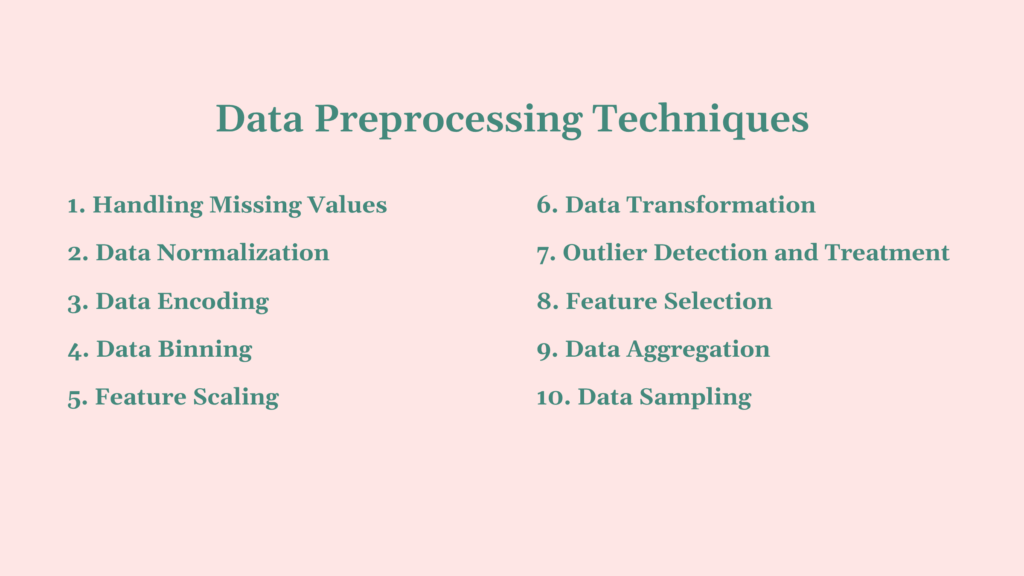
One of the most common issues in raw data is missing values. Techniques to handle them include removing records with missing data, replacing missing values with statistical measures (like mean, median, or mode), or using algorithms such as K-Nearest Neighbors (KNN) to estimate and fill in the gaps. Choosing the right method depends on the volume and importance of the missing data.
Normalization is the process of scaling numerical data to a common range, typically between 0 and 1. This technique ensures that no particular feature dominates due to its scale, which is especially important for distance-based algorithms like K-Means and KNN. Common normalization methods include Min-Max Scaling and Z-Score Normalization.
Machine learning models require numerical input, so categorical data must be transformed using encoding techniques. The most widely used methods are Label Encoding, which assigns a unique number to each category, and One-Hot Encoding, which creates binary columns for each category. Proper encoding improves model accuracy and interpretability.
Binning or discretization is the technique of converting continuous data into discrete categories or bins. This can be done using fixed-width binning, quantile binning, or clustering-based binning. Binning is useful for simplifying data, reducing noise, and preparing it for algorithms that work better with categorical data.
Feature scaling ensures that all features contribute equally to the analysis. Apart from normalization, another popular technique is standardization, which transforms data to have a mean of zero and a standard deviation of one. This is crucial for algorithms like logistic regression, SVM, and PCA.
Data transformation involves applying mathematical functions such as logarithms, square roots, or exponentials to change the distribution or scale of data. This is useful for reducing skewness, handling outliers, and improving the performance of machine learning models. It also helps normalize data that doesn’t follow a normal distribution.
Outliers can distort analysis and model predictions. Techniques for detecting and handling outliers include statistical methods like the Z-score or IQR (Interquartile Range), visual methods like box plots, or machine learning approaches like isolation forests. Outliers may be removed or transformed depending on their relevance.
Feature selection is the technique of identifying and selecting the most relevant features from the dataset. Methods include filter techniques (like correlation or chi-square), wrapper methods (such as Recursive Feature Elimination), and embedded methods (like Lasso regression). This helps reduce dimensionality and improve model performance.
Aggregation involves summarizing data by grouping and applying operations like sum, mean, or count. This is especially useful in time-series or transactional data, where observations are combined to derive higher-level insights. Aggregation simplifies complex data and makes it more meaningful.
When dealing with large datasets, data sampling helps in reducing the dataset size while maintaining its integrity. Techniques include random sampling, stratified sampling, and systematic sampling. Sampling improves processing speed and allows for faster experimentation with machine learning models.
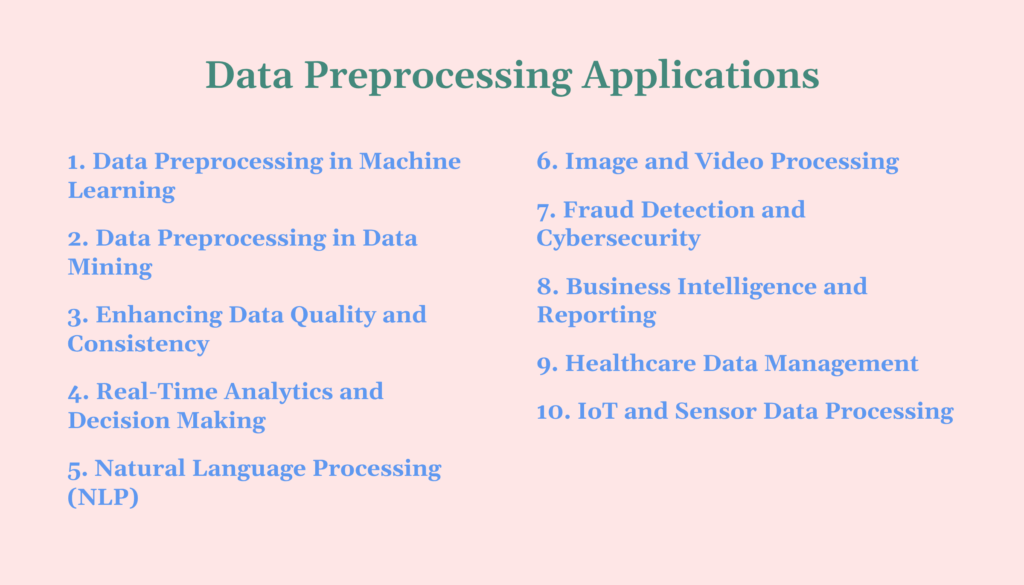
One of the most important applications of data preprocessing in machine learning is preparing raw data for training predictive models. Machine learning algorithms rely heavily on clean, consistent, and well-structured input. Through techniques like normalization, encoding, and feature selection, data preprocessing helps improve model accuracy and prevent issues like overfitting or bias.
In the field of data preprocessing in data mining, preprocessing enables the discovery of meaningful patterns and relationships from large datasets. It ensures that the mined results are not distorted by inconsistencies, noise, or irrelevant information. Preprocessing steps such as data integration and data cleaning help data mining tools produce more reliable insights.
What is data preprocessing? At its core, it is a critical process that improves the quality and consistency of data. High-quality data is essential for making informed business decisions, accurate forecasting, and risk assessment. Preprocessing eliminates errors, fills in missing values, and aligns data formats, ensuring uniformity across the dataset.
Data preprocessing plays a vital role in real-time analytics, especially in sectors like finance, healthcare, and e-commerce. When real-time decisions depend on incoming data streams, preprocessing ensures the data is immediately cleaned and structured, allowing systems to react with precision and speed.
In NLP applications such as chatbots, sentiment analysis, and language translation, data preprocessing involves text cleaning, tokenization, stop-word removal, and stemming. These steps are crucial to convert unstructured textual data into a form that NLP models can understand and process effectively.
Data preprocessing in machine learning is equally essential in computer vision tasks. Preprocessing techniques like image resizing, normalization, and augmentation help improve the performance of models in applications such as facial recognition, object detection, and medical imaging diagnostics.
In cybersecurity and fraud detection, preprocessing helps in structuring large amounts of user behavior data. Data preprocessing in data mining enables anomaly detection systems to identify suspicious patterns by reducing noise and focusing on relevant variables. This leads to faster and more accurate threat identification.
Organizations use data preprocessing to feed clean and consistent data into their business intelligence tools. Whether it’s sales forecasting, customer segmentation, or performance analytics, preprocessing ensures dashboards and reports reflect accurate, actionable information.
In the healthcare sector, data preprocessing in machine learning helps in processing patient records, lab reports, and imaging data. Preprocessing supports the development of predictive models for diagnosis, treatment planning, and disease outbreak forecasting, ultimately improving patient outcomes.
With the rise of IoT devices, massive volumes of sensor data are being generated every second. Data preprocessing is used to filter, clean, and standardize this data before feeding it into analytical systems. This is vital for applications like smart homes, industrial automation, and environmental monitoring.
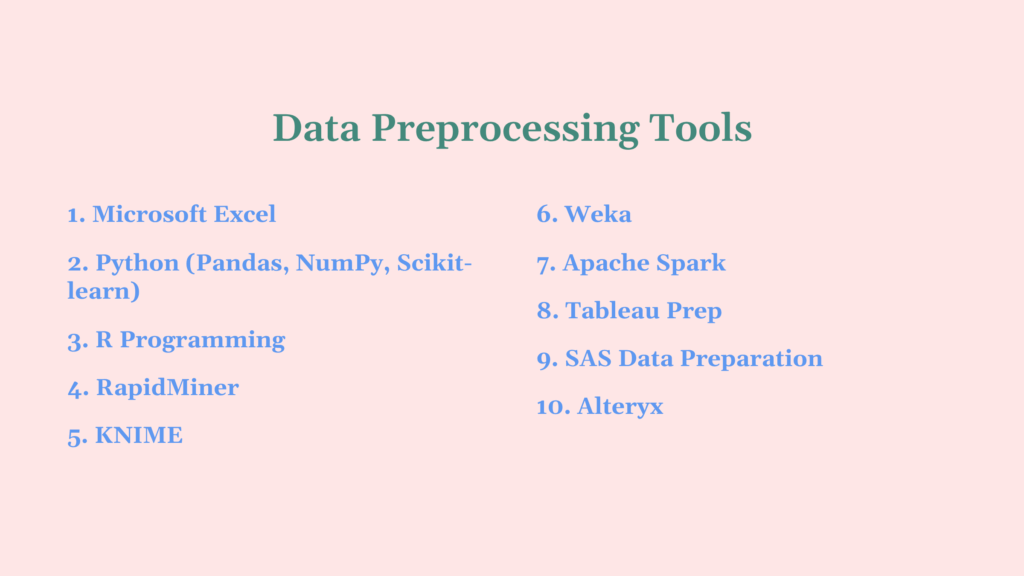
Excel is one of the most accessible and user-friendly tools for initial data handling. It allows users to sort, filter, remove duplicates, handle missing values, and perform basic calculations and transformations. It’s ideal for small datasets and preliminary data exploration.
Python is a popular programming language for data analysis. Libraries like Pandas and NumPy are used for data manipulation, cleaning, and formatting. Scikit-learn offers built-in methods for tasks such as scaling, encoding, and splitting data, making it highly useful for preparing data before model training.
R is a statistical computing language widely used for data analysis and visualization. Packages like dplyr, tidyr, and caret provide comprehensive tools for cleaning, transforming, and preparing datasets. R is particularly favored in academic research and statistical modeling.
RapidMiner is a no-code platform that enables users to clean, transform, and analyze data through a visual interface. It is suitable for those who prefer drag-and-drop workflows over coding, making it great for business analysts and non-programmers.
KNIME is an open-source data analytics platform that supports visual workflows for data preparation and analysis. It allows users to integrate, clean, and transform data using a graphical interface, making it powerful yet accessible for users at different skill levels.
Weka is a lightweight software tool that provides a collection of machine learning algorithms and data preprocessing functions. It includes filtering, attribute selection, and basic data transformations. Weka is commonly used in educational settings for learning and experimentation.
Apache Spark is designed for big data processing. It allows for fast and distributed handling of large datasets. Spark is capable of cleaning and transforming data at scale, which makes it suitable for real-time analytics and applications involving high volumes of data.
Tableau Prep is a visual data preparation tool that helps users clean and reshape data before analysis. With a simple drag-and-drop interface, it allows for merging, filtering, and transforming data, and is often used alongside Tableau’s visualization features.
SAS offers advanced data preparation solutions suitable for enterprise-level analytics. It supports profiling, cleansing, and transforming data with a strong focus on accuracy and compliance. It’s commonly used in industries like finance, healthcare, and government.
Alteryx provides a visual workflow platform for advanced data preparation and analytics. It supports blending data from multiple sources, cleaning, transformation, and even integrating machine learning, all without requiring deep programming knowledge.

It is important to follow some best practices that can help you maximize the effectiveness of your preprocessing efforts. There are, however, a few practices I think you should consider:
Before you get into the preprocessing, it is critical that you know the data very well. Perform exploratory data analysis to see the structure of the data you are working with. What you are trying to understand in particular are:
Without knowing the features of the data to begin with, there is a high chance you may apply the wrong preprocessing, thereby corrupting the data.
It is a general truth in preprocessing that certain tasks may be repeated on the same dataset. This automation, through pipeline building, will ensure consistency and efficiency and reduce the likelihood of human errors. Use a pipeline to automate the workflow, whether you are using scikit-learn or a cloud-based tool.
Documentation of the preprocessing steps gives you two things:
Every decision, transformation, filtering done to the data should be documented and the reasoning why you made the decision, in fact documents should be kept that have all the steps laid out. Good documentation and reasoning increases team collaboration and allows processing of work begun at some point in the past.
Data preprocessing is not a one-shot job, it should be an iterative and continuous process. As the models evolve and feedback on performance is generated, use that feedback to go back and improve or modify your preprocessing steps, that will lead to better results. For example, feature engineering may lead to new useful features, or tuning up your handling of outliers may improve model accuracy, use those results to modify your preprocessing steps again.
Data preprocessing is the heart and soul of any successful data analysis or machine learning project. When you take the time to clean, standardize, and organize your data, you’re laying the groundwork for accurate insights and dependable predictions. As we look ahead to 2025, with data becoming more complex, mastering efficient preprocessing is essential for every data professional. Using the right tools and techniques not only enhances model performance but also makes the entire workflow smoother.
Remember that high-quality input leads to high-quality output, and your results can only be as good as the data you start with. So, invest some time in learning and applying the latest preprocessing methods to unlock the full potential of your data and make impactful business decisions. Start polishing your data today for smarter, more effective analytics tomorrow!
Read More:

Data preparation is the work of cleaning, organizing, and transforming raw data into an appropriate format to facilitate analysis and/or modeling efforts.
Example: You may want to remove errors and fill in gaps before running a machine learning algorithm on a dataset.
Tip: It is well worth the expense of time to preprocess your data because it makes your outcomes noticeably more accurate or reliable.
Data Collection – Gather raw data from sources.
Data Cleaning – Fix missing values and errors.
Data Integration – Combine data from multiple sources.
Data Transformation – Normalize and format data.
Data Reduction – Simplify data by reducing size or features.
Example: Cleaning missing customer details and converting categories into numbers before analysis.
Tip: Preprocess well to ensure accurate and efficient data analysis.
Data Cleaning – Fix missing or noisy data.
Data Integration – Combine data from different sources.
Data Transformation – Normalize or encode data.
Data Reduction – Simplify data by reducing size or features.
Example: Cleaning customer data, merging multiple files, scaling values, and removing irrelevant features before analysis.
Tip: Each stage improves data quality, don’t rush through them!
Some popular software tools for preparing your data include Python (with Pandas, NumPy), R, Excel, Tableau Prep, and RapidMiner.
For example: You could use Pandas in Python to filter out missing values and transform your data before analyzing it.
Tip: Choose a tool with which you are comfortable, and that is also capable of handling the size and complexity of your data.
Pandas is the most widely used Python library for data preprocessing operations such as cleaning, transforming and reorganizing data.
Example: Using Pandas to fill missing values and change categories of data into numbers before analysis.
Tip: Learn the basics of Pandas as it really helps you to manage your data into a manageable form quickly and efficiently.
Surveys/Questionnaires: Get opinions or facts directly from people.
Web Scraping Tools (like BeautifulSoup): Extract data from websites automatically.
Sensors/IoT Devices: Capture real-time information such as temperature, movement, or location.
APIs: Get data from online services or databases programmatically.
Example: Using a survey via a Google Form to receive customer feedback for a product.
Suggestion: Pick a tool depending on the type of data and the origin of the data.