


It is essential to understand what MPhil vs PhD are when making your choice. An MPhil involves a research project contributing to knowledge in a specific field, while a PhD requires a more extensive and original research project that advances the discipline.
An MPhil (Master of Philosophy) is typically a shorter, master’s-level research degree focused on developing foundational research skills and may serve as a stepping stone to a PhD. In contrast, a PhD (Doctor of Philosophy) is a long-term, doctoral-level program centered on original research that contributes new knowledge to an academic field. Your choice depends on your research interests, career goals, and commitment to in-depth study.
However, as per the National Education Policy (NEP) 2020, the MPhil (Master of Philosophy) program has been discontinued in India and will no longer be offered as a qualification between postgraduation and PhD.
This blog explains each degree in detail, highlighting their purpose, duration, and career scope. By understanding the key difference between MPhil and PhD, you’ll be better equipped to make the right academic and career decision.
An MPhil (Master of Philosophy) is a postgraduate research degree that typically involves independent study and the submission of a thesis. It is designed to develop advanced research skills and usually serves as a foundation for pursuing a PhD. However, as per the National Education Policy (NEP) 2020, the MPhil program has been discontinued in India.
It’s one of the popular postgraduate research degrees. Many people also want to know – what is MPhil PhD? It’s considered as preparation for a PhD degree. A master of Philosophy is an esteemed degree that enables learners to pursue a study in a chosen field. Students undertake research on their own with the mentorship of a professor/supervisor. MPhil educates students on research methodologies and critical thinking abilities to conduct research in their respective fields.
Before being discontinued under NEP 2020, the MPhil (Master of Philosophy) program in India typically followed this process and structure:
PhD is a doctorate program in a given area of study. It is the highest education level that you can meet in your specific field of expertise. PhD is an abbreviation of the term Doctor of Philosophy. About 2% of the total population of the UK are PhD holders. It is a research-based degree that demands candidates to produce an original work as a dissertation or thesis.
The primary intent of a PhD is to achieve advanced knowledge and skills in research within a specific academic discipline. It enables a person to gain extensive knowledge within his or her area of specialization. A PhD prepares an individual for jobs in educational and research institutions, government institutes, the private sector, and non-profit organizations.
Here’s a simplified overview of the PhD process and duration in India:
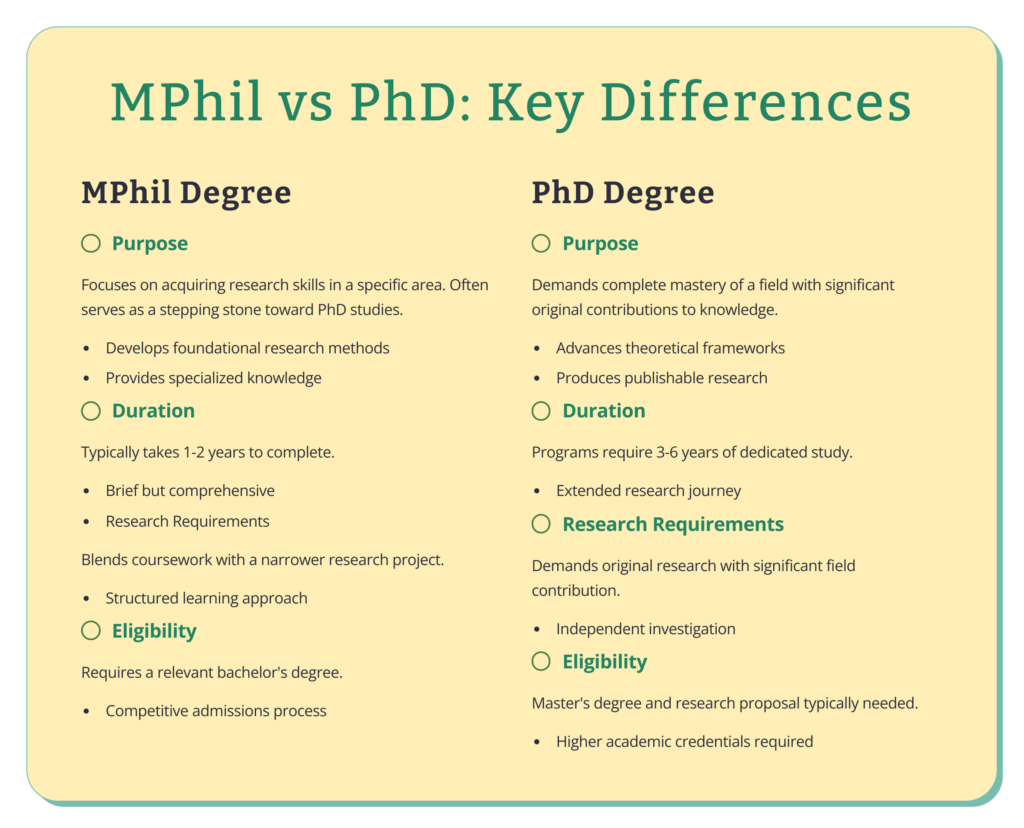
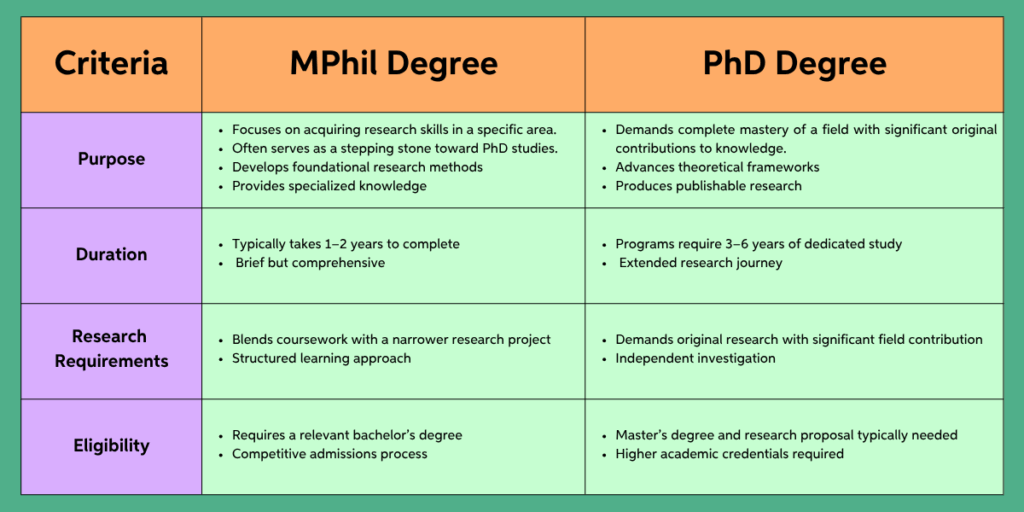
Many people are unsure what sets the two programs apart from one another. You have come to the right place if you’re one such person. So, what is the difference between MPhil and PhD Let’s discuss the role, course duration, subjects offered, research descriptions, and prerequisites for MPhil and PhD programs. MPhil vs PhD, let’s see which one suits your academic and future career plans better!
| Aspect | MPhil (Master of Philosophy) | PhD (Doctor of Philosophy) |
|---|---|---|
| Duration | Typically 1–2 years | Typically 3–6 years |
| Research Focus | Independent research with some guidance | In-depth original research contributing new knowledge |
| Coursework | Limited coursework; mainly research-oriented | Includes comprehensive coursework followed by intensive research |
| Admission Process | Based on academic merit and entrance exams/interviews | More competitive; requires strong academic record and research plan |
| Thesis Requirement | Mandatory thesis; less extensive than PhD | Extensive dissertation; must defend original contribution |
| Recognition/Value | Intermediate research degree; often a stepping stone to PhD | Highest academic degree; globally recognized |
| Career Scope | Leads to teaching roles, research jobs, or PhD programs | Opens doors to academia, R&D, policy, and high-level industry roles |
MPhil is a postgraduate program that emphasizes acquiring research skills and knowledge in a given area. It is usually regarded as a first step towards doing a Ph.D. A PhD is a higher degree that involves undertaking original research to extend the knowledge base of a particular field of study.
Eligibility criteria play a significant role in deciding the best option between an MPhil vs PhD.
To apply for a PhD in India, candidates must have a Master’s degree in a relevant field with at least 55% aggregate marks (or 50% for reserved categories). Some universities may also require a specific academic background or prior research exposure relevant to the chosen discipline.
PhD aspirants are usually required to clear a national or university-level entrance exam. Popular national exams include UGC-NET / UGC-NET JRF for Humanities and Social Sciences, CSIR-NET for Science streams, and GATE for Engineering and Technology. Other domain-specific exams include ICAR-AIEEA, ICMR JRF, and DBT-BET. Several universities, including IITs, JNU, DU, and state universities, also conduct their entrance exams. You may be exempt from the university’s entrance test if you qualify for exams like UGC-JRF or have a valid GATE score.
A strong research proposal is a crucial part of the application. It should outline your chosen topic, the core research problem, objectives, proposed methodology, and expected contributions. This document is assessed to determine your research aptitude and alignment with faculty expertise.
Shortlisted candidates are invited for a personal interview or presentation. The selection panel evaluates your academic background, research readiness, communication skills, and how well your proposal aligns with the department’s research interests and capabilities.
An MPhil degree is beneficial in many ways. It enables you to gain specific knowledge in a given area, sharpen your reasoning, and improve your research capacity. However, challenges related to MPhil programs stem from the demanding nature of conducting in-depth research, managing time, and struggling to balance research commitments and coursework.
A PhD degree presents many benefits, such as becoming an expert in a specialized area, gaining a competitive edge in the job market, and contributing research to the academic community. However, challenges linked to PhD programs include the lengthy duration, the complexities of the research process, and potential feelings of isolation.
Pursuing both MPhil and PhD degrees offers valuable opportunities to any person. However, it is crucial to be ready to tackle the challenges that may arise throughout your academic journey.
As per the latest implementation of the National Education Policy (NEP) 2020, the MPhil (Master of Philosophy) program has been officially discontinued across Indian universities. The policy clearly states that MPhil is no longer a required or recognized qualification between a Master’s degree and a PhD. This move is aimed at simplifying and modernizing the academic structure, allowing students to directly pursue a PhD after completing their postgraduate studies, thereby making the research pathway more streamlined and time-efficient.
The decision to remove the MPhil program is based on several key reasons:
With the phasing out of MPhil, students aspiring for a research or academic career should:
Let us explore the academic and research openings for MPhil graduates and the diverse career paths for PhD holders in academia, industry, and research.
MPhil degree holders are well equipped with the knowledge and skills to advance in a career in academics or research. They can engage as research assistants, project officers, research centers, or business organizations. MPhil holders can also continue their studies and pursue a PhD for academic advancement.
Key opportunities for MPhil graduates:
A PhD holder can hold several positions within academia, industries, and research institutions. In academia, PhD holders can work as professors, lecturers, or researchers in universities and colleges. They can also work as data scientists, consultants, or research analysts for various industries. In the research sector, PhD holders can engage in research organizations and government and non-government organizations.
Career Path Options for PhD Holders:
MPhil and PhD holders may be occupationally mobilized differently depending on the industry and sector they find themselves in. While MPhil holders enter the job market with more first-level research-oriented positions, PhD holders may lead research projects, prepare papers, seek grants, and supervise students. Let us explore the job roles and responsibilities for MPhil vs PhD.
After understanding what is PhD and MPhil, it’s time to see the differences in job positions.
Many people have had MPhil and PhD. They have been highly productive in their respective fields. Some examples include Nobel winners, business magnates, and famous researchers who have impacted their fields tremendously, like:
MPhil and PhD degrees are the two popular choices among students for higher education in India. Both qualifications hold immense value in the academic and professional world. However, there are specific considerations that you must keep in mind before choosing between an MPhil vs PhD.
India’s education system is known for its diversity and depth. It offers a wide range of options to pursue higher studies. The system is divided into different levels, starting from primary education to higher education, which universities and colleges primarily offer.
Both PhD and MPhil degrees are considered prestigious qualifications in India. Many academic and research positions in universities, research institutions, and other organizations require these degrees. PhD and MPhil demonstrate high expertise and specialized knowledge in a particular study area, making learners competitive in the job market.
MPhil vs PhD holders are often recognized as experts in their respective fields. Many institutions seek them for their research and analytical skills. The research output produced during these programs also contributes to the country’s academic and intellectual development.
The admission process for the MPhil vs PhD programs in an Indian university depends upon the university/college and the course/program requirements. In general, admission criteria may require students to possess a postgraduate degree in a particular stream with a minimum percentage of marks. They also need a research proposal and proposed research goals in an area of interest.
Some universities may set examinations or interviews to gauge the candidate’s suitability for research and readiness to take a research program. Furthermore, students may have to select a supervisor to sponsor them throughout the program while supervising the research.
IISc is one of the leading research institutions in India, famous for its state-of-the-art infrastructure and highly qualified faculty members. It offers MPhil and PhD programs in engineering, science, and humanities. If you’re weighing your options, exploring the MPhil vs. PhD offerings at IISc can help you choose the right path for your academic and research ambitions!
JNU is a reputed University of India with a special focus on research and inter-disciplinary areas of knowledge. The university has postgraduate courses in MPhil and PhD in social sciences, languages, and international studies. If you’re considering your options, understanding the MPhil vs PhD landscape at JNU can help you make an informed decision about your academic path.
Anyone interested in studying any of these degrees in India must consider the program provision, the institution offering the program, and the intended career path. When checking MPhil vs. Ph.D., consider your academic interests, career goals, and research aspirations when checking MPhil vs PhD. Each degree provides different avenues for researching and advancing in academia or one’s chosen discipline. Explore how MPhil vs PhD salary differences can shape your future career, highlighting the earning potential and growth opportunities each path offers. Choosing the right one correctly can determine the trajectory of one’s career.
Read More: Easy Guide on How to Apply for PhD in India
Choosing between MPhil vs PhD can shape your career path, as each offers distinct opportunities for research and professional growth.MPhil provides advanced research skills to a candidate. However, it is more structured and includes coursework with a shorter duration. PhD, on the other hand, is a more extensive course and has a longer duration. The coursework allows students to build a solid foundation in their area of study.
The course duration plays an important role when deciding between an MPhil vs PhD. The Master of Philosophy degree requires one to two years to complete. This is the main reason why many aspirants seek this program. A PhD course, on the other hand, takes three to seven years to complete.
The program lets you earn a position in many fields. You can work as a lecturer in colleges and tertiary institutions. You can also serve private organizations in their research facilities. Many MPhil graduates become public and civil servants based on their interests and career goals.
No. It isn’t necessary to hold an MPhil degree to pursue a PhD. Those with a master’s degree can directly apply for the doctorate program. However, some institutions require you to have an MPhil degree before applying for a PhD degree. This is usually expected from candidates who don’t have research experience.
Both degrees are prestigious in India. These degrees are for academic and research positions in research institutions, universities, and other organizations. These degrees prove specialized knowledge and a high level of expertise in a particular area of study. This makes you more competitive in the job market.
A PhD is better for advanced research and academic careers, offering deeper expertise and higher earning potential. An MPhil is shorter, ideal for those seeking a quicker postgraduate qualification or as a PhD stepping stone.
Yes, you can skip MPhil and go directly to a PhD, depending on the university’s admission criteria and your qualifications.
Yes, you can typically convert an MPhil into a PhD by applying to upgrade your degree status, subject to meeting specific criteria set by your university.
Yes, an MPhil is a valid degree.