Interested in the medical field and want to know about how to become a surgeon? Surgeons are not just doctors; they are life-savers, dedicated to repairing the human body and restoring health.
Becoming a surgeon in India is a challenging yet rewarding journey that requires dedication, rigorous education, and hands-on training. The path typically begins after completing 12th grade with a focus on science subjects—Physics, Chemistry, and Biology. Aspiring surgeons must then qualify for medical entrance exams like NEET-UG to secure admission into an MBBS program, which serves as the foundational degree for all medical professionals. The MBBS course lasts about five and a half years, including practical internships, and equips students with essential medical knowledge and clinical skills.
After earning an MBBS degree, the next crucial step in how to become a surgeon in India involves pursuing a postgraduate specialization in surgery, commonly an MS (Master of Surgery), which typically takes three years. During this period, students gain in-depth knowledge and hands-on experience in general surgery. Many surgeons further specialize by enrolling in super-specialty courses such as MCh, focusing on areas like neurosurgery, cardiothoracic surgery, or plastic surgery. Success in this career demands continuous learning, commitment, and practical expertise, but it offers the chance to make a significant impact on patients’ lives and enjoy a respected and well-compensated profession.

Surgeons diagnose and treat injuries, diseases, and deformities through surgical procedures. They perform operations to repair or remove damaged tissues, organs, or tumors. Surgeons also collaborate with medical teams to plan patient care before and after surgery. Their work requires precision, deep medical knowledge, and the ability to make quick decisions in critical situations.
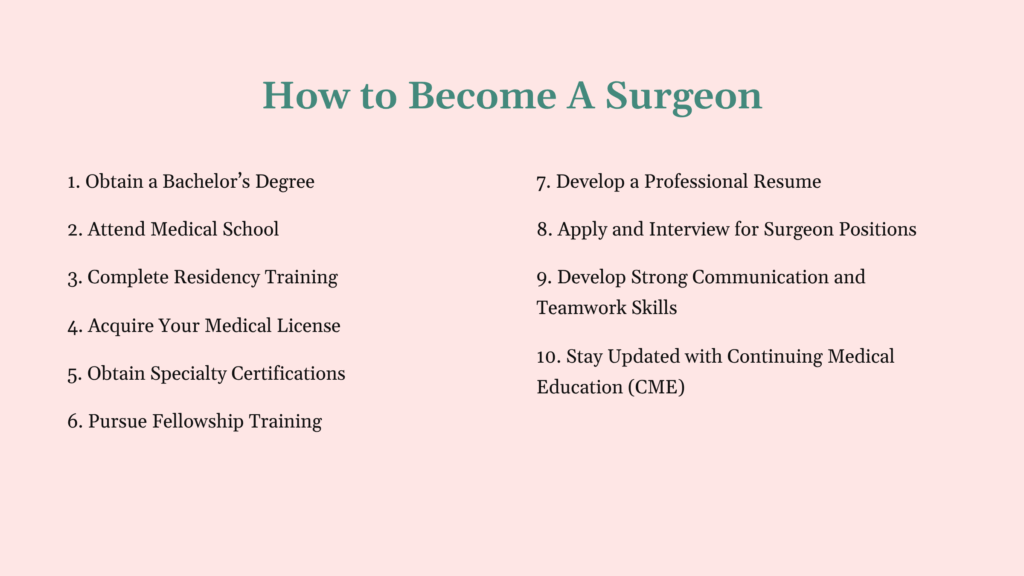
To learn how to become a surgeon, start by earning a bachelor’s degree in pre-med, biology, or a related field. Your coursework should include science and math classes, along with some liberal arts courses to develop critical thinking skills. Near the end of your junior year, take the Medical College Admissions Test (MCAT), which is required for medical school applications through the American Association of Medical Colleges (AAMC).
Medical school typically lasts four years and leads to a Doctor of Medicine (MD) degree. The first two years cover foundational subjects such as anatomy, biochemistry, pharmacology, and patient care. The last two years consist of clinical rotations in hospitals and clinics. To progress in how to become a surgeon, passing Step 1 and Step 2 of the United States Medical Licensing Examination (USMLE) is essential.
Residency is a critical phase in how to become a surgeon, involving specialized training under supervision. Depending on your chosen specialty, residency length varies—from two years for family medicine to seven years for cardiothoracic surgery. During residency, you must also pass Step 3 of the USMLE to qualify for medical licensure.
Obtaining a medical license allows you to legally practice as a surgeon in your state. Licensing requirements vary but generally include completion of education, training, and successful licensing exams. This step is an indispensable part of how to become a surgeon.
As part of how to become a surgeon, earning board certification through the American Board of Medical Specialties can significantly improve your credentials. This involves proving your experience and passing a surgery-specific exam by the American Board of Surgery (ABS). Certifications also require ongoing education to stay current.
After residency, you may opt to complete a fellowship for advanced training in subspecialties like pediatric or vascular surgery. Fellowships typically last one to two years and include clinical rotations and research opportunities. Though optional, fellowships enhance your expertise and job prospects.
Create a detailed resume showcasing your education, training, certifications, clinical experience, and publications. Reviewing job postings helps tailor your resume to the skills employers seek. Always proofread and have someone else review your resume for accuracy.
Look for job openings via online portals, networking, and industry publications. Submit applications with required documents, and prepare for interviews by practicing common questions. Effective preparation is key when navigating how to become a surgeon in the job market.
Success in surgery depends not only on technical skill but also on strong communication and collaboration with patients, families, and healthcare teams. Cultivating these skills is essential for anyone serious about how to become a surgeon.
Medicine evolves rapidly, so surgeons must pursue lifelong learning through continuing medical education. Attending workshops and conferences helps maintain certifications and ensures you stay informed of the latest techniques and research.
The average salary of surgeons in India, based on current trends and reliable salary data:
The average salary of a surgeon in India ranges between ₹10 lakh to ₹25 lakh per year, depending on experience, specialization, and location. Entry-level surgeons typically earn on the lower end, while experienced and highly specialized surgeons can earn significantly more.
Salaries vary greatly by surgical specialty. For example:
Urban centers like Delhi, Mumbai, Bangalore, and Hyderabad generally offer higher salaries due to greater demand and more advanced healthcare infrastructure. Surgeons in tier-2 or rural areas may earn less, but may face lower competition and cost of living.
Here are 10 compelling reasons to choose a career as a surgeon in India, with the keyword “how to become a surgeon” naturally included in 5 of the points:
India has a growing need for qualified surgeons, especially in rural and semi-urban areas, making it a stable and in-demand career choice.
Surgeons are highly respected in Indian society due to the critical nature of their work, which often involves saving lives and making life-changing interventions.
One of the top reasons people explore how to become a surgeon in India is the potential for high earnings, especially in specialized fields and private practice.
India offers diverse surgical specialties such as neurosurgery, plastic surgery, orthopedic surgery, and cardiovascular surgery, allowing individuals to choose a path that matches their interests and strengths.
Choosing how to become a surgeon allows you to make a real difference in people’s lives by improving their health and quality of life through hands-on medical care.
The process of how to become a surgeon in India includes a clear roadmap: from MBBS to specialization, residency, and certifications—providing well-defined goals at each stage.
Indian surgeons with proper qualifications and experience often find it easier to pursue opportunities abroad, as their training is recognized in many countries after clearing required exams.
For those inclined toward academia or medical research, how to become a surgeon in India also opens doors to research in surgical techniques, medical devices, and advanced therapies.
Surgery is a field where technological advancements enhance your role, rather than replace it. This gives you long-term job security and relevance throughout your career.
Becoming a surgeon in India means you can mentor aspiring doctors and contribute to the healthcare system’s growth by teaching or training future professionals.
Careers for Surgeons
Here are 10 types of careers that surgeons can pursue in India, based on specialization, work setting, and career progression:
Performs a wide range of surgeries including abdominal, gastrointestinal, and trauma-related procedures. It’s often the starting point before super-specialization.
Specializes in surgeries related to bones, joints, and the musculoskeletal system. This is a high-demand field, especially in trauma care and sports medicine.
Focuses on surgeries involving the heart, lungs, and chest. Requires extensive training and is among the highest-paid surgical careers in India.
Performs complex surgeries on the brain, spinal cord, and nervous system. This career demands exceptional precision and long training periods but is highly prestigious.
Deals with cosmetic as well as reconstructive surgeries, including burns, trauma recovery, and congenital deformities. This field offers both hospital and private practice opportunities.
Specializes in performing surgeries on infants and children. This role requires additional training and a deep understanding of child physiology and care.
Performs cancer-related surgeries to remove tumors or affected tissues. Oncosurgeons work closely with medical oncologists and radiologists in cancer treatment centers.
Focuses on organ transplant procedures such as kidney, liver, or heart transplants. These roles are usually found in large multispecialty hospitals with advanced facilities.
Surgeons with a passion for teaching can become professors or lecturers in medical colleges, training the next generation of doctors while continuing clinical practice.
Senior surgeons may transition into leadership roles such as hospital administration, medical directorship, or healthcare consulting, combining clinical expertise with management.
| Institute Name | Location | Courses Offered | Course Duration | Approx. Total Fees (MBBS + MS) | Entrance Exam |
| AIIMS (All India Institute of Medical Sciences) | New Delhi | MBBS, MS, MCh | MBBS: 5.5 yrs + MS: 3 yrs | ₹12,000 – ₹15,000 (Highly subsidized) | INI-CET, NEET-UG |
| PGIMER (Postgraduate Institute of Medical Education & Research) | Chandigarh | MBBS, MS, MCh | MBBS: 5.5 yrs + MS: 3 yrs | ₹25,000 – ₹35,000 (Nominal) | INI-CET, NEET-UG |
| CMC Vellore (Christian Medical College) | Tamil Nadu | MBBS, MS | MBBS: 5.5 yrs + MS: 3 yrs | ₹6 – ₹7 lakh (Full course) | NEET-UG, NEET-PG |
| AFMC (Armed Forces Medical College) | Pune | MBBS, MS | MBBS: 5.5 yrs + MS: 3 yrs | ₹1 lakh + service bond | NEET-UG, AFMC Interview |
| MAMC (Maulana Azad Medical College) | New Delhi | MBBS, MS | MBBS: 5.5 yrs + MS: 3 yrs | ₹50,000 – ₹1 lakh | NEET-UG, NEET-PG |
| KGMU (King George’s Medical University) | Lucknow | MBBS, MS | MBBS: 5.5 yrs + MS: 3 yrs | ₹2 – ₹4 lakh | NEET-UG, NEET-PG |
| Grant Medical College | Mumbai | MBBS, MS | MBBS: 5.5 yrs + MS: 3 yrs | ₹2 – ₹3 lakh | NEET-UG, NEET-PG |
| Seth GS Medical College & KEM H |
One major benefit that attracts many to explore how to become a surgeon is the lucrative income. The surgeon salary in India ranges from ₹10 lakh to ₹35 lakh per year, depending on experience and specialization, making it one of the highest-paid professions in the country.
Surgeons are always in demand across India, from rural hospitals to top-tier metro hospitals. Once you understand how to become a surgeon and complete the required training, you’ll enter a field with stable, long-term career prospects.
Surgeons hold a prestigious position in Indian society. The intensive education and life-saving role contribute to high social status and respect, which further motivates many students to pursue how to become a surgeon.
After earning an MS in General Surgery, surgeons can super-specialize (e.g., neurosurgery, cardiac surgery) through MCh or fellowships, which significantly enhances their expertise and boosts the surgeon salary in India.
Becoming a surgeon allows you to save lives, alleviate suffering, and improve patients’ quality of life. For those researching how to become a surgeon, the long journey is rewarding emotionally and ethically.
Pursuing a career in surgery is both a noble and challenging journey, requiring dedication, academic excellence, and years of structured medical training. Understanding how to become a surgeon involves starting with the right educational foundation, such as a science stream in 12th grade, followed by clearing NEET-UG, completing an MBBS degree, and then specializing with an MS in General Surgery. Further super-specialization through MCh or fellowships can open up even more opportunities in high-demand surgical fields. Along the way, candidates must also clear various licensing exams and continually update their skills through practical experience and continuing education.
For students wondering how to become a surgeon after 12th in India, the pathway begins by choosing the PCB (Physics, Chemistry, Biology) stream, preparing rigorously for NEET-UG, and securing admission into a reputable MBBS program. With consistent effort, mentorship, and perseverance, students can progress to post-graduate surgical training and build a rewarding career in healthcare. India offers a wide range of top institutes, affordable medical education (especially in government colleges), and growing opportunities in both public and private sectors—making it an excellent country to train and thrive as a surgeon.
It typically takes around 10 to 14 years to become a surgeon in India, including 5.5 years of undergraduate medical education (MBBS), followed by 3 years of postgraduate education (MS), and additional years for specialisation if needed.
If you’ve finished 12th grade with Physics, Chemistry, and Biology, the first step is to clear the NEET examination for admission into an MBBS degree. After MBBS, you must pursue a postgraduate degree in surgery (MS or DNB). Some may choose to super-specialize further, which requires additional years of study and training.
Surgeon salary in India varies by experience and specialization but generally ranges between ₹10 lakh to ₹35 lakh annually, with super-specialists earning even higher.
Yes, clearing NEET-UG is mandatory for MBBS admission, and NEET-PG or INI-CET is required for postgraduate surgical training like MS or MCh.
As mentioned above, there are multiple surgical specializations to choose from like:
1. General
2. Orthopedic
3. Cardiovascular
4. Neurosurgery
5. Plastic and Reconstructive Surgery.
The path involves completing MBBS, followed by an MS or MCh in surgery, passing licensing exams, and gaining practical experience through residencies and fellowships before practicing independently.