


In 2025, how to become a data scientist continues to rank among India’s most in-demand and future-proof careers. From healthcare and finance to e-commerce and entertainment, organizations across every industry rely on data scientists to interpret complex information, make data-driven decisions, and develop intelligent systems. If you enjoy solving problems, working with numbers, and using technology to find insights, data science could be your perfect career path.
This guide will walk you through everything you need to know about becoming a data scientist in India—from the educational qualifications and technical skills you’ll need, to certifications, specializations, and real-world experience that can set you apart. Whether you’re a student exploring options after graduation or a working professional looking to switch careers, this article will help you map out a clear, step-by-step path to launch a successful data science career in 2025 and beyond.

A Data Scientist analyzes complex data to help organizations make informed decisions. Using statistics, machine learning, and coding (Python, R, SQL), they extract insights and present them through visualizations and reports. Their expertise is crucial in industries like finance, healthcare, and technology.
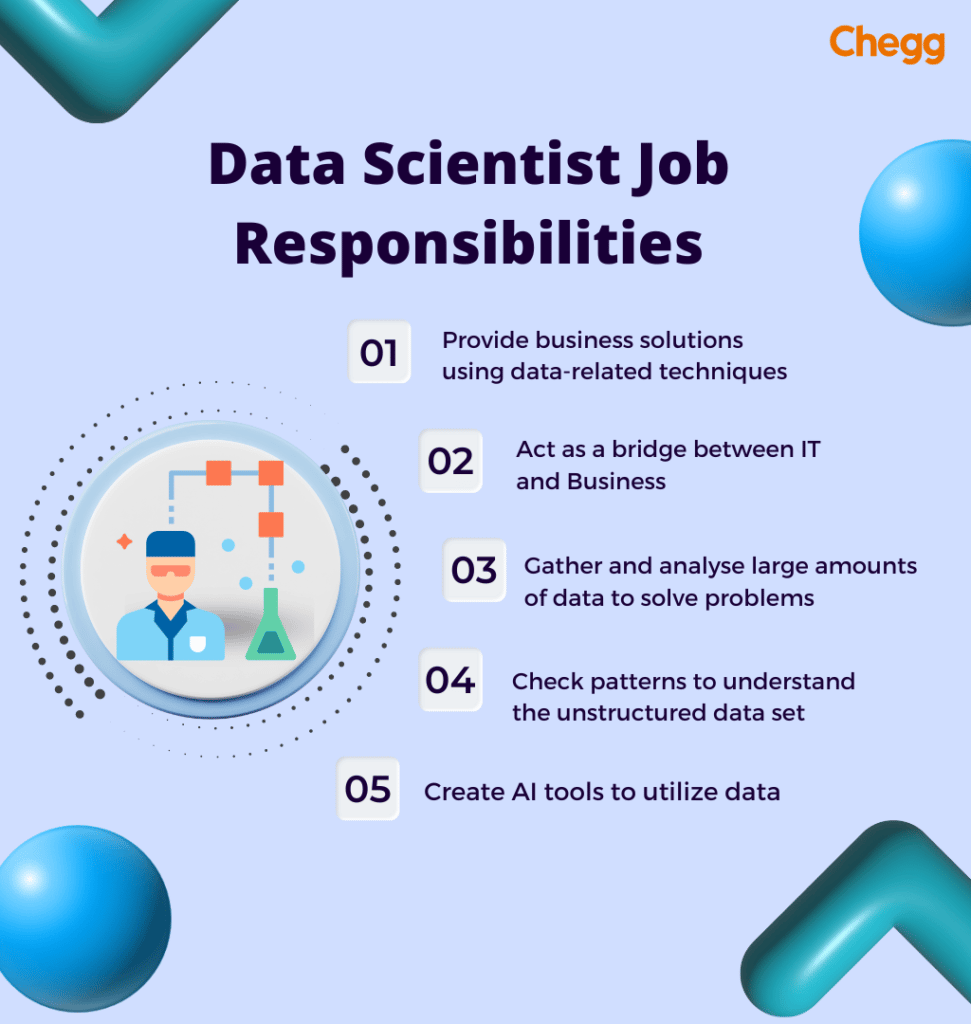
Data science goes beyond data handling—it combines curiosity, creativity, tools, and subject expertise. To become a data scientist, industry knowledge and structured learning are key. It plays a vital role in business planning, problem-solving, and predictive analysis across various sectors.
Data scientists analyze large datasets using math, statistics, and programming to solve problems and uncover insights. Strong analytical skills and expertise in data interpretation are essential for success. If you find patterns in data intriguing, a data science career in India could be a great fit!

Becoming a data scientist requires a blend of academic qualifications, technical skills, and practical experience. Here’s a step-by-step guide to help you pursue this rewarding career:
Begin your journey with a bachelor’s degree in Computer Science, Mathematics, Statistics, Engineering, or a related field. This foundational education prepares you in programming, analytics, and critical thinking.
Strong programming skills are vital in data science. Focus on:
Depending on your goals, you may also explore tools like Scala, Java, or Julia.
Data scientists need to understand:
These help in understanding how algorithms work and tuning models for better accuracy.
Build your portfolio through:
Platforms like Kaggle, DataCamp, and GitHub are great places to start.
As you progress, focus on a specific area such as:
This makes your skill set more targeted and job-ready.
If you aim for advanced or research roles, consider a master’s or Ph.D. in Data Science, AI, or related fields. Alternatively, pursue professional certifications to strengthen your credibility.
Technology evolves quickly. Keep learning through:
A proactive learner with strong projects often stands out more than just qualifications alone.
Certifications validate your skills and improve your job prospects. Here are the most trusted certifications in the field:
One or more of these can differentiate you in a competitive job market.
Choosing a niche specialization can shape your long-term career. Here are top domains within data science:
Focuses on designing self-learning systems and building predictive models.
Works with text data, powering chatbots, sentiment analysis, and virtual assistants.
Builds scalable systems for processing massive datasets. Emphasizes ETL (Extract, Transform, Load) and big data tools.
Applies AI to visual inputs like facial recognition, image segmentation, or autonomous driving.
Uses data to create dashboards, reports, and visual insights for business decision-making.
These specializations can help you stand out and align better with industry demand.
While academic knowledge is essential, real-world exposure is what makes you job-ready. Here’s how to build that experience:
Look for data analyst or junior data scientist roles in startups or mid-size firms. Internships help apply your skills in a structured environment.
Create a GitHub portfolio of:
This demonstrates initiative and problem-solving.
Join platforms like:
Take small gigs on platforms like Upwork, Toptal, or Freelancer. This builds confidence and exposes you to different industries.
Real-world projects show employers that you can apply theory to practical problems.
If you’re looking for an entry-level job in data science, there are several steps you can take to increase your chances of success. Here are some tips on how to find an entry-level job in data science:
To land an entry-level job in data science, you must have a strong foundation in technical skills like programming, machine learning, and data analysis. Consider taking online courses, attending workshops, or participating in data science competitions to build your skills and demonstrate your knowledge.
Employers in the field of data science often seek candidates with practical experience working with real-world datasets. To enhance your profile and increase your chances of landing an entry-level job, consider creating a portfolio of projects that showcase your skills in data analysis, machine learning, or data visualization. For those wondering how to become a data scientist in India, working on projects that highlight your expertise and knowledge is a crucial step. Some project ideas include:
Networking is a key component of any job search, and the field of data science is no exception. Attend conferences, meetups, and other events to connect with other professionals in the field, and consider joining online communities like LinkedIn or Kaggle to expand your network.
Look for entry-level positions in data science, data analysis, or data engineering, and apply to as many as you can. Don’t be discouraged if you don’t hear back from every application – finding a job in data science can take time, and persistence is key. In India, there are several job platforms that are ideal for finding data scientist jobs, including:
Preparing for a data scientist interview can be a challenging and nerve-wracking process, but with the right approach, you can increase your chances of success. Here are some tips on how to prepare for a data scientist interview:
The first step in preparing for a data scientist interview is to review the job description carefully. Make sure you understand the key responsibilities and requirements of the role, as well as the company culture and values.
Data science interviews often involve technical questions related to programming, machine learning, statistics, and data analysis. Be sure to brush up on these skills, and practice coding in languages such as Python, R, and SQL. Here are some sample interview questions:
In addition to technical questions, data science interviews often include behavioral questions to assess your problem-solving skills, communication skills, and teamwork abilities. Here are some examples of behavioral questions:
Before your interview, take the time to research the company and its mission, values, and culture. This will help you understand the company’s needs and how you can contribute to its success.
The more you practice, the more confident you will be during the interview. Consider doing mock interviews with friends or colleagues, and ask for feedback on your responses.

This online certification course is offered by IBM and provides learners with a comprehensive introduction to data science. The data science course covers a range of topics, including data analysis, data visualization, machine learning, and data ethics. Learners will complete a variety of hands-on projects using tools like Jupyter Notebooks, and RStudio.
This certification course is offered by Microsoft and is designed for data scientists who work with Azure. The course covers topics such as data preparation, modeling, and deployment, and includes hands-on labs using tools like Azure Machine Learning and Azure Databricks.
This online certification course is offered by Google and is designed for learners who want to gain foundational skills in data analytics. The course covers a range of topics, including data analysis, data visualization, and data storytelling, and includes hands-on practice using tools like Google Analytics and Google Data Studio.
This certification program is offered by Harvard University and provides learners with a comprehensive introduction to data science. The course covers topics such as data wrangling, data visualization, statistical inference, and machine learning. Learners will complete a variety of hands-on projects using tools like R and Python.
This certification course is offered by Cloudera and is designed for data scientists who work with Hadoop and other big data technologies. The course covers topics such as data preparation, modeling, and deployment, and includes hands-on practice using tools like Apache Spark and Apache Hadoop.
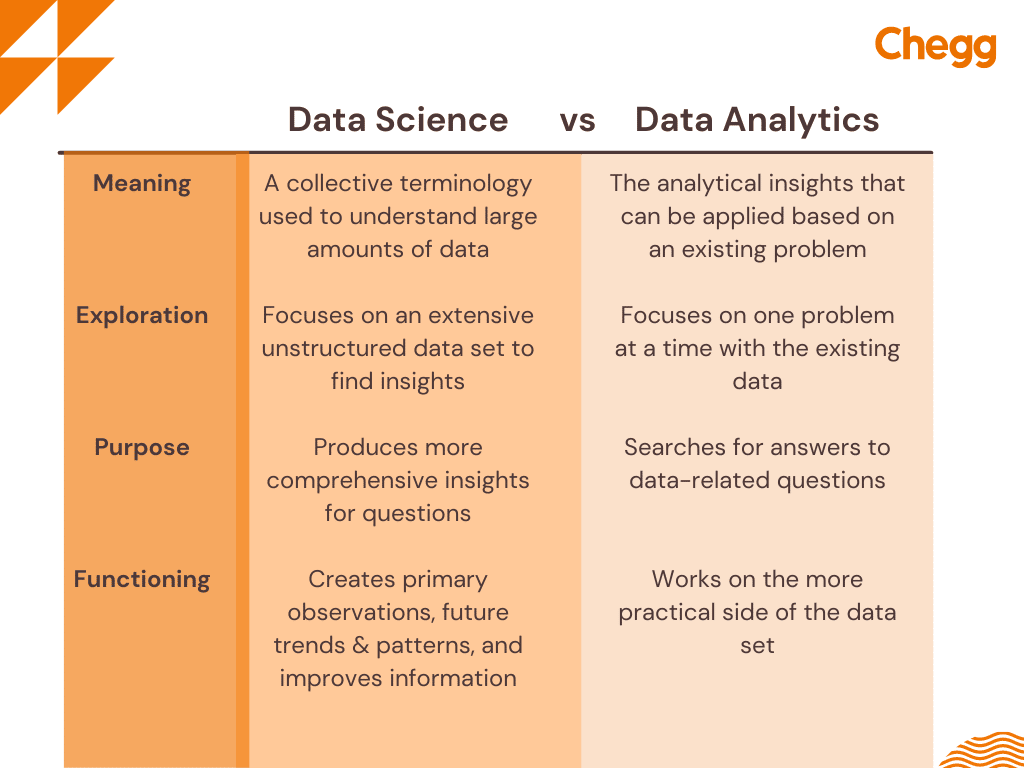
Data Science and Data Analytics are two highly interconnected fields. In fact, they usually go hand-in-hand. However, the major points of difference are listed below
The average salary of a Data Scientist in India with less than a year’s experience starts from Rs 4.5 lakhs per annum. However, with experience, the salary growth is high in data science, where the salary with eight years of experience could be as high as Rs 25.8 Lakhs per annum on average.
There has been a considerable growth in the median salary of data scientists to Rs 16.8 lakhs annually, up by 25.4% in 2024. The number of data science professionals earning Rs 15-25 LPA and Rs 25-50 LPA bracket grew from 14.5% to 20.5% and 7.8% to 13.7%, respectively, against the growth in 2024. (Source: Economic Times)
In India, the data science industry is predicted to see enormous growth by 2026. the demand for data scientists in India is at an all-time high, and it has been expected that the field will create 11 Million job openings by 2026.
There is also a growing demand for experienced data scientists who have worked in other companies and have already gained experience creating new products and services. They may have worked on projects with a lot of data involved, which means they have the skills needed to handle vast amounts of data and use it to develop something new and innovative.
Data Scientists are in high demand across all industries. While there are many different types of companies, the following industries employ more data scientists than any other industry:
Healthcare is one of the largest employers of data scientists, with 1 in 4 employees working as data scientists. According to the Bureau of Labor Statistics, there will be 18,300 new jobs for data scientists by 2026.
SaaS (Software as a Service) companies need to collect large amounts of data from their customers, which requires data scientists to analyze and extract valuable information. These companies also have high employee turnover rates due to their fast-paced environment.
Financial services have been a hotbed for data scientists because they require a deep understanding of financial markets and their workings. This knowledge can only be gained through years of experience or education at a university-level program like an MBA or PhD program.
Here are some of the top recruiting companies for Data Scientists:
Amazon is usually looking for data scientists who have significant experience working with large datasets and who can help them use these datasets for making decisions on where to locate their headquarters or other important business decisions.
Microsoft has been hiring many people from across the globe since 2012 when it opened its first data center in Amsterdam. The company has now set up more than 160 locations worldwide and is looking for people with expertise in machine learning, deep learning, artificial intelligence (AI), big data analytics, and more so that they can help them improve their products.
IBM has an open job listing database where people can browse working on projects and available jobs and apply for them directly through their website. There are also several internships available at IBM’s Watson Research Center in New York City, where students can work on real-world problems while earning money while they complete their coursework.
While these are the industries where data scientists and data analysts are demanded, there are a few companies in India where data scientists can get lucrative offers. The companies are as follows:
Read more – Data Analyst Interview Questions
To embark on a career as a Data Scientist after finishing 12th grade, consider these essential steps:
1. Select the Appropriate Stream: Choose the science stream, focusing on subjects like Mathematics, Statistics, and Computer Science during your 12th grade.
2. Pursue an Undergraduate Degree: Enroll in a suitable undergraduate program, such as:
3. Master Programming Languages: Develop skills in programming languages that are vital for data science, including Python, R, and SQL.
4. Enhance Analytical Skills: Engage in courses that sharpen your analytical and statistical abilities.
5. Explore Online Courses and Certifications: Broaden your knowledge with online courses and certifications in data science, machine learning, and related areas.
6. Acquire Practical Experience: Get involved in internships, projects, and competitions to gain real-world experience.
7. Consider Higher Education (Optional): Think about pursuing a master’s degree or specialized certifications to deepen your expertise.
8. Stay Informed: Keep abreast of the latest developments in data science by reading research articles, attending workshops, and connecting with professional communities.
Are you interested in solving computer science-related problems for your peers? Become a Subject Matter Expert so you can earn money while answering students’ questions across the globe. You can work wherever you want, whenever you want, and whenever convenient. Build a strong peer network by getting exposure to the business world and meeting experts from various fields and domains. All you have to do is sign up!
Read more-
To start a data science career in India, pursue a degree in Computer Science, Statistics, or Mathematics. Build strong programming skills in Python, R, SQL, and data tools like Pandas. Learn machine learning techniques and explore big data technologies like Hadoop and Spark. Develop a project portfolio, earn data science certifications, and gain hands-on experience through internships or entry-level roles while networking for career growth.
Not solely focused on IT, the job of a data scientist could be called an IT-enabled data management job. Unlike an IT job, where the main focus is on technological advancement and issues, data scientists work on enabling an organization with data management using IT skills.
They are a fusion of computer science, statistics, and math that discover any information from the given/collected data.
Yes, the job of a data scientist is not easy and comes with challenges. Even with all the skills like knowledge of computer science, statistics, and math, they could find themselves struggling due to increased competition in the field in recent years. Furthermore, the enormous size of data is another challenge many data scientists face, and thus they need sound data science skills to perform well on the job.
The demand for data scientists has increased exponentially in the past few years because of the growing data load. Everything is becoming computerized; thus, the data needs to be managed efficiently. According to Glassdoor, data scientists earn Rs 116100 per annum on average. Job opportunities are increasing, and there is no decline in sight.
Some data scientists have a background in formal, undergraduate, graduate, and doctorate education in statistics, mathematics, or computer science. This makes it easier for them to enter the data science domain as they already have most of the required skills. Many online and offline universities provide courses specifically related to data science.
1. Programming: Data scientists need to be well-versed in programming languages like Python, R, and SQL.
2. Statistical Analysis: Data scientists need to have a strong understanding of probability, data mining, and statistics.
3. Data Visualization: Data scientists need to be able to effectively visualize data to better communicate their findings.
To become a data scientist, you usually need about 4 to 5 years of study if you start with a bachelor’s degree in a relevant area, followed by another 1 to 2 years for a master’s degree. On the other hand, if you’re looking for a quicker route, intensive boot camps and online courses can get you ready for entry-level positions in just 7 to 12 months. The total time it takes can vary based on your previous experience and educational history.
To embark on a career as a data scientist, it’s crucial to have a solid grounding in mathematics, statistics, and programming languages such as Python, R, and SQL. Additionally, proficiency in data analysis and machine learning is vital. Gaining hands-on experience through projects and internships plays a key role in developing your expertise.
Embarking on a journey to become a data scientist can be quite demanding, as it requires a solid foundation in technical skills, a commitment to ongoing education, and hands-on experience. Nevertheless, with perseverance and access to the right tools, it is certainly within reach.
A data scientist is a skilled analyst who gathers, processes and interprets vast quantities of both structured and unstructured data. Utilizing their expertise in mathematics, statistics, and programming, they derive insights that help tackle intricate challenges and facilitate data-driven decision-making across a range of industries.
Read More: