

For most students in India, one of the biggest dilemmas after completing school is deciding between a diploma or a degree. With over 4 crore students enrolled in higher education (AISHE 2023 report), it’s clear that the path you choose can significantly shape your career trajectory. But with so many options available—short-term skill-based diplomas, 3-year undergraduate programs, and 4-year professional degrees—the decision can feel overwhelming.
According to India Skills Report 2024, industries increasingly prefer candidates with practical skills, but degrees still carry weight when it comes to career advancement, postgraduate studies, and competitive exams. This balance of skills and credentials is why understanding the difference between the two is so important.
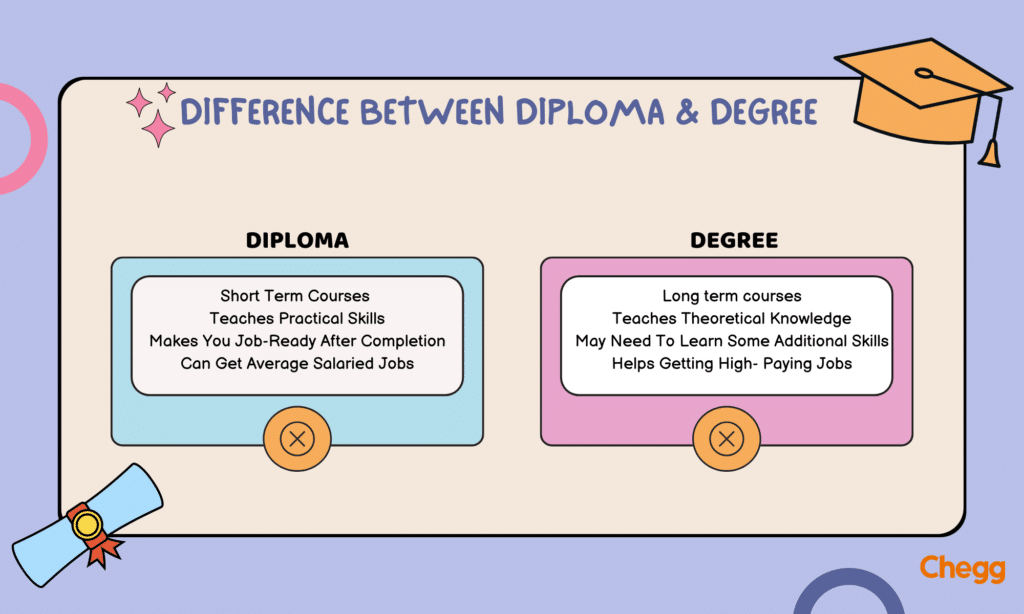
|
Core area |
Degree |
Diploma |
|
Meaning |
A degree is an undergraduate or postgraduate program after a particular study at a specific level. |
A diploma is a certificate given to a student after a specific course. |
|
Eligibility |
Higher Secondary |
Highschool |
|
Time |
2–4 years |
6–12 months |
|
Fee |
Comparatively high |
Comparatively low |
|
Admission |
Annually |
Half-yearly and annually |
|
Awarded by |
Colleges and universities |
Universities, colleges, and private institutions |
|
Salary |
Comparatively high |
Comparatively low |
|
Flexibility |
Yes |
No |
|
Conducted by |
Universities |
Universities, educational institutes, and private companies |
A degree is a formal recognition given by universities or colleges after completing a structured academic program. It offers in-depth knowledge, research opportunities, and career advancement.

A diploma is a short-term course (6 months – 2 years) that focuses more on practical, job-ready skills than academic theory.
Related Read:
To further clarify the difference between diploma and degree, the advantages of both are given below :
| Diploma | Degree |
| A diploma teaches you the relevant skills and prepares you for a job role in a short span of time. | Enhances career growth prospects as recruiters know that you have professional know-how of the skills that a job demands. |
| A diploma teaches hands-on skills. Anyone can use these skills to land a variety of job roles, from stitching to carpentry. | A degree is proof that you have earned your skills. |
| A diploma degree can serve as a pathway to enter specific careers directly. | A degree puts you in contact with other people in the same field. |
| Individuals with diplomas may find it easier to secure entry-level positions and gain relevant work experience in their field of interest. | Individuals with a degree tend to earn higher salaries compared to those with diplomas or lower levels of education. |
| Diploma programs offer flexibility in terms of scheduling and course options. | Pursuing a degree equips you with a wide range of transferable skills. |

Here are some disadvantages highlighting the difference between a diploma and degree
| Diploma | Degree |
| A diploma degree is considered less important in some fields and industries. | The degree requires a longer time duration to get completed. |
| Individuals with degrees may have a higher earning potential compared to those with diplomas. | Obtaining a degree can be costly, especially at prestigious universities. |
| Diplomas typically offer a narrower scope of academic subjects compared to a degree program. | Degrees often encompass a broader range of subjects and provide more general education. |
Here are some uses highlighting the difference between diploma and degree.
| Diploma | Degree |
| A diploma offers additional qualifications and professional training. | A degree is a step towards advancing your career. You can build the foundation of your knowledge in a subject by pursuing a degree. |
| A diploma degree teaches practical ways of dealing with the job at hand. | A degree on one’s resume helps form a good impression on the recruiter. |
| A diploma degree can be an excellent option for individuals looking to enter the workforce quickly. | A degree offers the time to learn from and exchange ideas with people in one’s field. |
After knowing the difference between a diploma and a degree, it’s time to know what employers seek out.
A diploma may be extremely useful in fields such as information technology, design, and crafts since it emphasizes practical abilities and hands-on experience. Employers in these industries frequently value the specialized training offered by diploma programs.
Employers often prefer degrees for positions in management, academics, or disciplines requiring advanced expertise (such as law, medicine, and engineering). A degree offers a broad grasp and is sometimes required for more advanced positions.
In India, the salary difference between diploma and degree can be significant. Diploma holders typically earn between ₹2-4 LPA (Lakhs Per Annum) in entry-level roles, while degree holders can start with ₹3-6 LPA, depending on the field. Engineering, IT, and management graduates often secure higher salaries compared to diploma holders in similar industries. However, experience, skills, and industry demand play a crucial role in salary growth. While degrees offer long-term career growth, diplomas provide quicker job opportunities with specialized skills. Explore which option aligns with your career goals and financial expectations.
After analyzing the difference between diploma and degree its your turn to make a choice. Diploma or degree whatever you choose one thing is obvious you will get to gain knowledge. Now, the decision is whether you want to gain knowledge of practical skills of a specific job via a diploma degree. Or you want to gain theoretical knowledge of an industry or subject. The decision is yours, but be specific with what you want and choose the path that matches your interests, career prospects and circumstances.
Yes, you can pursue a diploma and a degree together in India, but there are some conditions. According to UGC guidelines, you can only do this if one course is in full-time mode and the other is through distance or online learning. For example, you can study for a full-time bachelor’s degree while also taking a diploma course online or through distance education. This is a great way to gain additional skills alongside your degree, making you more job-ready. However, it’s important to check if both courses are recognized and whether their schedules allow you to manage them effectively.
Since the difference between diploma and degree is clear it is important to consider the following points When deciding whether to pursue a certificate or a degree:
Future Objectives : Consider your long-term career goals before choosing between a diploma and a degree. If you aim for quick employment in a skill-based role, a diploma is ideal. However, if you seek career advancement, leadership positions, or further studies, a degree provides better opportunities.
Time and Resources : A diploma takes less time and is usually more affordable, making it a good option if you want to enter the workforce quickly. A degree requires a longer commitment and higher financial investment but offers greater career stability and higher earning potential in the long run.
Personal Interests : Choose a path that aligns with your passion and learning style. If you enjoy hands-on training and practical work, a diploma may suit you better. If you prefer deep academic learning and theoretical knowledge, a degree will provide a more fulfilling educational experience.
To explore about numerous options of different degrees and diplomas deep dive into our guide on Career Advice.
Difference Between Diploma and Degree: Ultimately, deciding if a diploma or a degree is right for you depends on your career aspirations, how much time you are willing to invest in your education, and your style of learning. A degree programs offers applicable academic depth and breadth which allows for continued education. Weighing the amount of work in the program, industry recognition, and what is important to you ensures that you find your educational pathway. Both types of credential can provide achievement with some foresight and desire.
In the end, what truly matters is how you leverage your education. Whether it’s a diploma leading to early employment or a degree that sets the stage for long-term career growth, success comes from continuously upskilling, adapting to industry trends, and staying committed to your goals. Education is not just about the credential—it’s about the skills, knowledge, and experiences you carry forward into your career.

There is a difference between a diploma and a degree. Degrees are more beneficial in the long run. More recruiters choose employees with degrees rather than diplomas. However, many recruiters also hire individuals who have job-specific skills, which are learned by a diploma degree.
Diploma is better if you want to learn skills related to a specific job and a degree provides you with detailed knowledge of subjects. They both are different in terms of duration, specialization and importance according to the industry or career you choose. So, no diploma and degree are not same.
No, the diploma is not higher than the graduation degree. Every individual has different goals; therefore, their choices may also differ. What matters is keeping in mind the difference between diploma and degree when opting for either and how the choice will affect their long-term goals.
Yes, diploma degree certificate is good for a career. As it provides you with the job skills which help you get into the selected field easily. Diploma makes you job-ready on the go so that you can get hired immediately.
Yes, diploma courses are typically more practical and skill-oriented, preparing students for specific industries. In contrast, degree programs provide a broader academic foundation with theoretical and research-based learning.
Yes, diploma holders can secure jobs in various industries, especially in technical, vocational, and skill-based roles. Many companies hire diploma graduates for entry-level positions with salaries ranging from ₹2-4 LPA, depending on the field and experience.
A report from the Indian Ministry of Education highlights that, on average, degree graduates earn 50% more than diploma holders over their careers. This financial aspect is a key consideration for students deciding between the two educational paths.
A UG Diploma, or Undergraduate Diploma, is a qualification awarded after completing a program of study at the undergraduate level, typically after high school or secondary education
A diploma is a certificate an educational institution awards to a student for completing a specific course and passing the examination, while a degree is a credential a college or university grants upon successful completion of a course.
Yes, many ITI and polytechnic diplomas are open after Class 10.