

Careers after electrical engineering are expanding rapidly, with India’s electrical equipment industry projected to reach $70 billion by 2025, growing at a 12% CAGR. This growth reflects the rising demand for skilled engineers in diverse sectors. For instance, companies like Siemens and Tata Power are actively hiring electrical engineers for projects in renewable energy and smart grid solutions, showing how industry leaders are shaping the future of sustainable power.
If you’re an electrical engineering student or recent graduate, this is the perfect time to explore the vast range of opportunities available in this dynamic field. Take the case of Ankit Sharma, an electrical engineering graduate from IIT Delhi, who started as a design engineer in a semiconductor firm and within three years transitioned into an R&D role in AI-powered chip design. His journey highlights how electrical engineers can diversify their careers beyond traditional roles into cutting-edge domains.
From core technical positions to emerging fields like renewable energy, artificial intelligence, and semiconductor design, the possibilities are both diverse and rewarding. In this guide, we’ll walk you through the best careers after electrical engineering in India, the skills required, salary insights, and tips to choose a path that aligns with your interests and long-term goals.
Electrical engineering involves designing, developing, and utilizing systems and equipment that operate using electricity, electronics, and electromagnetism. Electrical engineers handle projects from initial planning to ongoing maintenance. They contribute across various sectors, including transportation, technology, and government services.
Electrical engineers apply their deep understanding of physics, electromagnetism, and electronics in diverse tasks. They work with electrical systems, devices, and infrastructure. Their responsibilities include:
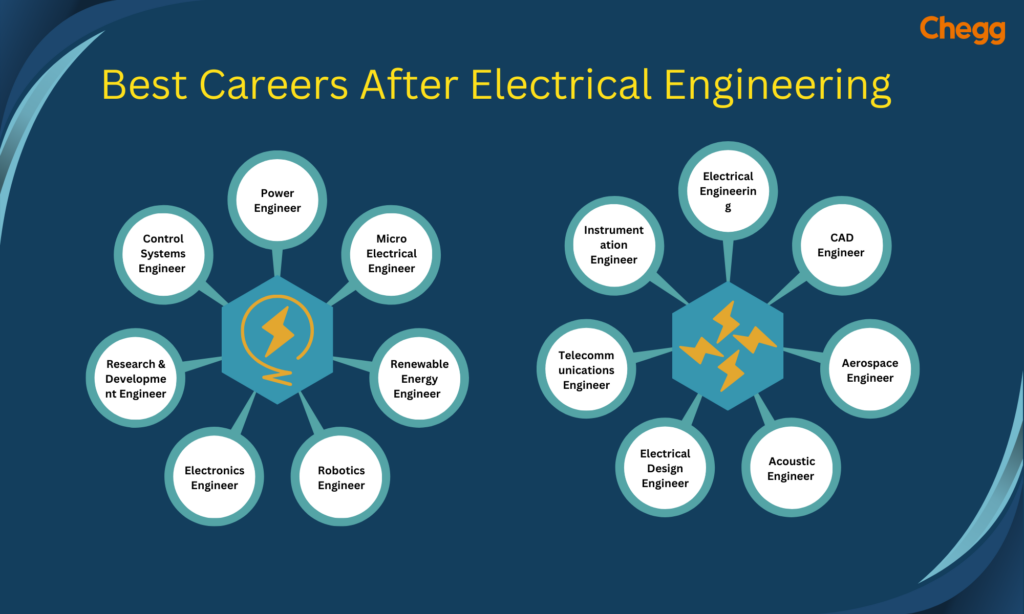
The best careers after electrical engineering are:
With the growing demand for technological innovation, there are numerous careers after electrical engineering that offer high growth potential. Now let’s explore these careers after electrical engineering one by one in detail:
Power Engineering is one of the top careers after electrical engineering. As a power engineer, you will design, operate, and troubleshoot systems that generate and utilize electrical power. Your role involves ensuring the safe and efficient operation of power plants, electric grids, and energy systems. To excel in this career, a background in electrical engineering and relevant certifications or licenses are essential.
Becoming a Power Engineer is one of the best careers after electrical engineering as there are several scopes in this job profile. You can work in fields of Power generation, distribution, transmission, energy storage, renewable energy, and energy management and may even work in industries like utilities, manufacturing, and construction.
Power engineers have several responsibilities such as designing, operating and maintaining power systems. Along with managing multiple projects, most importantly they have to ensure safety and compliance regarding electricity while they provide technical assistance to the team and collaborate with other teams and third-party persons for bigger projects.
The average salary of a Power Engineer in India is 6.4 LPA.
Control Systems Engineer is also on the list of best EEE careers after electrical engineering which you can choose positively. A control system engineer is a professional who designs, analyses and maintains systems that control the behaviour of other systems, such as machines or processes. For this, you need to use a combination of math, physics, and engineering principles to develop and implement control algorithms and optimize system performance.
Control Systems Engineering offers exciting careers after electrical engineering, with opportunities across industries like aerospace, automotive, manufacturing, energy, and robotics. With the growing demand for AI robots, advanced machinery, and cars, these fields continue to expand, providing a wealth of career prospects.
Control Systems Engineers have several responsibilities to fulfil, such as designing and developing control systems, analyzing system requirements, testing, commissioning control systems, troubleshooting problems with the control system, documenting the design created, and getting its approval to create and much more. And you gain experience, your responsibilities will increase.
A Control Systems Engineer can earn up to 10 lakhs per annum in India.
If you are interested in finding new things in the field of EEE engineering jobs then becoming a Research and Development Engineer is one of the best careers after electrical engineering for you. A Research and Development Engineer is a professional who designs, develops, and tests new products, processes, or technologies. As an R&D engineer, your primary task will be to conduct research, analyze data, and develop prototypes of new products.
If you want to create one of the best careers after electrical engineering for yourselves you need to look out for various career scopes. As an R&D engineer, you get to work in a wide range of industries, including technology, manufacturing, aerospace, creating customer goods, working in energy industries, or chemical you can even work in the healthcare industry.
R&D Engineering is a rewarding career after electrical engineering, offering a range of responsibilities. As an R&D engineer, you will research, gather data, and design prototypes for new products. Once approved, you’ll work on the development process, collaborating with other team members and sometimes across teams to bring innovations to life.
The average salary of an R&D engineer in India is around 9.2 LPA.
Electronics engineering is one of the best careers after electrical engineering for you if you love to explore the field of electronic equipment. As a professional electronics engineer, you will be designing, developing, and testing electronic systems and components such as circuits, devices, and communication systems. This will be done using your expertise in electrical theory, materials science, and mathematics to create new technologies and improve existing ones.
Careers after electrical engineering offer vast opportunities across various high-paying and growing industries. Some of the top sectors include research and development, automotive, telecommunications, aerospace, medical, consumer goods, and even defence, providing a wide range of career prospects for electrical engineers.
As electronics engineers, you have to fulfil several responsibilities in your job, such as designing and developing electronic circuits, and then testing and evaluating those electronic systems. You also have to troubleshoot problems and provide solutions to ensure that electronic devices and systems are functioning properly. Overall, Electronics Engineers play a crucial role in advancing technology and shaping our modern world.
The average salary of an Electronics Engineer is 5 LPA.
With AI and robotic technology taking the world by storm making a vocation as robotics engineer is one of the best careers after electrical engineering field in India. As a robotics engineer, you will design, build, and maintain robotic systems. You can work on different aspects of a robot’s design, such as sensors, programming, and control systems. All this will be done using principles of mechanical, electrical, and software engineering.
There is a vast scope for electrical engineers in the robotics field. Several industries need good robotics engineers, some of the high-paying and growing industries for robotics engineers are manufacturing, education and research, defence, automobiles, agriculture and healthcare. You just need to decide which industry interests you and develop your skills accordingly and you are ready to get hired.
When you choose one of the best careers after electrical engineering it brings certain responsibilities too. As a robotics engineer, you need to design and develop robotics systems, create their algorithms and test and evaluate them. Sometimes robotics engineers also collaborate with other experts, such as computer scientists, mathematicians, and physicists, to create innovative and efficient robotic solutions.
As a Robotics Engineer, you can make up to 5.4 LPA.

If you advocate sustainable development and renewable resources then becoming a Renewable Energy Engineer is one of the best careers after electrical engineering for you. As Renewable Energy Engineer you work on designing, developing and implementing renewable energy systems and technologies such as solar, wind, geothermal, hydro, and biomass. Your work aims to reduce reliance on non-renewable energy sources and mitigate the negative impacts of climate change.
With the rise in demand for renewable energy and government initiatives, various EEE job opportunities for renewable energy engineers are available. Some of the best industries to look out for are wind energy industry, solar, hydro-electricity, bio-energy and energy industries. You can also work smart grid and energy efficiency industry.
As renewable energy engineers your work is to evaluate site-specific conditions and determine the best renewable energy options to meet the energy demands of a particular building or community. You also need to conduct feasibility studies, oversee the construction and operation of renewable energy systems, and ensure compliance with regulations and safety standards suggested.
The average salary of a Renewable Energy Engineer in India is 5.9 LPA.
Microelectronics is a division of electronics that concentrates on the design of small electronic parts like circuit boards, semiconductors, and microchips used to design instruments of electronic, new biomedical, information technologies, aerospace devices, etc. Microelectronic engineers develop plans and build electronic circuit chips, circuit boards, and semiconductor prototypes. They develop new designs, perform specialized tests, and record and interpret data on the performance of new models.
This is one of the best careers after electrical engineering, and it has a great career scope. The demand for microelectronics, such as microchips and semiconductors, has increased by 26%, resulting in the need for and demand for skilled micro-electrical engineers.
The responsibilities of micro-electrical engineers depend on their experience and the size of their team. These responsibilities include design and modelling in system C or equivalent, testing and analyzing the designed microchip model, logical synthesis and timing analysis, level integration, and much more.
The average salary of a micro-electrical engineer is INR 2 LPA, which can be raised with an increase in experience and skills.
An electrical engineer generally focuses on large-scale electrical systems such as power transmission, motor control, utilizing electricity, and transmitting energy. They design and develop new electrical systems, test equipment, and solve problems. Electrical engineers are also one of the best careers after electrical engineering, as they can work on a diverse range of technologies, from the design of household appliances to telecommunication systems, building lighting and wiring, satellite communications, and electrical power stations.
Electrical engineers are crucial for creating and maintaining electrical control systems, machinery, and all the other equipment used in daily life and industrial work. So, there is a lot of scope in this field after electrical engineering.
The responsibilities of electrical engineers include designing and developing electrical products as per clients’ demands, following the latest regulations. Understanding design specifications and technical drawings, testing products to ensure their quality, researching manufacturing methods, and servicing and maintaining the electric system are also their job.
The salary of an electrical engineer in India is 5 LPA.
Recommended read: Difference between Electrical and Electronics Engineering
An instrumentation engineer typically works for industries with automated processes to improve productivity, safety, reliability, stability, and optimization. Instrumentation engineering is one of the best careers after electrical engineering for those who can think out of the box and translate project needs into design development of hardware suitable for the task, sound problem-solving skills, and good communication skills.
There is a lot of scope in this one electrical engineering career path; a qualified instrumentation engineer can work in automation, construction, railways, Machinery, control systems, manufacturing, packaging, etc.
Instrumentation engineers are commonly responsible for integrating sensors with recorders, displays, transmitters, or control systems. They are also responsible for testing and maintaining the system. They generally design or specify installation, wiring, and signal conditioning.
If you choose this career after electrical engineering, you can earn 5 LPA as an Instrumentation engineer.
A telecommunication engineer is a good career option after electrical engineering for someone with good knowledge of logging and database tables, experience designing and implementing LAN, WAN, Wireless LAN, and WWAN, and a fair technical understanding of network hardware, internet standards, and protocols.
If you have this job as one of the careers after electrical engineering then you can make a great career for yourself. As there is a lot of scope in this job, you can enter the fields of aviation, radio and telecommunication, analytical equipment manufacturing, and consumer electronics as a telecommunications engineer.
Telecommunication engineers are responsible for examining new network technologies and offering suggestions regarding integration. They have to ensure network availability and provide necessary maintenance and support. People are experts in managing data such as voice, calls, text, and video over different modes of communication. They install and design different telecommunication equipment.
The average salary of a telecommunications engineer is 7 LPA in India.
An electrical engineer is one of the good career options after electrical engineering for an individual who possesses strong communication, analytical, and problem-solving skills, who can work under pressure in a specific timeline, who also has organizational, leadership, and creative skills as it comes in handy for an electrical design engineer.
This is one of the best careers after electrical engineering paths to choose from. With so many constructions and developments happening there is a lot of scope in electrical design engineer jobs. You can work in the construction and infrastructure industry, and create data services, uninterruptable power supply, lightning design and controls etc.
An electrical design engineer develops new electrical systems for various applications. They are responsible for developing system specifications and layouts. Electrical design engineers also test their systems and make adjustments as needed. They also provide support throughout the manufacturing of the electrical systems they have designed.
If you choose to become an electrical design engineer after electrical engineering, then you can earn 5.4 LPA in India.

Choosing an acoustic engineer as one of the careers after electrical engineering will be a good choice if have a keen interest in sounds and voice effects, Acoustic consultants are professionals who work designing, controlling and adjusting the sound effects in electronic applications like mobile, radio, speakers etc.
Acoustic engineering has good scope after electrical engineering, as you will be working to enhance people’s lives. An acoustic engineer can work in the fields of architecture, entertainment, industrial, environmental, and transport production.
As an acoustic engineer, your responsibilities will be to do sound insulation detailing and testing, modify noise from transport vehicles, heat ventilation, aircraft, etc. You also need to do data analysis, prediction, assessment and reporting are some of the responsibilities.
The average salary of an acoustic engineer in India is 9 LPA.
If planes and rockets have always fascinated you, then you can consider aerospace engineering as one of the best careers after electrical engineering for yourself. Aerospace engineers are the professionals who work on the research, design, development and maintenance of aircraft.
Becoming an aerospace engineer is an exciting career option after completing your electrical engineering degree, as you can work with space stations and aviation manufacturing companies and help in the designing, developing, and maintaining of aircraft.
The responsibilities of aerospace engineers are creating aircraft by applying principles of science and technology, researching and developing design specifications, supervising the assembly of aircraft parts, taking part in flight-test programmes, and regular inspection of aircraft and maintenance. All these tasks are done by an aerospace engineer.
The average salary of an aerospace engineer is 7.8 LPA in India.
If you possess engineering skills and creativity, CAD Engineering can be an excellent choice among careers after electrical engineering. This role involves collaborating with architects and design engineers to create precise 2D and 3D technical drawings, making it a rewarding option for those who enjoy design and innovation.
As a CAD engineer, you will get great opportunities to present your great intellect, creativity and skills. You can work in good positions in the field of architectural offices, firms and even Government organizations.
As a CAD engineer, your responsibilities will be to create high-quality detailed technical drawings and plans based on designs supplied by architects. Ensure that designs are compliant with health and security regulations, calculate costs and knowledge of engineering principles etc.
The average salary of a CAD Engineer is 6.9 LPA.
These were the various careers after electrical engineering. An electrical engineer is a key factor in the industrial sector. Almost every sector involves the use of electrical engineers, ranging from small products and equipment to large-scale projects and equipment.
Recommended read: 20 Most Popular Electrical Engineering Interview Questions

Beyond conventional engineering roles, Electrical Engineers can explore exciting interdisciplinary careers:
Pursuing higher education or professional credentials after a degree in electrical engineering can open doors to specialized careers, research opportunities, and leadership positions.
1. M.Tech in Electrical Engineering (India)
2. MS Abroad
3. PhD / EngD (Engineering Doctorate)
4. Professional Certifications & Licensing
5. Competitive Exams & Government Roles
The world of electrical engineering is always evolving, and new exciting careers after electrical engineering are emerging. Here are some of the best career paths for electrical engineers in emerging fields:
Artificial Intelligence (AI) and Machine Learning (ML) are exciting options within careers after electrical engineering. As an electrical engineer, you can leverage these technologies to enhance electrical systems, such as creating predictive power grids to prevent blackouts or developing smart homes that adapt to user habits, making systems smarter and more efficient.
The future of transportation is electric, and India is gearing up for this revolution. As an electrical engineer in the EV industry, you could work on designing better batteries, creating efficient charging systems, or developing the electronics that make electric cars run smoothly.
Smart grids are the future of power distribution. They use digital technology to deliver electricity more efficiently and reliably. Working in this field, you could help create a more sustainable and resilient power infrastructure for India.
Nanotechnology is about working with incredibly tiny particles to create new materials and devices. In electronics, this could lead to faster computers, more efficient solar panels, and even wearable technology that’s as thin as a second skin!
According to industry reports and academic surveys, electrical engineering graduates in India and globally enter diverse sectors. A broad distribution looks like this:
With so many exciting options, how do you choose the best careers after electrical engineering? Here are some tips to help you decide:
Remember, your first job doesn’t have to be your forever job. Many engineers explore different areas throughout their careers, so don’t be afraid to try new things!
Pursuing further studies and specializations after completing a degree in electrical engineering can enhance your skills and open up new career opportunities. Here are some popular options:
Further studies and specializations can significantly enhance your expertise and career prospects.
Continuing professional education can significantly enhance your career. Some valuable certifications and credentials include:
Engage in Continuing Professional Development (CPD) by attending workshops, online courses, and industry seminars.
Gaining practical experience during or after your degree can significantly improve your job prospects in electrical engineering. Employers value candidates who have applied their knowledge in real-world settings.
1. Internships & Industrial Training
2. Apprenticeships & Entry-Level Roles
3. Student Competitions & Projects
4. Join Professional Bodies
5. Campus & Alumni Networks
Government jobs are a popular choice for careers after electrical engineering in India. These positions offer job security, competitive salaries, and the opportunity to work on large-scale projects that impact the nation. Some of the top government sectors for electrical engineering include:
For Careers after Electrical Engineering, you might start interviewing for various electrical engineering firms to start working. Here are some of the top recruiters who hire individuals after electrical engineering.
| Company | Industries | Hiring Process | Skills Required |
|---|---|---|---|
| Siemens | • Automation • Manufacturing • Energy | • Written tests • Technical interviews • HR interviews | • Automation • Control systems • Project management |
| General Electric (GE) | • Aviation • Healthcare • Energy | • Online assessments • Technical interviews • HR interviews | • Power systems • Renewable energy • Data analysis |
| Tata Power | • Power generation • Transmission • Distribution | • Written tests • Technical interviews • HR interviews | • Power systems • Grid management • Electrical safety |
| ABB Group | • Robotics • Power • Automation | • Online assessments • Technical interviews • HR interviews | • Robotics • Automation • Control systems |
| Infosys | • IT services • Consulting • Outsourcing | • Online tests • Technical interviews • HR interviews | • Programming • Data analysis • Cybersecurity |
| Wipro | • IT services • Consulting • Business process services | • Written tests • Technical interviews • HR interviews | • Programming • Software development • IT infrastructure |
| Larsen & Toubro | • Construction • Engineering • Manufacturing | • Written tests • Technical interviews • HR interviews | • Project management • Construction • Engineering • Automation |
| Honeywell | • Aerospace • Automation • Performance materials | • Online assessments • Technical interviews • HR interviews | • Control systems • Automation • Data analysis |
| Schneider Electric | • Energy management • Automation | • Online tests • Technical interviews • HR interviews | • Energy management • Control systems • Project management |
| Bosch | • Engineering • Electronics • Technology services | • Written tests • Technical interviews • HR interviews | • Electronics • Embedded systems • Automation |
To succeed in career option after electrical engineering, you’ll need a mix of technical and soft skills. Here are some key skills to develop:
Remember, technology is always changing, so the most important skill is the ability to learn and adapt to new things!
Choosing a career after electrical engineering offers numerous paths, each with its own opportunities and challenges. Whether you’re interested in government jobs, private sector roles, or higher studies, the key is to identify your strengths and align them with long-term goals. You can build a fulfilling and future-ready career by staying updated with the latest trends, such as renewable energy, smart grids, and semiconductor innovation.
For those considering careers after electrical engineering in India, the outlook is bright, with growing industry opportunities. Start exploring your options today and take the first step toward a rewarding professional journey.
Electrical engineering provides vast possibilities-from traditional power and infrastructure to cutting-edge domains like AI and green technologies. With internships, certifications, or advanced study, you can achieve success both in India and abroad.
Follow authoritative sources like IEEMA (Indian Electrical & Electronics Manufacturers’ Association), IEEE (Institute of Electrical and Electronics Engineers), and official government skill portals to track industry demand and emerging technologies. This will strengthen your knowledge and ensure you’re preparing with credible, up-to-date information.
If you want a guide, don’t worry, Chegg India is here. Click the following link to get the best Career Guidance of your life.
Read more:
Top 10 Successful Careers After Computer Science Engineering in 2025
Yes, an EEE student can get a job at Google by building the right skills. Google hires for roles like hardware engineer, data center engineer, embedded systems, and even software developer. To qualify, focus on programming (C++, Python, DS/Algo), core electronics (VLSI, FPGA, circuits), or cloud and networking. Strong projects, internships, certifications, and coding practice are key. With consistent upskilling and smart applications, EEE graduates can secure rewarding careers at Google.
Yes, EEE does involve coding, though it’s not as intensive as Computer Science.
Embedded Systems & Microcontrollers – Coding in C/C++ or Python to control hardware.
VLSI & FPGA Programming – Using Verilog/VHDL for chip design.
Automation & Robotics – Writing control algorithms and simulations (MATLAB, Python).
Software Integration – Coding for IoT devices, AI, and power systems.
While EEE is hardware-focused, coding is essential to design, test, and optimize modern electrical systems.
The best career options after electrical engineering include:
1. Electronics Engineer
2. Control Systems Engineer
3. Power Engineer
4. Telecommunications Engineer
5. Project Engineer
6. Systems Engineer
7. Renewable Energy Engineer
8. Electrical Design Engineer
9. Robotics Engineer
10. Automation Engineer
Job opportunities for electrical engineers include:
Design Engineer
Systems Engineer
Project Engineer
Control Systems Engineer
Electronics Engineer
Test Engineer
Power Engineer
Telecommunications Engineer
Field Service Engineer
Research and Development Engineer
Industries employing electrical engineers include:
– Renewable Energy
– Automotive
– Aerospace
– Telecommunications
– Manufacturing
– Defence
– Construction
– Robotics
– Consumer Electronics
– Utilities
The scope of electrical engineering in India is expanding, with growing opportunities in power generation, telecommunications, and electronics, driven by technological advancements and a focus on renewable energy.
Yes, EEE has strong future scope with opportunities in power, renewable energy, smart grids, and automation.
Energy Sector Growth – Expanding renewable and smart power systems boost demand.
Diverse Careers – Roles in core, IT, robotics, and PSUs.
Global Scope – Skills valued in clean energy-focused nations.
Higher Studies – AI, IoT, and power specializations open high-paying paths.
EEE remains a future-proof and versatile career choice.
EEE course salary (India): Freshers typically earn ₹2.5–6 LPA, mid-level engineers ₹6–15 LPA, and senior/specialist roles ₹15–40+ LPA (MNCs, power firms, or R&D). Pay varies by college, internships, skills (embedded systems, power, PLC, MATLAB), location, and higher studies.