

Are you intrigued by the fast-paced world of finance and eager to make your mark on Wall Street? If you’ve ever thought about how to become an investment banker, you’re not alone. This career is one of the most desired in the business world. It promises high rewards, intellectual challenges, and a lively work environment. However, getting a sought-after role in investment banking takes more than just ambition. It requires a clear plan, the right qualifications, and a smart approach.
In this guide, you’ll learn how to become an investment banker, step by step. We will cover everything from choosing the right educational path and developing relevant skills to networking with industry professionals and succeeding in tough interviews. We’ll explain what it takes to stand out in this competitive field. Whether you’re a student planning your first move or a professional considering a career change, get ready to discover the roadmap to success in investment banking.

An Investment Banker is a finance professional who helps organizations, such as companies, governments, or institutions, raise capital, manage financial risk, and carry out complex financial transactions like mergers, acquisitions, and IPOs (Initial Public Offerings).

Investment banking is a competitive field where investment bankers need profound skills to prosper. Before focusing on how to become investment banker, you need to know the educational qualifications to become one.
2. Investment banker requirements often include a master’s degree if you want to have prospects. But a bachelor’s degree is adequate for entry-level jobs, and you can work your way up. You can also do internships in an investment bank to gain experience.
But how long does it take to become an investment banker? Well, it depends on you. The timeframe varies if you pursue your career right after your bachelor’s degree compared to pursuing it after a master’s or doctorate. It may take up to 7 years to be a successful investment banker.
Read more:
Is investment banking hard? Yes, which is why having the necessary educational qualifications may be inadequate. The investment banker’s requirements may include specialized skills. Below mentioned pointers list the skills required for investment banking:

Wondering how to become investment banker in India? The key to investment banking is acquiring the preferred education and skills. It is time to focus on how to become an investment banker, which gets you started with the basic steps. If you’re wondering how to become an investment banker after the 12th, there are five essential steps. Let’s see them one by one.

How to start a career in investment banking? After completing the 12th standard, choosing the right course will get you one step closer to becoming an investment banker. Pursuing BBA or any other B.A. course with finance streams is suggested.
A bachelor’s degree is enough to get an entry-level job in investment banking. However pursuing a master’s degree will increase your value among competitors. A master’s degree will give you a shot at a more sophisticated job on the corporate ladder.
The next step is to join internships with credible investment banks to gain work experience. No matter your talent, investment banking will need experience to succeed.
You can always thrive for more; this competitive field has room for improvement. Get certified in popular finance-related courses. For instance, get a Chartered Financial Analyst (CFA) certificate and keep up with the rest of the world.
If you want to crave your career path, you need a professional network you can trust and lean on. Ensure you have established a smooth relationship with your clients and fellow bankers. Conduct informal interviews to get the best jobs and internships.
India is a developing country housing top investment banking firms, including some global investment banks. These investment banks offer blooming opportunities that make investment bankers a thriving career in India. We provide a list of top investment banks in India here.
| S.no | Top Investment Banking Firms |
| 1. | Avendus Capital, Mumbai. |
| 2. | Axis Capital Limited, Mumbai. |
| 3. | Edelweiss Financial Services, Mumbai. |
| 4. | JM Financial Institutions Securities, Mumbai. |
| 5. | ICICI Securities Limited, Mumbai. |
| 6. | IDBI Capital, Mumbai. |
| 7. | O3 Capital Global Advisory Services, Mumbai. |
| 8. | Goldman Sachs – US-based, Bangalore. |
| 9. | JP Morgan Chase – US-based, Mumbai. |
| 10. | Citi Bank – US-based, Mumbai. |
| 11. | Morgan Stanley – US-based, Mumbai, and Bengaluru. |
| 12. | Bank of America Merrill Lynch – US-based, Mumbai, Bengaluru, Chennai, and Delhi NCR. |
| 13. | Barclays Bank – United Kingdom, Delhi NCR, Mumbai, and Pune. |
| 14. | HSBC – United Kingdom, Delhi NCR, Mumbai, and Bengaluru. |
| 15. | Credit Suisse – Switzerland-based, Mumbai. |
Read more: Top 20 Venture Capitalists in India for NRI Investment
Avendus Capital is a Mumbai-based financial services firm that provides custom solutions. The firm specialises in asset management, credit solutions, investment banking, and wealth management. The firm cares about its employees and offers them a remarkable environment that enables them to grow. It also provides distinctive career opportunities for students and experienced professionals that allow them to achieve greater heights.
Axis Capital Limited is a wholly-owned subsidiary of Axis Bank with expertise in servicing the financial needs of companies, government entities, and private investors. It provides focused solutions in investment banking and institutional equities. Axis Capital appreciates fresh thoughts and innovation regardless of age and experience. It allows the employees to work with veteran leaders and innovators to make their career paths.
Edelweiss Financial Services is a leading financial services conglomerate that provides financial consultancies. It provides a professional ecosystem that values personal and professional aspirations with composure. With divergent business and roles, challenging grounds, and a constant focus on self-development, it helps its employees grow.
The Goldman Sachs Group is a global financial firm that provides distinctive financial services worldwide. It provides financial services to companies, governments, and investors. Goldman Sachs considers its people as their greatest assets. It takes utmost care in recruiting individuals to uphold its principles. It presents opportunities to collaborate with global leaders, while team-driven learning promotes individual talents.
JP Morgan Chase is a renowned investment banking company for its wide range of financial services. It offers phenomenal client services, supports the growth of its employees, and upholds integrity and responsibility. As a talent-driven firm, it provides a diverse workspace for its employees where everyone feels like they belong. JP Morgan Chase provides full-time jobs, apprenticeships, and internships to help graduates learn and develop.
Investment banking owes its popularity to the high salary range. But make no mistake; the work pressure is as high as the salary. However, it’s worth the struggle. Unfortunately, the salary of an investment banker in India is considerably low compared to salaries in foreign countries.
Because Indian investment banking firms provide services at low prices, an investment banker’s salary ranges between ₹ 1.8 Lakhs to ₹ 39.2 Lakhs with an average annual salary of ₹ 4.0 Lakhs per annum. The salary package will vary according to your location and experience.
Every field has pros and cons, and investment banking is no exception. Investment bankers are talented enough to tackle any financial crisis but sometimes face considerable challenges. Here we explain some of the common challenges in investment banking.
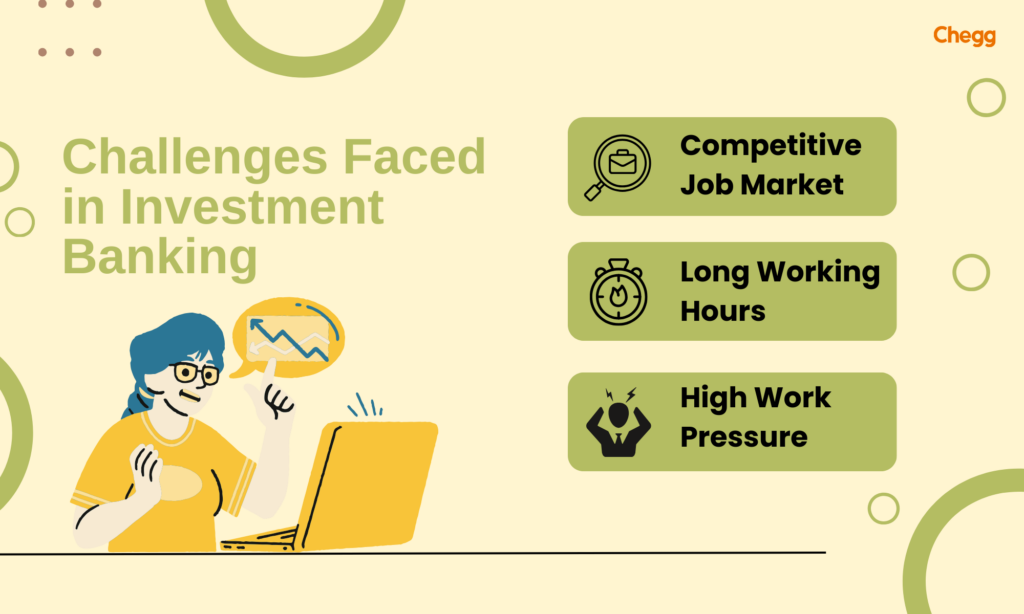
Investment banking is a competitive job market with many leading companies on the ground as it offers a high salary range. The increasing demand for finance professionals to assist organizations leads to the field’s competitive nature. It is possible to get rejected even with astonishing skills in this field. To get your dream job, you must always be at the top of your game.
As fancy as it looks, investment bankers are associated with long working hours. A survey indicates that an investment banker works around 80 hours a week. This may increase to around 100 hours a week, depending on the situation.
As an investment banker, you often experience high work pressure. It can be stressful sometimes as you must finish your work to meet deadlines. Sometimes it’s also implied by the client. To be successful, you have to be ready to tackle work-life balance.
By now, we hope you understand the definition, education qualification, and how to become an investment banker. All challenges apart, investment banking, is still one of the leading professions worldwide. If you’re a finance geek who loves crunching numbers, investment banking will be a great career path. But remember, it is a competitive field full of talented graduates and experienced professionals.
So, we advise you to learn as much as possible and get certified in popular investment banking courses. In a field as competitive as investment banking, nothing is ever enough. Learning will always be a part of your growth.
Evaluate numerous career choices to choose the right career path for yourself. Dive into our guide on Career Advice.
Breaking into investment banking may seem challenging, but with the right preparation and determination, it’s completely possible. By following the steps outlined, such as gaining the right education, building key skills, and connecting with industry professionals, you’ll be on your way to starting a successful career.
Remember, every top investment banker began with a single step and a vision for their future. Stay persistent, keep learning, and don’t hesitate to grab new opportunities. Your journey to becoming an investment banker starts now. Make it count!
Investment bankers generally make more than Chartered Accountants, especially at top firms. However, CAs can achieve high earning potential with experience and specialization, particularly in financial advisory or corporate jobs.
It typically takes 5 to 7 years. This includes 3 years for a bachelor’s degree, often in finance or economics, and 2 to 3 years for an MBA or relevant experience to enter investment banking roles.
Yes, becoming an investment banker is tough. It demands strong academic credentials, competitive internships, networking, and great analytical, communication, and financial modeling skills to get jobs in top investment banks.
Yes, investment banking is one of the most stressful careers. It involves long hours, averaging 80 to 100 each week. There is intense pressure, tight deadlines, and demanding clients. This is especially true during deal-making or financial crisis periods.
Due to high demand and limited talent, AI engineers earn more than CAs, especially in tech-driven companies. However, CA earnings can be strong in senior financial or consulting roles.
Yes, investment bankers use a fair amount of math, especially financial modeling, valuation, and data analysis. However, this math is more applied and focused on finance rather than theoretical mathematics.