
Technology and computer applications have vital implications in the modern tech-driven world. Students from a science background often face the common dilemma of choosing the right career. The very common question that arises is BCA vs BTech. It is a puzzling decision for tech-savvy students.
Deciding between a BCA (Bachelor of Computer Applications) and a BTech in Computer Science depends on your career goals. BCA emphasizes practical skills and software development, whereas BTech offers a deeper, more technical engineering foundation with multiple specialization options.

Although both courses are driven toward technological advancements, each course has different points of contrast. This article will provide a complete picture of BCA vs BTech that can help you choose the right course. Before looking at both courses, first, let us understand what BCA and BTech are.
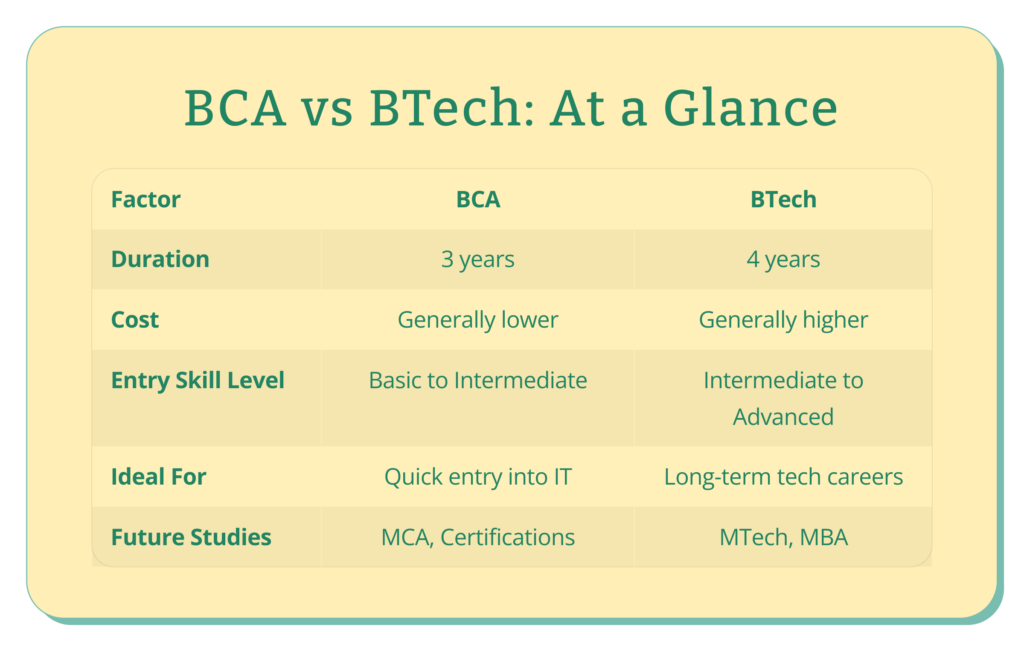
BCA (Bachelor of Computer Applications) and BTech (Bachelor of Technology) are both undergraduate courses in the tech field but differ in focus. BCA mainly deals with software, programming, and application development, ideal for those interested in coding and software careers. BTech, especially in Computer Science, is more technical and includes both hardware and software, with a deeper focus on engineering concepts. BTech is usually four years, while BCA is three years. Both offer great career opportunities in IT.

BCA, or Bachelor in Computer Applications, is an undergraduate degree course that enhances students’ knowledge of computer applications.
It includes subjects like Database Management, Operating Systems, Logical Analysis, Software Design, Client-Server Technology, and various computer languages like C, C++, Python, and many more. In the context of BCA vs. BTech, the BCA syllabus also covers topics from the management domain, which complements the software languages and technical skills.
Bachelor of Technology is a four-year engineering course that prepares students for technical skills, hardware, and software proficiency. After two years, students can specialize in their chosen field of interest.
These specializations may include electrical, mechanical, information technology, computer science, and civil engineering. You also learn Database Management and different computer languages.
Students will be required to fulfill specific criteria before selecting BCA or BTech (CSE):
The first step in identifying the available options is to raise awareness of what is necessary for a BCA or BTech (CSE). You must then choose your prospective path based on your academic foundation.
| College Name | Location | BCA Offered | BTech Offered |
|---|---|---|---|
| Christ University | Bangalore | Yes | No |
| Symbiosis Institute of Computer Studies & Research (SICSR) | Pune | Yes | No |
| Amity University | Multiple Cities | Yes | Yes |
| Vellore Institute of Technology (VIT) | Vellore | No | Yes |
| Manipal Academy of Higher Education | Manipal | Yes | Yes |
| SRM Institute of Science and Technology | Chennai | Yes | Yes |
| Delhi University (DU) | Delhi | Yes | No |
| Indian Institute of Technology (IITs) | Multiple Cities | No | Yes |
| National Institute of Technology (NITs) | Multiple Cities | No | Yes |
| Banaras Hindu University (BHU) | Varanasi | Yes | Yes |
When choosing a career in the tech field, many students find themselves comparing BCA and BTech. Both courses offer promising opportunities but differ in structure, focus, and outcomes. In this section, we’ll explore the course highlights to help you decide between BCA or BTech, which is better based on your goals and interests.
| Criteria | BCA | BTech |
| Course Emphasis | Computer Applications | Technology |
| Duration | 3 Years | 4 Years |
| Eligibility | 10+2 examination in any discipline from a recognized board.A minimum aggregate of 45% to 55%. | 10+2 qualifying examination in science stream.A minimum aggregate of 60% of entrance exams is to be cleared. |
| Subject Knowledge | Computer Networks, Java Programming, C Programming, Digital Computer Operating Systems | Information Technology, Software Engineer, Electrical and Electronic Engineer, Computer Engineering Communication |
| Specialization | None | Computer Science Engineering, Civil Engineering, Aeronautical Engineering, Information Technology, Mechanical engineering |
| Job Prospects | Software Engineer, IT Consultant, Programmer, Mobile Application Developer, Software Consultant | System Analyst, Computer Programmer, Web Designer, IT Coordinator, Data Security Officer |
| Admission Process | 10+2 examination performance Entrance exams in certain cases | Entrance Exams like JEE, VITEEE, BITSAT, etc. |
| Fees | 50K – 2L | 3L – 19L |
| Career Scope | Master of Business Administration (MBA), Master of Computer Management, Information Security Management, Master’s Degree in Information Management, Post Graduate Program in Corporate Studies | Master of Technology (MTech), Masters in Engineering (ME), Masters of Business Administration (MBA), Post Graduate Diploma in Management (PGDM), Post Graduate Program in Data Science |
| Average Salary | 3.18 LPA | 7.2 LPA |
B.Tech offers a wide range of technical and emerging field specializations, often beginning from the 3rd or 4th semester depending on the university:
These specializations prepare students for in-demand technical roles and often lead to higher packages in core technology companies.
While BCA programs are usually more general, some universities and online platforms offer focused electives or certification-based tracks in the final year:
BCA specializations are often aligned with job-oriented skills and certifications (e.g., Google, AWS, IBM) rather than deeply technical research paths.
Read More:- career options after BCA.
Both degrees offer strong placement potential, but BTech often opens doors to more technically demanding and higher-paying positions.
Tip: Generally, if you are looking for an academic or research role, BTech → MTech is preferred. Otherwise, BCA → MCA is an effective way to progress into advanced software development.
BTech graduates can get the following job opportunities:
BCA graduates get the following job opportunities:
| Feature | BCA | BTech |
|---|---|---|
| Primary Focus | Application development, software programming, IT tools | Comprehensive study of software, hardware, system architecture |
| Curriculum Orientation | More theoretical and coding-focused | Engineering-oriented with emphasis on both theory and practicals |
| Practical Exposure | Moderate (mainly through academic projects and optional internships) | Extensive (labs, real-time systems, industry internships, workshops) |
| Math & Physics Emphasis | Low to moderate (basic quantitative aptitude and logic) | High, especially in initial semesters (maths, electronics, mechanics) |
| Program Duration | 3 years | 4 years |
| Career Pathways | Software developer, IT support, web/app development | Software engineer, system architect, R&D, tech consulting |
Insight: BTech programs are generally more intense in emphasizing theory and practical engineering experience. In my experience, BCA is much more focused, streamlined, and specialized in coding and app development.
The admission process for BCA and BTech differs significantly. Most BCA colleges offer admission based on merit, considering a student’s 10+2 performance, though some institutes may conduct entrance exams or interviews assessing vocabulary, logical reasoning, and quantitative skills. In contrast, BTech admissions typically require students to clear entrance exams, with top institutions like NITs, IIITs, and GFTIs selecting candidates based on their JEE Mains scores.
Read More:-
BCA is generally less expensive as compared to BTech. However, the course fees of both courses vary from university to university. The fees are relatively less in government institutes than in private institutes. The average course fees for the are:

BCA is very similar to BTech regarding subject knowledge and future job recruiters. However, there is a massive gap in professionalism BCA adds to its students compared to BTech. The career scope of BCA and BTech are as follows:
BCA offers a wide range of courses for higher studies. Some of them are as follows:
BTech is more inclined towards students from the science stream who are interested in engineering sciences. The courses after BTech are as follows:
A BCA graduate earns an average salary of INR 3.18 Lakhs per annum, which increases with experience. A BTech graduate earns an average salary package of INR 7.2 Lakhs annually, which increases with experience.
Technology Development and Degree Alignment
The technology sector is twenty-four-seven and now features nearly endless opportunities for specialized practitioners or developers in Artificial Intelligence (AI), Machine Learning (ML), Cybersecurity, Data Science, and Cloud Computing.
BTech graduates are likely to have an advantage in these specialized roles because they focus more on engineering principles, algorithms (when applied to AI/ML), and system design.
BCA graduates will have a background in programming and software development. Still, they may have to pivot into the specialized developer fields through certifications or by continuing their education with an MCA.
Final Thoughts: BTech is likely to help a graduate enter the hottest technology development roles, while a BCA will better serve those wanting a quick entry into the software career space, while still keeping an avenue open for specialization.
Both BCA and BTech have great value in their paths in the tech industry, as they cater to different interests and career choices. While BCA gives aspiring professionals – and software developers – a strong base in software development and application-level knowledge, BTech offers a more substantial, still valuable, ability to understand engineering principles and hardware-related systems. Ultimately, student choices will depend on their own strengths and career aspirations. Both careers will lead to rewarding careers in the IT industry, so long as student professionals exhibit strong commitment and effort, and realize that our field is incredibly dynamic, evolving, and simply not static.

BCA is a 3-year course focused on computer applications, ideal for students wanting to enter the tech industry quickly. BTech is a 4-year program offering deeper technical knowledge and specializations. Your choice should depend on your interests, time commitment, and long-term career goals.
BTech is generally more complex than BCA due to its engineering-focused curriculum and longer duration. While BCA covers application-based concepts, BTech dives deeper into technical subjects. However, difficulty depends on the student’s interest, background, and approach to learning.
No, BCA and BTech are not equal. BCA focuses on computer applications, while B. Tech emphasizes core technology and engineering. Their subject matter differs significantly, and BTech is generally more technical and in-depth than BCA, making them distinct undergraduate programs with different goals.
Yes, you can pursue BTech after BCA, but both are undergraduate degrees, so opting for a postgraduate program is usually more beneficial. Courses like MCA, M.Tech, ME, or MSc are better suited for advancing your knowledge after completing BCA.
The average BTech salary in India ranges from ₹3 LPA to ₹12 LPA, depending on the specialization, college, and job role. Graduates from top institutes like IITs and NITs can earn starting packages of ₹10 LPA or more through campus placements in tech and engineering firms.
The better option will depend on whether you have a specific career target and your long-term aim. MCA is for those looking for advanced software skills after graduation, while BCA. B.Tech will provide a broader engineering foundation.
BE (Bachelor of Engineering) focuses more on theoretical knowledge and principles of engineering.
BTech (Bachelor of Technology) is more practical and application-oriented with hands-on technical training.