
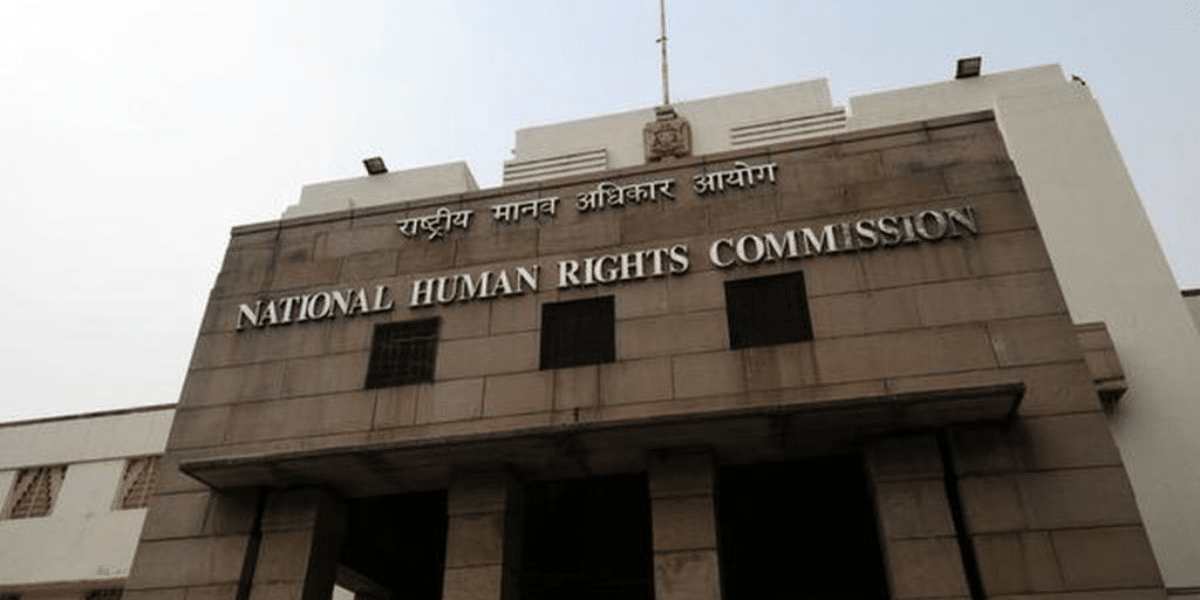
national human rights commission of india

National Human Rights Commission of India

Published on July 23, 2025
|
6 Min read time

Quick Summary

  • NHRC Full Form: National Human Rights Commission of India.
  • Established: Formed in 1993 under the Protection of Human Rights Act.
  • Purpose: Safeguards rights like life, liberty, and dignity; acts as a watchdog against violations.
  • Global Roots: Inspired by UDHR and global human rights commitments.
  • Reforms: Strengthened by the 2019 Amendment for a broader scope and inclusivity.

Table of Contents

The National Human Rights Commission of India (NHRC) is a statutory body established to protect and promote human rights nationwide. NHRC full form is National Human Rights Commission, and it functions as an autonomous public body. Human rights, as defined by the NHRC, are the rights relating to life, liberty, equality, and dignity of the individual guaranteed by the Constitution or embodied in international covenants and enforceable by Indian courts. NHRC acts as a watchdog to ensure that the State or its agents do not violate these rights. It plays a critical role in upholding democratic values and ensuring justice, especially for marginalized communities.

History of the National Human Rights Commission

The Universal Declaration of Human Rights (UDHR), adopted by the United Nations General Assembly in 1948, serves as the foundational global document for promoting and protecting human rights. It outlines a comprehensive set of civil, political, economic, social, and cultural rights to which all individuals are inherently entitled, regardless of nationality, ethnicity, or background. The National Human Rights Commission of India (NHRC) draws significant inspiration from the principles enshrined in the UDHR, and the UDHR forms a crucial part of its operational and philosophical framework.

The Protection of Human Rights Act, 1993, which established the NHRC, explicitly defines “human rights” as the rights relating to life, liberty, equality, and dignity guaranteed by the Constitution or embodied in international covenants, including the UDHR. As such, the NHRC serves as a domestic institution that localizes the spirit of the UDHR within India’s constitutional and legal context. Through its advisory role, investigations, and awareness initiatives, the NHRC ensures that India’s commitments under international human rights instruments like the UDHR are upheld in letter and spirit, helping to bridge global standards with national implementation.

The NHRC was established on 12 October 1993 under the Protection of Human Rights Act, 1993, following India’s growing commitment to human rights as a signatory to international covenants such as the Universal Declaration of Human Rights (UDHR) 1948 and the International Covenant on Civil and Political Rights (ICCPR) 1966. The NHRC full form, National Human Rights Commission, represents India’s national-level commitment to align with global human rights norms. Domestic and international pressures prompted the commission’s creation.

NHRC full form-national human rights commission of india

Composition – Members of NHRC

According to the amended Protection of Human Rights Act, 1993, the Act consists of:

  • Chairperson: A former Chief Justice of India.
  • One member: Who is or has been a Judge of the Supreme Court.
  • One member: Who is or has been the Chief Justice of a High Court.
  • Three other members: Appointed from persons knowing of, or having practical experience in, matters relating to human rights.
  • Ex officio members: Chairpersons of National Commissions for Scheduled Castes, Scheduled Tribes, Women, Minorities, and Backward Classes.

Appointment of NHRC Members

The President of India appoints the Chairperson and members based on the recommendations of a high-level committee comprising:

  • Prime Minister (Chairperson)
  • Speaker of Lok Sabha
  • Home Minister
  • Leader of the Opposition in the Lok Sabha
  • Leader of the Opposition in the Rajya Sabha
  • Deputy Chairman of the Rajya Sabha

Including both ruling and opposition leaders ensures a balanced and fair selection.

Functions & Powers of NHRC

India’s National Human Rights Commission has many functions and powers as laid out in the Protection of Human Rights Act, 1993 (with subsequent amendments). These empower it to investigate, advise, monitor, and promote the safeguarding of human rights in the country. Below is a detailed breakdown of the key functions and powers:

1. Investigative Powers

  • Suo Motu Inquiry: NHRC can initiate investigations on its own (suo motu) into cases of human rights violations or negligence in preventing such violations by a public servant.
  • Complaints Handling: It can inquire into petitions filed by victims or any person on their behalf regarding human rights violations.
  • Civil Court Powers: While conducting inquiries, HRC has the powers of a civil court, such as summoning witnesses, ordering the discovery and production of documents, and receiving evidence on affidavits.

2. Intervention in Legal Proceedings

  • With the court’s permission, the National Human Rights Commission can intervene in any court proceeding concerning human rights violations. This allows the Commission to support or supplement legal efforts to secure justice for victims.

3. Review of Safeguards

  • The Commission reviews existing laws and constitutional safeguards related to human rights and recommends measures for their effective implementation and improvement.
  • It also studies international human rights treaties and instruments and advises the government on their application and implementation.

4. Institutional Oversight

  • NHRC inspects prisons, detention centres, and mental health institutions to evaluate inmate living conditions and treatment. It recommends reforms to ensure humane treatment and prevent rights violations based on its findings.

5. Promoting Human Rights Awareness

  • The Commission undertakes and encourages research in the field of human rights.
  • It promotes awareness through education, public campaigns, seminars, publications, and collaboration with NGOs and academic institutions.

6. Advising on Policy and Legislation

  • NHRC can recommend measures to the central and state governments to improve the protection of human rights.
  • It reviews and comments on legislative bills and policy documents to ensure alignment with human rights standards.

7. Monitoring State Compliance

  • The Commission monitors the actions taken by government authorities in response to its recommendations. Although NHRC cannot enforce its decisions, it maintains accountability through regular reporting.

8. Special Focus Areas

  • NHRC pays special attention to the rights of vulnerable and marginalized groups, including women, children, SC/ST communities, persons with disabilities, and LGBTQ+ individuals.
  • It conducts thematic investigations and provides recommendations for better protection of these groups.

9. International Collaboration

  • NHRC engages with international human rights bodies and foreign national commissions to share best practices and align its efforts with global standards.
  • It plays a role in India’s reporting obligations under various UN human rights mechanisms.

Limitations of the Human Rights Commission

Despite its importance, NHRC faces several limitations:

  1. Recommendatory Powers: NHRC can only make recommendations, not enforce them.
  2. Limited Jurisdiction: Cannot act against violations by private individuals unless there is state negligence.
  3. Backlog of Cases: Due to limited manpower and increasing complaints.
  4. Delayed Action: Delay in reporting to authorities affects timely redressal.
  5. Lack of Autonomy: Dependence on the government for funds and infrastructure.

These constraints often hinder the Commission’s ability to provide timely justice.

Major Issues Related to the Human Rights Commission

  • Underutilization of Recommendations: Ministries and states often disregard NHRC’s reports.
  • Insufficient Awareness: Many people, especially in rural India, are unaware of NHRC and its mandate.
  • Political Interference: Sometimes, the commission is accused of selective investigation.
  • Delay in Appointments: Vacancies affect the functioning and credibility of NHRC.

Reforms are needed to empower NHRC both institutionally and operationally.

Term & Removal of Chairperson of NHRC

  • The Chairperson and members of NHRC hold office for 3 years or until they attain the age of 70 years, whichever is earlier.
  • They are not eligible for reappointment.

Removal:

The President can remove the Chairperson or members only on proven misbehavior or incapacity, after an inquiry by the Supreme Court.

This provision ensures independence and protection from arbitrary removal.

The Protection of Human Rights (Amendment) Act, 2019

The 2019 Amendment made several critical changes to the 1993 Act:

  • Expanded eligibility for the Chairperson to include Chief Justices of High Courts.
  • Reduced the term from 5 years to 3 years.
  • Included the National Commission for Backward Classes chairperson as an ex officio member.
  • Allowed appointment of persons with knowledge in human rights, not just a legal/judicial background.
  • Aligned with the Paris Principles, which the United Nations laid down.

Difference Between the Protection of Human Rights Act 1993 Vs. 2019

FeatureProtection of Human Rights Act, 1993Protection of Human Rights (Amendment) Act, 2019
EnactmentPassed in 1993Amendment passed in 2019
ObjectiveTo provide for the constitution of a National Human Rights Commission, State Human Rights Commissions, and Human Rights Courts.To strengthen the Human Rights institutions and ensure their compliance with the Paris Principles.
Chairperson of NHRCOnly a former Chief Justice of India could be appointed.Includes former Chief Justice of India or a former Judge of the Supreme Court.
Members of NHRCOne member having knowledge of or practical experience in human rights.Increased to three members, including one woman.
Inclusion of Other MembersNo provision for National Commission chairpersons.Chairpersons of the National Commissions for Backward Classes, Minorities, Scheduled Castes, Scheduled Tribes, and Women are deemed NHRC members.
TenureIncludes a former Chief Justice of India or a former Judge of the Supreme Court.This brings HRC closer to the Paris Principles of the UN.
Eligibility for ReappointmentNo specific provision.The chairperson had to be a Chief Justice of a High Court.
State Human Rights CommissionsAmended to allow a Judge of a High Court to be the Chairperson.Expands the definition to include “other treaties” as may be notified by the Central Government.
Human Rights DefinitionBrings NHRC more in line with the Paris Principles of the UN.As defined in the international covenants specified in the Act.
Paris Principles ComplianceLimited reference.Chairperson and members held office for 5 years or until 70.

Conclusion

The National Human Rights Commission of India is a cornerstone of India’s democratic framework. Despite limitations, it plays a pivotal role in ensuring justice, monitoring custodial environments, and pushing reforms in human rights policies. Strengthening NHRC with more autonomy, enforcement powers, and public awareness will make it more effective in protecting the fundamental rights of every citizen.

Frequently Asked Questions(FAQs)

How many members are there in the NHRC?

The Commission in India has a trial of 12 members, five of them are full-time members, while the other 7 are deemed members.

When was the National Human Rights Commission established?

NHRC was established on 12 October 1993 under the Protection of Human Rights Act, 1993.

Where is the headquarter of the NHRC?

The National Human Rights Commission of India is situated in New Delhi, having its officer at Manav Adhikar Bhavan, Block-C, GPO Complex, INA, New Delhi – 110 023.

Who can be the Chairperson of the National Human Rights Commission?

A former Chief Justice of India or a former Chief Justice of a High Court can be appointed.

Who is the current chairperson of the National Human Rights Commission in India?

The Current chairperson of the Indian National Human Rights Commission is Justice V. Ramasubhramanian, who has been serving the commission since 23rd December 2024.


Authored by, Muskan Gupta
Content Curator

Muskan believes learning should feel like an adventure, not a chore. With years of experience in content creation and strategy, she specializes in educational topics, online earning opportunities, and general knowledge. She enjoys sharing her insights through blogs and articles that inform and inspire her readers. When she’s not writing, you’ll likely find her hopping between bookstores and bakeries, always in search of her next favorite read or treat.

Editor's Recommendations