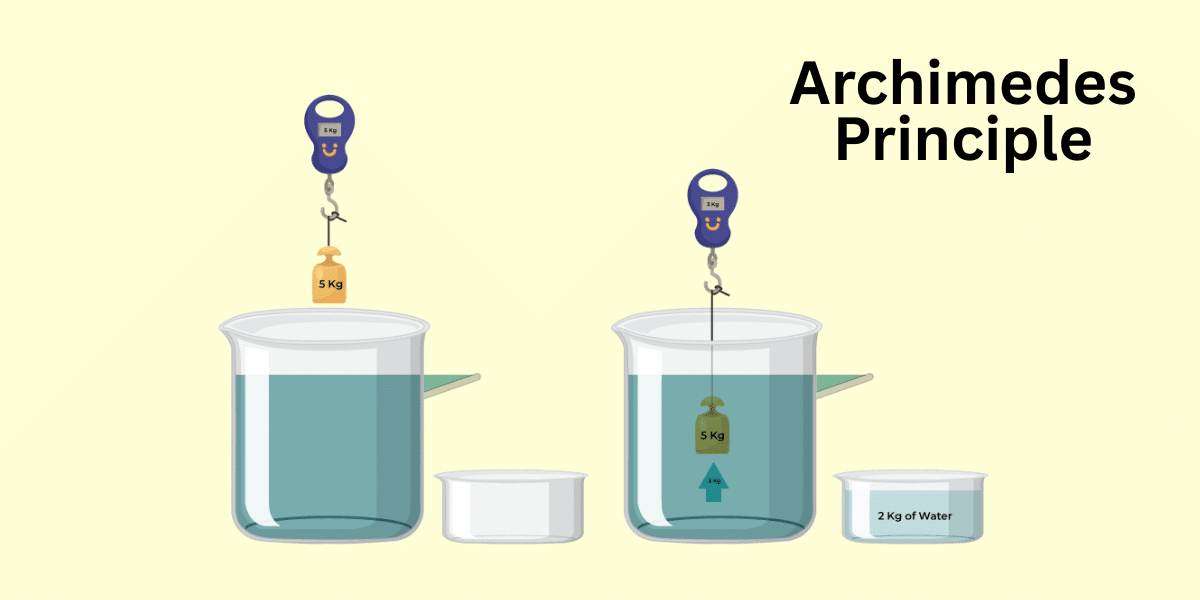
Core Definition: Archimedes’ Principle states that any object immersed in a fluid experiences an upward Buoyant force equal to the weight of the fluid it displaces.
Formula: The buoyant force (Fb) is calculated by the Archimedes principle formula: Fb = ρ * g * V
Floatation Law: An object floats if its weight equals the weight of the fluid displaced; sinks if heavier; stays suspended if weights match exactly (Law of Floatation).
Universal Application: The principle governs buoyancy in all fluids, explaining why ships float (water), hot air balloons rise (air), and submarines control depth.
Foundational Impact: This ancient Greek genius discovery remains vital for modern engineering, from ship design and hydrometers to geology and aeronautics.
Table of Contents
Imagine a brilliant ancient Greek mathematician leaping from his bath, shouting “Eureka!” (I have found it!), and running naked through the streets of Syracuse. This iconic moment, etched into scientific legend, marks the discovery of one of physics’ most fundamental and practical principles: Archimedes Principle. More than just a quirky historical anecdote, this principle provides the bedrock for understanding why massive steel ships glide effortlessly across oceans, why hot air balloons soar, and why you feel lighter when submerged in a swimming pool.
What is the Archimedes’ Principle? In its essence, it explains the mysterious upward force, known as the buoyant force or buoyancy force, that fluids (liquids and gases) exert on objects placed within them. This article delves deep into the life of Archimedes, unravels the science behind his famous principle, explores its mathematical formulation (the Archimedes principle formula or upthrust formula), demonstrates its derivation, illustrates it with vivid Archimedes Principle examples, describes simple Archimedes Principle experiments, and showcases its vast Archimedes Principle applications – from shipbuilding to modern hydraulics and aeronautics.
Whether you’re a student grappling with physics concepts, an aspirant preparing for competitive exams like UPSC or SSC, or simply a history enthusiast fascinated by ancient genius, join us on a journey to master the law of floatation and truly comprehend what is the Archimedes’ Principle? and why it remains utterly indispensable over two millennia later.
Who Was Archimedes? The Genius of Syracuse
Before we state Archimedes Principle, let’s meet the mastermind. Archimedes (c. 287 – c. 212 BC) wasn’t just a mathematician; he was a polymath ahead of his time, born in the vibrant Greek colony of Syracuse on the island of Sicily.
The Engineer-Scientist: Archimedes blurred the lines between theoretical mathematics and practical engineering. He is famed for inventions like the Archimedes Screw (still used for irrigation today), compound pulleys, and fearsome war machines used to defend Syracuse against Roman sieges. His theoretical work, however, laid the foundations for integral calculus and advanced geometry centuries before Newton or Leibniz.
A Life of Inquiry: Legend surrounds him – from allegedly using mirrors to set Roman ships ablaze (“the Heat Ray”) to his triumphant cry of “Eureka!” upon discovering the principle of buoyancy while investigating the purity of a golden crown for King Hiero II. His relentless curiosity drove his monumental contributions.
A Tragic End: Archimedes died at the hands of a Roman soldier during the sack of Syracuse in 212 BC, reportedly while deeply engrossed in a mathematical diagram. His loss was a profound blow to ancient science.
Legacy: Archimedes prioritized principles over inventions. His works, preserved through Arabic and later Latin translations, became cornerstones of the Scientific Revolution. His approach – meticulous reasoning and practical verification – remains the gold standard in science.
Understanding Buoyancy: The Upward Push of Fluids
To grasp Archimedes’ Principle, we must first understand buoyancy. What makes a beach ball bob on water or a helium balloon rise?
What is Buoyancy? Buoyancy is when an object immersed (partially or fully) in a fluid (liquid or gas) experiences an upward force. This force counteracts the object’s weight, making it seem lighter or even causing it to float.
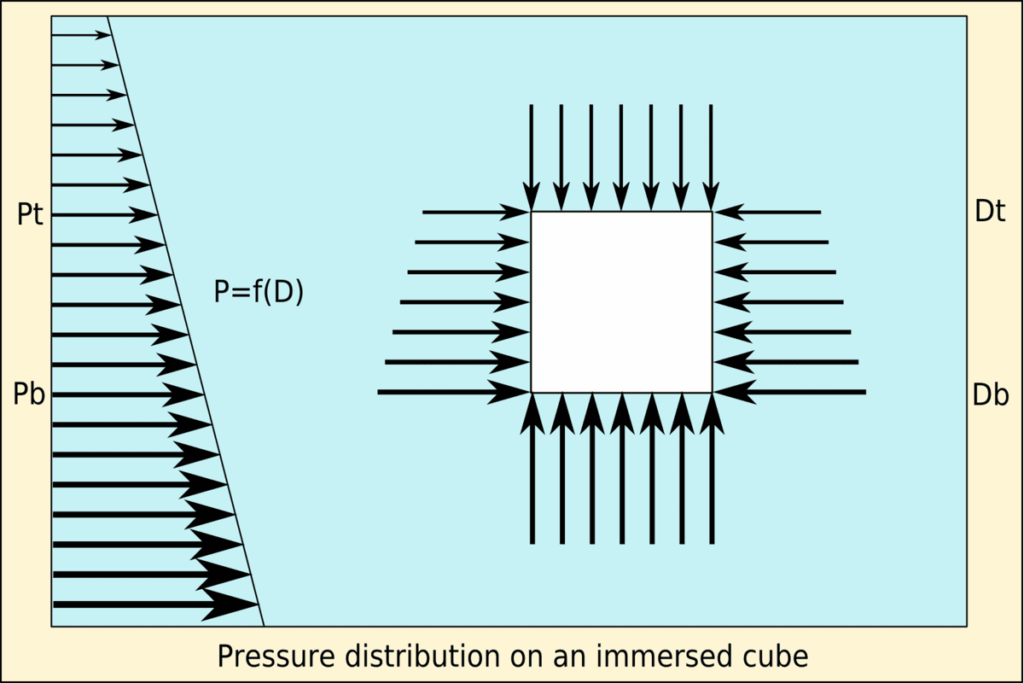
The Source: Pressure Difference: Fluids exert pressure on any surface they touch, and this pressure increases with depth. Imagine a cube submerged in water. The water pressure pushing upwards on the bottom face of the cube is greater than the pressure pushing downwards on the top face (because the bottom is deeper). This pressure difference creates a net upward force, the buoyant force.
Key Insight: The buoyant force isn’t magic; it’s a direct consequence of the fluid’s weight and the pressure gradient created by gravity within it. Every submerged object experiences this upward push regardless of material or density.
Stating Archimedes Principle: The Core Insight
So, What is the Archimedes’ Principle? Let’s formally state Archimedes Principle as he discovered it:
“Any object, wholly or partially immersed in a fluid, is buoyed up by a force equal to the weight of the fluid displaced by the object.”
This deceptively simple statement holds immense power. Let’s break it down:
“Buoyed up by a force…”: This is the buoyant force (F_b).
“…equal to…”: The magnitude of F_b is precisely determined by the next part.
“…the weight of the fluid…”: Not the weight of the object itself, but the weight of the fluid it pushes aside.
“…displaced by the object.”: When an object enters a fluid, it occupies space that was previously filled with that fluid. The volume of fluid pushed aside is called the “displaced volume” (V_displaced). The weight of that specific volume of fluid is the key.
Therefore: Buoyant Force (F_b) = Weight of Displaced Fluid
The Archimedes Principle Formula: Quantifying the Buoyant Force
Translating the principle into mathematics gives us the essential Archimedes principle formula or upthrust formula:
F_b = ρ_fluid * g * V_displaced
Where:
F_b = Buoyant Force (measured in Newtons, N)
ρ_fluid (rho_fluid) = Density of the fluid (measured in kilograms per cubic meter, kg/m³)
g = Acceleration due to gravity (approximately 9.8 m/s² on Earth)
V_displaced = Volume of fluid displaced by the object (measured in cubic meters, m³)
Crucial Notes on the Formula:
Magnitude: This formula gives the magnitude (size) of the buoyant force. Its direction is always vertically upwards.
Depends ONLY on Fluid & Displacement: F_b depends solely on the density of the fluid (ρ_fluid) and the volume of fluid displaced (V_displaced). It does not depend on:
The object’s total weight or mass.
The object’s density (though density determines if and how much it displaces).
The object’s shape (as long as the displaced volume is the same).
The depth of immersion (as long as the object is fully submerged. For partially submerged objects, V_displaced changes).
Why “Upthrust”? The buoyant force literally “thrusts” the object upwards against gravity, hence the synonym “upthrust”.
Derivation of Archimedes Principle: Connecting Pressure to Force
How do we arrive at the Archimedes principle formula from basic fluid mechanics? Let’s see the Archimedes Principle derivation step-by-step, considering a simple object like a cube fully submerged in a fluid.
The Setup: Imagine a solid cube with side length ‘L’, completely submerged in a fluid of density ρ_fluid. The top face is at depth h1 below the fluid surface. The bottom face is at depth h2 = h1 + L (since the cube has height L).
Fluid Pressure: Fluid pressure (P) at any depth is given by P = ρ_fluid * g * h (where h is depth below the surface). Atmospheric pressure acts equally on all sides and cancels out, so we focus on the pressure due to the fluid column.
Force on Top Face:
Pressure on top face (P_top) = ρ_fluid * g * h1
Area of top face (A) = L²
Force on top face (F_top) = P_top * A = (ρ_fluid * g * h1) * L² (Direction: Downwards)
Force on Bottom Face:
Pressure on bottom face (P_bottom) = ρ_fluid * g * h2 = ρ_fluid * g * (h1 + L)
Area of bottom face (A) = L²
Force on bottom face (F_bottom) = P_bottom * A = (ρ_fluid * g * (h1 + L)) * L² (Direction: Upwards)
Net Vertical Force (Buoyant Force): The forces on the vertical sides cancel each other out because pressures at equal depths are equal and opposite. The net force is the difference between the upward force on the bottom and the downward force on the top: F_b = F_bottom – F_top = [ρ_fluid * g * (h1 + L) * L²] – [ρ_fluid * g * h1 * L²] = ρ_fluid * g * L² * (h1 + L – h1) = ρ_fluid * g * L² * L = ρ_fluid * g * L³
Displaced Volume: The volume of the cube (and thus the volume of fluid it displaces, V_displaced) is L * L * L = L³.
The Result: Therefore, F_b = ρ_fluid * g * V_displaced
Weight of Displaced Fluid: The mass of the displaced fluid (m_displaced) is its density times its volume: m_displaced = ρ_fluid * V_displaced. The weight of the displaced fluid is W_displaced = m_displaced * g = ρ_fluid * V_displaced * g.
Archimedes’ Statement Confirmed: Comparing step 7 (F_b) and step 8 (W_displaced), we see: F_b = W_displaced. The buoyant force equals the weight of the displaced fluid.
This derivation, though using a cube for simplicity, holds for any shape because any irregular shape can be considered composed of many small cubes. The net buoyant force is still the weight of the displaced fluid.
The Law of Floatation: When Objects Stay Afloat
Archimedes Principle directly leads to the law of floatation, which explains why some objects float and others sink, and how floating objects behave.
Statement of the Law of Floatation:
“A floating object displaces a volume of fluid whose weight is equal to the object’s own weight.”
Explanation:
For an object to be in static equilibrium (floating steadily without accelerating up or down), the net force acting on it must be zero.
Vertically, only two significant forces act: the object’s weight (W_object) pulling down, and the buoyant force (F_b) pushing up.
Therefore, for floatation: F_b = W_object
But Archimedes Principle tells us F_b = Weight of Displaced Fluid (W_displaced)
Sink: The object sinks if W_object > F_b (i.e., W_object > W_displaced_max). Its average density (ρ_object) is greater than the fluid density (ρ_fluid).
Float: The object floats if W_object = F_b (i.e., W_object = W_displaced). Its average density is less than the fluid density. It displaces just enough fluid so that the weight of that fluid equals its own weight.
Neutral Buoyancy (Suspended): If W_object = F_b and the object is fully submerged, it remains suspended at any depth (like a submarine maintaining depth). Its average density equals the fluid density.
Density is Key: The law of floatation highlights that whether an object floats or sinks depends on the average density of the object compared to the density of the fluid. An ocean liner floats because its vast shape encloses a lot of air, making its average density much less than seawater’s, even though the steel itself is denser. A solid steel block sinks because its average density is high.
Draft and Loading: For ships (floating objects), the ship’s weight (including cargo) equals the weight of seawater displaced. Adding cargo increases the ship’s weight, requiring it to displace more water to achieve F_b = W_object. This causes the ship to sit lower in the water (increased draft). The “Plimsoll line” on ships marks safe loading limits for different water densities.
Experimental Verification: Seeing Archimedes’ Principle in Action
Verifying Archimedes Principle is straightforward and makes an excellent Archimedes Principle experiment. Here’s a classic method:
Materials:
Spring scale (or force sensor)
Solid object (metal cylinder, stone)
Beaker or overflow can
Water (or another fluid)
Catch container
Graduated cylinder (optional)
Digital scale (optional)
Procedure:
Measure True Weight: Hang the object from the spring scale in air. Record its weight (W_air).
Setup Displacement: Place the overflow can on a stable surface. Fill it with water until water just starts to flow out the spout into the catch container. Stop adding water once it stops dripping.
Measure Apparent Weight: Submerge the object completely in the water within the overflow can, ensuring it doesn’t touch the sides or bottom. Hold it under using the spring scale. Record the new reading (Apparent Weight, W_apparent). Notice it’s less than W_air. The difference (W_air – W_apparent) is the buoyant force (F_b).
Collect Displaced Fluid: The water displaced by the submerged object flows out the spout into the catch container.
Measure Displaced Fluid Weight:
Method A (Direct Weighing): Weigh the catch container with the displaced water. Subtract the weight of the empty catch container. This gives the weight of the displaced water (W_displaced).
Method B (Volume & Density): Pour the displaced water from the catch container into a graduated cylinder to measure its volume (V_displaced). Calculate its weight: W_displaced = ρ_water * g * V_displaced. (ρ_water ≈ 1000 kg/m³, g ≈ 9.8 m/s²).
Observation & Conclusion:
Compare the buoyant force (F_b = W_air – W_apparent) to the weight of the displaced fluid (W_displaced).
Result: F_b ≈ W_displaced. This experimentally confirms Archimedes’ Principle – the upward buoyant force equals the weight of the fluid displaced by the object.
Visualization: The experiment makes the abstract principle concrete. The “missing weight” (F_b) is directly linked to the physical water pushed aside.
Applications of Archimedes’ Principle: From Ancient Ships to Modern Tech
The Archimedes’ Principle applications are vast and critical across numerous fields. Understanding buoyancy force isn’t just academic; it shapes our world:
Shipbuilding (The Quintessential Application):
How Ships Float: Massive steel ships float because their hulls are designed to displace a huge volume of water. This displaced seawater’s weight equals the ship’s total weight (hull, cargo, fuel, crew) – satisfying the law of floatation.
Stability: Ship design must ensure stability. The center of buoyancy (the point where the buoyant force acts) and the center of gravity must be positioned so the ship rights itself after tilting (e.g., from waves). Ballast tanks adjust weight distribution.
Draft and Load Lines: As per the law of floatation, the ship’s draft (how deep it sits) changes with cargo load. The Plimsoll line indicates safe loading limits for different water densities (saltwater is denser than freshwater).
Submarines (Mastering Buoyancy):
Diving & Surfacing: Submarines actively control their buoyancy using ballast tanks. To dive, valves open, letting seawater flood the tanks, increasing the sub’s weight (W_object) while keeping V_displaced relatively constant (hull volume is rigid), making W_object > F_b. To surface, compressed air forces seawater out of the tanks, decreasing W_object until F_b > W_object. For neutral buoyancy, W_object is precisely adjusted to equal F_b.
Hull Design: Pressure hulls withstand immense deep-water pressure, but buoyancy control relies on Archimedes’ principle applied to the entire vessel and its ballast systems.
Hot Air Balloons and Airships (Buoyancy in Gases):
Archimedes’ Principle applies to gases (fluids) too. A balloon floats in the air because the air it displaces is heavier (denser) than the hot air or helium inside the envelope. The buoyant force (weight of displaced cool air) exceeds the weight of the balloon (envelope + basket + heated air/gas).
Hydrometers (Measuring Density):
Function: A hydrometer is a sealed glass tube with a weighted bulb at the bottom and a calibrated stem. It floats vertically in a liquid.
Principle: According to the law of floatation, it displaces a weight of liquid equal to its own weight. In denser liquids (e.g., concentrated battery acid), it needs to displace less volume to achieve F_b = W_object, so it floats higher (stem sticks out more). In less dense liquids (e.g., pure water), it displaces more volume and floats lower. The stem’s calibration directly reads specific gravity or density. Crucial for checking battery charge, milk quality, alcohol content, etc.
Swimming and Life Jackets:
Humans are slightly less dense than water, allowing us to float with lungs full of air. Life jackets work by significantly increasing the wearer’s volume with very low-density material (foam), dramatically increasing V_displaced and thus F_b, ensuring the head stays above water even if unconscious.
Geology and Isostasy (Large-Scale Floatation):
Earth’s crust “floats” on the denser, semi-fluid mantle below. Mountain ranges, like icebergs, have deep “roots” – they displace more mantle material to balance their enormous weight, following the law of floatation on a planetary scale. This concept is called isostasy.
Medical Diagnostics (Densitometry):
Techniques like hydrostatic weighing (underwater weighing) use Archimedes’ Principle to determine human body density. By measuring weight in air and apparent weight underwater, body fat percentage can be calculated accurately, as fat is less dense than muscle or bone.
Water Transport Systems (Locks and Dams):
Understanding buoyancy and displacement is crucial for designing locks that raise or lower boats between bodies of water at different levels. The buoyant force ensures the boat floats within the lock chamber regardless of the water level.
Archimedes’ Principle in Daily Life: Simple Examples
Beyond major applications, Archimedes’ Principle examples are everywhere:
Ice Cubes in Water: Ice floats because it’s less dense than liquid water. The buoyant force (weight of displaced water) equals the ice cube’s weight.
Oil on Water: Oil floats because its density is less than water’s.
Feeling Lighter in a Pool: You feel lighter because the water exerts a significant buoyant force upwards, counteracting your weight.
Floating vs. Sinking Eggs: A fresh egg sinks in pure water (ρ_egg > ρ_water). Adding salt increases water density (ρ_fluid). Eventually, ρ_fluid > ρ_egg, and the egg floats! A direct demonstration of density comparison.
Weather Balloons: Balloons filled with helium or hydrogen rise because the displaced air is heavier than the gas inside. They expand as they ascend into lower-pressure regions until they burst.
Visualizing Archimedes: Timeline of a Genius
Year (BC)
Event
Significance for Archimedes’ Principle
c. 287
Archimedes born in Syracuse, Sicily.
c. 250
Studies in Alexandria, Egypt (center of learning).
Exposure to advanced mathematics and ideas.
c. 240
King Hiero II commissions a gold crown; suspects goldsmith of fraud.
The “Eureka!” Moment: While investigating how to test the crown’s purity without damaging it, Archimedes realizes the principle of buoyancy in his bath.
c. 240
Archimedes verifies the crown is not pure gold using displacement.
First practical application of his principle.
c. 225
Writes “On Floating Bodies” (Περὶ τῶν ὀχουμένων).
Formal treatise presenting his principles of hydrostatics, including buoyancy and stability.
212
Siege of Syracuse by Romans. Archimedes killed.
His works preserved and transmitted, influencing science for millennia.
Conclusion: A Principle for the Ages
From a bathtub in ancient Syracuse to the colossal container ships traversing our oceans and the submarines exploring their depths, Archimedes Principle stands as a testament to the power of human curiosity and logical reasoning. We’ve explored what is the Archimedes’ Principle? – the profound realization that the buoyant force acting upwards on an immersed object equals the weight of the displaced fluid.
We’ve seen its mathematical expression in the Archimedes principle formula (F_b = ρ_fluid * g * V_displaced), understood its derivation from fluid pressure, and learned how it governs the law of floatation. Through simple Archimedes’ Principle experiments and countless Archimedes’ Principle examples in nature and technology, we witness its pervasive truth.
The vast Archimedes’ Principle applications – in ship design, submarines, balloons, hydrometers, and even geology – underscore that this isn’t just abstract physics; it’s engineering bedrock. State Archimedes’ Principle today, and you invoke a principle as vital and relevant now as it was when Archimedes first cried “Eureka!” It remains a cornerstone of fluid mechanics, a brilliant solution born in water, lifting our understanding of the physical world ever higher.
Archimedes’ Principle states that when you put something in water (or any fluid), the water pushes it up with a force equal to the weight of the water that gets pushed out of the way. That’s why heavy ships can float – they push aside a huge amount of very heavy water.
What is the formula for buoyant force?
The Archimedes principle formula for the buoyant force (F_b) is: F_b = ρ_fluid * g * V_displaced. Here, ρ_fluid is the fluid’s density, g is gravity (9.8 m/s²), and V_displaced is the volume of fluid pushed aside by the object. This is also called the upthrust formula.
Why do some objects float and others sink?
It boils down to density. An object floats if its average density is less than the density of the fluid it’s in. It sinks if its average density is greater. The law of floatation explains this: a floating object displaces fluid weighing exactly as much as itself.
Does Archimedes’ Principle work in air?
Yes! Archimedes’ Principle applies to all fluids, including gases like air. That’s why hot air balloons and helium balloons rise – the air they displace is heavier than the hot air or helium inside them, creating an upward buoyant force. The effect is just much smaller than in water because air is less dense.
Can an object sink in one fluid but float in another?
Absolutely! It depends on the fluid’s density. An egg sinks in pure water (density ~1000 kg/m³) but floats in saltwater (density ~1025 kg/m³) or even denser salty water. Similarly, a steel block sinks in water but would float in mercury (density ~13,500 kg/m³) because mercury’s density is much higher than steel’s.
What is the difference between buoyant force and weight?
Weight (W_object): The downward force due to gravity acting on the object’s mass. It depends only on the object (mass, gravity). Buoyant Force (F_b): The upward force exerted by the fluid on the immersed object. It depends only on the fluid (density) and the displaced volume, according to Archimedes’ Principle (F_b = ρ_fluid * g * V_displaced). Whether an object sinks, floats, or is suspended depends on the balance between these two forces.
Authored by, Muskan Gupta Content Curator
Muskan believes learning should feel like an adventure, not a chore. With years of experience in content creation and strategy, she specializes in educational topics, online earning opportunities, and general knowledge. She enjoys sharing her insights through blogs and articles that inform and inspire her readers. When she’s not writing, you’ll likely find her hopping between bookstores and bakeries, always in search of her next favorite read or treat.