

When my cousin enrolled in a BSc Nursing program, I saw how demanding yet meaningful the journey was. Her days were filled with long study hours, hospital rounds, and hands-on training with patients. It wasn’t just about textbooks—it was about developing the discipline, empathy, and resilience that nursing truly requires.
A Bachelor of Science in Nursing (BSc Nursing) is a 4-year undergraduate program open to students who have scored at least 55% in Physics, Chemistry, and Biology in Class 12. Admissions usually happen through competitive exams like AIIMS, JIPMER, or CPNET.
The course covers a wide range of subjects, including basic nursing practices, anatomy, psychology, pharmacology, and community health, ensuring that graduates are prepared to work in hospitals, clinics, and public health centers. Many students go on to pursue a Master’s degree (MSc Nursing) or short-term certifications in areas like critical care, pediatric nursing, or midwifery to advance their careers.

Here are some compelling reasons to consider enrolling in a B.Sc Nursing course:
The BSc Nursing course is a four-year undergraduate program designed to train students in providing medical care and support to patients. The course includes both classroom learning and hands-on clinical training in hospitals and healthcare centers. Throughout the four years, students study subjects like anatomy, physiology, nutrition, and community health. The program also focuses on developing communication and practical skills needed in the nursing profession. It prepares students for roles in hospitals, clinics, and other healthcare settings.
Candidates who wish to pursue BSc Nursing must meet certain academic, professional, and health-related requirements. Eligibility varies slightly between the two pathways—BSc Nursing (Basic) and BSc Nursing (Post-Basic)—but both are regulated by the Indian Nursing Council (INC) and relevant state authorities.
This is a 4-year undergraduate program for fresh candidates entering nursing after school.
This is a 2-year program designed for diploma holders in nursing.
In summary, BSc Nursing (Basic) is meant for fresh 12th-pass students with PCB, while BSc Nursing (Post-Basic) is a professional upgrade course for GNM diploma holders already working as registered nurses.
After completing your B.Sc in Nursing, there are many courses you can take to specialize and improve your knowledge and skills. These courses will help you have better job opportunities in nursing. Here are some of the best options after your B.Sc in Nursing.

This is an advanced course for those who already have a nursing degree. Nurses in this program are trained to care for people in critical condition. Critical care is important for seriously ill patients who are having surgery or facing other serious health issues.
Thus, critical Nurses handle patients admitted to an ICU or under other intensive care treatment. These patients need 24/7 care, and the nurses must regularly check up on them.
Admission is taken on a merit-based or entrance exam basis.
A Diploma in Cardiovascular and Thoracic Nursing, also called CVT Nursing, is a course you can take after your BSc Nursing. In this diploma program, nurses learn to care for patients with heart problems, such as those who use a pacemaker, have bypass surgery, or need stents in their hearts. Nurses work with a team of cardiologists and are trained to handle various cardiology issues. The program lasts for 2 years.
Entrance exam and merit-based admission system.
While many aim to be bedside nurses, others want to manage teams and work in behind-the-scenes roles. This diploma course is designed for those interested in this path. It teaches students management and administrative skills.
Nursing administrators will know and implement all nursing procedures in a healthcare environment. They manage a team of nurses who will work on the front lines interacting with the patients seen in the facility.
They also ensure that standards and guidelines are followed at the health care center and ensure that there is enough staff to look after the patients. It is a one-year course after BSc Nursing.
Admission is taken on an entrance basis, and merit-based admission differs from college to college.
Clinical surgeons need skilled surgical nurses to help them during surgeries. To meet this demand, nurses should learn about the different surgical techniques and how these techniques affect patients. This course, taken after BSc Nursing, trains nurses in the tools and procedures used before surgery. It is a 1-year diploma program.
The candidate must have a BSc degree in nursing, or Diploma in Nursing and Midwifery, or a post-basic BSc in Nursing. With a minimum of 50% marks from a recognized college or university.
Admission is taken on merit-based or entrance exams.
Besides diploma courses, one can take many PG courses after a BSc in Nursing. Here is a list of some of the best PG courses:
This is a one-year course after BSc Nursing that can be pursued. It is a specialized course that trains nurses to care for infants and children. Nurses detect the condition of kids based on their responses. They know how to take care of children and their needs.
The candidate must have scored 50% in Graduation with a related subject under the (10+2+3) scheme from a recognized college or university.
This diploma trains nurses to work with children. However, this training also includes handling delicate newborns who require the utmost care. This is a one-year course after BSc Nursing.
This is a one-year course that trains nurses to cater to patients who need immediate assistance. They get placed in emergency wards and deal with patients in emergency conditions. Emergencies include heart attack, stroke attack, trauma, or suicidal attempts. It is a very demanding job since patients constantly need nurses.
This is also one of the best courses after BSc Nursing. This PG Diploma course trains nurses to deal with patients suffering from mental health issues. They assist people with mental anxiety, depression or personality disorder issues. However, this job is very strenuous since nurses must work patiently as these patients need intensive care and attention. The nurses work under a psychiatrist and know how to treat unstable patients.
Candidate must have completed a BSc in nursing from a reputed university or college with valid marks.
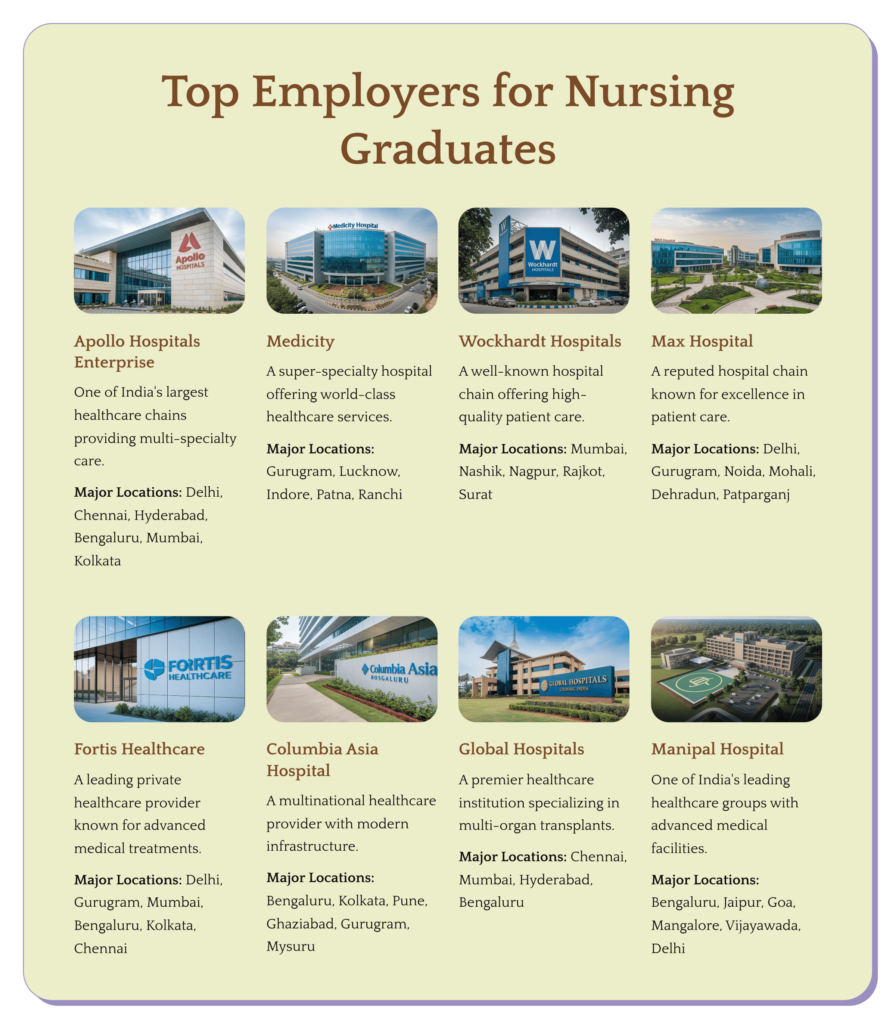
BSc Nursing graduates bring a distinctive blend of skills and expertise that makes them highly desirable to numerous healthcare institutions. These organizations understand the critical role of qualified and proficient BSc Nursing professionals in delivering quality care.
Some of the leading employers that consistently seek out BSc Nursing graduates include:
Read More- Nursing Interview Questions and Answers
BSc Nursing is an essential and fulfilling field within healthcare, providing students with comprehensive medical expertise and hands-on skills necessary for effective patient care. This program opens doors to various career paths in hospitals, clinics, research facilities, and even global healthcare environments. As the need for qualified nurses continues to grow, this degree offers job security opportunities for advancement and the ability to make a significant difference in people’s lives. Furthermore, it lays the groundwork for further education and specialization. Pursuing a BSc in Nursing is a rewarding and meaningful career option for individuals dedicated to healthcare.
Beyond immediate career options, a BSc in Nursing also opens global opportunities. Many Indian nursing graduates pursue jobs in countries like the UK, USA, Canada, and the Middle East, where skilled nurses are in high demand. International placements often come with attractive salaries, professional growth, and exposure to advanced healthcare systems. Whether you choose to work in India or abroad, nursing offers not just job security but also a chance to make a meaningful difference in people’s lives every single day.

It depends on your choice and what you want to do after your BSc in Nursing. Suppose you want to study further to gain expertise. In that case, there are courses like a Diploma in Critical Care Nursing, a Diploma in Nursing Administration, a PG Diploma in Emergency Nursing, and more. If you want to start a career, you can become a nurse, lab assistant, nurse trainer, at-home caretaker, etc.
Some of the highest paying jobs after a BSc in nursing are nurse managers, male staff nurses, ICU, and critical nurses. Do the specialization course to go in any of the career fields after your BSc in Nursing. You can positively secure a higher position with a nice salary and incentive.
If you are pursuing a BSc in Nursing and want to become a doctor after this, then there are a few steps that you need to follow.
You need to follow the same path as 12th-class students. It means preparing for NEET, then cracking the exam, and pursuing the MBBS.
Yes, you can apply for a diploma in Gynaecology after completing your BSc in Nursing. This will be a great career path for you to choose after nursing, which can apply if you have a minimum of 55% marks from a recognized college or university. So, apply for a gynecology degree if you are interested in it after obtaining a BSc in nursing.
They can work in diverse roles such as bedside nursing, healthcare administration, research, teaching, and consultancy.
To apply for BSc Nursing (Basic), candidates must have passed Class 12 (10+2) with Physics, Chemistry, Biology, and English as compulsory subjects, securing at least 45–50% aggregate marks in PCB. For BSc Nursing (Post-Basic), candidates must have completed GNM (General Nursing and Midwifery) and be registered as an RNRM.