

A Six Sigma certification provides validation of your value in a data-driven methodology to improve business processes by reducing error and variability, ultimately increasing efficiency and customer satisfaction. The Six Sigma certification is organized along a series of belt levels (Yellow, Green, Black, Master Black Belt), with each level representing increased proficiency and experience. Six Sigma is useful in virtually every industry (technology, healthcare, finance, etc.). Getting a Six Sigma certification will also allow you to boost your career prospects, increase your salary potential, and give companies a low-cost competitive advantage by solidifying their business operations and quality.
Six Sigma is a set of management techniques that help organisations attain exceptional quality. Industries aim to boost operational efficiency and reduce defects in tasks. Six Sigma understands this requirement and enables you to learn strategies to enhance performance levels. You must also stay updated with the latest trends in Six Sigma to understand the latest methodologies that help with business growth. That is why you should enroll in the Six Sigma Certification program to learn more about various techniques and strategies. The certification helps in your professional development, equipping you with skills to streamline processes. It also enables you to identify defects and improve organisational efficiency.
The Six Sigma certification course is essential for professionals because it gives them the necessary Six Sigma tools to lead strategic initiatives. In this article, we will learn more about the certification, its levels, cost, and other details.
Six Sigma Certification is an official recognition of an individual’s ability to understand and implement Six Sigma principles in a professional environment. Earning this certification demonstrates proficiency in quality management, data analysis, and process improvement.
Professionals with Six Sigma Certification are highly sought after in industries such as manufacturing, IT, healthcare, finance, and supply chain management. The certification not only enhances skills but also significantly boosts career growth and earning potential.
Six Sigma certifications are categorized into different levels based on expertise and role in process improvement projects. Understanding the Six Sigma certification levels helps professionals choose the right path for career advancement:
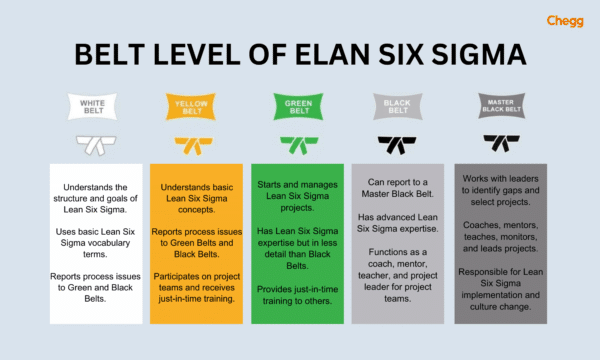
1. White Belt
Each Six Sigma Certification level builds on the previous one, allowing professionals to enhance their expertise and drive impactful changes in their industries.

Lean Six Sigma certification focuses on teaching a fact-based, data-driven philosophy of improvement across businesses. This course aims to teach you how to value stream mapping defect prevention over defect detection. This enables you to learn how to drive customer satisfaction and bottom-line results by promoting the use of work standardization.
| Category | Six Sigma Certification | Lean Six Sigma Certification |
| Focus | Reducing defects and improving quality | Combination of defect reduction and waste elimination |
| Methodology | DMAIC (Define, Measure, Analyze, Improve, Control) | Integrates DMAIC with Lean principles |
| Tools | Emphasises statistical tools and techniques | Uses both Lean tools, like 5S, value stream mapping, and Six Sigma tools |
| Objective | Reducing process variation and improving process control | Improving efficiency by eliminating waste and reducing variation |
| Philosophy | Quality control through defect reduction | Quality control through waste reduction and defect reduction |
| Approach | Focuses on process improvement through statistical cost–benefit analysis | Integrates process improvement with a focus on flow and waste reduction |
| Certification Levels | White Belt, Yellow Belt, Green Belt, Black Belt, Master Black Belt | Yellow Belt, Green Belt, Black Belt, Master Black Belt |
| Implementation | Within specific projects | Broader application across various processes |
| Training Content | Statistical cost–benefit analysis and process improvement | Combination of Lean principles and Six Sigma statistical cost–benefit analysis |
Lean Six Sigma certification has several benefits, which include:
Adding the Lean Six Sigma certification to your job application shows you can help improve business operations. This gives you a significant advantage over other candidates who do not have similar skills.
Lean Six Sigma training enables you to deliver a real-world improvement project with support and mentoring. It means you can build the expertise to manage lean projects and implement process improvements across businesses.
Having a Lean Six Sigma certification on your resume means you are committed to continuous improvement. You also have the required knowledge and skills to impact an organisation positively. Hence, the certification makes you more marketable and helps you get more job opportunities.
Here is an overview of the Lean Six Sigma certification process. It usually involves integrating Lean principles with Six Sigma methodologies. This helps you focus on both quality improvement and waste reduction. The certification enables professionals to streamline processes and eliminate inefficiencies across businesses.
There are some crucial steps involved in the Six Sigma certification process. These include:
You must understand whether your organization or industry requires a Six Sigma framework. This involves knowing the industry’s organisational philosophy. You can pursue the course if you feel Six Sigma can help your organisation prevent product defects.
Six Sigma and Lean Six Sigma may work towards the same goal, but have different functionalities. Understand the difference between both practices and select the one that suits your organisational needs.
As mentioned earlier, Six Sigma certification has different belt levels depending on your level of expertise. Choose the belt level that suits your requirements and get started with your course.
The levels related to the Six Sigma methodology require varied tools and techniques. You must analyse the methods related to the certification course and undertake tests accordingly.
The final step is to enroll in a training course of your choice after selecting your belt level. Then, you must undertake the associated test to get the final certification.
Here are the requirements and prerequisites of each Six Sigma certification level.
Here’s a straightforward guide on how to get your Six Sigma Certification:
There are several benefits of Six Sigma certification that help professionals enhance their career prospects. These include:
The Six Sigma certification is highly regarded across several industries. It also helps showcase your commitment to quality and excellence. That is why several companies may consider you for leadership roles to lead critical projects.
Employers recognise the value of Six Sigma professionals in driving operational excellence across businesses. This ultimately drives operational excellence and helps achieve cost savings. The business, in turn, offers you higher salaries for your specialised skills.
The Six Sigma certification process provides training in quality management and process improvement. You learn to apply statistical tools and methodologies to identify and eliminate defects and optimise processes. These skills are critical for improving the quality of products and services in any business environment.
Several industries value stream mapping a Six Sigma certification. Here is a look at some of these industry names and their associated roles
Six Sigma certification, a globally recognized standard, is a powerful tool for process management and quality improvement professionals. As industries worldwide strive to enhance operational efficiency, reduce defects, and streamline processes, Six Sigma is at the forefront of this pursuit. Understanding the process is crucial for obtaining a Six Sigma yellow, green, or black belt certification.
Getting Six Sigma certification offers several compelling benefits. It enhances your career prospects by demonstrating expertise in improving processes and reducing defects, making you a valuable asset across industries like manufacturing, healthcare, IT, and finance. Certified professionals often command higher salaries and are sought after for leadership roles. Six Sigma also equips you with in-demand data analysis, problem-solving, and quality management skills, enabling you to contribute significantly to operational excellence and business success.
This article will provide you with a comprehensive understanding of what Six Sigma certification entails, the various levels of Six Sigma certification, the reasons to pursue Six Sigma certification, how to prepare for the exams, and most importantly, how to apply this knowledge in your professional endeavors, empowering you to make a tangible difference in your work.
Elevate your career with the Certified Lean Six Sigma Green Belt Course. Secure your spot now and start mastering process improvement!
These various applications highlight the versatility of Six Sigma in many sectors and organizations striving to improve process efficiency, minimize waste, and advocate better quality.
Here are some great reasons to consider getting Lean Six Sigma Certification:
Pursuing Six Sigma Certification enhances your career by equipping you with transferable skills to improve operational processes, eliminate inefficiencies, and demonstrate commitment to quality across any industry.
Understanding the Six Sigma Certification cost is essential for planning your career investment. Costs vary based on certification level, mode of training, and the institute offering the program:
Many institutes offer online training and self-paced courses, making it accessible for working professionals to obtain certification without disrupting their careers.
As organizations continue to embrace digital transformation, Six Sigma remains relevant and increasingly in demand. Key trends for Six Sigma professionals in 2025 include:
Recommended Read course for six sigma certification:
In 2025, Six Sigma Certification is more than just a credential; it is a strategic career investment. From enhancing problem-solving skills to opening doors for higher salaries and leadership roles, Six Sigma empowers professionals to drive efficiency, improve processes, and deliver tangible business results.
Whether you are aiming for Six Sigma Green Belt Certification, Black Belt Certification, or Lean Six Sigma Certification, investing in this globally recognized program can elevate your career and make you a valuable asset to any organization.
Embrace the journey of continuous improvement, unlock your potential, and take a decisive step toward career excellence with Six Sigma Certification today.
Six Sigma certification is a course that recognises expertise in quality management and process improvement. It has its roots in statistical methodology. The certification also focuses on reducing defects and improving the quality of operational processes. It involves rigorous training in various statistical management techniques, like project management and cost–benefit analysis.
The Six Sigma certification levels are in the form of belts. They include the yellow belt, green belt, brown belt, black belt, and master black belt. Each belt implies a different level of expertise and understanding of Six Sigma methodologies. Achieving higher belt levels shows deeper knowledge.
The Six Sigma certification cost depends on the belts you choose for your course. Currently, the white belt course is free. The yellow belt and the green belt cost ₹8274.51 and ₹13,289.36, respectively. Meanwhile, the Six Sigma black belt certification cost is ₹19,140.02. You may have to pay a little more for advanced certifications.
A Six Sigma certification is beneficial for both companies and individuals. The course usually emphasises quality and efficiency. It means you can gain experience in project management and advance your career if you become Six Sigma certified. The certification can also lead to higher earning potential and make you a valuable professional.
Consider the study material, the cost of training for taking a certifying exam, and the exam format when choosing your course. This also involves verifying the reputation of organisations certifying your Six Sigma credential. You can find more information from the reviews posted in the Council for Six Sigma Certification’s provider directory.
Achieving the pinnacle of manufacturing excellence means delivering products without errors 99.99966% of the time. To reach this goal, Six Sigma training emphasizes the creation of management processes that consistently produce nearly flawless outcomes, whether in manufacturing or any other business endeavor.
Six Sigma gets its name from the statistical term “sigma,” which represents one standard deviation within a data set. The concept suggests that a process should only produce defects after six standard deviations have been accounted for. When a process operates at Six Sigma quality, it means that there are only 3.4 defects for every million opportunities, showcasing an exceptionally high level of precision and reliability.
Six Sigma focuses on pinpointing and minimizing errors while enhancing the efficiency of business operations. Its main goal is to ensure customer satisfaction, and to reach this aim, a variety of techniques are employed to boost the performance of products or business processes.
The cost of Six Sigma certification depends on the level you choose. Exam fees typically range from INR 7,000 to INR 52,000.
AI doesn’t replace Six Sigma—it makes it even more effective. By working together, AI and Six Sigma help professionals reach higher levels of process improvement and overall performance. AI adds speed, precision, and deeper insights to Six Sigma’s structured approach, empowering teams to make smarter decisions and drive better results across the organization.