

Marketing is no longer just a tool for selling products or services it has evolved into a strategic function that drives business growth, brand recognition, and customer engagement. As businesses compete in an increasingly digital world, understanding the scope of marketing is essential for professionals and students aiming to build a successful career. This blog will explore the nature of marketing, its importance, various marketing functions, and lucrative career opportunities that you can pursue in 2025.
Traditional marketing once revolved around print, radio, and television. While those methods still play a role, the rise of online platforms and analytics has reshaped the scope of marketing into a global powerhouse. Today, marketing extends far beyond advertising it’s about crafting strategies, shaping brand identity, and building long-term customer relationships. Understanding the full scope of marketing enables professionals to adapt, innovate, and succeed in a fast-changing world where customer engagement drives every success story.

The scope of marketing is vast and multidimensional. It encompasses every activity that helps a business reach its target audience, create value, and foster lasting customer relationships. Marketing is not limited to advertising campaigns it includes research, product development, branding, pricing strategies, distribution, and customer relationship management.
The scope of marketing has expanded further with the rise of digital platforms. Today, businesses leverage social media marketing, influencer marketing, email campaigns, and search engine optimization to reach global audiences. Professionals who understand the full spectrum of marketing opportunities are better positioned to start a career in marketing that aligns with their skills and interests.
To appreciate the nature of marketing, it is crucial to recognize that marketing is both a science and an art. It combines analytical skills, creativity, and strategic thinking to achieve business goals. The primary aspects of the nature of marketing include:
The nature of marketing emphasizes its role in building long-term relationships, rather than just short-term sales.
The importance of marketing cannot be overstated. It is the backbone of any business, whether traditional or digital. Here are some key reasons why marketing is crucial:
Understanding the importance of marketing allows aspiring professionals to make informed decisions when pursuing a career in marketing.
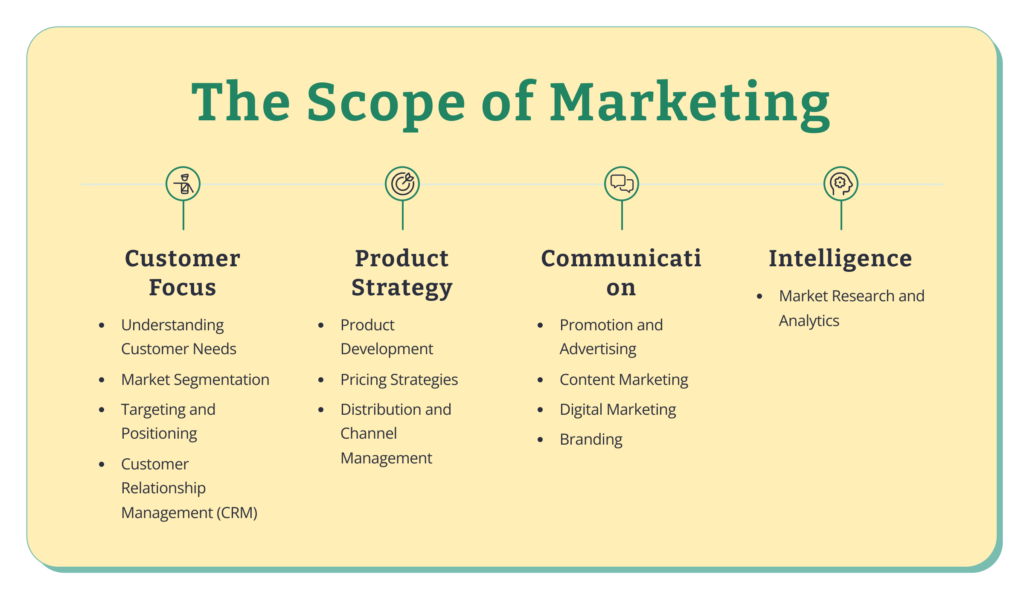
The scope of marketing spans all business functions connecting customers, creativity, and strategy to ensure sustainable growth and success.
Marketing encompasses a variety of strategies designed to connect businesses with their target audiences.

Each type of marketing serves unique goals together, they showcase marketing’s versatility in reaching and engaging diverse audiences.
Marketing is a multi-functional discipline, and its functions of marketing include:
These marketing functions collectively ensure that a business can deliver value effectively while achieving its goals.
Studying successful campaigns shows how marketing impacts brands:
Brands that embrace the scope of marketing tend to be more successful in their strategic initiatives.
The scope of marketing enables companies to align their products with customer desires.
Before digital platforms became mainstream, traditional marketing dominated the business landscape. Traditional marketing includes print ads, television commercials, radio spots, billboards, and direct mail. While it remains relevant in certain industries, it has limitations in tracking performance and measuring ROI.
Modern marketing leverages digital tools, including social media campaigns, content marketing, influencer marketing, email campaigns, and search engine optimization. The integration of analytics and automation has transformed marketing into a more measurable and efficient process.
Understanding traditional marketing alongside modern methods gives professionals a holistic view of the scope of marketing, making them versatile and adaptable.
The marketing industry is booming, and there has never been a better time to start a career in marketing. With businesses increasingly relying on data-driven decisions and digital channels, marketing professionals are in high demand. Some of the top career paths include:
Digital marketing specialists focus on SEO, social media marketing, content marketing, and online advertising. They analyze data to optimize campaigns and enhance online visibility.
Brand managers are responsible for building and maintaining a brand’s identity. They oversee product launches, marketing campaigns, and customer engagement strategies.
Market research analysts gather and interpret data to help companies understand consumer behavior, market trends, and competitor strategies.
Content marketing managers create engaging content that attracts and retains customers. They focus on storytelling, SEO, and content distribution.
Sales and marketing executives develop strategies to promote products, generate leads, and close sales, balancing both marketing insights and sales performance.
Social media managers manage a brand’s presence on platforms like Instagram, Facebook, LinkedIn, and TikTok. They create campaigns, engage followers, and measure performance metrics.
PR specialists manage a company’s reputation by handling media relations, press releases, and public communications
Product, Price, Place, and Promotion form the foundation of any marketing strategy. Product refers to goods or services that meet customer needs; Price represents what customers pay based on value and competition; Place ensures efficient distribution to the target market; and Promotion involves advertising, PR, and sales efforts to create awareness and drive interest. Together, these elements help businesses create value, reach their audience effectively, and achieve their goals in a competitive market.
| Aspect | Marketing | Sales | Advertising |
|---|---|---|---|
| Definition | A strategic process to understand and meet customer needs | The direct process of selling products and services to customers | Paid communication that promotes products, services, or brands |
| Primary Goal | Build brand, create interest, nurture leads | Turn leads into paying customers | Create awareness and interest through messaging |
| Focus | Long-term brand value and customer relationships | Short to medium-term revenue generation | Delivering messages and ensuring visibility |
| Key Activities | Market research, branding, pricing, product positioning, content creation | Prospecting, negotiating, closing deals | Creating ad campaigns, buying media, testing messages |
| Channels Used | SEO, email, social media, content marketing, PR | Direct outreach, CRM, calls, meetings | TV, radio, print, social media, Google Ads, display ads |
| Audience Approach | Segmentation, targeting, and positioning | Individual outreach or B2B persuasion | Messaging for mass or targeted audiences |
| Time Frame | Long-term strategy | Short to medium-term focus | Can be short or long-term, depending on the campaign |
| Metrics for Success | Website traffic, brand awareness, CAC, MQLs | Revenue, conversion rate, deal size, quota attainment | Impressions, CTR, engagement, ad ROI |
| Interdependence | Generates and nurtures leads for sales, uses feedback from sales | Uses leads and brand trust from marketing to close deals | Supports marketing by amplifying messages and reaching broader audiences |
| Analogy | Paving the road for the customer journey | Driving the vehicle to reach the customer | Billboards and signposts attracting attention along the way |
The marketing landscape is constantly evolving, and staying updated with trends is crucial. Some of the top trends shaping the scope of marketing in 2025 include:
Keeping up with these trends ensures that marketing professionals remain relevant and competitive in 2025 and beyond
Understanding the scope of marketing enables brands to build meaningful connections with their audiences and stay competitive in a fast-changing world. Marketing continues to evolve with technology, data, and creativity, offering businesses countless ways to engage customers and drive growth. Whether through digital platforms, storytelling, or analytics, effective marketing helps organizations create value and long-term relationships.
For those considering a career in marketing, now is the perfect time to step in. The field offers immense opportunities for creative thinkers and strategic minds alike. As industries expand and adapt to new trends, marketing skills will remain in high demand. Embrace this dynamic field it’s not just about selling products, but about shaping experiences and driving innovation.

Digital marketing uses online channels like search engines, social media, and email to reach customers. It’s essential because most consumers now make purchasing decisions online.
AI is transforming marketing through data analysis, personalization, chatbots, and predictive insights, helping brands deliver more targeted and efficient campaigns.
Key trends include AI-driven marketing, voice search optimization, sustainability branding, influencer partnerships, and immersive AR/VR experiences.
Influencer marketing involves collaborating with social media creators who can promote a brand authentically to their followers, driving trust and engagement.
Traditional marketing uses offline channels like TV and print, while digital marketing leverages online platforms for more measurable and interactive campaigns.
Customer, Cost, Convenience, and Communication—these focus on customer needs instead of just the product.
Performance marketing is a results-based strategy where advertisers pay only for specific actions, such as clicks, leads, or sales.
Social media helps brands reach wider audiences, gather insights, and create personalized connections through real-time engagement.