

A management consultant is an external expert hired by an organization to analyze its business and recommend actionable advice to improve business performance, solve complex problems, and support growth. Consultants analyze a firm, gather and interpret data, develop strategies, and recommendations for management to implement at the firm or business unit level, typically involving strategic, operational, technological, or financial analysis. Consultants have specialized expertise, and the objectivity that internal teams and management may lack, to help businesses be more efficient, save money, and plan for contextual changes in the market.
Becoming a managing consultant is a rewarding career path for those who enjoy problem-solving and working with people. According to the U.S. Bureau of Labor Statistics, management analyst jobs are expected to grow by 14% from 2022 to 2032.
In this blog, we will walk you through the steps to becoming a consultant and provide you with useful tips to succeed in this field.

A management consultant is a professional who provides advice to organizations to help them grow, reduce costs, or improve processes. Businesses often hire consultants to bring fresh perspectives and expertise. Consultants analyze a company’s operations and provide recommendations on strategy, structure, and other areas to achieve better results.
A Management Consultant helps organizations improve efficiency, solve business challenges, and drive growth. Their key responsibilities include:
No matter what industry you specialise in or the type of business you work in, management consultants tend to focus on three main areas. These, or some combination of these, are likely to be areas you will work in:
1.Types of Expertise and specialities: Management consultants provide expertise to businesses the in several areas. These might be general or highly specialised and include:
2. Application of analysis: Management consultants conduct detailed analysis and research in relation to specific areas within a business. You have to be objective and impartial if you want to be able to offer insight into the problems required solving.
3. Project management: Management consultants will play a leading role in delivering the solutions they identify. You will work with teams to deliver and monitor these solutions and be working directly with business executives.
There are various specializations within management consulting, each catering to different business needs:
Strategy consultants focus on long-term planning and corporate decision-making. They help businesses identify growth opportunities, enter new markets, and optimize competitive advantage.
Operations consultants streamline business processes, supply chains, and production systems to enhance efficiency and reduce costs.
Financial consultants guide businesses in risk assessment, investment strategies, mergers and acquisitions, and regulatory compliance.
Technology consultants help organizations integrate and manage IT systems, digital transformation initiatives, and cybersecurity measures.
HR consultants assist companies in talent acquisition, employee engagement, performance management, and organizational restructuring.
To be a successful management consultant you do need to have varied skills. There are several skills that can differentiate you in this segment, some of which include:
Becoming a consultant offers you a chance to work with a wide range of industries, from healthcare to finance. It’s a fast-paced and exciting career where you can make a real impact. If you enjoy variety, helping businesses overcome challenges, and constantly learning new things, this could be the career for you.
Here are some of the key benefits that make management consulting an attractive profession:
You’ll be exposed to a wide range of industries and businesses. From healthcare to finance, tech to manufacturing, you’ll work on diverse projects, gaining knowledge in different fields and helping clients tackle unique challenges.
If you enjoy solving complex problems, this career option is a great fit for you. You’ll be tasked with analyzing business issues, developing strategies, and providing solutions that drive real results, making you a key player in business success.
The role offers endless opportunities for personal and professional growth. You’ll constantly be learning about new trends, tools, and methods, ensuring that you stay at the top of your game and are always ahead of industry changes.
this career offers competitive salaries and bonuses. The high demand for consultants across industries, combined with the value they provide, often leads to attractive compensation packages.
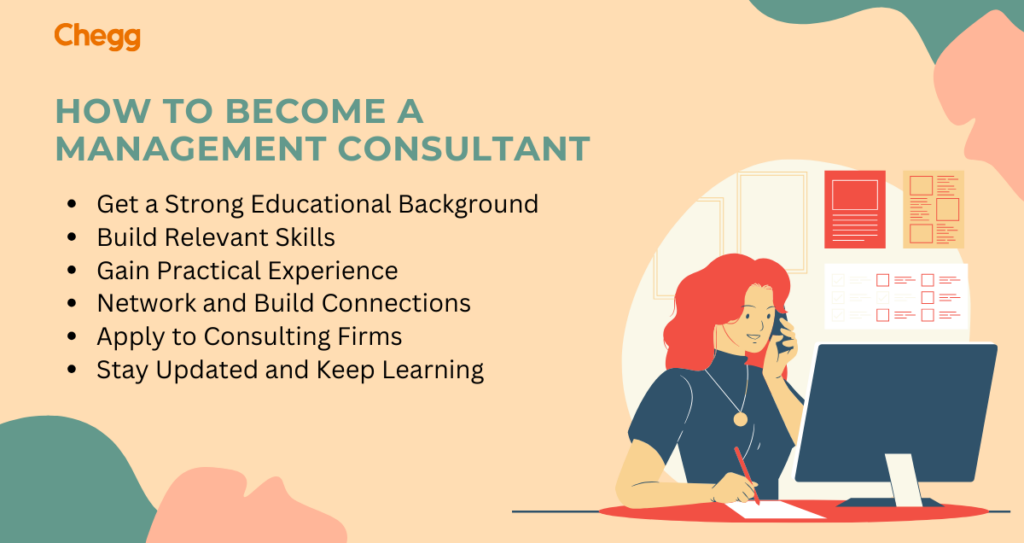
Now, let’s dive into the steps to become a management consultant.
To become a management consultant, you generally need at least a bachelor’s degree. Business, economics, or degrees are commonly pursued, but any field that helps you develop critical thinking and problem-solving skills can be valuable. Some consultants go on to earn an MBA (Master of Business Administration) to further boost their credentials.
To thrive as a management consultant, you need to develop a mix of hard and soft skills.
Experience in business or consulting is crucial. You can start by working in entry-level positions such as a business analyst or associate consultant. Many aspiring management consultants begin their careers at consulting firms, where they can learn from experienced professionals.
In the world of management consulting, networking is important. Attend industry events, workshops, and webinars where you can meet established consultants. Networking helps you stay informed about job opportunities and industry trends.
Once you have the necessary skills and experience, it’s time to apply for jobs. Many management consultants start their careers at top consulting firms like McKinsey, Bain, or BCG. These firms offer excellent training and opportunities to work on high-impact projects.
The consulting industry is always evolving, and as a management consultant, you need to stay on top of industry trends. Continuous learning, whether through certifications, workshops, or self-study, will help you stay relevant and grow in your career.
Management consultants play a vital role in helping businesses streamline operations, enhance efficiency, and drive growth. Their scope extends across various industries and functions, including:
Management consultants take on various responsibilities depending on their specialization and client needs. Their key duties include:
Here are the characteristics of a successful management consultant:
To succeed as a management consultant, you need to think outside the box and have a problem solving mindset. Businesses often face complex challenges, and they hire consultants to come up with creative solutions.
Clients rely on management consultants to explain problems and solutions clearly. Effective communication is key to getting buy-in for your recommendations and fostering trust with clients.
As a management consultant, you will work with different companies, industries, and business environments. Being adaptable and flexible is important for successfully navigating diverse challenges.
A successful management consultant is never satisfied with the status quo. Whether it’s improving processes or suggesting new strategies, you should always strive to make things better.
Management consulting offers a lucrative career path with various roles and compensation levels. Here’s an overview of career progression:
Salaries vary based on experience and firm reputation. Entry-level consultants typically earn ₹8-15 lakh per annum, mid-level consultants earn ₹15-30 lakh per annum, while senior consultants and partners can make ₹50 lakh to ₹1 crore per annum.

Becoming a management consultant can be a fulfilling career if you have the right skills and mindset. It offers opportunities to work with diverse clients, solve challenging business problems, and make a tangible impact. By following the steps outlined in this blog, you’ll be well on your way to becoming a successful management consultant. From getting the right education to gaining practical experience and staying updated with industry trends, you can build a rewarding career as a management consultant.
Management consultants are trusted advisors, hired to confront an organization’s challenges and grow. They take a deep dive into the organization to discover what they want to achieve and the data behind the goals.
They are experts in developing plans based on data to develop customized solutions whether to define and refine strategies, improve operations, manage changes, and maximize financial success. They provide your business fresh eyes and practical solutions for business success.
Some major tasks are:
Doing research and analyzing data from a company
Discovering issues and inefficiencies in a business
Reporting recommendations to leadership
Helping with strategic questions and implementation
Keeping track and revising solutions if necessary
The Big 4 management consulting firms are:
Deloitte Consulting – Strategy, operations, tech, and HR consulting.
PwC Advisory (Strategy&) – Business strategy and risk consulting.
EY Consulting – Digital transformation and strategy.
KPMG Advisory – Management, risk, and tech consulting.
Analytical thinking, problem-solving, communication, business acumen, project management, interpersonal skills, adaptability, technical skills, leadership, and time management.
Yes, management consulting is a high-paying job. Salaries range from $70K–$100K (entry-level) to $200K–$1M+ (senior roles), with top firms like McKinsey, BCG, Bain, and Big 4 offering competitive pay and bonuses.
The top 3 management consulting firms (MBB) are:
McKinsey & Company – Strategy consulting leader.
Boston Consulting Group (BCG) – Innovation & business strategy.
Bain & Company – Corporate strategy & performance improvement.
The highest-paid consultants are senior partners at McKinsey, BCG, Bain (MBB), and Big 4, earning $1M+ per year. Top independent consultants in finance, tech, and healthcare can charge $500–$5,000 per hour.
Entry-Level / Freshers (0–1 yr): ₹6.5 L to ₹7 L per annum
Junior / Early Career (1–3 yrs): ₹8 L – ₹13 L
Mid-level (3–5 yrs): ₹15 L – ₹25 L
Senior Consultant (5–9 yrs): Around ₹24 L – ₹37 L
Lead/Principal / Manager: ₹25 L – ₹58 L, depending on firm tier
Yes, you can become a management consultant without an MBA by leveraging strong analytical skills, relevant professional experience, domain expertise, and strategic networking.