

The LLM course, which stands for Master of Laws, is a postgraduate academic program designed for law graduates who wish to deepen their legal knowledge and specialize in a particular area of law. The LLM full form reflects its focus on advanced legal studies, offering students the opportunity to explore subjects such as international law, corporate law, human rights, intellectual property, and more. This course is ideal for those aiming to enhance their legal expertise, pursue research, or improve their career prospects in both academia and legal practice.

Enrolling in an LLM course allows students to gain a comprehensive understanding of complex legal issues, develop critical thinking skills, and engage with contemporary legal challenges. The program typically spans one or two years and is offered by numerous universities worldwide. With the increasing demand for specialized legal professionals, completing an LLM course not only elevates a candidate’s qualifications but also opens doors to diverse career opportunities, including roles in law firms, multinational corporations, government agencies, and international organizations.
The LLM course in India is a postgraduate legal program designed for law graduates who wish to advance their knowledge and specialize in specific areas of law such as constitutional law, corporate law, criminal law, or international law. Typically lasting one or two years, this course provides in-depth theoretical and practical insights into the legal system, preparing students for higher academic pursuits, research, or enhanced career opportunities in law firms, judiciary, academia, and corporate sectors.
Recognized by the Bar Council of India, the LLM program is offered by numerous reputed universities and institutes across the country, including the National Law Universities (NLUs), making it a sought-after qualification for aspiring legal professionals looking to build expertise and credibility in the Indian legal landscape.
| Type of LLM Course | Description |
| Constitutional Law | Focuses on the principles and interpretation of the Constitution of India and fundamental rights. |
| Corporate and Commercial Law | Covers laws related to business, trade, companies, contracts, and corporate governance. |
| Criminal Law | Deals with laws concerning crime, criminal procedures, and justice administration. |
| Intellectual Property Rights (IPR) | Focuses on protection of inventions, trademarks, copyrights, and patents. |
| Environmental Law | Studies legal frameworks addressing environmental protection, sustainability, and regulations. |
| Human Rights Law | Concentrates on laws protecting individual rights and freedoms both nationally and internationally. |
| International Law | Covers laws governing relations between countries, including treaties, diplomacy, and trade. |
| Taxation Law | Focuses on laws related to direct and indirect taxes, tax planning, and compliance. |
| Part-time/Distance Learning | Flexible options for working professionals to pursue LLM without full-time attendance. |
| Interdisciplinary Programs | Combines law with fields like business, technology, or social sciences for broader expertise. |
| Course Name | Specialization | Institute | Location | Approximate Fees (INR) |
| LL.M (General, Business, HR) | Business Law, Human Rights, Constitutional Law | National Law School of India University (NLSIU) | Bangalore, Karnataka | ₹2.85 lakh/year (total ≈ ₹2.88 lakh) |
| LL.M (Various specializations) | Corporate, Commercial Law, Legal Theory, Public Law | NALSAR University of Law | Hyderabad, Telangana | ₹1.75 lakh/year (Collegedunia, Clatathon) |
| LL.M (IPR, H.R., IPR) | Intellectual Property, Human Rights, Corporate Law | NLU Delhi | Delhi | ₹2.52–4.16 lakh total |
| LL.M (Constitutional/Admin Law) | Constitutional & Administrative Law | NUALS (NLU Kochi) | Kochi, Kerala | ₹1.50 lakh (Careers360 Law) |
| LL.M (General) | LLM (Broad/general) | NUSRL Ranchi | Ranchi, Jharkhand | ₹2.20 lakh |
| LL.M (Law & Development) | Law and Development | Azim Premji University | Bangalore, Karnataka | ₹1.32 lakh |
| LL.M (Human Rights) | Human Rights | Babasaheb Bhimrao Ambedkar University (BBAU), Lucknow | Lucknow, Uttar Pradesh | ₹6,000 |
| LL.M (Maritime Law) | Maritime Law | Kerala University of Fisheries and Ocean Studies | Kochi, Kerala | ₹1.69 lakh |
| LL.M (Corporate & Securities) | Corporate & Securities Laws | Keshav Memorial College of Law, Hyderabad | Hyderabad, Telangana | ₹52,000 |
| LL.M (Business Law) | Business Law | KES’ Shri Jayantilal H Patel Law College, Mumbai | Mumbai, Maharashtra | ₹79,930 |
| LL.M (Family/Criminal Law) | Family Law, Criminal Law | Army Institute of Law | Mohali, Punjab | ₹1.55 lakh (total) |
| LL.M (Corporate, IPR, ADR etc.) | Corporate Law, IPR, International Trade, ADR | University School of Law & Legal Studies (USLLS), GGSIPU | Delhi | Fee not specified |
| Job Role | Average Annual Salary (INR) |
| 1. Corporate Lawyer / Specialized Lawyer | ₹7 L – ₹20 L (Entry–Mid), ₹20 L – ₹60 L+ (Senior) |
| 2. Legal Advisor / Consultant | ₹3 L – ₹6 L (Entry), ₹6 L – ₹12 L (Mid), ₹15 L+ (Senior) |
| 3. Judge / Civil Judge / Magistrate | ₹5 L – ₹10 L+ (depending on level) |
| 4. Legal Researcher / LPO Analyst / Document Reviewer | ₹3 L – ₹4 L (Entry), ₹5 L – ₹7 L (LLP) |
| 5. Professor / Assistant Professor (Academia) | ₹4 L – ₹5 L (Entry), ₹6 L – ₹10 L (Mid) |
| 6. General Counsel / Senior Legal Manager | ₹15 L – ₹25 L (Senior); up to ₹40 L (Top Tier) |
| 7. Chief Compliance Officer / M&A Lawyer | ₹20 L – ₹50 L (Compliance), ₹20 L – ₹60 L+ (M&A) |
| 8. Public Sector Roles (Law Clerk, Public Prosecutor, etc.) | ₹3.6 L – ₹10 L depending on position |
| 9. Roles in Top Law Firms (e.g., Khaitan, AZB, S&R) | ₹16 L – ₹21 L (average for associates) |
| 10. International Law / Multinational Legal Advisor | ₹20 L – ₹80 L+ depending on organization and experience |

Pursuing an LLM course is a strategic step for law graduates aiming to deepen their legal knowledge and gain specialization in areas such as corporate law, human rights, intellectual property, or international law. This postgraduate degree not only refines legal understanding but also opens up diverse professional opportunities ranging from legal practice and academia to judicial services and corporate consultancy. Whether you’re looking to advance in your current legal career or transition into a niche field, the LLM provides the academic and practical foundation necessary for growth.
In India, the demand for specialized legal professionals continues to rise, with both public and private sectors actively recruiting LLM graduates. Top institutions like NLSIU, NALSAR, and NLU Delhi offer rigorous LLM programs that are well-aligned with global standards. With expanding legal frameworks and evolving socio-economic policies, an LLM in India is increasingly seen not just as an academic pursuit but as a valuable investment in one’s professional future, offering both intellectual enrichment and strong career prospects.
LLM stands for Legum Magister in Latin, which translates to Master of Laws. This is a postgraduate legal degree designed to provide advanced and specialized knowledge in diverse areas of law.
In India, the LLM course duration is typically two years, divided across four semesters. While some universities still offer a one-year option, the two-year format is becoming the standard, especially following the Bar Council of India’s recommendations.
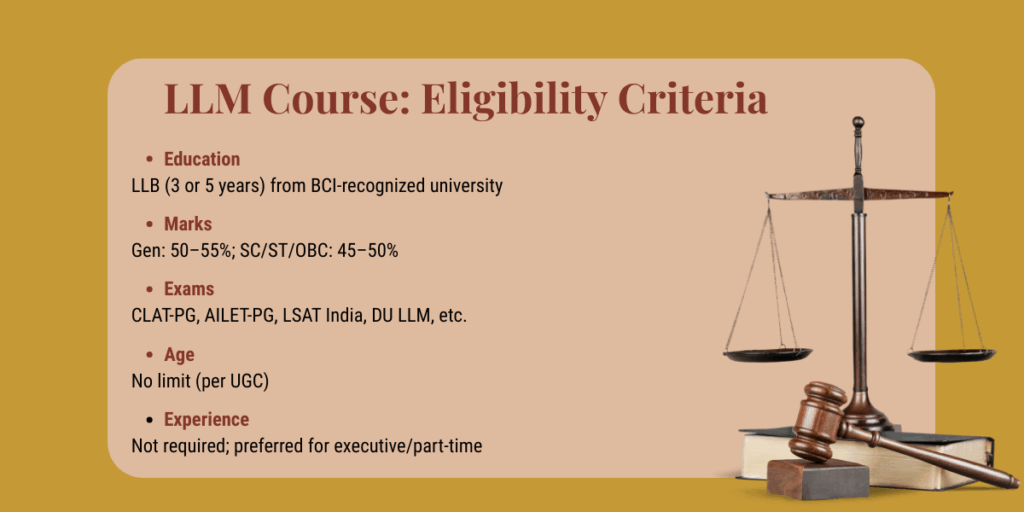
To pursue an LLM in India, candidates must have completed an LLB (3-year or 5-year) from a recognized university, generally with a minimum aggregate of 50% (45–50% for reserved categories). Admission often requires clearing entrance exams such as CLAT-PG, AILET, or university-specific tests.
The LLM course details usually include a structured mix of core subjects, elective specializations, and a dissertation component. The curriculum is research-oriented, covering advanced legal theories, methodologies, and niche areas like corporate law, international law, human rights, and more.
Admission to LLM programs in India can be highly competitive. For instance, BBAU’s one-year LLM course attracted 600 applicants for just 24 seats, resulting in approximately 24 applicants per seat, while another variant saw 1,031 applicants for 46 seats—around 22 per seat.