


Are you dreaming of designing complex software systems and leading technical teams? Becoming a software architect is a respected and fulfilling career in the changing tech industry. By 2025, companies will look for professionals who can connect business goals to technical solutions. Software architects create high-level designs, make important technological decisions, and ensure software systems are scalable, secure, and efficient. This role needs a strong background in programming, experience with various technologies, and good leadership and communication skills.
The journey usually begins with a degree in computer science or a related field, followed by years of hands-on development experience and continuous skill improvement. Ready to shape the future of technology? Let’s explore the steps, skills, and strategies needed to become a successful software architect in today’s digital world.
A software architect designs a system’s basic structure, interface, and components. They do everything they can to meet their clients’ or companies’ requirements while handling the technical issues on their end. They translate their clients’ business or commercial requirements into software solutions.
Moreover, they also ensure the proper analysis of business needs from all aspects. They ensure that the software solution they provide to their clients is the best. They check their clients’ requirements and balance them with the needs of their present customers. They build a software solution that adheres to all wishes.
Before any developer writes a single line of code, a Software Architect is responsible for designing the system’s blueprint. Just like an architect designs the layout of a building, software architects design how different components of the software will interact.
Just as a carpenter picks the best tools for a project, a Software Architect must choose the right technologies for the job. The tech stack (programming languages, frameworks, databases, and tools) impacts the software’s performance, security, and future scalability.
Design patterns are like proven solutions to common software development challenges. Software Architects leverage these patterns to ensure the software is well-structured, easy to maintain, and adaptable.
Software architects don’t just sit behind a screen; they work closely with multiple teams to ensure that the software development process runs smoothly.
A Software Architect’s job doesn’t end after designing the system; they must also ensure that the final product is high-performing, secure, and free of significant flaws.
Becoming an architect is not complex without a comprehensive guide like this. It will inform you of all the details beforehand. Here are the vital points you should keep in mind while going through the path of a software architect:
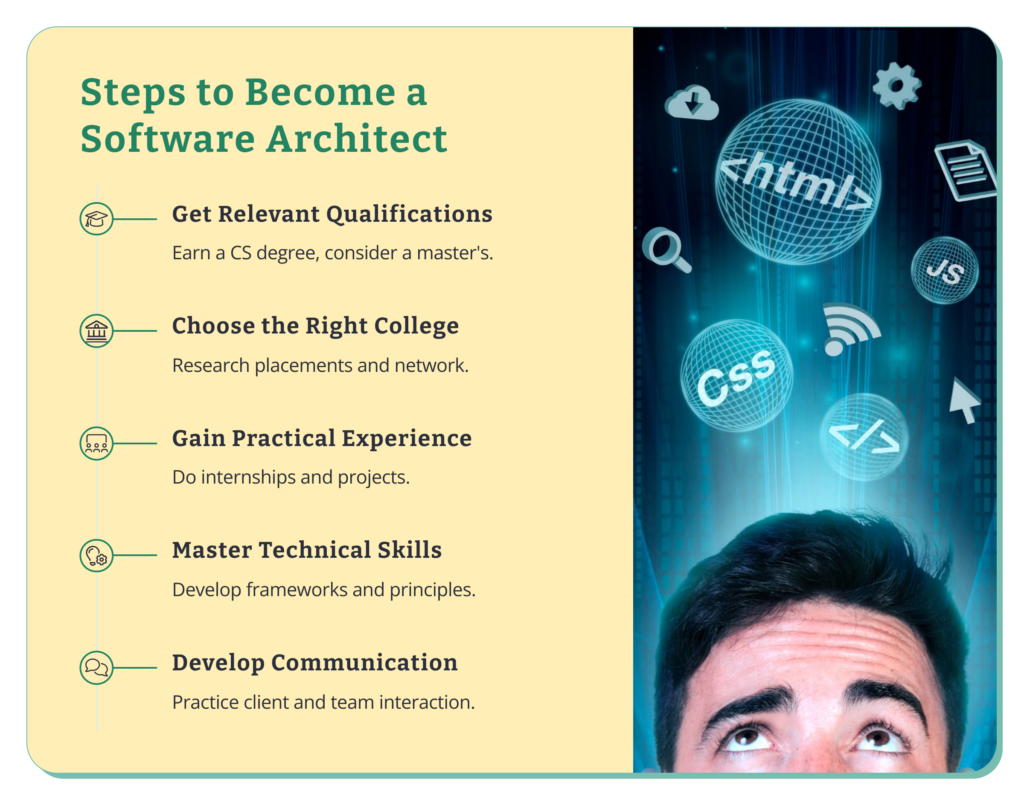
The essential requirement to become an architect is to get a bachelor’s degree in the field. Getting a master’s degree and specialization in the technology industry can help you land this job quickly and easily. In the next section, we shall discuss the qualifications of a software architect in detail.
Since you need to be a graduate to be a software architect, ensure the college you choose for your future studies is one of the best colleges for this career. Before finalizing your college, check its pass-outs, placement offers, and recruiting companies. In this way, you can contact the pass-outs while studying. This improves your understanding and removes the hurdles in becoming an architect beforehand.
Learning how to develop software solutions through books is futile if you cannot experiment with this knowledge in the real world. Try participating in as many internships and cooperative activities as possible during graduation. It will help you build an attractive resume and give you extensive practical experience with software solution development.
They should have extensive knowledge of programming languages and software solution development. They should also know the fundamental principles of the technology industry. They should have in-depth knowledge of TOGAF, MODAF, Zachman, and others to build the best software solutions with minimalistic effort.
As said, architects must closely contact their clients and company teams. They should have precise communication skills to avoid asking the clients frequently and deliver a flawless software solution in one go.
Completing graduation is not enough to be skilled. Possessing many skills and qualifications is also necessary. Here are some vital qualifications and skills you should learn while becoming a software architect:
Pursue your computer science or software development degree to become an architect. Higher education in these fields will help you learn the basic concepts of software solutions development in college. Moreover, you can learn more skills during the internship programs and extracurricular activities organized by your college. If you wish to get a better package and job position, pursue post-graduation in a similar field after graduation.
You must have understood by now that an architect’s job profile involves programming languages and technical frameworks. However, an architect should also know the basic details about a business, how it runs, and how to expand it.
Sometimes, they may have to analyze the current business condition for which they provide a software solution.
All jobs require employees to have soft and hard skills to excel in their fields, and the same goes for this.
| Hard Skills | Soft Skills |
| 1. Programming Proficiency | 1. Communication Skills |
| 2. System Design and Architecture | 2. Leadership |
| 3. Knowledge of the Software Development Lifecycle | 3. Problem-Solving |
| 4. Database Management | 4. Adaptability |
| 5. Cloud Computing | 5. Collaboration |
| 6. Security Best Practices | 6. Analytical Thinking |
| 7. Software Development Tools | 7. Decision Making |
| 8. Design Patterns | 8. Creativity |
| 9. Data Structures and Algorithms | 9. Time Management |
| 10. API Design | 10. Team Management |
If you love experimenting with programming languages, analyzing clients’ problems, and offering unique solutions, an architect’s job fits you. The career aspect of an architect is beautiful to those who wish to continue learning new concepts of the technology industry and experimenting with them.
However, if you are still interested in this job, their salary in India may help you decide.
However, you should understand that their salary in India depends on many factors. Understanding those factors will ensure you can secure the best option available in front of you when you complete your graduation or post-graduation:
No company or firm will pay ₹2 million annually to a novice.
A software architect with more skills, certificates, and qualifications will have a higher salary than a software architect with one or two skills. If you want a good entry-level salary, you should learn as many skills as possible during college. These skills define you and your working caliber.
India is a growing hub of the technical industry, but this industry is concentrated in metropolitan cities like Bengaluru and Delhi. This means an entry-level architect working in Bengaluru or Delhi gets paid more than an entry-level architect in other cities.
While interviewing for a software architect, try to land a job in a metropolitan city to ensure a high initial package.
They are required in almost all sectors and industries of an economy, thanks to their extensive knowledge and impeccable software solutions. However, if you land a job in a non-IT sector, you may not be paid as much as a software architect working directly in the IT sector.
To get a better value and salary, you should try to land a job in IT services, finance, consulting, or e-commerce.
Before finalizing your job as an architect, ensure the company you will be working for has a good reputation in the IT sector. It means the company pays its employees well. The company should also have been in this field for years. Moreover, it also has a diverse client base to help you explore your skills better. This small research can help you land your dream job within a few years.
Some companies offer extra benefits like bonuses, incentives, stock options, and living expenses to entry-level employees. You can always try to work for such companies for a better compensation package as an architect.
The needs and trends of the market are continuously changing, which is why architects must stay updated with them in case they have to learn a new skill to upgrade their value. Even after landing a secure job, you should know which skills the vital market needs to learn and offer better software solutions.
Becoming a software architect involves continuous learning, innovation, and leadership. By mastering programming languages, understanding architectural patterns, and staying updated with the latest technology trends, you will be well-positioned for this role. Software architects not only design strong systems but also mentor teams, match tech solutions with business needs, and drive digital change. As demand grows in 2025, those who combine technical skills with strategic vision and effective communication will stand out.
Don’t hesitate to pursue certifications, attend industry events, and work on challenging projects to build your portfolio. With dedication and the right skills, you can advance your career and make a lasting impact in the tech industry. Your path to becoming a software architect starts now; embrace the challenge and lead the way!
A Software Architect usually has a Bachelor’s degree in Computer Science, IT, Software Engineering, or similar fields. Many also go for Master’s degrees or certifications in system design, cloud architecture, or enterprise solutions.
Example: A candidate with a B.Tech in Computer Science and over 5 years of development experience can become a Software Architect.
Tip: Pair your degree with hands-on experience in large projects and certifications like AWS Solutions Architect or TOGAF to boost your profile.
Yes, but less often than developers. A Software Architect mainly focuses on system design, architecture decisions, and technical leadership. They may write code for prototypes, important modules, or proof-of-concepts.
For example, an architect might code the core API or integration module while guiding the development team.
Tip: Stay current with coding skills in relevant languages and frameworks to effectively lead and review the team’s work.
Yes, it is a rewarding and in-demand role that offers strong career growth, challenging projects, and excellent salary potential.
Example: Experienced Software Architects in top IT firms in India earn around ₹20 to 40 LPA while leading critical projects.
Tip: Focus on continuously learning new technologies and leadership skills to boost growth and job satisfaction.
Yes, becoming a Software Architect is challenging. It requires strong coding skills, knowledge of system design, problem-solving ability, and experience in leadership.
Example: A developer needs 5 to 10 years of experience in large projects before becoming an architect.
Tip: Gain experience in full-stack development and large systems. Improve your communication skills to lead teams and make architectural decisions effectively.
A software architect usually earns between $130,000 and $160,000 a year in the US, though this can vary a lot based on location, experience, and company size. For instance, a software architect at a major tech company in Silicon Valley might make around $180,000 or more.
Tip: Besides coding skills, work on improving your communication and leadership abilities. Clearly explaining complex ideas and guiding a team is what really distinguishes a great software architect.
Skills needed to become a Software Architect:
Strong programming and system design
Cloud and DevOps knowledge
Security and database expertise
Clear communication
Leadership and problem-solving
Big-picture thinking
Example: A software architect at a fintech startup designs a secure, scalable payment system that can handle thousands of transactions per second. They also guide the development team on best practices.
Tip: Practice designing complete projects and explaining your choices to others. It really helps!
Here are the most important technical skills for a Software Architect:
System Design & Architecture (scalability, reliability)
Programming Languages (multiple, deep knowledge)
Cloud Platforms (AWS, Azure, GCP)
DevOps & CI/CD (automation, containerization)
Security Best Practices (data protection, authentication)
Database Design (SQL & NoSQL)
API Design (REST, GraphQL)
Tip: Mastering system design and cloud tech will give you a huge edge!