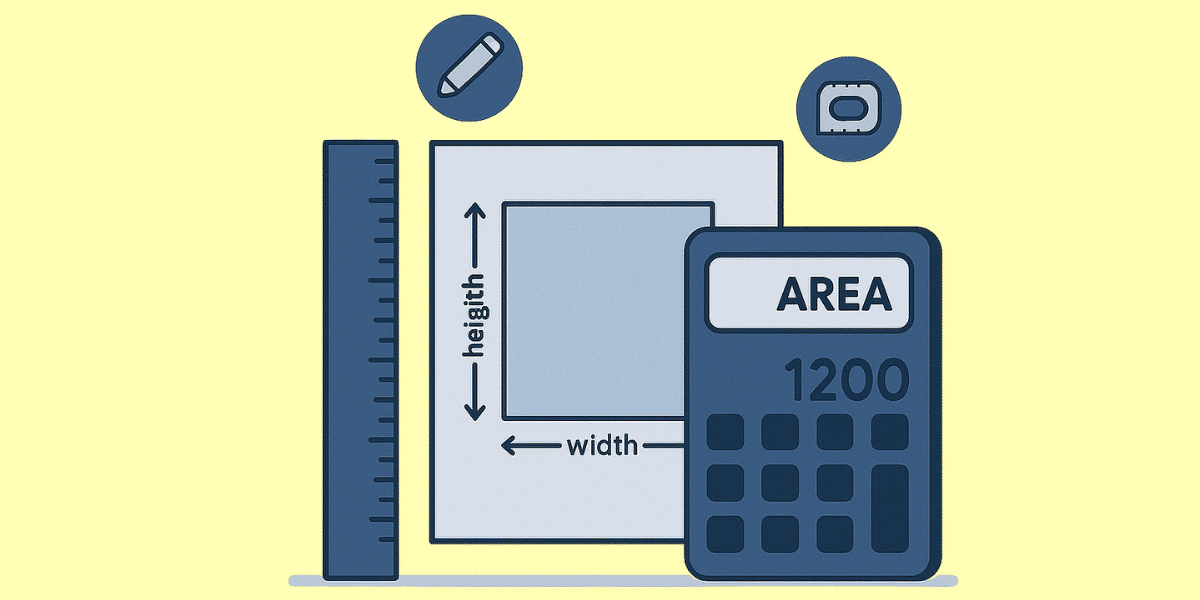
Area calculator is a simple and efficient online tool that helps you quickly determine the area of any shape and area is the fundamental concept in mathematics and everyday life, referring to the amount of space a two-dimensional shape occupies. Calculating area is essential in countless real-world scenarios from planning construction projects and designing interiors to teaching geometry in schools and organizing gardens. Whether you’re laying new flooring, ordering materials, or simply solving problems, knowing how to calculate area is a practical skill.
This blog serves as your one-stop guide for understanding and calculating the area of various shapes. We’ll cover the basics, provide step-by-step formulas, and highlight how a calculator can make your work faster and more accurate.
How to Calculate Area?
Calculating area is a straightforward process once you know the shape and its properties. The general approach area formula is:
- Identify the Shape:
Determine whether you’re dealing with a square, rectangle, triangle, circle, or another polygon.
- Gather Necessary Measurements:
Collect the required dimensions, such as side length, width, height, or radius.
- Apply the Correct Formula:
Use the appropriate formula for the shape in question.
- Ensure Unit Consistency:
Make sure all measurements are in the same units before calculating. If not, convert them to avoid errors.
- Calculate:
Plug the numbers into the formula and solve for the area.
Below, we’ll explore the formulas for several common shapes of area calculator.
Area Calculator Formulas by Shape
Area Of Square
Formula:
Area=side×side
Example:
If a square has a side length of 5 meters, its area is:
5×5=25 m

Area Of Rectangle
Formula:
Area of a rectangle =length × width
Real-world Example rectangle area formula :
A room that is 6 meters long and 4 meters wide has an area of:
6×4=24 m

Area Of Triangle
Formula:
Area=1/2×base×height
Note:
This Triangle area calculator formula works for all types of triangles equilateral, isosceles, or scalene as long as you know the base and the corresponding height.

Area Of Circle
Formula:
Area=π×radius2
Explanation of π (Pi):
Pi (π) is a mathematical constant approximately equal to 3.1416. It represents the ratio of a circle’s circumference to its diameter.
Real-world Analogy:
If you have a circular garden with a radius of 7 meters, the area is:
π×72≈3.1416×49≈153.94 m2π×72≈3.1416×49≈153.94 m2
Area Of Parallelogram
Formula:
Area=base×height
Comparison to Rectangle:
A parallelogram is similar to a rectangle but with slanted sides. The area is still base times height, but the height is the perpendicular distance from the base to the opposite side.
Area Of Rhombus
Formula:
Area= ½ × d1 × d2, where d1 and d2 are the lengths of the diagonals.
Properties:
A rhombus is a type of parallelogram with all sides equal. Its area can also be calculated using the parallelogram formula if you know the base and height.
Area Of Hexagon
Regular Hexagon:
Area= (3√3 / 2)×s²
Tip:
For irregular shapes, you can break them down into simpler shapes like triangles and rectangles, calculate each area, and then add them together.
Area Of Pentagon
Regular Pentagon:
Area= 1/2 × p × a, where p is the perimeter of the pentagon and a is the apothem of a pentagon
Alternative:
If you know the perimeter and the apothem (the line from the center to the midpoint of a side), you can use:
When to Use an Area Calculator
Area calculations are used in a wide variety of real-life situations:
- Flooring and Tiling:
Determining how much material to buy for a room.
- Gardening and Landscaping:
Planning the layout of plants, lawns, or paving.
- Construction:
Estimating materials for walls, roofs, and foundations.
- Buying Materials:
Ensuring you purchase the correct amount of paint, wallpaper, or carpet.
Advantages of Using an Online Area Calculator:
- Speed:
Instant results save time, especially for complex shapes.
- Accuracy:
Reduces the risk of manual calculation errors.
- Convenience:
Accessible anywhere, often with options to switch between units.
If you’re tackling a project and need quick, reliable calculations, consider using an area calculator tool. It’s a practical solution for professionals and DIY enthusiasts alike.
Conclusion
Understanding how to calculate area is a valuable skill with countless applications in everyday life. Whether you’re a student, a professional, or a homeowner, mastering these formulas helps you make informed decisions and use resources efficiently.
For the most accurate and hassle-free results, try our easy-to-use area calculator or area converter. It’s designed to handle a variety of shapes and units, making your calculations quick and error-free. Explore more geometry tools in our Calc Corner and take the guesswork out of your next project!
Which quadrilateral shape encloses the maximum possible area?
Among all quadrilaterals, the square has the largest area when all sides are equal, because it maximizes space within equal perimeter constraints efficiently.
What method is used to determine the measurement of a land’s surface area?
Land area is calculated by measuring the plot’s length and width, then applying appropriate formulas depending on its shape. For irregular plots, surveying techniques and unit conversions (like square feet, gaj, or acres) ensure accurate results.
What shape has the largest area given perimeter?
For a given perimeter, the circle encloses the largest possible area compared to any other shape, because of its perfectly symmetrical distribution of boundary length around the center.
How do I calculate area of an irregular shape?
To calculate an irregular shape’s area, divide it into smaller regular shapes such as rectangles, triangles, or circles, measure their dimensions, compute individual areas using formulas, and finally add them together for the total.
How many feet is 1 sq ft?
One square foot means a square that is 1 foot long and 1 foot wide. If you draw a square on the ground with sides of one foot, the space inside it is one square foot.